
Door Frame Anatomy & Parts: The Chowkhat (India 2026)
Head, jambs, sill, rebate, horn, transom and mullion — the chowkhat glossary every Indian homeowner and carpenter should know.
When a carpenter says the rebate is too shallow, or your timber merchant quotes the chowkhat by the running foot with a single rebate, it helps to know exactly what they mean. Understanding door frame anatomy turns a confusing site conversation into a clear one — you can check the order, spot a poor frame before it goes into the wall, and explain a problem precisely. This guide walks through every named part of an Indian door frame (the chowkhat), what each part does, and the glossary that homeowners, carpenters and site engineers actually use on Indian projects.
Door frame anatomy at a glance
The frame is the fixed surround built into the wall opening; the leaf (shutter) is the moving part that swings or slides. In most of India the frame is called the chowkhat (also chaukhat, chowkat). It is sold by the running foot (rft) of timber section, in a standard profile such as 100×62mm (4″×2.5″) or the lighter 75×62mm. The frame carries the hinges and the latch strike, so its strength and accuracy decide whether the door hangs true for decades. The governing Indian standard for timber frames is IS 4021; steel frames follow IS 4351.
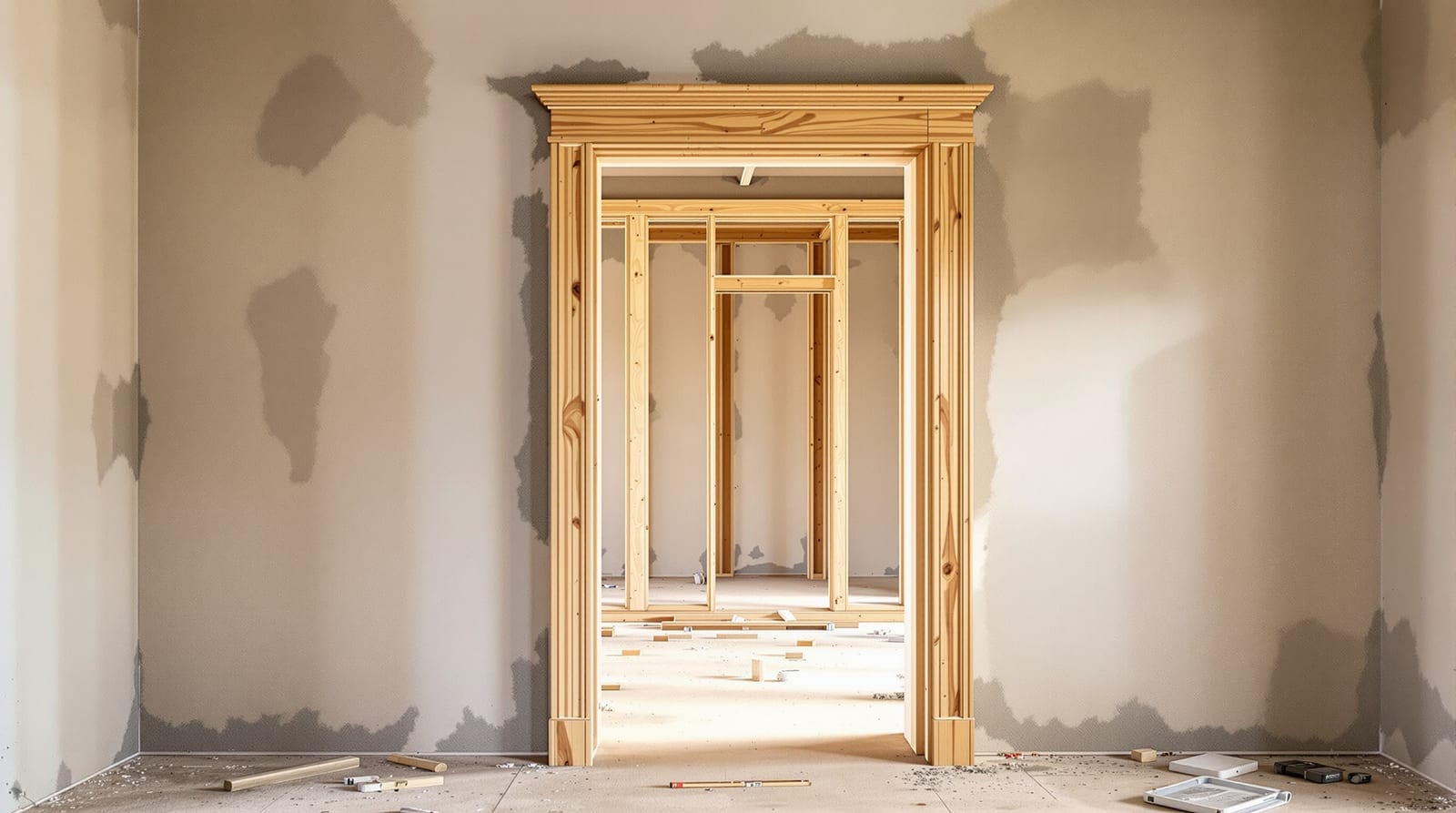
Getting the door frame anatomy right matters because every other part of the doorset depends on it: hinges are screwed into the jamb, the strike plate is set into the lock jamb, the architrave covers the wall junction, and the threshold seats on the sill. A frame that is the wrong section, missing its rebate, or out of plumb cannot be rescued by a good leaf or expensive hardware. Think of the frame as three or four members joined into a rigid surround. The diagram below labels the main parts.
The core members: head, jambs and sill
These three (or four) pieces make the basic rectangle.
Head
The head is the top horizontal member that spans the opening and ties the two jambs together. It carries no door weight directly but keeps the frame square. Above it sits the structural lintel (RCC header) which actually carries the wall load — never confuse the frame head with the lintel.
Jambs (posts)
The jambs, also called posts, are the two vertical members. The hinge jamb carries the hinges and takes the full swinging load of the leaf; the lock jamb (or strike jamb) holds the latch strike plate. Jambs must be dead plumb — out-of-plumb jambs are the single biggest reason a door won't latch or swings open on its own.
Sill
The sill is the bottom horizontal member. On external doors it is essential — it sheds water and seats the threshold. On internal doors the sill is usually omitted so the floor runs through unbroken; the frame is then a three-sided “U”. Where there is no sill, a temporary tie batten holds the jambs at the correct width until the frame is fixed and grouted.
The working details: rebate, horn, transom and mullion
This is where most homeowners get lost — and where ordering errors happen.
Rebate (check)
The rebate (or check) is the L-shaped recess machined into the inner face of the frame that the leaf closes into. Its depth equals the leaf thickness (so the closed door sits flush with the frame face) and its width is typically 12–15mm. A single rebate suits one leaf; a double rebate is used for double doors or for weather-sealing external doors. When you order a chowkhat, you must specify single or double rebate — it changes the section and the price.
Horn
The horn is a short projection left on the end of a jamb (about 100–150mm) that is embedded into the floor or built into the masonry to anchor the frame. For internal frames with no sill, the horn is often cut off once the frame is fixed. Horns are a traditional, strong anchoring detail still common on Indian site-built frames.
Transom and mullion
A transom is a horizontal divider across the frame, usually under a fanlight (the small fixed glazed panel above a door). A mullion is a vertical divider that splits a wide opening into a door plus a fixed sidelight, or into two leaves. Transoms and mullions appear on large main-door and shopfront frames, not on simple internal doors.
Architrave (casing)
The architrave (or casing/trim) is the moulding that covers the joint between the frame and the wall plaster, mitred at the corners. It is a finishing member, not structural — timber, MDF or WPC, roughly ₹40–150/rft. See our note on architraves and door trim for profiles and fitting.
Quick glossary table
| Part | Also called | What it does |
|---|---|---|
| Head | Top member, transom head | Spans the top; ties jambs square |
| Jamb | Post | Vertical member; carries hinges or strike |
| Sill | Threshold base, dehleez seat | Bottom member; sheds water (external) |
| Rebate | Check | Recess the leaf closes into |
| Horn | Lug, projection | Embedded end that anchors the frame |
| Transom | — | Horizontal divider under a fanlight |
| Mullion | — | Vertical divider for sidelight / twin leaf |
| Architrave | Casing, trim | Covers the frame-to-wall junction |
| Stop | Door stop bead | Bead the leaf shuts against (where no rebate) |
| Strike plate | Keeper | Metal plate on lock jamb the latch enters |
Section, materials and how the corners join
The section is the cross-sectional size of the frame timber. Two common Indian sizes are below, along with how each part is normally joined at the corners and which material is appropriate where.
| Frame attribute | Typical Indian practice | Notes |
|---|---|---|
| Standard section | 100×62mm (4″×2.5″) or 75×62mm | Sold per running foot (rft) |
| Corner joinery | Mortise-and-tenon, dowel-pinned | Haunched M&T at head-to-jamb |
| Hardwood frame | Sal / sheesham ₹250–600/rft | Seasoned, anti-termite treated |
| Teak frame | ₹700–1,200/rft | Premium, stable, durable |
| WPC frame | ₹180–400/rft | Termite/water-proof; ideal bathrooms |
| Steel frame | ₹1,200–3,000/frame | Welded corners, grouted in |
| RCC / precast | ₹600–1,500/frame | Cheap, fire/water-proof, brittle |
In timber frames the strongest corner joint is the mortise-and-tenon, locked with a dowel pin; steel frames are welded; uPVC frames are welded or mechanically jointed. For a deeper look at corners see door frame joinery and the rebate detail. To choose between timber, WPC, steel and RCC for your conditions, read door frame materials, or use the door frame material selector.
Why the glossary matters on site
Knowing the names is not pedantry — it protects build quality:
- Ordering — you can specify section, single/double rebate and material correctly, so the merchant cuts the right chowkhat the first time.
- Damp and termites — in India the jamb foot and horn sit in ground/masonry contact. The frame base must rest on a DPC and be anti-termite treated; in bathrooms prefer WPC, PVC, RCC or aluminium, never untreated timber. A precise vocabulary lets you instruct this clearly.
- Fixing — you can confirm the jambs are anchored with M.S. holdfasts (3 per jamb for a 2.1m frame) and packed behind the hinge and lock points so the frame does not bow. See door frame fixing methods.
- Sizes — the frame outer size plus a 10–12mm packing gap each side gives the rough opening; check door frame sizes.
For the full picture across leaf, hardware and finishing, see the complete door guide and this phase's pillar, the door frames overview.
Frequently asked questions
What is the difference between a frame and a chowkhat?
Nothing — chowkhat is simply the common Hindi/Indian word for the door frame: the fixed surround (head, jambs and sometimes a sill) built into the wall. The moving panel is the leaf or shutter.
What is the rebate on a door frame?
The rebate (or check) is the L-shaped recess on the inner face of the frame that the leaf shuts into. Its depth matches the leaf thickness so the closed door sits flush, and its width is about 12–15mm. Specify single rebate for one leaf, double for twin or weather-sealed external doors.
What is a horn on a door frame?
The horn is a short projection (about 100–150mm) left on the end of a jamb that is built into the floor or masonry to anchor the frame. On internal frames with no sill, horns are usually cut off after the frame is fixed.
Do internal doors have a sill?
Usually not. Internal frames are made as a three-sided “U” so the floor finish runs through unbroken; only a temporary tie batten holds the jamb spacing until the frame is fixed. External doors keep the sill to shed water and seat the threshold.
What standard governs timber door frames in India?
IS 4021 covers timber door, window and ventilator frames; IS 4351 covers steel door frames. NBC 2016 sets minimum opening widths and egress requirements, and the RPwD Act with the Harmonised Guidelines governs accessible (flush) thresholds.
Is the head the same as the lintel?
No. The head is the top member of the frame itself. The lintel is the structural RCC beam in the wall above the opening that actually carries the wall load — it needs 150–200mm bearing each side and is separate from the frame.
Export this guide
Related Guides — Deep-dive reading
Door Frame Rebate Explained: Depth, Width & Seal (India 2026)
What the rebate (check) in a chowkhat actually is, how deep and wide it should be, and why it decides whether your door draught-proofs, sound-proofs and locks securely.
Home Doors & EntrancesDoor Frame Joinery in India: Strong, Square Corners (India 2026)
How the head joins the jambs — mortise-and-tenon, dowel pinning, mitres, and welded steel and uPVC corners for frames that stay square.
Home Doors & EntrancesDoor Frame Fixing Methods: Holdfasts & Anchors (India 2026)
How to fix a chowkhat to masonry with M.S. holdfasts, lugs, screws and frame anchors — numbers, spacing and packing that keep the frame true.
Home Doors & EntrancesRelated Tools — Try Free
Door Frame Cost Calculator
Estimate door frame (chowkat) cost from the opening size and frame material — sal, teak, WPC, steel, RCC or granite.
Door CalculatorDoor Material Comparison Tool
Compare 2–4 door materials on cost, durability, maintenance, security and moisture resistance.
Comparison ToolWindow Material Comparison Tool
Compare uPVC, aluminium, wood, steel and composite windows on cost, life, upkeep and insulation.
Compare