
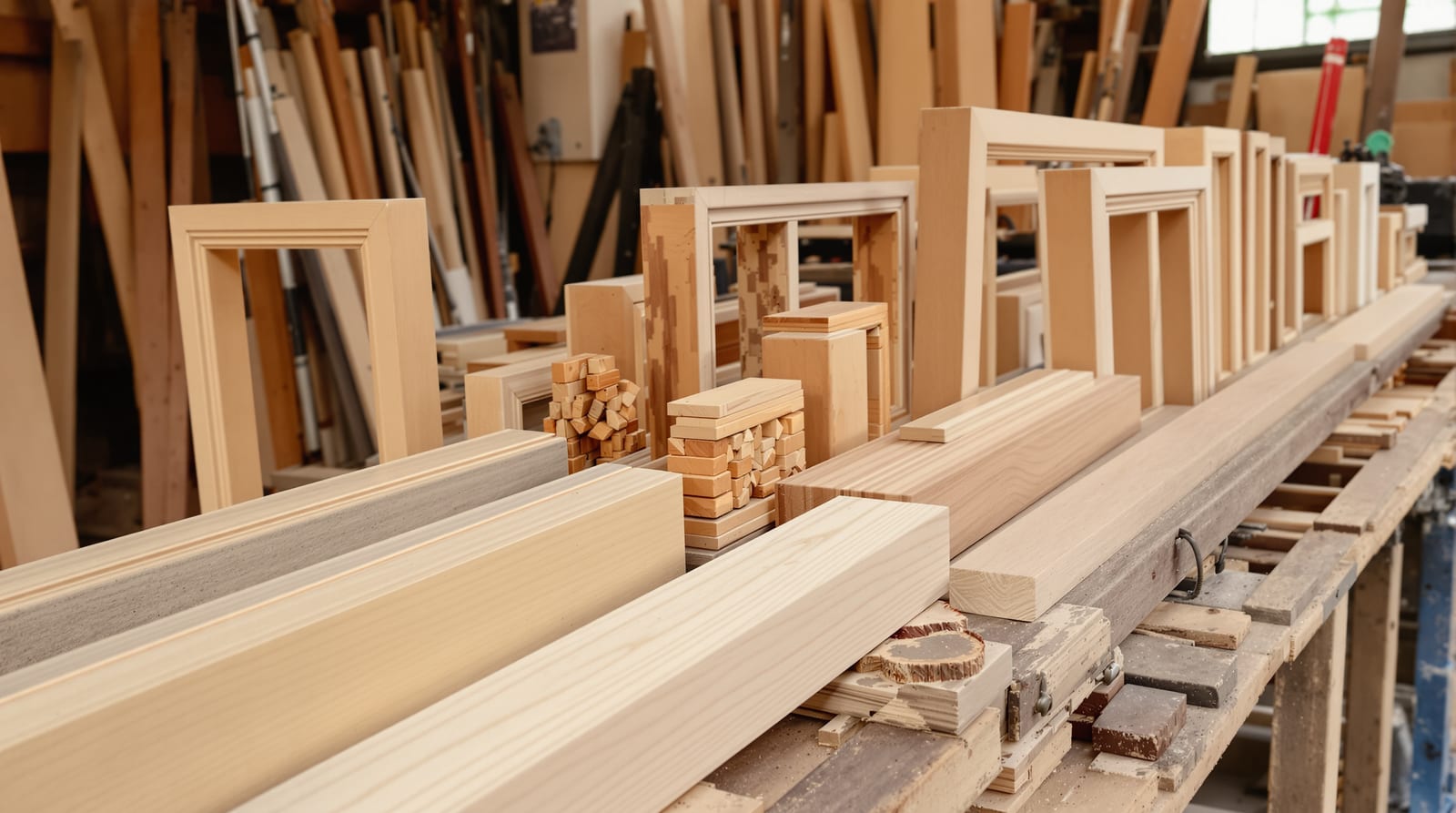
Door Frame Profiles in India: Sections & Shapes (India 2026)
Plain, chamfered, splayed, ovolo, rebated and integral-architrave chowkhat profiles compared on looks, cleaning and cost.
When people pick a chowkhat they obsess over the timber and the size, but the door frame profiles — the actual shape of the section in cross-cut — quietly decide how the doorway reads, how easy it is to dust, and how much paint or polish it drinks. A profile is what you would see if you sliced the jamb across with a saw: is the edge a crisp right angle, a soft chamfer, a flared splay, or a fancy ovolo curve? In India, where dust, monsoon damp and termites are real, the profile you choose also affects cleaning and longevity, not just looks. This guide walks through every common profile, what it costs as a rule of thumb, and how to choose one for each room — framed around Indian materials, IS standards and ground reality.
What a frame profile actually is
The frame (chowkhat) has three or four members — the head (top), two jambs (verticals) and sometimes a sill (bottom). The profile is the moulded shape worked along the inner and outer faces of those members. Every timber frame starts as a plain rectangular section, typically 100×62mm or 75×62mm under IS 4021, and the carpenter then runs a router or spindle moulder along it to cut the chosen profile. The rebate — the L-shaped recess the leaf shuts into, about 12–15mm wide and as deep as the leaf is thick — is part of the profile too, and it is the one feature you cannot skip.
Two faces matter. The reveal is the inner edge that faces the door leaf; the outer/wall face is what the architrave or wall meets. A profile can be cut on one or both. Mass-produced WPC, uPVC and aluminium frames come pre-extruded in fixed profiles, so with those you select a section rather than cut one. Timber gives you full freedom — which is exactly why profile choice is mostly a timber-frame decision.
The six common profiles
Plain rectangular (square-edged)
The default. Crisp 90° arrises, a single rebate, no decoration. It is the cheapest to make, the most modern-looking, and the easiest to fit an architrave or laminate against. The downside: sharp arrises chip and show every knock, and the flat reveal collects a visible line of dust. It suits contemporary flats, MDF/laminate finishes and flush doors.
Chamfered (bevelled edge)
A small 45° flat cut (typically 6–12mm) knocks the sharp arris off the reveal. This is the quiet workhorse profile in Indian homes: it hides minor chipping, catches light softly, and — importantly — the angled face sheds dust better than a flat 90° corner, so it wipes cleaner. Cheap to cut, easy to paint, forgiving.
Splayed (flared reveal)
The whole reveal is angled outward so the opening looks wider from inside the room and lets more light into the doorway. Common on main doors and pooja-room frames where a sense of welcome matters. It uses more timber (wider section) and so costs more, and the wide flat splay does gather dust — but it looks generous and traditional.
Ovolo / moulded (curved)
A convex quarter-round (ovolo) or an ogee S-curve worked into the edge — the classic "colonial" or heritage frame. Beautiful under PU polish on teak, and the rounded face genuinely resists chipping. The catch: the curves trap dust and are fiddly to clean, and a multi-curve profile is the most labour-intensive to cut, so it is the priciest. Reserve it for feature doors, not every bathroom.
Rebated / double-rebated
Every frame has at least one rebate; a double rebate adds a second step so the leaf seats deeper, improving weather-sealing and security — the right call for external and main doors. It pairs with a gasket or EPDM seal in the rebate. More timber, slightly more cost, better performance against monsoon drafts and dust.
Frame with integral architrave
Here the casing/trim is milled as one piece with the jamb instead of being a separate strip nailed on later. It gives a seamless, joint-free look (no gap to caulk, nowhere for dust to lodge at the wall junction) and is common in WPC and uPVC factory frames. The trade-off: it needs a wider raw section, is harder to scribe to an uneven wall, and on timber it wastes more material — so it costs more than plain frame + separate architrave but saves fitting labour.
How profile affects looks, cleaning and cost
The table below sets the six profiles against the things you actually live with. Treat the ₹ bands as a rule of thumb for the profiling labour and extra timber over a plain section — the timber species (sal/sheesham ₹250–600/rft, teak ₹700–1,200/rft under IS 4021) dwarfs the profile premium.
| Profile | Look | Cleaning / dust | Chip resistance | Profile premium over plain |
|---|---|---|---|---|
| Plain rectangular | Modern, crisp | Flat reveal shows a dust line | Low (sharp arris chips) | Baseline (₹0) |
| Chamfered | Soft, neutral | Best — angled face sheds dust | Medium | +₹10–30/rft |
| Splayed | Wide, welcoming | Moderate — broad flat splay | Medium | +₹30–60/rft (wider section) |
| Ovolo / moulded | Heritage, ornate | Hardest — curves trap dust | High (rounded) | +₹60–150/rft |
| Double rebated | Clean, recessed | Easy; rebate hidden | Medium-high | +₹20–50/rft |
| Integral architrave | Seamless, no joint | Easy — no wall-junction gap | Medium | +₹40–100/rft |
Material reality
Profile freedom is not equal across materials. The table shows what each frame material practically allows in India.
| Frame material | Profile options | Typical use | Note |
|---|---|---|---|
| Seasoned hardwood / teak | Any — fully router-cut | Living, bedroom, main door | Most decorative; needs anti-termite + DPC base |
| WPC | Pre-extruded plain or integral-architrave | Bathrooms, wet areas | Water/termite-proof; limited profile range |
| uPVC (multi-chamber) | Fixed extruded profile | uPVC door systems | Profile is the system; not changeable |
| Aluminium | Fixed extruded, slim square | Glass/aluminium doors | Crisp modern look only |
| Pressed steel / RCC | Plain pressed or cast | Service, commercial, budget | Minimal profile; grouted in mortar |
A few honest points. Decorative ovolo and deep splays only make sense on timber — in a bathroom you should choose WPC, PVC or aluminium for damp and termite reasons, and there your profile is essentially whatever the extrusion gives. Never run untreated timber down to a wet floor; sit it on a stone or RCC base block over a DPC. And whatever profile you cut, the rebate must match the leaf thickness or the door will not shut clean.
How to choose a profile
Work room by room, then sanity-check against cleaning and budget.
- Main door / entrance: splayed or double-rebated timber (teak), polished. The splay reads as welcome; the double rebate seals against monsoon drafts and dust. Vastu-favourable N/E/NE placement pairs naturally with a generous frame.
- Living and bedrooms: chamfered or plain, painted enamel or laminate to match the leaf. Chamfered is the safe all-rounder — forgiving, easy to dust.
- Bathrooms and utility: WPC or PVC, plain or integral-architrave section. Skip decorative timber profiles entirely; prioritise water and termite resistance.
- Heritage / pooja / feature doors: ovolo or moulded teak under PU polish, accepting that the curves need more dusting.
- Tight budget / rented: plain rectangular hardwood, separate MDF/WPC architrave. Cheapest to cut and replace.
Three practical checks before you commit. First, cleaning load — a busy dusty-city home is happier with chamfered or integral profiles than ovolo. Second, finish — crisp profiles suit laminate and enamel; curves suit polish that flows over the shape. Third, fit the rebate to the leaf and confirm the carpenter packs behind the hinge and lock points so the profiled frame does not bow. For true work — even reveals, mitred architrave corners, a clean rebate — a skilled carpenter is worth the rate; profile errors are obvious and permanent.
To cost it out and choose the right section, the door frame material selector helps match material to room, and the door frame timber calculator estimates running feet so you can price the profile premium. For deeper reading, see the door frame anatomy of head, jambs and horn, the dedicated door frame rebate explainer, the door frame joinery of corner joints, and how architraves and door trim finish the wall junction. Compare materials in the door frame materials overview and wooden door frames guide. This page sits under the door frames phase pillar and the wider complete door guide.
Frequently asked questions
Which door frame profile is easiest to keep clean in a dusty Indian home?
Chamfered and integral-architrave profiles are the easiest. The angled chamfer face sheds dust instead of collecting it on a flat 90° ledge, and an integral architrave removes the frame-to-wall gap where grime usually lodges. Ovolo and deep moulded profiles look the richest but their curves trap the most dust, so reserve them for feature doors rather than every opening.
Does the profile change the door frame cost much?
Not as much as the timber does. The profile premium over a plain section is roughly ₹10–150 per running foot depending on complexity, while the species sets the base — sal/sheesham ₹250–600/rft, teak ₹700–1,200/rft as a rule of thumb. So an ovolo teak frame costs more for its teak than for its curves. Use a timber calculator to price your running feet first.
Can I get decorative profiles on WPC or uPVC frames?
Only within the extrusion. WPC and uPVC frames come in fixed factory profiles — usually a plain or integral-architrave section — because they are extruded, not router-cut on site. If you want a true splay or ovolo you need timber. In bathrooms and wet areas, though, you should choose WPC or PVC anyway for damp and termite resistance, and accept the limited profile range.
What is the difference between a single and double rebate?
A single rebate is the one L-shaped recess every frame has for the leaf to shut into. A double rebate adds a second step so the leaf seats deeper and you can fit a gasket or EPDM seal, which improves weather-sealing, security and dust exclusion. Double rebates suit external and main doors; internal doors are usually fine with a single rebate.
Does the profile affect accessibility or thresholds?
The jamb profile itself does not, but the frame must still respect free egress and accessible-threshold rules. Under the RPwD Act 2016 and the Harmonised Guidelines, thresholds should be ≤12–13mm and bevelled or flush for wheelchair access, regardless of how fancy the jamb profile is. Choose your profile for looks and cleaning, but keep the bottom of the doorway level and clear.
Export this guide
Related Guides — Deep-dive reading
Zero Threshold Doors in India: Level Access (India 2026)
How to detail a flush, step-free door threshold for wheelchairs and ageing-in-place while still keeping monsoon water out.
Home Doors & EntrancesDoor Frame Rebate Explained: Depth, Width & Seal (India 2026)
What the rebate (check) in a chowkhat actually is, how deep and wide it should be, and why it decides whether your door draught-proofs, sound-proofs and locks securely.
Home Doors & EntrancesThe Complete Home Door Guide for Indian Homes (2026): Types, Materials, Cost, Security & Vastu
Everything an Indian homeowner needs to specify the right door for every opening — from main entrance to bathroom — with real 2026 prices, IS/NBC standards and Vastu sense.
Home Doors & EntrancesRelated Tools — Try Free
Door Material Comparison Tool
Compare 2–4 door materials on cost, durability, maintenance, security and moisture resistance.
Comparison ToolDoor Cost Calculator
Estimate the all-in cost of a door — leaf, frame, hardware, fitting and GST — by type, material and size.
Door CalculatorBathroom Door Material Selector
Get the best wet-area door material — WPC, FRP, PVC, marine ply or aluminium — ranked for your bathroom or utility.
Material Selector