
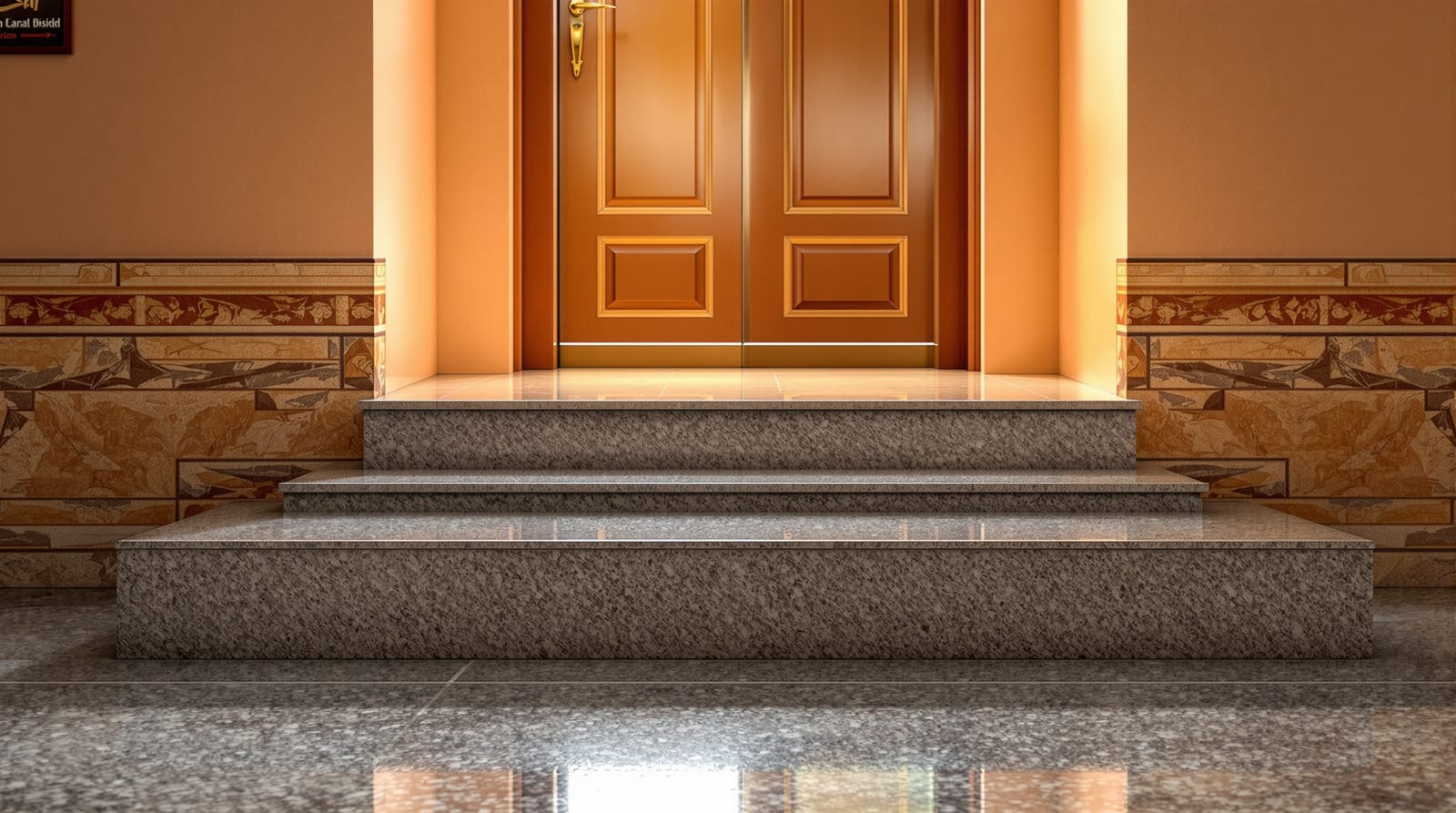
Door Thresholds & Sills: The Complete Guide India 2026
What a threshold (dehleez/umbara) is, the main types, accessibility limits, monsoon waterproofing and the Vastu of the door step — for Indian homes.
The door threshold — the dehleez or umbara in most Indian homes, vasal padi in the south — is the bottom member of the doorway: the step, saddle or strip you cross as you walk through. It is the most over-looked part of any door and the part that causes the most grief afterwards: monsoon water seeping under the main door, a bathroom that floods the corridor, a raised step that trips an elder or blocks a wheelchair. Get the door thresholds right and the door performs for decades; get them wrong and no amount of leaf quality or hardware fixes it. This pillar explains what a threshold is, the types you can choose, the accessibility rules, how to waterproof one for India's climate, and the Vastu around the umbara. It sits inside the larger door frames family and the complete door guide.
What a threshold is and why it matters
A threshold does four practical jobs at once. It bridges the level change between two floors (or floor and ground). It seals the gap under the leaf against water, dust, draughts, insects and noise — the leaf bottom, a weather bar and the threshold together form the bottom seal. It finishes the floor junction so two different finishes (say marble inside, granite step outside) meet cleanly. And it protects the frame foot from standing water, the single biggest cause of timber frame rot in India.
Because it carries foot traffic and water, the threshold takes more abuse than any other part of the doorway. That is why durable, non-absorbent materials — granite, stone, WPC, aluminium — dominate, and why untreated timber on a wet or external sill is a mistake. The bottom member is often called the sill on external doors; its design is covered in depth in door sill design.
The main threshold types
There is no single "correct" threshold — the right one depends on whether the door is internal, external or wet-area, and on accessibility. The full menu is in threshold types; the table below is the quick map.
| Type | What it is | Best for | Indicative cost |
|---|---|---|---|
| Stone / timber saddle | A flat raised bar across the opening | Internal, main doors | ₹150–600/rft (granite) |
| Ramped (bevelled) | Sloped to ease a level change | Accessible routes, level steps | bevel cut into saddle |
| Recessed / rebated | Leaf drops into a rebate in the sill | Better external seal | profile of frame |
| Aluminium threshold strip | Metal strip with rubber/brush seal | Draught-proofing, retrofit | ₹250–900/door |
| Finned / weather-bar | Raised fin + weather bar at leaf base | External, monsoon-facing | ₹400–1,200/door |
| Zero / level | Flush, no step | Wheelchair access | needs drainage detail |
As a rule of thumb, internal doors often have no separate threshold at all (the frame has no sill); main and external doors get a granite saddle plus a weather bar; bathrooms get a raised waterproof kerb; and accessible routes get a flush or low bevelled threshold. The door threshold selector walks you through location, exposure and accessibility to land on the right type. A dedicated weather bar is explained in door weather bar, and fitting a stone saddle in door saddle installation.
Threshold section: how it is built up
The section above shows the four moves that keep an external threshold dry: a saddle that slopes outward, a drip/throating groove under the lip so water cannot track back, a weather bar at the leaf foot, and a DPC under the frame so the timber never sits in water. Miss any one and the monsoon finds the gap.
Accessibility: the ≤12mm rule
This is the rule most Indian homes break. The RPwD Act 2016 and the Harmonised Guidelines 2021 treat the threshold as a barrier: on any accessible route a threshold should be ≤12–13mm high, bevelled if it exceeds 6mm, and preferably flush. A tall traditional step is a trip hazard for elders and impassable for a wheelchair or walker.
| Threshold height | Accessibility status | Action |
|---|---|---|
| Flush (0mm) | Ideal | Add external drainage channel + slope |
| ≤6mm | Acceptable, no bevel needed | Fine on most routes |
| 6–12mm | Acceptable if bevelled | Bevel both faces |
| 12–20mm | Borderline / non-compliant | Ramp or lower it |
| >20mm step | Barrier | Add a ramp or saddle |
The practical Indian compromise is a low, bevelled granite saddle with an external drainage channel rather than a tall umbara — you keep water out without creating a trip step. The deep dives are zero-threshold doors, accessible doors and wheelchair-accessible doors. Before committing to a flush detail, the zero-threshold feasibility checker flags whether your floor levels and drainage can support it. Never forget that thresholds also sit in the free-egress path — a step that traps a person fleeing a fire is a life-safety failure, not just an inconvenience.
Waterproofing wet and external thresholds
India's monsoon and wet bathrooms demand a waterproofing strategy at the threshold, not an afterthought. For an external door, the recipe is the section above: granite saddle sloped outward, drip groove, weather bar, DPC, and silicone (not acrylic) at the frame-wall junction. For a bathroom or balcony, raise a small kerb or set a granite saddle bedded in sealant, and crucially integrate it with the floor waterproofing membrane so water cannot creep under the saddle into the adjoining room. The threshold must slope away from the dry side.
Material matters here: never use untreated timber on a wet or external sill. Use WPC, PVC, RCC/precast or aluminium frames and a granite/stone saddle, all of which shrug off water and termites. The full method is in waterproofing door thresholds, with frame-base protection in door frame damp-proofing. For weather sealing across the whole door, see the existing door seals & weatherstripping guide.
The Vastu of the threshold
The umbara carries real cultural weight in Indian homes. Vastu Shastra treats a clean, intact, raised main-door threshold as auspicious — a boundary that holds prosperity in and keeps negativity out, which is why the threshold is decorated at festivals and never stepped on carelessly. The practical wisdom inside the tradition is sound: a raised umbara blocks water and dust at the main door, and a cracked or missing one is read as inauspicious precisely because a damaged threshold lets the elements in. Favourable main-door zones are generally north, east and north-east.
The tension is between the auspicious raised step and the accessibility rule. The resolution is the same low, bevelled, intact granite saddle: it honours the umbara symbolically and keeps water out, while staying within the ≤12mm accessible limit. More on this in main-door threshold Vastu and the broader entrance Vastu guide.
Frequently asked questions
What is a door threshold called in India?
The threshold is the bottom member or step of the doorway. In most of India it is the dehleez or umbara; in the south it is the vasal padi. On external doors the same member is often called the sill. It can be a stone or timber saddle, a metal strip, or a flush level threshold.
How high should a door threshold be?
For accessibility, the RPwD Harmonised Guidelines want it ≤12–13mm, bevelled if over 6mm and preferably flush. Internal doors often have no threshold; external doors use a low sloped saddle. A tall traditional umbara is auspicious but is a trip and wheelchair barrier, so a low bevelled granite saddle is the usual compromise.
How do I stop water coming under my main door?
Use the four-part recipe: a granite saddle sloped outward, a drip/throating groove under its lip, a weather bar at the leaf foot, and a DPC under the frame. Seal the frame-wall junction with silicone outside. Never sit untreated timber on the sill.
What threshold should a bathroom door have?
A raised waterproof kerb or granite saddle bedded in sealant, integrated with the floor waterproofing membrane and sloped away from the dry side. Use a WPC, PVC, RCC or aluminium frame — never untreated timber on a wet floor. See waterproofing door thresholds.
Does a raised threshold break accessibility rules?
It can. A high umbara is a trip hazard and blocks wheelchairs, and it sits in the free-egress path. Keep the threshold ≤12mm and bevelled or flush on any accessible route. A low, intact, bevelled granite saddle honours Vastu and keeps water out while staying compliant.
Is a raised threshold good for Vastu?
Traditionally yes — a clean, intact, raised main-door umbara is considered auspicious and should never be cracked or missing. Practically it blocks water and dust. The modern approach keeps the symbolic raised saddle but makes it low and bevelled so it also meets the accessibility limit.
Export this guide
Related Guides — Deep-dive reading
Zero Threshold Doors in India: Level Access (India 2026)
How to detail a flush, step-free door threshold for wheelchairs and ageing-in-place while still keeping monsoon water out.
Home Doors & EntrancesDoor Threshold Standards for Indian Homes: Sill, Weather Bar & Accessibility (2026)
What the strip under your door actually does - water, dust, draft and insect barrier, level transition and trip-safe accessibility - with the right material, the 12 mm accessibility limit, weather-bar and drip-groove detailing for external doors, and the wet-bathroom threshold.
Home Doors & EntrancesWaterproofing Door Thresholds in India (India 2026)
Stopping water tracking under bathroom and external door frames with a raised kerb, granite saddle and a membrane that turns up into the threshold.
Home Doors & EntrancesRelated Tools — Try Free
Accessible Door Checker
Check a door against wheelchair-accessibility guidance — clear width, threshold, handle and closer force per RPwD 2021.
Compliance ToolMonsoon-Readiness Checklist
Pre-rain home audit across 9 categories — terrace, drains, waterproofing, electrical, HVAC, pest, vehicles, documents.
Seasonal AuditBathroom Sealant Calculator
How many tubes of silicone sealant a bathroom needs and the cost — by joints to seal, lengths and bead size, with an anti-fungal note.
Bathroom Calculator