
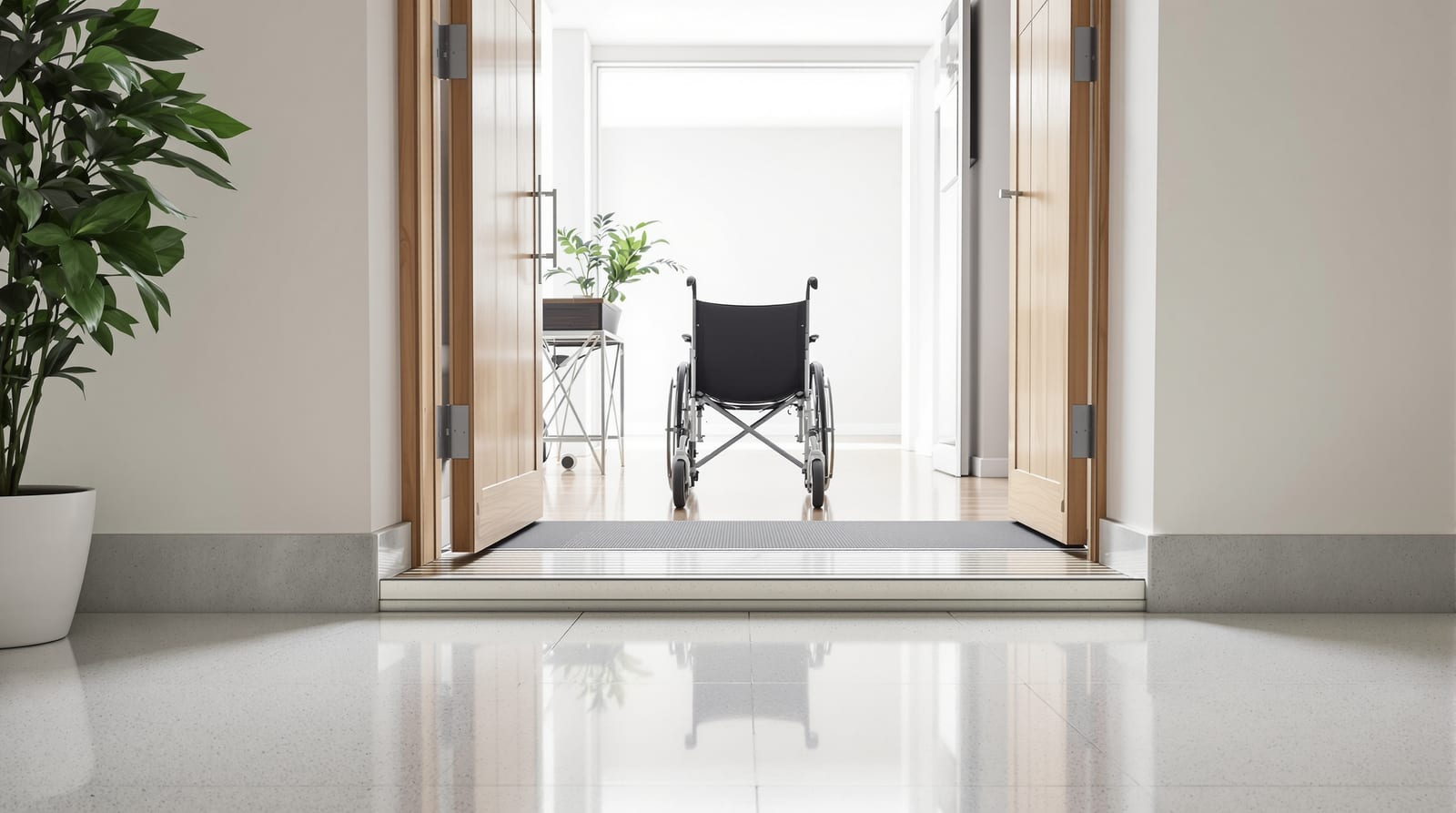
Zero Threshold Doors in India: Level Access (India 2026)
How to detail a flush, step-free door threshold for wheelchairs and ageing-in-place while still keeping monsoon water out.
A raised step at the door is invisible to most people and an impassable wall to someone in a wheelchair, on a walker, or simply unsteady with age. Zero threshold doors remove that step: the floor inside and the surface outside meet at the same level, so a wheel, a stick or a cautious foot crosses without lifting. India's accessibility law makes this more than a courtesy. The RPwD Act 2016 and the Harmonised Guidelines 2021 require accessible thresholds to be effectively flush — no more than 12-13mm high, and bevelled if anything over 6mm remains. The catch is that the same step you are removing is what kept rainwater out, so a flush external threshold only works if you replace the step with a drainage channel and a slope. This guide explains the rule, where level thresholds belong in an Indian home, and how to detail one that stays dry through the monsoon.
What 'zero threshold' really means
A true zero or level threshold is one a wheel rolls over without a bump. In practice nothing is ever perfectly flat — a finished floor, a frame sill and an outside surface rarely land at exactly the same level — so the accessibility codes set a tolerance rather than demanding literal zero.
The rule from the Harmonised Guidelines for Accessible Built Environment (2021), which give effect to the RPwD Act 2016, is straightforward:
- The threshold should be flush wherever possible.
- Any unavoidable upstand must be no more than 12-13mm high.
- Anything over 6mm must be bevelled (ramped), not a sharp vertical lip, so a small front castor does not jam against it.
This matches international practice and is the figure to quote to your architect or carpenter. It is also the standard you should hold an entrance to if you are building for ageing-in-place — the home you intend to grow old in — even if no one currently uses a wheelchair.
| Threshold height | Accessibility status | What it means |
|---|---|---|
| 0mm (flush) | Ideal | Wheel rolls straight across; best for wheelchair and walker |
| Up to 6mm | Acceptable, no ramp needed | Minor lip; most wheels and feet clear it |
| 6-13mm | Acceptable only if bevelled | Must slope the upstand, not leave a vertical face |
| Over 13mm | Non-compliant | A barrier under RPwD / Harmonised Guidelines |
| 18-25mm+ (traditional step) | Barrier | Common stone umbara; blocks wheels entirely |
Where level thresholds belong
Not every door needs to be flush, and chasing zero thresholds everywhere creates drainage headaches you do not need. Prioritise the doors on the accessible route — the path a wheelchair user must travel from the gate to a usable bedroom, bathroom and living space.
- Main entrance — the single most important one. A level entry, paired with a ramp instead of steps outside, is what makes the whole home reachable. See accessible doors and wheelchair accessible doors for the matching clear-width rules.
- Bathroom and toilet doors — the highest-risk room for falls. A flush threshold here removes a trip hazard and lets a shower wheelchair enter. It is also the hardest to detail because of water; see waterproofing door thresholds.
- Balcony and terrace doors — the classic conflict point. People want level access onto the balcony; the balcony is open to rain. This is where a channel drain earns its place.
- Internal room doors — usually easy, because there is no rain and often no level change at all. Just avoid adding a raised sill.
For internal doors there is rarely a water issue, so going flush is mostly about not adding a step. For external doors — entrance, balcony, terrace — the entire challenge is keeping water out without the step that normally does it.
The drainage problem and how to solve it
A traditional raised threshold (the stone umbara, Vastu-auspicious and practical) works as a dam: it physically stops sheeting rain and washed-in dust from crossing into the house. Remove the dam for level access and you must give the water somewhere else to go. The proven detail has three parts working together.
1. Slope the outside away from the door
The finished surface outside the door must fall away from the threshold — a gentle gradient of roughly 1:50 to 1:100 (about 10-20mm per metre) over the first metre or two. Water then runs away from the leaf instead of pooling against it. This slope is gentle enough to remain wheelchair-friendly.
2. Put a channel drain across the opening
A linear channel drain (a recessed slot or grated trough) set into the floor immediately outside the door catches any water that does reach the threshold before it can cross. Granite-lined or with a stainless/galvanised grate flush with the surface, it spans the full door width and connects to the rainwater drain. The grate slots must be narrow enough (typically ≤8mm) that a castor cannot drop in.
3. Seal the gap under the leaf
Because there is no upstand to shut against, the leaf needs a drop seal or brush seal at its base — an automatic drop-down strip that lowers onto a flush aluminium threshold strip when the door closes, or a weather-bar-and-brush arrangement. This is what stops wind-driven rain and draughts at the line where the step used to be.
Choosing and detailing the threshold strip
The physical strip that bridges floor-to-floor at the door line carries the seal and defines the final height. Match it to the location.
| Threshold strip type | Best use | Height / detail | Notes |
|---|---|---|---|
| Aluminium flush strip + drop seal | Main entrance, balcony | 6-12mm low-profile | Bevelled both sides; pairs with automatic drop seal |
| Bevelled (ramped) saddle | Where a small level change exists | Slope upstand 6-13mm | Granite or aluminium; never a vertical lip |
| Recessed / rebated track | Sliding balcony doors | Flush channel in floor | Keep weep holes clear; drains to outside |
| Granite saddle bedded flush | Bathroom door | ≤12mm, sealed | Bed in waterproof sealant onto membrane |
| Brush / fin threshold | Light external doors | Low aluminium + brush | Cheaper; less watertight than drop seal |
For an external flush threshold the leaf, frame and seal matter as much as the strip. Use a WPC, uPVC, aluminium or RCC frame at wet and ground-contact locations — never untreated timber, which rots where it meets a flush, occasionally-wet floor (see door frame damp-proofing). The frame base must sit on a DPC, and the strip should be bedded in sealant and tied into the floor's waterproofing membrane so water cannot track underneath. Get the door threshold selector to narrow the strip type, and run your opening through the zero threshold feasibility checker to see whether a flush detail is realistic for your level changes and exposure. For the frame layer overall start at door frames, and for the whole topic see the complete door guide.
Indicative cost is modest against the door itself: an aluminium flush threshold strip with a drop seal runs roughly ₹800-2,500 as a rule of thumb, a stainless or galvanised channel drain ₹1,500-4,000 per metre plus laying, and a granite saddle bedded flush a few hundred rupees of stone plus mason's time. GST is 18% on the hardware.
When to keep a small upstance
Be honest about exposure. On a fully exposed terrace door facing driving monsoon rain, a perfectly flush threshold is genuinely hard to keep watertight even with a channel drain. The accessible compromise is a bevelled 10-12mm saddle plus the channel drain — still compliant, still wheelchair-crossable because the upstand is ramped, but with a little more margin against water. Reserve the truly flush detail for sheltered entrances (under a porch or deep overhang) and for internal and bathroom doors where the water load is controlled. A skilled site engineer should set the levels here; getting the floor falls, the membrane and the drain invert right is not a job to improvise on site.
Frequently asked questions
What is the maximum height for an accessible door threshold in India?
Under the RPwD Act 2016 and the Harmonised Guidelines 2021, an accessible threshold should be flush where possible and no more than 12-13mm high. Anything above 6mm must be bevelled (ramped), not left as a sharp vertical lip, so a wheelchair castor does not catch on it.
How do you stop a flush external threshold from leaking?
Replace the step's water-blocking job with three things: slope the outside surface away from the door (about 1:50 to 1:100), set a linear channel drain across the opening to catch run-off, and fit an automatic drop seal or brush seal at the base of the leaf. Together they keep rain out without an upstand.
Can I have a zero threshold on a bathroom door?
Yes, and it is one of the best places for one because it removes a fall hazard. Use a granite saddle or aluminium strip bedded flush in sealant onto the floor's waterproofing membrane, slope the floor toward the shower drain, and choose a WPC, PVC, uPVC or aluminium frame — never untreated timber — to handle the damp.
Is a raised threshold ever better than a flush one?
For a fully exposed terrace or balcony door in heavy monsoon, a bevelled 10-12mm saddle with a channel drain is a sensible compromise: it stays within the accessible limit because it is ramped, yet gives extra protection against driving rain. Reserve fully flush thresholds for sheltered, overhung or internal doors.
Does a level threshold conflict with Vastu?
Vastu values a clean, present main-door threshold (umbara), traditionally a small raised stone. A bevelled flush saddle still reads as a defined, intact threshold rather than no threshold at all, so you can usually honour both intentions — keep the favourable N/E/NE door zones (see entrance vastu) while keeping the door accessible.
Export this guide
Related Guides — Deep-dive reading
Wheelchair Accessible Doors for Indian Homes: Clear Width, Thresholds & Hardware (2026)
The exact specs that make a door usable from a wheelchair - clear opening width, near-flush threshold, lever hardware, approach clearance and low-force or auto operation, mapped to the RPwD Harmonised Guidelines 2021.
Home Doors & EntrancesWaterproofing Door Thresholds in India (India 2026)
Stopping water tracking under bathroom and external door frames with a raised kerb, granite saddle and a membrane that turns up into the threshold.
Home Doors & EntrancesDoor Threshold Standards for Indian Homes: Sill, Weather Bar & Accessibility (2026)
What the strip under your door actually does - water, dust, draft and insect barrier, level transition and trip-safe accessibility - with the right material, the 12 mm accessibility limit, weather-bar and drip-groove detailing for external doors, and the wet-bathroom threshold.
Home Doors & EntrancesRelated Tools — Try Free
Monsoon-Readiness Checklist
Pre-rain home audit across 9 categories — terrace, drains, waterproofing, electrical, HVAC, pest, vehicles, documents.
Seasonal AuditAccessible Door Checker
Check a door against wheelchair-accessibility guidance — clear width, threshold, handle and closer force per RPwD 2021.
Compliance ToolBathroom Floor Slope Calculator
Work out the floor fall to the drain and screed depth from the run and slope ratio — with a drains-properly verdict.
Bathroom Calculator