
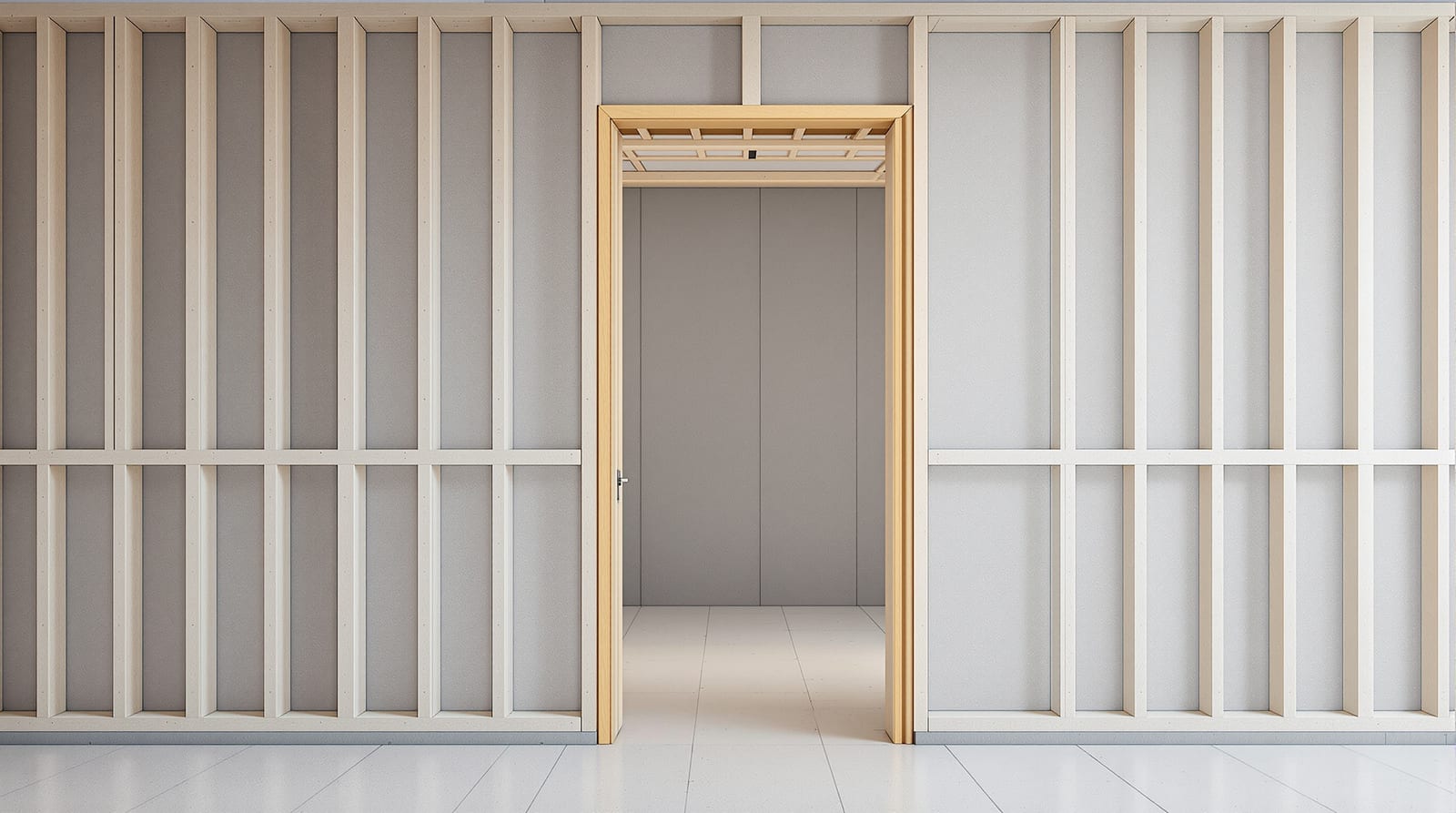
Door Frame in Drywall: Fixing to Gypsum Partitions India 2026
How to fix a door frame to a drywall or gypsum partition the right way — a stud sub-frame, screwing to studs, cavity anchors and load limits.
Fixing a door frame in drywall is one of the most quietly botched jobs on an Indian fit-out. A door frame (chowkhat) hung in a masonry wall transfers its load and the daily slam-and-swing into solid brick through holdfasts or grout. A gypsum partition has no such mass: the board itself is 12.5mm of plaster that holds almost nothing in withdrawal, and the cavity behind it is mostly air and a 48-70mm metal or timber stud at intervals. Get the framing wrong and the door sags, the architrave cracks, the latch stops meeting the strike, and within months the screws pull a ragged crater out of the board. This guide is the professional's playbook: why you need a stud sub-frame around every opening, how to fix into studs rather than board, which cavity anchors actually carry load, the realistic limits, and when a heavy leaf demands a reinforced opening. For frame anatomy and fixing into solid walls, pair this with the door frames overview and the masonry method in door frame anchoring in masonry.
Why drywall changes the rules
Drywall (gypsum board on a metal or timber stud frame, commonly Gyproc/Saint-Gobain or Knauf systems in India) is a non-load-bearing partition. The board is a cladding, not a structure. Three realities follow:
1. The board carries no withdrawal load. A screw driven into 12.5mm gypsum alone holds a few kilograms at best before it strips. Hanging a door — which applies a cantilever pull on the top hinge every time it swings — straight into board is a guaranteed failure.
2. Load must reach the studs. All real fixing has to land in the vertical studs (or a sub-frame you add). Studs in a partition usually sit at 600mm centres (sometimes 400mm for boarding rigidity), so a 750-900mm opening will rarely have studs exactly where the jambs fall.
3. The opening must be pre-planned, not cut later. A drywall door opening is framed during partition erection: studs are doubled at the jambs and a head track / lintel spans the top. You cannot saw a doorway into a finished, single-stud partition and expect it to hold.
This is why a door in drywall is detailed on the framing drawing, before a single board goes up. Retrofitting an opening means opening the board back to the nearest studs and rebuilding the framing.
The stud sub-frame: the part that actually carries the door
The correct detail is a boxed opening in the stud framing, sometimes called a sub-frame, structural opening, or rough buck. The chowkhat is then fixed to this, never to the board.
Anatomy of a framed drywall opening
- Doubled jamb studs (king + jack/trimmer): at each side of the opening, two studs are boxed together (metal studs back-to-back, or a timber post inside the metal stud). These take the hinge and lock loads.
- Head member / door header: a horizontal track or timber lintel spanning between the jamb studs, supporting the head of the frame and any boarding above.
- Cripple studs: short studs above the header up to the ceiling track, to stiffen the board over the door.
- Floor and ceiling tracks: the U-channels the studs sit in, fixed to slab and soffit.
For the head and the question of whether a load-bearing lintel is ever needed, see door lintel requirements — in a non-load-bearing partition the header carries only the door and the board above it, not floor load.
Load limits: what a drywall opening can honestly take
A correctly framed and packed drywall opening can carry surprisingly heavy doors — the partition systems are tested to it — but only because the load is in the studs, not the board. As a rule of thumb:
| Leaf type | Approx. leaf weight | Drywall feasibility | Framing needed |
|---|---|---|---|
| Hollow-core flush, 35mm | 12-22 kg | Routine | Single doubled stud each jamb |
| Solid-core flush / WPC, 35-40mm | 25-40 kg | Standard | Doubled studs + timber insert |
| Engineered / solid wood, 45mm | 40-60 kg | Heavy — design it | Boxed timber sub-frame, header tied to slab |
| Glazed / fire / steel leaf | 60-100 kg+ | Special detail | Steel sub-frame or studs back to structure |
Gypsum board alone, with the right anchor, carries only light static loads — a 25mm cavity/toggle anchor in 12.5mm board is rated roughly 10-25 kg pull-out depending on type, and far less under the repeated dynamic load a swinging door applies. Never treat a board anchor as a hinge fixing. Board anchors are for the architrave, stops, and light trim — not the frame's structural fixing. Use the door frame material selector to keep the leaf weight realistic for a partition.
Cavity and stud anchors — what to use where
Three fixing situations arise on a drywall door. Match the anchor to each:
| Situation | Correct fixing | Notes |
|---|---|---|
| Frame jamb into a stud behind board | Long wood/self-drilling screw through frame + board into stud | The only acceptable structural fixing; 75-100mm screws, 3 per jamb min, packed |
| Frame into a timber sub-frame post | Screws into solid timber | Best case — full holding like a masonry frame |
| Architrave / stop / light trim into board only | Plasterboard cavity anchor — spring toggle, metal/nylon self-drill (Driva type), or umbrella toggle | Light loads only; never a hinge or strike fixing |
| Strike plate where no stud falls | Add a noggin/timber block between studs first | Then screw into the block, not the board |
Key rule: a hinge or lock fixing must land in a stud or solid timber every time. If a stud does not fall under the hinge line, that is a framing fault to correct before fixing — add a stud, a timber post, or a flat steel strap. Cavity anchors (spring toggles, Molly bolts, Driva self-drilling plugs) are excellent for towel rails and light trim and useless for a door's working load. Pack behind every hinge and the lock point with shims so the jamb cannot bow when you drive the screws — the same discipline as a masonry frame, covered in door frame fixing methods.
Reinforcing a heavy opening
When the leaf is heavy (a 45mm solid hardwood main-to-balcony door, a glazed pivot, or a fire door), the standard doubled-stud opening is upgraded:
- Timber buck inside the studs: a full seasoned hardwood post (anti-termite treated, per door frame damp-proofing) boxed into the metal jamb studs gives a continuous solid edge to screw the chowkhat to anywhere along its height.
- Tie the header to the structure: for tall or heavy doors, run the jamb studs and header back to the floor slab and soffit rather than relying on the partition tracks alone, so the door's weight is grounded.
- Steel sub-frame for fire/security leaves: a welded steel buck (akin to steel door frames) built into the partition. Fire-rated openings must follow the tested system detail — board type, stud gauge and cavity barriers are part of the rating; do not improvise.
- Mind free egress: in any escape route the door must still open freely; NBC 2016 egress widths and the RPwD Act 2016 accessible-threshold rule (a finished threshold ≤12-13mm, bevelled if over 6mm) apply just as on a masonry opening. Detail the floor junction per door thresholds.
IS 4021 governs timber door frames whether they sit in masonry or a partition; the frame section and rebate do not change — only how it is fixed does.
Installation sequence in drywall
1. Frame the opening first — doubled jamb studs, header, cripples, DPC at the floor track — to the chowkhat outer size plus a 10-12mm packing gap each side.
2. Set the chowkhat plumb, level and square in the boxed opening on wedges/packers; check diagonals and jamb plumb within ~1-2mm over the height. See door frame plumb and level.
3. Screw the jambs into the studs/timber — minimum 3 fixings per jamb, behind hinge and lock points, packed so the jamb stays straight.
4. Fill the gap with low-expansion PU foam or packers (never let foam push the jamb out of plumb), then trim flush. See gap filling around door frames.
5. Board, tape and skim up to the frame; the board butts the frame, it does not carry it.
6. Hang the leaf, fit lock, check even reveals, then fit the architrave over the frame-board junction — see architraves and door trim.
7. Seal the junction with paintable acrylic caulk (silicone in wet zones).
Avoid the classic drywall errors: screwing the frame to board, no stud under the hinge, no noggin behind the strike, foam over-expanding and bowing the jamb, and cutting an opening into finished board without rebuilding the framing. For the wider list see door installation mistakes, and estimate the job with the door fitting cost estimator. The full cluster lives in the complete door guide.
Frequently asked questions
Can I fix a door frame directly to gypsum board?
No. 12.5mm gypsum board holds almost no withdrawal load and a swinging door applies a repeated cantilever pull. The frame must be screwed into the studs or a timber sub-frame behind the board. Board-only anchors are for architrave and light trim, never for hinges or the strike.
What if no stud falls where the hinge needs to go?
That is a framing fault to fix before hanging the door. Add an extra stud, box a timber post into the jamb studs, or fit a steel strap, so every hinge and the lock both land in solid material. Designing the opening on the framing drawing avoids this entirely.
How heavy a door can a drywall partition carry?
With a properly framed and packed opening, a partition can carry solid-core doors of 40-60 kg, and heavier with a timber or steel buck. The board never carries the load — the doubled jamb studs and header do. For very heavy or fire leaves, tie the framing back to the slab and follow the tested system detail.
Are toggle bolts and cavity anchors ever enough for a door?
No for the frame's structural fixing. Spring toggles, Molly bolts and self-drilling plugs (Driva type) suit light static loads — trim, stops, towel rails — typically 10-25 kg pull-out in board, and far less under a door's dynamic load. Use them only for non-structural items.
Do accessibility and egress rules still apply to a drywall door?
Yes. NBC 2016 egress widths and the RPwD Act 2016 / Harmonised Guidelines 2021 accessible-threshold rule (finished threshold ≤12-13mm, bevelled if over 6mm, preferably flush) apply regardless of wall type. The partition substrate changes how you fix the frame, not the life-safety or accessibility requirements.
Can I add a doorway to an existing drywall partition?
Not by sawing into finished board. Open the board back to the nearest studs, build the doubled jamb studs, header and cripples for the opening, fix DPC at the floor, then re-board, set the frame to the studs and make good. Treat it as new framing, not a simple cut-out.
Export this guide
Related Guides — Deep-dive reading
Door Fitting Guide: Step-by-Step Installation (India 2026)
The complete step-by-step door fitting guide for India — set the frame plumb, fix it with holdfasts, grout, hang the leaf on three hinges, fit the lock, trim and seal — with the tools and checks a homeowner needs.
Home Doors & EntrancesDoor Frame Anchoring to Masonry: Holdfasts (India 2026)
How to anchor timber, steel and WPC door frames into brick, concrete block, AAC and RCC walls — fixings, edge distance, loads and India site realities.
Home Doors & EntrancesDoor Frame Security in India (2026): Anchoring the Chowkhat Break-Ins Actually Exploit
A homeowner's guide to the real weak point behind most forced entries: the frame, not the leaf or the lock, and how to anchor, pack and reinforce a chowkhat so a strong door genuinely stays in the wall.
SecurityRelated Tools — Try Free
Door Frame Material Selector
Find the best door-frame material — timber, teak, WPC, steel, RCC, aluminium or uPVC — for your wall, location and budget.
Material SelectorDoor Material Comparison Tool
Compare 2–4 door materials on cost, durability, maintenance, security and moisture resistance.
Comparison ToolFire Door Rating Checker
See the likely fire-door rating (30/60/90/120 min) and components a location needs per IS 3614 / NBC — guidance, confirm with your architect.
Compliance Tool