
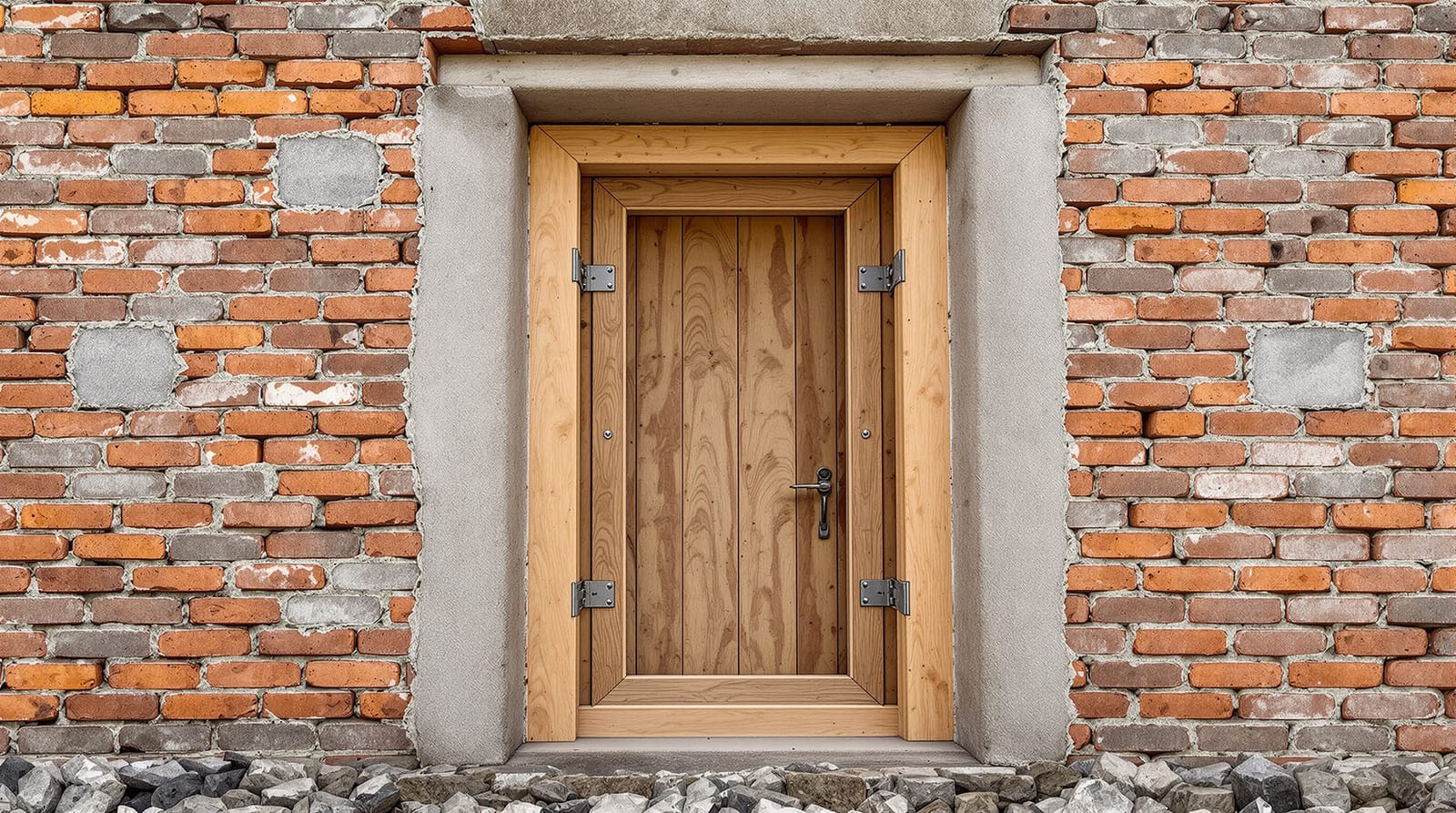
Door Frame Fixing Methods: Holdfasts & Anchors (India 2026)
How to fix a chowkhat to masonry with M.S. holdfasts, lugs, screws and frame anchors — numbers, spacing and packing that keep the frame true.
Getting the door frame fixing methods right is what separates a leaf that latches with a soft click for twenty years from one that drops, rubs and self-swings within a monsoon. A chowkhat carries the entire working life of the door — every slam, every gust, the weight of a teak shutter and the leverage of a heavy lock — and it can only do that if it is anchored to the masonry along its full height and packed solid behind the points that take load. This guide covers the four ways an Indian frame is fixed to the wall — M.S. holdfasts, lugs and cramps, screws with rawl plugs, and proprietary frame anchors — how many of each and at what spacing, where to pack behind hinges and the lock, and how to choose by wall type. It is a site-engineer and carpenter’s guide; the standards behind it are IS 4021 (timber frames) and IS 4351 (steel frames).
Why fixing is the whole game
A frame that is plumb, level and square but only nailed to a couple of points will bow under the leaf and rack out of shape. The fixings do two jobs: they transfer the door’s working loads into the wall, and they hold the jambs straight so the reveal stays even and the leaf keeps its 3mm margins. Two failures dominate Indian sites: too few fixings (the jamb springs when you lean on it) and no solid packing behind the hinge and lock (the jamb flexes inward each time you operate the door, the gaps wander, and the latch stops engaging). Both are cheap to prevent and expensive to chase after plaster and paint are on.
Before any fixing goes in, the base of a timber jamb must sit on a DPC (damp-proof course) or a stone/RCC base block — never on a wet floor — and the foot should be anti-termite treated. In India’s damp and termite climate this is not optional; the best fixing in the world cannot save a frame whose foot rots. In bathrooms, prefer WPC, PVC, RCC or aluminium frames over timber for exactly this reason.
The four fixing methods
M.S. holdfasts — the traditional standard
A holdfast (“hold-fast” clamp) is a flat mild-steel strap, typically ~30×6mm and 200–300mm long, with a forked or split tail at one end and screw holes at the other. The screw end fastens to the back of the timber jamb; the tail is embedded in the masonry inside a cement-concrete pocket so it locks into the wall as the mortar cures. This is the method IS 4021 assumes for timber frames built into brick or block walls, and it remains the default for site-built construction.
The rule of thumb most B.O.Q.s follow is 3 holdfasts per jamb for a standard ~2.1m frame: one near the top, one near the bottom, and one in the middle — roughly 600mm and 1500mm up from the floor with the third at mid-height, never more than ~750mm apart vertically. Tall frames (2.4m+) take a fourth. Set each holdfast so it lands on a bed joint of the brickwork and pour 1:2:4 cement concrete into the cut pocket around the tail; let it cure before loading the frame.
Lugs and cramps
Lugs (sometimes called cramps) are a close cousin — L-shaped or fishtail steel tabs screwed or welded to the frame and built into the masonry as it is raised, course by course. They are common where the frame is set before the wall goes up (govt and commercial work), and standard on pressed-steel frames, which carry three welded lugs per jamb from the factory. The lug tails are grouted into the mortar bed as each course is laid, so the frame and wall rise together and the bond is monolithic.
Screws and rawl plugs (drill-and-fix)
Where the wall already exists — a renovation, a frame fitted into a finished opening, or replacing a chowkhat — you drill through the jamb into the masonry and fix with a rawl plug (wall plug) and screw, or a frame fastener / nylon hammer-fix. Use 8–10mm × 100–150mm fixings into brick or solid block; for hollow or AAC block, use a longer screw into a chemical or expansion anchor that grips the cavity. The key discipline: pack behind every fixing with a shim before you tighten, so the screw clamps the jamb against a solid packer and does not pull the jamb out of plumb.
Proprietary frame anchors
Frame anchors are engineered fasteners — expansion anchors, sleeve anchors or through-frame nylon fixings — used for heavier or fire-rated leaves, steel sub-frames, and where pull-out resistance must be specified. They suit dense concrete and solid block. For uPVC and aluminium frames the manufacturer’s anchor and spacing schedule governs (typically a fixing within ~150mm of each corner and ~600mm centres between), and the frame profile is steel-reinforced to take the load.
How many, and where — the SVG layout
The two tables below set out the spacing and the method-by-method numbers.
Fixing count and spacing
| Frame height | Holdfasts / lugs per jamb | Vertical spacing | Notes |
|---|---|---|---|
| Up to 2.1m (7') | 3 | ~600 / 1350 / 2050mm | Standard internal/main; one at hinge height |
| 2.1–2.4m | 3–4 | ≤750mm centres | Add a fourth for tall/heavy leaves |
| Over 2.4m | 4+ | ≤600mm centres | Heavy/double doors, glazed frames |
| Head member | 1 each side if loaded | — | Wide frames / transoms only |
Method by wall type and situation
| Wall / situation | Best fixing | Embed / anchor medium | Watch-out |
|---|---|---|---|
| Brick, frame-first | M.S. holdfasts | 1:2:4 cement concrete pocket | Land tail on a bed joint |
| Solid block, built-in | Lugs / cramps | Mortar bed each course | Raise wall and frame together |
| Finished brick/block (reno) | Screw + rawl plug | Nylon plug, 100–150mm screw | Pack behind every screw |
| AAC / hollow block | Frame anchor / chemical | Sleeve or chemical anchor | Expansion plugs spin in AAC |
| Steel frame | Built-in + grout | 1:3 cement mortar back-fill | Fill voids fully, no rust traps |
| uPVC / aluminium | Mfr. frame fasteners | Per profile schedule | Steel-reinforced profile only |
Packing behind hinges and the lock
This is the step most often skipped and the one that decides whether the frame stays true. The hinge jamb takes the entire pulling weight of the leaf; the lock jamb takes the thrust of the latch and the abuse of slamming. If there is an air gap behind those points, the jamb flexes inward each time the door is used, the reveal opens and closes, and within weeks the latch stops catching cleanly. Insert solid shims or packers directly behind each hinge position and behind the lock/strike before you drive the fixing through, so the screw clamps the jamb against a hard packer, not into space. Then foam or grout the remaining gap. As a rule the hinge and lock packers are the first thing you set, the holdfasts second.
For steel frames the equivalent is full grouting — the frame is back-filled with 1:3 cement mortar so there is no void anywhere along the jamb; a hollow steel jamb that rings when tapped has not been grouted properly and will dent and bow. See door frame grouting for the full procedure.
Choosing by wall type — a quick decision
If you are building the wall and frame together, holdfasts in concrete pockets (timber) or welded lugs grouted course-by-course (steel) give the strongest, most monolithic bond and should be the default. If the opening is already built and plastered — a renovation or a frame replacement — you cannot cut pockets, so drill-and-fix with rawl plugs into solid brick/block, or chemical/sleeve frame anchors into AAC and hollow block, where ordinary expansion plugs simply spin in the soft cellular concrete. uPVC and aluminium frames always follow the manufacturer’s anchor schedule through a steel-reinforced profile. Whatever the method, the non-negotiables are the same: enough fixings, ≤750mm apart, on a DPC base, with solid packing behind every hinge and the lock.
When the wall is out of plumb, the opening is undersized, or the leaf is heavy, this is carpenter-and-engineer territory — a true fit cannot be improvised, and a frame fixed proud or racked will haunt the project for years.
Related guides and tools
This fits inside the wider door frames layer of the complete door guide. For the masonry-specific detail see frame anchoring in masonry and fixing frames in drywall; for steel frames see door frame grouting. Before fixing, get the rough opening right and the frame plumb and level, and protect the foot with damp-proofing. To plan it on site, use the door rough opening calculator and the door fitting cost estimator.
Frequently asked questions
How many holdfasts do I need per door frame?
Three per jamb for a standard ~2.1m frame — one near the top, one at hinge height in the middle, and one near the bottom, never more than ~750mm apart vertically. Taller frames (2.4m+) take a fourth, and heavy or double doors need closer spacing.
Can I fix a door frame with just screws and rawl plugs?
Yes, and it is the standard method for renovations or replacing a chowkhat in a finished wall where you cannot cut concrete pockets. Use 8–10mm × 100–150mm screws into solid brick or block, and crucially pack a shim behind every fixing — especially the hinge and lock points — so the screw clamps the jamb against a solid packer and not into an air gap.
Why must I pack behind the hinges and lock?
The hinge jamb carries the leaf’s weight and the lock jamb takes the thrust of the latch and slamming. If there is a void behind those points the jamb flexes inward in use, the reveal wanders and the latch stops catching. Solid packing behind each hinge and the lock keeps the jamb straight and the gaps even.
How are steel door frames fixed?
Pressed-steel frames carry three welded lugs per jamb and are built into the wall as it rises, then back-filled (grouted) with 1:3 cement mortar so there is no void along the jamb. A hollow steel frame that rings when tapped has not been grouted fully and will dent and bow — fill it completely.
What fixing works in AAC or hollow blocks?
Ordinary expansion plugs spin uselessly in soft AAC. Use a chemical anchor or a sleeve-type frame anchor sized for the cavity, with longer screws. Land fixings to grip solid material and follow the anchor manufacturer’s spacing — typically within ~150mm of each corner and ~600mm centres between.
Does the standard say which method to use?
IS 4021 covers timber door, window and ventilator frames and assumes holdfasts in masonry, while IS 4351 covers pressed-steel frames built in and grouted. NBC 2016 governs minimum widths and free egress, and RPwD accessibility rules cover thresholds. The standards set the framework; the right fixing still depends on wall type and whether you are building in or retrofitting.
Export this guide
Related Guides — Deep-dive reading
Door Frame Anchoring to Masonry: Holdfasts (India 2026)
How to anchor timber, steel and WPC door frames into brick, concrete block, AAC and RCC walls — fixings, edge distance, loads and India site realities.
Home Doors & EntrancesDoor Frame Installation: Set a Chowkhat True (India 2026)
Step by step on setting a door frame into the opening — propping, bracing, plumb, level and square, fixing and grouting — so the leaf hangs perfectly.
Home Doors & EntrancesDoor Frame Security in India (2026): Anchoring the Chowkhat Break-Ins Actually Exploit
A homeowner's guide to the real weak point behind most forced entries: the frame, not the leaf or the lock, and how to anchor, pack and reinforce a chowkhat so a strong door genuinely stays in the wall.
SecurityRelated Tools — Try Free
Door Material Comparison Tool
Compare 2–4 door materials on cost, durability, maintenance, security and moisture resistance.
Comparison ToolWindow Replacement Cost Calculator
Estimate the cost to replace existing windows — material, glass, removal and floor access.
Window CalculatorMaterial Schedule Generator
Generate a room-wise finish schedule — walls, floors, ceilings, trim, and joinery by location.
Material Schedule