
Concrete Door Frames in India: RCC Chowkhat Guide (India 2026)
Why precast cement-concrete door frames win on cost and durability in budget housing and wet areas, and where they fall short.
If you have ever seen a door frame that looks like grey stone, takes a wall colour straight off the paint roller and shrugs off years of monsoon damp, you have met a concrete door frame. Concrete door frames — usually precast RCC (reinforced cement concrete) sections cast in a steel mould — have quietly become the default chowkhat in low-cost housing schemes, government quarters, hostels, schools and the wet corners of ordinary homes across India. They are cheap, they do not burn, termites cannot touch them and standing water cannot rot them. They are also brittle, heavy and unforgiving if you ever want to move a hinge. This guide walks an Indian homeowner through the anatomy, fixing, finishing, costs and honest trade-offs so you can decide where an RCC frame earns its place — and where timber or WPC still wins.
What a concrete door frame actually is
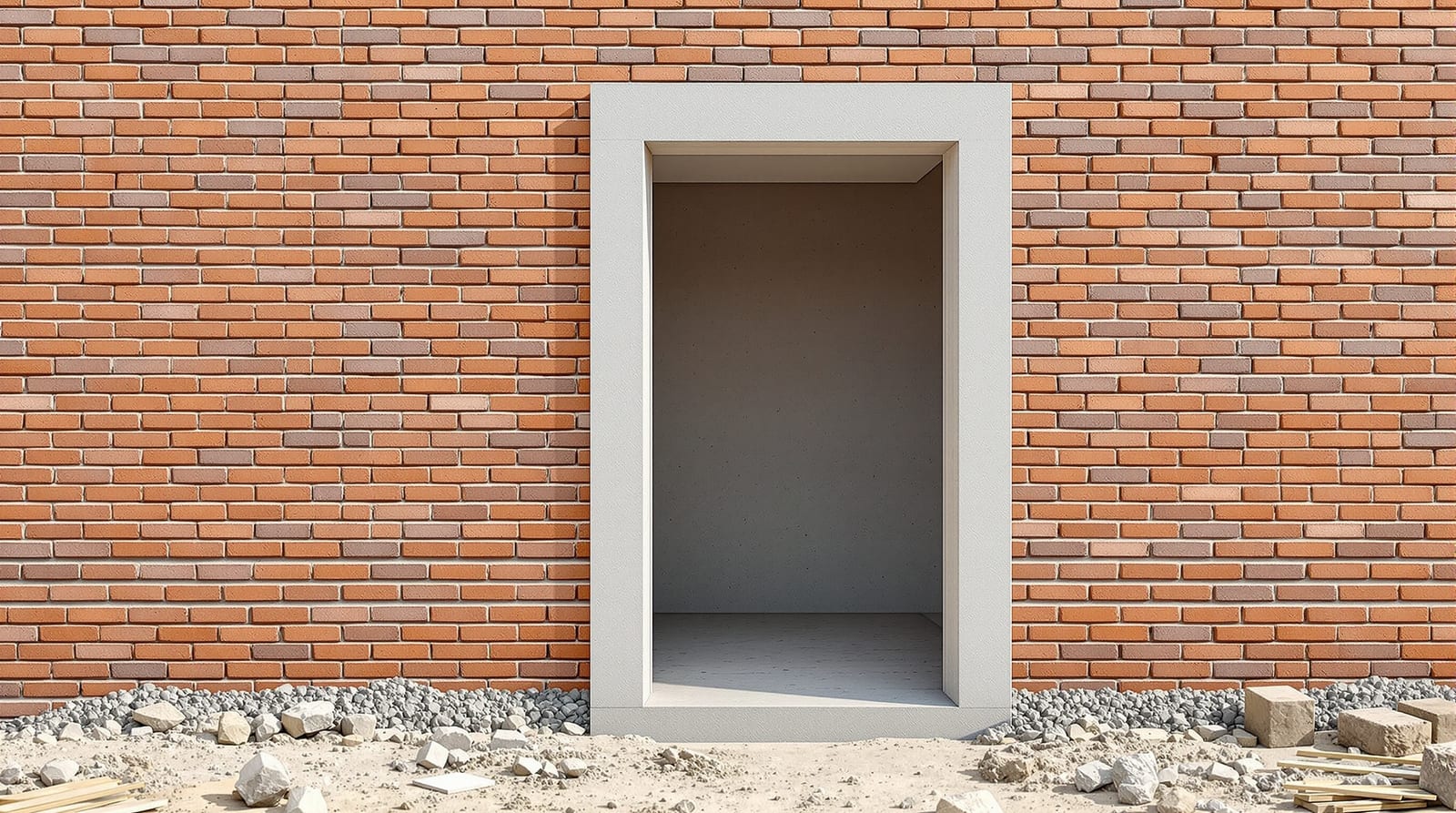
A concrete door frame is the same chowkhat you know from timber — a head (top horizontal member), two jambs (vertical posts) and sometimes a sill at the bottom — but cast in cement concrete instead of cut from wood. Most are precast: poured into a reusable steel mould off-site (or at the site casting yard), reinforced with thin steel bars or a welded cage, cured for a week or two and then carried to the opening as a finished unit. A few are still cast in situ, poured into a timber/steel shutter set right in the wall opening, which is slower and rarely worth it for a single house.
The section is typically a plain rectangle around 100 x 60 mm to 100 x 75 mm, with a moulded rebate (the recessed check the leaf shuts against, roughly 30-35 mm deep to match the leaf thickness and 12-15 mm wide). Reinforcement is usually 2-4 longitudinal bars of 6-8 mm with 6 mm links — enough to stop the slender section snapping in handling, not enough to make it a structural beam. Because it is cement, the frame is naturally fire-resistant, termite-proof and water-proof, which is its whole selling point.
Anatomy at a glance
Concrete versus timber and WPC: the honest comparison
No frame material wins everywhere. Concrete is a specialist that earns its keep in damp, fire-prone and budget situations. The table below sets it against the materials it most often replaces.
| Property | RCC / precast concrete | Seasoned hardwood / teak | WPC frame |
|---|---|---|---|
| Termite-proof | Yes (inert) | No (needs treatment) | Yes |
| Water/damp-proof | Yes | No (rots in wet areas) | Yes |
| Fire-resistant | Excellent | Poor | Limited |
| Re-screw / move hinge | Very hard | Easy | Easy |
| Brittleness / chipping | Brittle; edges chip | Tough | Tough |
| Weight & handling | Heavy (2-person lift) | Moderate | Light |
| Looks (natural) | Plain; needs paint | Premium grain | Plain; paint/laminate |
| Typical use | Bathrooms, budget housing, external | Main doors, joinery-grade | Bathrooms, kitchens |
| Cost per frame (indicative) | Low | High | Low-moderate |
The pattern is clear: concrete trades workability and looks for immunity to the three things that destroy Indian door frames — termites, monsoon damp and fire. That is why you see it in toilet and bath openings, balcony and washing-area doors, and entire affordable-housing blocks, but rarely as a showpiece main-door frame in a premium home.
How hardware is fixed — the cast-in insert trick
This is the single most important thing to understand before you buy a concrete frame: you cannot simply drive a screw into cured concrete the way you would into wood. A wood screw has nothing to bite and will spin out, and drilling for an expansion plug risks cracking the brittle section. The frame must therefore arrive with its fixings already cast in.
- Cast-in hinge inserts — small timber, plywood or steel blocks (or threaded steel plugs) are positioned in the mould at the exact hinge locations before the concrete is poured, so the cured frame has a screwable medium at each hinge point. Quality frames also have a steel hinge plate or welded butt-hinge leaf cast flush into the jamb.
- Cast-in lock/latch plug — a similar embedded block at handle height (roughly 900-1050 mm from floor) so the strike plate and latch mortise can be cut and screwed.
- Anchoring legs / horns — the jamb bottoms often carry projecting reinforcement or notches that key into the floor screed; the back of the frame may have lugs or a roughened face so the wall mortar grips.
If a frame turns up without these inserts, fixing the leaf becomes a job for chemical/epoxy anchors or carefully drilled expansion bolts, which a skilled fitter can do but which raises cost and crack-risk. Always confirm the insert positions match your leaf's hinge layout (typically three hinges: about 200 mm from the top, 250 mm from the bottom, and one in the middle) before you accept delivery. For the leaf hardware itself, our door hardware guide and door hinge replacement guide cover sizing and fixing in detail.
Installing a concrete frame
A concrete frame is set into the rough opening — frame outer size plus roughly 10-12 mm packing each side, with an RCC or stone lintel above (minimum 150-200 mm bearing each end). Because the unit is heavy and rigid, it is usually built into the masonry as the wall goes up, or grouted in afterwards.
| Step | What happens | Watch-out |
|---|---|---|
| 1. Position | Set frame plumb, level and square on packers | Check diagonals; a racked frame will not latch |
| 2. Anchor | Key horns into screed; tie/grout lugs into masonry | Pack behind hinge and lock points so it cannot bow |
| 3. Grout | Back-fill the gap with 1:3 cement mortar / concrete | Fill solidly — voids crack under door slam |
| 4. Cure | Let grout set before hanging the leaf | Hanging too early loosens the frame |
| 5. Hang leaf | Screw hinges into the cast-in inserts | Never force-screw into bare concrete |
| 6. Finish | Prime and paint; seal frame-wall junction | Sit base on a DPC in wet areas |
Get the frame plumb and square first — within about 1-2 mm over its height — because once it is grouted in, a concrete frame cannot be planed, shimmed or re-hung the way timber can. This is genuinely a job for a competent mason and fitter, not a weekend DIY. The full sequence applies to any material; see our door installation guide and the door rough opening calculator to size the opening correctly. Tolerances and gaps are covered in door clearances and tolerances.
Finishing a concrete frame
Raw concrete is porous and plain, so finishing matters both for looks and to seal the surface:
1. Cure and dry fully — paint over green concrete blisters and peels.
2. Skim/putty minor casting blemishes; sponge off form-release residue.
3. Prime with a cement/masonry primer (an alkali-resistant primer stops lime staining).
4. Top-coat with enamel or washable acrylic emulsion; the frame can simply be rolled the same colour as the wall, or contrasted.
5. Seal the junction between frame and wall with acrylic caulk internally, or silicone in wet areas, and run a bead at the floor.
Unlike timber, there is no grain to polish and no melamine/PU option — concrete is a painted finish only. In bathrooms, ensure the frame base sits on the waterproofing/DPC and the threshold sheds water away from the room.
What an RCC frame costs
Concrete frames are sold per frame (a complete head-plus-jambs unit), not by the running foot the way timber is. Prices vary with size, reinforcement and region, but as a rule of thumb:
| Item | Indicative band (per frame) |
|---|---|
| Precast RCC door frame (standard) | ₹600 - ₹1,500 |
| Heavier / external / larger section | ₹1,500 - ₹2,500 |
| WPC frame (for comparison) | low-moderate |
| Seasoned hardwood frame (for comparison) | mid-high |
| Teak frame (for comparison) | highest |
| Grouting mortar + fixing labour | ₹300 - ₹800 |
A precast concrete frame typically lands well below a teak or even a hardwood frame of the same opening, with negligible maintenance over its life — no termite treatment, no anti-fungal coats, no rot replacement. Add GST at 18% on the frame and hardware. For a full comparison across materials, see door frame cost in India and the door frame cost calculator.
Pros, cons and where it belongs
Strong points: immune to termites, damp and rot; non-combustible; very low lifetime cost and zero maintenance; dimensionally stable (no warping or shrinking in humidity); ideal under a damp-proofing regime in bathrooms, balconies and washing areas.
Weak points: brittle — corners and the rebate edge can chip on impact or rough handling; heavy, needing two people and care in transit; inflexible — you cannot re-mortise, plane or relocate a hinge once cast; relies on cast-in inserts that must be ordered correctly; and a plain, utilitarian look that needs paint and rarely suits a premium main door. For accessible openings, keep the threshold within the RPwD/Harmonised Guidelines limit (around 12-13 mm, bevelled or flush) and never let a raised concrete sill obstruct free egress.
For materials that handle better while still resisting water and termites, weigh up WPC door frames; for grain and prestige on a main door, wooden door frames; and for the full menu, the door frame materials guide. To compare every option for your opening, the cluster's complete door guide and the phase pillar on door frames tie it all together. Frame anatomy is unpacked further in door frame anatomy, and you can let the door frame material selector suggest a fit for your room.
Frequently asked questions
Can I screw a hinge directly into a concrete door frame?
Not into bare concrete — wood screws will not hold and drilling risks cracking the brittle section. Concrete frames must arrive with cast-in inserts (timber/steel blocks or threaded plugs) at the hinge and lock positions. If they are missing, a fitter must use chemical/epoxy anchors. Always confirm insert positions match your leaf before accepting the frame.
Are concrete door frames good for bathrooms?
Yes — they are one of the best wet-area choices because they are water-proof and rot-proof, alongside WPC, PVC and aluminium frames. Sit the base on the DPC/waterproofing layer, slope the threshold to shed water, and seal the frame-wall junction with silicone. Untreated timber should never be used in a bathroom opening.
How much does a precast RCC door frame cost in India?
As a rule of thumb, a standard precast RCC frame runs about ₹600-₹1,500 per frame, with heavier or larger sections going up to ₹2,500. Add grouting and fixing labour and 18% GST. That is typically well below a hardwood or teak frame, with almost no lifetime maintenance cost.
Will a concrete frame crack or chip?
It can. Concrete is brittle, so corners and the rebate edge may chip from impact or rough handling, and the slender section can crack if grouting leaves voids or the frame is hung before the grout cures. Solid grouting, careful transport and proper packing behind the hinges and lock prevent most problems.
Concrete or WPC frame — which should I choose?
Choose concrete for the lowest cost, fire resistance and external/heavy-duty wet areas where looks do not matter. Choose WPC when you want a lighter, easily screwed, re-workable frame that still resists termites and water — better for finished interior bathrooms and kitchens. Both beat untreated timber in damp zones.
Export this guide
Related Guides — Deep-dive reading
Door Frame Security in India (2026): Anchoring the Chowkhat Break-Ins Actually Exploit
A homeowner's guide to the real weak point behind most forced entries: the frame, not the leaf or the lock, and how to anchor, pack and reinforce a chowkhat so a strong door genuinely stays in the wall.
SecurityDoor Frame Anchoring to Masonry: Holdfasts (India 2026)
How to anchor timber, steel and WPC door frames into brick, concrete block, AAC and RCC walls — fixings, edge distance, loads and India site realities.
Home Doors & EntrancesDoor Fitting Guide: Step-by-Step Installation (India 2026)
The complete step-by-step door fitting guide for India — set the frame plumb, fix it with holdfasts, grout, hang the leaf on three hinges, fit the lock, trim and seal — with the tools and checks a homeowner needs.
Home Doors & EntrancesRelated Tools — Try Free
Door Cost Calculator
Estimate the all-in cost of a door — leaf, frame, hardware, fitting and GST — by type, material and size.
Door CalculatorDoor Material Comparison Tool
Compare 2–4 door materials on cost, durability, maintenance, security and moisture resistance.
Comparison ToolMaterial Comparison Sheet
India's interior material cheatsheet — plywood, finishes, hardware, countertops, paints, waterproofing.
Reference Guide