
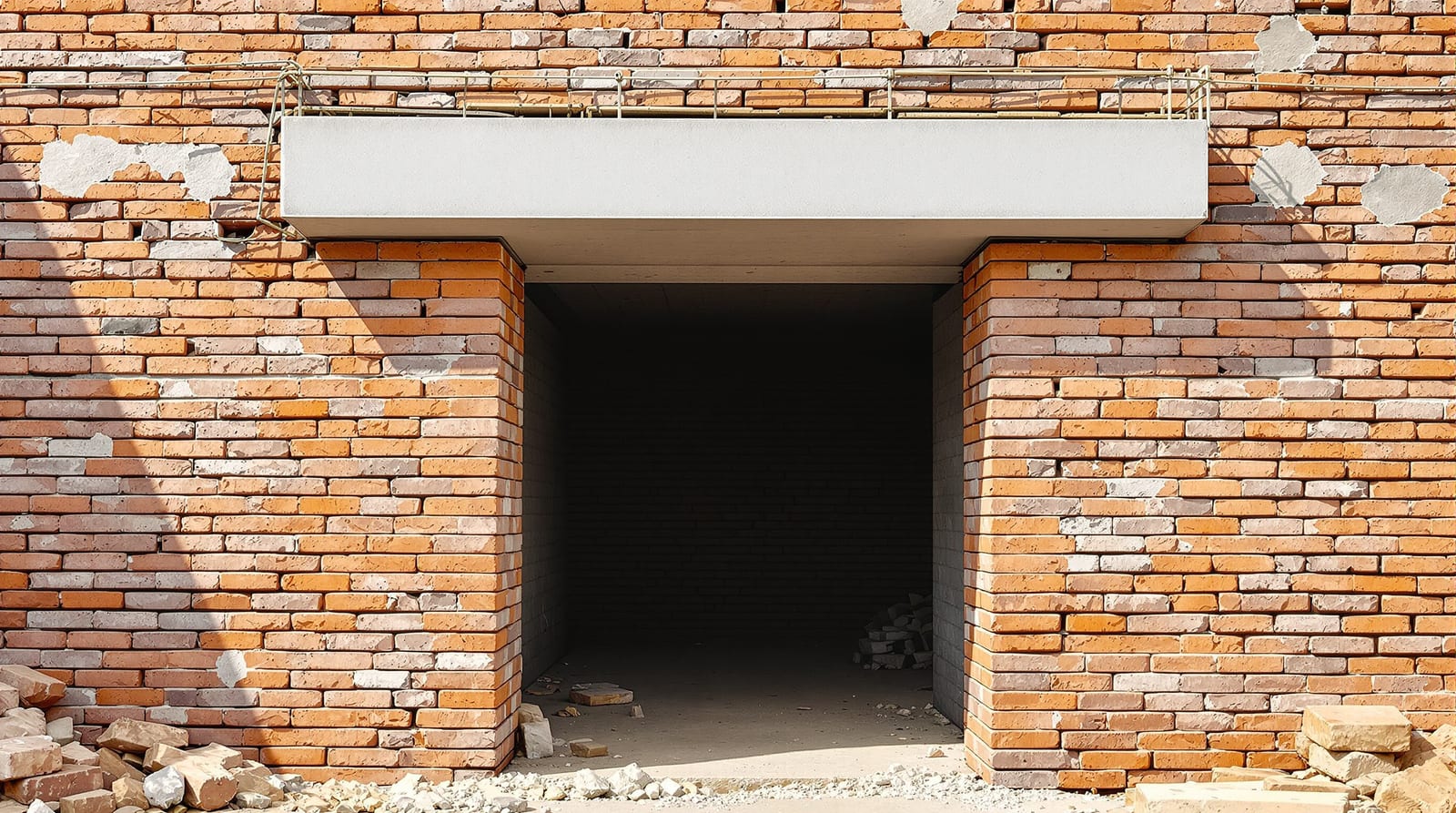
Door Lintel Requirements: RCC Header Sizing (India 2026)
Why every door opening needs a lintel — the RCC/precast header that carries the wall load, minimum bearing, depth rules of thumb, and lintel-vs-beam decisions.
Every door opening in a load-bearing or infill masonry wall needs something to carry the brickwork above it, and on Indian sites that something is almost always an RCC or precast lintel. Getting the door lintel requirements right is a structural job, not a finishing one: the lintel is the small beam that bridges the opening, picks up the wall (and sometimes the slab) load above the door, and delivers it safely down into the masonry on either side. Skip it, undersize it, or starve it of bearing and the wall over the door cracks, the frame distorts and the leaf stops latching. This guide is the site engineer's and architect's reference for why the lintel matters, how big it needs to be, how much it must sit on the wall each side, and when an ordinary lintel quietly becomes a beam that needs a proper design — in line with IS 456 (RCC), IS 2502 (bar bending) and NBC 2016.
Why a door opening needs a lintel
Cut a hole in a masonry wall and the bricks directly above the hole have nothing to stand on. Without a lintel they would have to span the gap themselves — and masonry has almost no tensile strength, so it simply cracks and drops. The door lintel requirements exist to solve exactly this: the lintel is a horizontal member that spans the opening, takes the weight of the wall above in bending, and transfers it as a near-vertical reaction into the masonry on each side of the door.
A useful idea here is the load triangle (or arching action). Masonry above an opening tends to arch over it, so the lintel usually carries only the triangle of wall within roughly 60 degrees of the opening — not the full height of wall above. If a slab, beam or heavy point load lands within that triangle, the lintel carries that too, and the calculation changes completely. That distinction — light wall load versus slab/point load — separates a standard precast lintel from a designed beam.
What carries the load: lintel options in India
Over the decades several systems have been used. RCC dominates today because it is strong, fire- and termite-proof, and easy to cast in place or precast.
| Lintel type | Where used | Pros | Cautions |
|---|---|---|---|
| Cast-in-situ RCC | Most modern doors; wider/loaded openings | Strong, monolithic, any span | Needs shuttering, curing time |
| Precast RCC | Standard internal doors, repetitive work | Fast, no on-site shuttering | Heavy to lift; needs correct bearing |
| Reinforced brick (RB) | Light, short spans; economy work | Cheap, matches brickwork | Limited span, weaker than RCC |
| Stone slab | Traditional, short spans, stone regions | Simple, durable | Brittle, narrow span only |
| Steel angle / joist | Retrofits, cutting an opening later | Slim, fast, no curing | Needs fire/rust protection |
| Masonry arch | Heritage, decorative openings | No steel, elegant | Needs skill, end abutment, more height |
For almost every new house door, the answer is an RCC lintel — cast in place when it sits in a run with the sunshade/chajja or band, or precast for plain internal openings.
Minimum bearing — the number that matters most
A lintel does no good floating in the opening; it must sit on the wall at each end by enough length to spread its reaction into the masonry without crushing it. This bearing length is the single most-failed item on site.
- As a rule of thumb, give a door lintel a minimum bearing of 150-200mm at each end (roughly the thickness of the wall, or 1/10 to 1/12 of the clear span, whichever is greater).
- For wider openings, heavier loads or weak masonry, increase the bearing or add a bearing plate / padstone (a small RCC or stone block) so the concentrated reaction does not crush the brick below.
- The opening you build must therefore be wider than the door frame to give the lintel its seats: provide the frame outer size plus the packing gap, and carry the masonry past each jamb so the lintel has its 150-200mm to land on.
Under-bearing is the classic defect: a lintel resting only 50-75mm on the wall punches into the brick, the corner of the opening cracks diagonally, and the frame goes out of square. When in doubt, give it more seat, not less.
Sizing the lintel — depth, width and steel
Depth resists bending; width usually matches the wall; the steel carries the tension on the underside. The numbers below are rules of thumb for light wall-load door openings only — anything carrying a slab, beam or point load must be designed by an engineer to IS 456.
| Clear door span | Typical RCC depth (rule of thumb) | Width | Indicative main steel | Notes |
|---|---|---|---|---|
| Up to 0.9m | 100-150mm | = wall (115/150/230mm) | 2 nos 10mm bottom | Most internal doors |
| 0.9-1.2m | 150mm | = wall | 2-3 nos 10-12mm bottom | Main entrance doors |
| 1.2-1.8m | 150-200mm | = wall | 3 nos 12mm bottom + nominal top | Wide / double doors |
| Over 1.8m or any slab load | Design required | Design required | Per IS 456 design | Treat as a beam, not a lintel |
A few sizing principles worth holding onto:
- Span-to-depth as a guide: keep overall depth around 1/12 to 1/10 of the clear span as a starting point for nominal door lintels; deeper if the load is real.
- Stirrups / links: provide nominal shear links (e.g. 6-8mm at ~150-200mm centres) even on small lintels.
- Cover: maintain ~25mm clear cover to reinforcement; more in coastal/wet exposure to resist corrosion.
- Bottom steel is the tension steel — it must be continuous and properly anchored into the bearings, not stopped short.
- Curing: a cast-in-situ lintel needs to gain strength before loading; do not pile the wall on a green lintel or strike props early.
Lintel or beam? Knowing when it changes
The word "lintel" gets used loosely, but structurally there is a clear line. A lintel carries the modest triangle of wall above an opening. A beam carries floor or roof loads and may also span between supports as part of the frame. The moment a door opening sits directly under a slab, a beam, a water tank, or a concentrated point load that falls inside the load triangle, the member over the door is doing a beam's job — and it must be designed to IS 456, not picked from a rule of thumb.
Watch for these triggers that turn a door lintel into a designed member:
- A floor or roof slab bears within the load triangle above the door.
- A plinth/floor beam, brick band, or column lands on or near the lintel.
- The clear span exceeds roughly 1.8-2.0m (wide or double-leaf openings, sliding-door pockets).
- Two openings sit close together with only a slender pier between — the piers and the combined load need checking.
- The wall above carries a point load (a beam reaction, a staircase, a heavy fixture).
In all these cases, get the section, depth and reinforcement from the structural engineer. Treating a loaded beam as a nominal lintel is one of the more dangerous shortcuts on a site.
The combined lintel: chajja, band and sunshade
In Indian construction the door/window lintel is frequently cast in one continuous run as a lintel band around the building, and external openings get a projecting chajja (sunshade) cast monolithically with the lintel to throw rain off the door. This is good practice — the band ties the masonry together (useful in seismic zones) and the chajja keeps water off the head of the frame and the threshold. Just remember the chajja is a cantilever: its main steel sits at the top of the projection, the opposite face from the lintel's bottom tension steel, and it must be tied back into the lintel. Curing the band properly before loading the wall above is essential.
Building the opening to suit the lintel
The lintel and the door opening are designed together. The rough opening must be sized for the frame plus packing, and the masonry must continue past each jamb to give the lintel its bearing seats. For the opening dimensions that feed this, see door rough opening and check the numbers with the door rough opening calculator. Once the lintel is cured and the opening is true, the frame is set plumb and level against it — see door opening prep and door frame plumb and level. If you are sizing the door itself, the door size calculator helps fix the opening early so the lintel can be cast at the right level.
Common errors that crack walls
- No lintel at all over a small internal door — the wall over it cracks in a few seasons. Even short openings need a header.
- Too little bearing (under 150mm) — the reaction crushes the brick and the opening corners crack diagonally.
- Lintel cast at the wrong level, fouling the frame head or leaving a gap the masonry can't bridge.
- Loading a green lintel — striking props or piling the wall up before the concrete has cured.
- Tension steel in the wrong place — bottom bars stopped short of the bearing, or a chajja with its steel at the bottom instead of the top.
- Ignoring a slab/point load in the triangle and using a nominal section — the lintel deflects, cracks, and the frame jams.
- Inadequate cover in wet or coastal exposure — the bars corrode and the lintel spalls.
For the frame-side consequences of a distorted opening, see door frame installation and the broader door installation mistakes.
Related guides and tools
This page sits in the frames-and-installation cluster. For the opening that the lintel sits over, see door rough opening; for setting the frame against the cured lintel, door opening prep and door frame plumb and level; for measuring it all up first, measuring for a door; and for the frame going in, door frame installation. See the phase pillar door frames and the cluster pillar complete door guide.
Frequently asked questions
Does every door need a lintel?
In any masonry wall, yes. Bricks above an opening have nothing to stand on and masonry can't span in tension, so without a lintel the wall over the door cracks and drops. Even small internal doors need a header — a precast RCC lintel, a reinforced-brick course, or a stone slab for very short spans.
What is the minimum bearing for a door lintel?
As a rule of thumb, 150-200mm at each end — roughly the wall thickness, or 1/10 to 1/12 of the clear span, whichever is greater. Less than that and the reaction crushes the brick, cracking the opening corners. Wide or heavily loaded lintels may need a padstone to spread the load.
How deep should an RCC lintel over a door be?
For a nominal wall-load door opening, a starting rule of thumb is a depth of about 1/12 to 1/10 of the clear span — commonly 100-150mm for internal doors and 150-200mm for wide or main doors. Anything carrying a slab, beam or point load must be designed to IS 456 rather than picked from a rule of thumb.
When is it a beam instead of a lintel?
When the member over the door carries more than the triangle of wall above it — a floor slab bearing within the load triangle, a beam reaction, a column or a heavy point load, or a clear span beyond roughly 1.8-2.0m. At that point it does a beam's job and needs proper structural design to IS 456.
Can I make the door opening first and add the lintel later?
It is far better to cast the lintel as the wall rises, with full bearing each side. Cutting an opening into an existing wall and inserting a lintel (or steel angle) afterwards is possible but is a propping-and-needling job for a structural engineer — never knock through a load-bearing wall without one.
Why is the chajja steel at the top while the lintel steel is at the bottom?
Because they bend in opposite directions. The lintel is a simply supported beam, so its tension face is the bottom. The chajja (sunshade) is a cantilever projecting out, so its tension face is the top — the steel must sit near the top surface and be anchored back into the lintel, or the chajja cracks at its root.
Export this guide
Related Guides — Deep-dive reading
How to Measure a Door India: Opening, Leaf, Frame and Hand the Right Way
A homeowner's measuring guide for India — measure the structural opening, work out leaf versus frame size, find the door hand and swing, allow for floor finish, and order without the classic too-tight or wrong-hand mistakes.
Home Doors & EntrancesThe Complete Home Door Guide for Indian Homes (2026): Types, Materials, Cost, Security & Vastu
Everything an Indian homeowner needs to specify the right door for every opening — from main entrance to bathroom — with real 2026 prices, IS/NBC standards and Vastu sense.
Home Doors & EntrancesCompound Wall Foundation in India: Footings, Soil and Reinforcement (2026)
The part of a boundary wall you never see is the part that decides whether it stands straight for decades or leans, cracks and falls — a plain, India-grounded literacy guide to what sits under your compound wall: how your soil drives the footing, the common footing types, how deep to go, the plinth and DPC transition, and why footing size and reinforcement are engineer-designed to your soil and wall height, never a build-to number.
Compound WallsRelated Tools — Try Free
Main Door Design Selector
Answer a few questions and get a main-door style — traditional, contemporary, luxury or budget-smart — plus material.
Design SelectorCross-Ventilation Analyzer
Estimate airflow and air changes per hour (ACH) from room size, window areas, layout, and local wind — with NBC 2016 Part 8 compliance check.
Ventilation CalculatorDoor Rough Opening Calculator
Work out the frame outer size and rough/structural opening for any finished door, with the packing gap and lintel.
Opening Calculator