
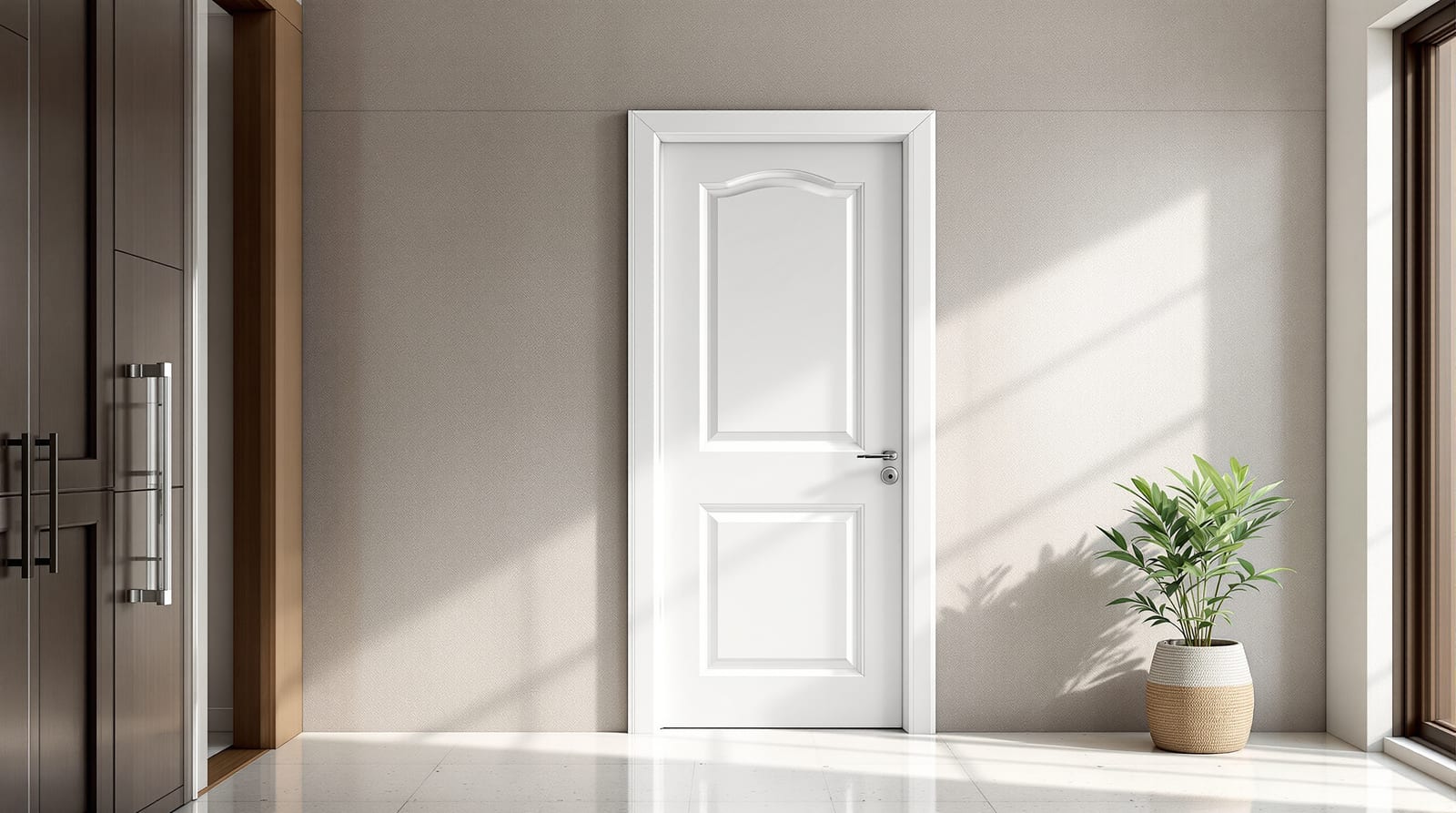
WPC Door Frames in India: Termite-Proof Frames (India 2026)
A homeowner's guide to wood-plastic composite door frames — composition, waterproof bathroom use, sizes, screw-holding, fixing and ₹ cost.
If you have ever pulled out a swollen, blackened timber chowkhat from a bathroom doorway, you already understand the problem WPC door frames were invented to solve. WPC — wood-plastic composite — is a moulded blend of wood fibre and plastic that does not absorb water, does not feed termites, and does not rot. In India's monsoon-and-termite climate that makes it the default sensible choice for bathrooms, balconies, utility areas, and any opening where a timber frame would eventually fail. This guide explains what WPC frames are made of, the sections and sizes you can buy, how well they hold screws, how a carpenter fixes them, and what they cost per running foot against teak and ordinary hardwood — so you can decide, opening by opening, where they belong.
What WPC door frames are made of
WPC is an extruded or moulded composite of wood flour (fine sawdust/wood fibre, often 50-70%) bound in a thermoplastic — usually rigid PVC or polyethylene — with mineral fillers, foaming agents, and additives for UV and fire performance. The result is a closed-cell, water-resistant solid that machines like wood (you can saw, drill, and screw it) but behaves like plastic around moisture: it does not soak, swell, warp, or delaminate.
Because there is no exposed cellulose for termites or fungi to digest, a WPC chowkhat is inherently termite-proof and borer-proof without chemical treatment — a real advantage over a timber frame that needs its foot anti-termite treated and re-treated. The trade-off is that WPC is less stiff than seasoned hardwood and softer than teak, so the way it is sectioned, filled, and fixed matters more than with timber (more on screw-holding below).
Most "WPC door frames" sold in India come as ready-moulded chowkhat profiles in fixed lengths, pre-rebated, ready to cut to size and assemble — far less skilled-joinery work than a traditional mortise-and-tenon timber frame.
Why WPC suits Indian bathrooms and wet areas
The single strongest case for WPC is the wet-area door. In a bathroom the frame foot stands in splash zones and humidity for years; untreated timber there will swell at the bottom, the paint will blister, and termites often arrive through the floor junction. WPC simply ignores all of that.
| Failure mode in wet areas | Timber frame | WPC frame |
|---|---|---|
| Water swelling / rot at foot | Common within 2-5 yrs | Does not absorb water |
| Termite / borer attack | Needs treatment; still at risk | Inherently immune |
| Paint blistering at base | Frequent | Stable; takes PU/laminate |
| Fungal mould on damp face | Likely | Wipe-clean, no food source |
| Re-screwing hinge after rot | Wood gives way | Holds if cored/filled |
For this reason WPC, PVC, RCC, or aluminium frames are the recommended materials in bathrooms — never an untreated timber chowkhat standing on a wet floor. WPC also pairs naturally with WPC flush doors, giving a fully water-immune door-and-frame set for the bathroom.
That said, WPC is not only a bathroom product. Its dimensional stability and zero-maintenance finish also make it a good choice for balcony doors, pooja-room and store doors, kitchen utility entries, and budget-conscious internal doors throughout a flat.
Sections, profiles and standard sizes
WPC frames are sold by the running foot (rft) of profile, like timber, but in moulded standard sections. Common chowkhat sections mirror timber sizes so they drop into the same openings.
| Profile (W × D, mm) | Typical use | Notes |
|---|---|---|
| 75 × 50 | Internal / bathroom doors | Lightweight, single-rebate |
| 100 × 50 | Standard internal | Most common section |
| 100 × 62 (4" × 2.5") | Main internal / matches timber | Single or double rebate |
| 125 × 62 | Heavier / wider openings | Stiffer, better screw lines |
The rebate (the recess the leaf shuts into) is usually moulded in — single-rebate for one leaf, double-rebate for double doors or better weather/sound stop. Depth of rebate equals the leaf thickness (typically 30-35mm for a flush door); rebate width is about 12-15mm.
Standard door openings WPC frames are cut to match:
- Bathroom: 600-750 × 1980-2100mm (W × H)
- Internal: 750-825 × 2000-2100mm
- Main/wide internal: 900-1000 × 2100mm
In the modular IS designation, 1M = 100mm, so a "7×20" frame suits a 700 × 2000mm bathroom door. Always confirm the frame outer size, then add the packing/grout gap for the rough opening (below).
Frame anatomy and how it fits the wall
The parts are the same as any chowkhat: the head (top horizontal), two jambs (verticals), and an optional sill at the bottom (usually omitted on internal/bathroom doors so the floor stays flush). The rebate is the lip the leaf closes against. Hinges go on one jamb (3 per leaf for a standard door); the lock plate on the other. The frame sits in the masonry opening with a small packing gap all round, fixed back to the wall.
Even though WPC is rot-proof, good practice still sets the frame base on a DPC strip or stone/RCC base block in wet areas, so the foot never sits in standing water and the floor waterproofing membrane can lap up against it.
Screw-holding: the one thing to get right
The honest weakness of WPC is screw-holding in hollow sections. Many cheaper WPC frames are foamed and partly hollow; a screw driven into thin wall material can strip out or pull through under load — exactly where a hinge or lock takes stress. The fix is straightforward but must be done:
- Choose solid or filled-core profiles for hinge and lock jambs, or profiles designed with internal screw bosses.
- At hinge, lock, and wall-fixing points, fill the chamber with PU/epoxy filler or insert a timber/uPVC packer so the screw bites into solid material.
- Use coarse-thread screws suited to composite/PVC, pre-drill pilot holes, and avoid over-driving (heat softens the plastic and strips the thread).
- Pack behind hinge and lock points so the jamb cannot bow inward when the screw tightens.
Done properly, a cored WPC jamb holds a hinge as reliably as timber. Skipped, it is the number-one reason a WPC bathroom door later sags. This is one place where a skilled carpenter who knows the product earns their fee.
Fixing a WPC frame in the opening
WPC frames are usually fixed with screws and rawl plugs/wall fasteners rather than the M.S. holdfasts grouted into masonry that timber frames traditionally use. The sequence:
1. Set the frame plumb, level and square in the rough opening using wedges/packers; check diagonals and jamb plumb.
2. Drill through the jamb into the masonry, insert wall plugs/anchors, and screw — about 3 fixings per jamb for a 2.1m frame, plus 1-2 in the head. Pack behind each fixing.
3. Fill the perimeter gap with low-expansion PU foam (or cement mortar in a masonry reveal); trim flush when cured.
4. Hang the leaf, check even reveals (~3mm at head and stiles), set the bottom undercut (6-12mm; a little more in bathrooms for ventilation).
5. Seal the frame-wall junction with silicone in wet areas, paintable acrylic caulk elsewhere.
6. Fit architrave/trim (WPC or MDF) to cover the junction.
For accessibility, keep the threshold low — the RPwD Act 2016 Harmonised Guidelines call for thresholds ≤12-13mm, bevelled if over 6mm, preferably flush, with a drainage channel where an external door needs a step. A bathroom WPC frame with no sill suits this well. Always preserve free egress — the door must open without a key from inside.
Cost: WPC vs timber, per running foot
WPC frames are typically priced per running foot of profile, and they sit below teak and often below good hardwood — while removing the lifetime cost of termite treatment and replacement. As a rule of thumb (India 2026, indicative; add 18% GST and fitting labour):
| Frame material | Indicative band (₹/rft) | Termite-proof | Waterproof | Best for |
|---|---|---|---|---|
| WPC frame | 180-400 | Yes | Yes | Bathrooms, balconies, budget internal |
| Seasoned hardwood (sal/sheesham) | 250-600 | No (needs treatment) | No | General internal |
| Teak | 700-1,200 | Partial | Partial | Premium main/internal |
| uPVC frame | section-priced | Yes | Yes | uPVC door sets |
| RCC / precast cement | ₹600-1,500 per frame | Yes | Yes | Cheapest wet-area; brittle, hard to re-screw |
A single bathroom WPC chowkhat (roughly 12-14 rft of section) therefore lands in a few thousand rupees of material before fitting — comparable to ordinary hardwood up front, but cheaper over its life because it never rots or needs anti-termite work. Architrave to finish adds about ₹40-150/rft.
WPC pros and cons at a glance
- Pros: termite- and water-proof, no warping/swelling, low maintenance, screws/machines like wood, takes PU/laminate finish, good value, ideal wet areas.
- Cons: softer and less stiff than hardwood, hollow profiles need core-filling for screws, lower load rating for very heavy main doors, quality varies sharply between brands, plastic content raises (debated) end-of-life recyclability questions.
For a heavy carved main entrance, timber or engineered hardwood still wins on stiffness and gravitas. For every wet, humid, or termite-prone opening in an Indian home, WPC is usually the smarter spec.
Where WPC frames fit in your door plan
Think material-by-opening rather than one frame everywhere. Pair WPC frames with WPC flush leaves in bathrooms and utility areas; keep timber or teak for the showcase main door; and let the structural opening, lintel, and clearances be the same regardless of frame material. Compare the alternatives in door frame materials, see the timber baseline in wooden door frames, and review concrete door frames as the other wet-area option. For sizing and fixing, use door frame sizes and door frame fixing methods. Start from the door frames phase pillar and the complete door guide. To plan budget and material quickly, try the door frame material selector and the door frame cost calculator.
Frequently asked questions
Are WPC door frames really termite-proof?
Yes. WPC contains no exposed, digestible cellulose for termites or wood borers, so a WPC chowkhat is inherently immune without chemical treatment — unlike a timber frame, whose foot must be anti-termite treated and periodically re-treated.
Can WPC frames be used for the main entrance door?
They can for lighter or budget main doors, but WPC is softer and less stiff than hardwood. For a heavy, wide, or carved main entrance, timber, engineered hardwood, or teak gives better load-bearing and a more substantial feel. WPC shines on bathroom, balcony, and internal doors.
Do WPC frames hold hinge and lock screws properly?
They do, provided you use solid or core-filled profiles at hinge and lock points, pre-drill pilot holes, and pack behind the fixings. In cheap hollow sections, screws can strip out — so insist on filled-core jambs and a carpenter who knows the product.
How much do WPC door frames cost in India?
As a rule of thumb, around ₹180-400 per running foot of profile (2026, indicative; add 18% GST and fitting). A bathroom chowkhat of about 12-14 rft therefore costs a few thousand rupees in material — competitive with hardwood up front and cheaper over its life since it never rots.
Is a WPC frame better than an RCC (cement) frame for a bathroom?
Both are termite- and water-proof. WPC is easier to screw into, machines like wood, and takes hinges and locks more readily, whereas precast RCC frames are cheaper but brittle and hard to re-screw. For most homeowners WPC is the more practical wet-area choice; RCC suits the tightest budgets.
How is a WPC frame fixed to the wall?
Usually with screws and rawl plugs/wall anchors — about three per jamb for a 2.1m frame — set plumb and square, packed behind each fixing, with the perimeter gap foamed and the junction sealed with silicone in wet areas. It does not require the grouted M.S. holdfasts that timber frames traditionally use.
Export this guide
Related Guides — Deep-dive reading
Concrete Door Frames in India: RCC Chowkhat Guide (India 2026)
Why precast cement-concrete door frames win on cost and durability in budget housing and wet areas, and where they fall short.
Home Doors & EntrancesDoor Fitting Guide: Step-by-Step Installation (India 2026)
The complete step-by-step door fitting guide for India — set the frame plumb, fix it with holdfasts, grout, hang the leaf on three hinges, fit the lock, trim and seal — with the tools and checks a homeowner needs.
Home Doors & EntrancesZero Threshold Doors in India: Level Access (India 2026)
How to detail a flush, step-free door threshold for wheelchairs and ageing-in-place while still keeping monsoon water out.
Home Doors & EntrancesRelated Tools — Try Free
Door Cost Calculator
Estimate the all-in cost of a door — leaf, frame, hardware, fitting and GST — by type, material and size.
Door CalculatorBathroom Door Material Selector
Get the best wet-area door material — WPC, FRP, PVC, marine ply or aluminium — ranked for your bathroom or utility.
Material SelectorModular Kitchen Budget Calculator
Live breakdown by running feet, countertop area, material tier and city — with wastage, design fee, GST.
Kitchen Calculator