
Door Frame Damp Proofing in India (India 2026)
Stopping rising damp and rot at the chowkhat foot with a DPC under the frame, a stone or RCC base block, and termite-treated ground contact.
A door leaf can be flawless and the joinery true, yet the whole frame can still fail from the bottom up. The first 150mm of a chowkhat — the foot of each jamb where it meets the floor — is the most punished part of any door in India, and the part site crews most often get wrong. Door frame damp proofing is the detail that keeps that foot alive: a damp-proof course (DPC) under the frame, a stone or RCC base block so timber never stands on a wet floor, anti-termite treatment at the ground-contact zone, and, in genuinely wet rooms, a frame material that simply cannot rot. This is the frame-base layer — distinct from termite-proofing the leaf or waterproofing the threshold surface. Get the foot right and the rest of the frame lasts decades; skip it and you are repainting a black, swollen, crumbling jamb within two monsoons.
Why the frame foot fails first
Three Indian realities converge at floor level, and they attack the jamb foot before anywhere else.
- Rising damp. Masonry and screed wick ground moisture upward by capillary action. A timber jamb bedded straight into or onto that wet base draws water into the end grain, where it cannot dry, and the foot rots from inside. Cement-grouted steel frames corrode at the same line.
- Termites. Subterranean termites in most of India travel up from the soil and enter timber at its lowest, dampest, hidden point — the jamb foot embedded in masonry. The horn (the jamb projection cast into the floor) is a classic entry route.
- Standing water. In bathrooms, balconies, pooja-room washes and ground-floor entrances, surface water sits against the foot at every cleaning or shower. End grain in contact with that water is the single fastest rot path on a door.
The cure is always the same idea: break the moisture path before it reaches the timber, and put termite-immune material or treatment in the way. A DPC handles rising damp, a base block lifts the timber clear of standing water, and anti-termite treatment guards the ground contact the DPC cannot.
The DPC under the frame
The damp-proof course is the horizontal barrier that stops rising damp crossing from wet masonry into the frame. In the wall it is already there (IS 3067 details building DPC); the job at a doorway is to make sure the frame sits on it rather than below it.
- The jamb foot — and the horn, if retained — must bear on the DPC line, not on raw screed or soil below it.
- Where the horn is cut off (standard for internal frames), the foot sits on the finished slab; bed it on a DPC strip, a bitumen layer or a stone pad, never directly on damp screed.
- A bitumen coat, a strip of DPC membrane, or a course of dense stone all serve as a local damp barrier under the foot.
A frame foot that drops below the wall DPC line is the commonest cause of a jamb that stays permanently damp — the masonry below the DPC keeps it wet from underneath, and no surface paint will ever dry it out.
The stone or RCC base block
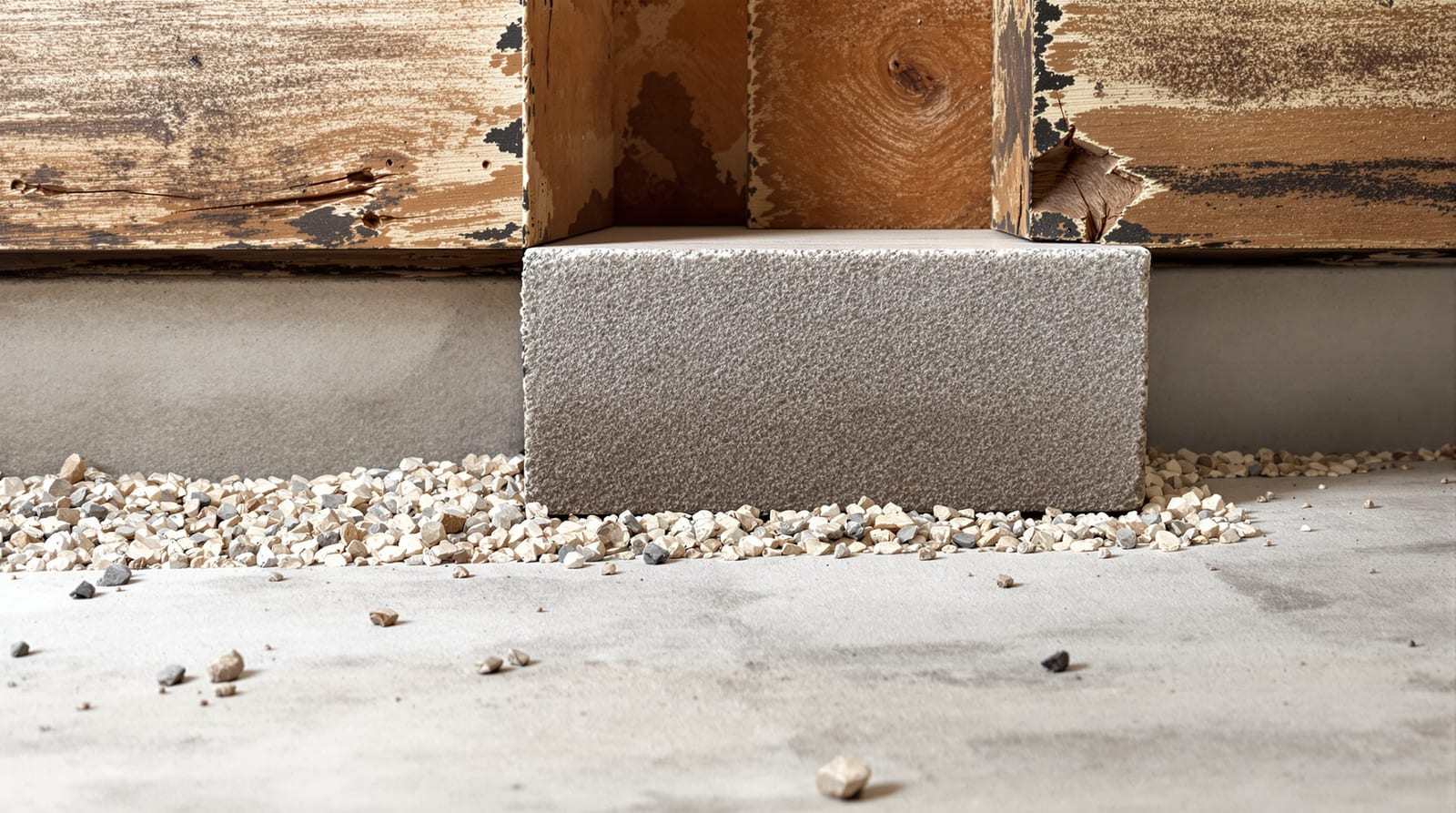
The most reliable detail for a timber frame in any damp or wet location is to never stand the timber on the floor at all — lift it on a base block of stone or RCC.
| Base detail | What it does | Best for |
|---|---|---|
| Granite / stone base block | Lifts the jamb foot 50-100mm clear of the floor; stone neither rots nor wicks | Bathrooms, balconies, ground-floor entries, wet-prone doorways |
| RCC / cement base block | Cast as part of the floor or precast; fire-, termite- and water-immune | Wet areas, budget builds, where stone is unavailable |
| DPC strip + bitumen pad | A flat damp barrier under a foot that must sit near floor level | Internal doors with low damp risk |
| Raised plinth / kerb | Sets the whole opening above the wet-floor line | Bathrooms, external thresholds |
The principle is simple: the timber meets stone or concrete, the stone or concrete meets the wet floor, and the rot path is broken. A 50-100mm granite block under each jamb foot is cheap, traditional in Indian construction, and outlasts every membrane. Bed it so its top is above the finished wet-floor level and seal the timber-to-stone joint with silicone, not acrylic caulk, which fails once wet.
Anti-termite treatment at ground contact
A DPC stops water but not termites. The ground-contact zone of any timber frame — the foot and the horn — needs anti-termite treatment in addition to the damp barrier. This works on two fronts:
- Soil treatment. Treat the soil and masonry around the opening as part of the building's pre-construction anti-termite course (IS 6313 details the chemical barrier), so termites cannot reach the frame from the ground.
- Timber treatment. Pressure-treat or brush-coat the jamb foot and horn with a wood preservative before fixing. Sal, sheesham and teak vary in natural durability; none should be left untreated at ground contact in a termite-active zone.
Treat the cut ends especially — sawn end grain is the most absorbent and the most vulnerable surface. Re-coat any site cuts before they go into the masonry. Where the leaf itself is the concern rather than the frame base, see termite proofing doors; the frame foot is a separate, often-missed line of defence.
Choosing the frame material for wet areas
The surest damp-proofing is to remove the rottable material entirely. In bathrooms, balconies and other genuinely wet rooms, do not specify untreated timber at floor level at all — choose a frame that cannot rot.
| Frame material | Damp / rot behaviour | Termite | Best use |
|---|---|---|---|
| WPC (wood-plastic composite) | Water-immune, no swelling at the foot | Immune | Default for bathroom doors |
| PVC / uPVC | Fully water-immune | Immune | Bathroom, utility, balcony doors |
| RCC / precast cement | Fire-, water- and termite-proof; brittle, hard to re-screw | Immune | Budget and wet-area doors |
| Aluminium | Corrosion-resistant; no rot | Immune | Glass/shower and external aluminium doors |
| Seasoned hardwood / teak | Rots at the foot if not protected | Vulnerable | Dry internal doors; wet areas only with DPC + base block + treatment |
| Steel (GI / pressed) | Corrodes at the grout line if not galvanised | Immune | Where galvanised; grout-fixed |
WPC is the usual default for a bathroom door foot — termite- and water-proof, no swelling, no rot. PVC, RCC and aluminium are equally immune. Timber stays the right choice for dry internal and protected external doors, but in those locations it still needs the DPC, base block and anti-termite foot detail above. For the full material decision see door frame materials and WPC door frames, or run the door frame material selector.
Common mistakes at the frame base
- Foot standing on a wet floor. The single biggest error — end grain in standing water rots in a season. Lift it on a base block.
- Frame foot dropped below the wall DPC. The masonry below keeps the foot permanently damp; no paint dries it. Bear the foot on the DPC line.
- Untreated timber at ground contact. Termites enter at the foot and horn. Treat soil and timber both.
- Timber frame in a bathroom. Use WPC, PVC, RCC or aluminium instead; even treated timber struggles against daily standing water.
- Acrylic caulk at the wet joint. It fails once wet. Use silicone at the timber-to-stone and frame-to-floor joints.
- No slope away from the foot. Water pools against the jamb. Slope the wet floor to the drain.
Tying the base detail together
Damp-proofing a door frame is three moves in one zone: break rising damp with a DPC, lift the timber off any wet floor on a stone or RCC base block, and guard the ground contact with anti-termite treatment — or sidestep all three by choosing a WPC, PVC, RCC or aluminium frame in wet rooms. It is the cheapest insurance on a door and the most ignored. For the surface side of the same junction see waterproofing door thresholds and door sill design; for fixing the frame into the wall see door frame fixing methods; and for the foot's finish coat see door frame finishing. The frame layer starts at door frames and the whole topic at the complete door guide. Size the timber with the door frame timber calculator.
Frequently asked questions
Why does the bottom of my door frame keep rotting?
Almost always because the jamb foot is standing on a damp or wet floor with no barrier. End grain wicks moisture, cannot dry, and rots from inside — fastest in bathrooms and ground-floor entries. The fix is to break the moisture path: a DPC under the foot, a stone or RCC base block lifting the timber clear of the wet floor, and anti-termite treatment at the ground contact, or a WPC/PVC frame that cannot rot at all.
Do I really need a base block under a door frame?
In any wet or damp-prone location, yes. A 50-100mm granite or RCC base block under each jamb foot lifts the timber clear of standing water and rising damp, and stone neither rots nor wicks. It is cheap, traditional in Indian construction, and outlasts surface membranes. Dry internal doors can use a DPC strip or bitumen pad instead, but a wet-area timber frame should always sit on a block.
Is a DPC enough to stop the frame foot rotting?
A DPC stops rising damp through the masonry, but it does not stop standing surface water against the foot or termites coming up from the soil. Pair the DPC with a base block to lift the timber clear of wet floors and anti-termite treatment at the ground contact. The three together — barrier, lift and treatment — are what actually keep a timber frame foot alive.
What frame material should I use in a bathroom?
WPC is the usual default — water- and termite-proof, no swelling or rot at the foot. PVC/uPVC, RCC and aluminium are also fully immune. Avoid untreated timber on a bathroom floor entirely; if timber is unavoidable at a protected external door, stand it on a DPC and stone base block and anti-termite treat the foot.
Should I seal the joint between the frame foot and the floor?
Yes, with silicone — not acrylic caulk, which fails once wet. Seal the timber-to-stone joint at the base block and the frame-to-floor junction so surface water cannot creep into the foot. Slope the wet floor away to the drain as well, so water is led off rather than pooling against the jamb.
Export this guide
Related Guides — Deep-dive reading
Termite Proof Door Guide India: Protect Door Frames from Termites in a Humid Climate
Why door frames are India's favourite termite meal — and how to beat them with the right material (WPC, uPVC, FRP, steel, properly seasoned teak), pre-construction and chemical anti-termite treatment of the wall and frame, boron treatment of timber, and keeping the frame off wet floors.
Home Doors & EntrancesMoisture-Resistant Building Materials in India: The Right Material for Every Wet Zone (2026)
Moisture is the biggest enemy of Indian buildings - monsoon, rising damp, condensation, leaks and coastal humidity. This guide separates waterproofing (a system) from choosing inherently moisture-tolerant materials, then names the right material for bathrooms, exteriors, roofs, basements and finishes - with a zone-by-zone selector table. A specify-and-select guide.
Building MaterialsConcrete Door Frames in India: RCC Chowkhat Guide (India 2026)
Why precast cement-concrete door frames win on cost and durability in budget housing and wet areas, and where they fall short.
Home Doors & EntrancesRelated Tools — Try Free
Door Material Comparison Tool
Compare 2–4 door materials on cost, durability, maintenance, security and moisture resistance.
Comparison ToolBathroom Door Material Selector
Get the best wet-area door material — WPC, FRP, PVC, marine ply or aluminium — ranked for your bathroom or utility.
Material SelectorWindow Material Comparison Tool
Compare uPVC, aluminium, wood, steel and composite windows on cost, life, upkeep and insulation.
Compare