
Door Frame Joinery in India: Strong, Square Corners (India 2026)
How the head joins the jambs — mortise-and-tenon, dowel pinning, mitres, and welded steel and uPVC corners for frames that stay square.
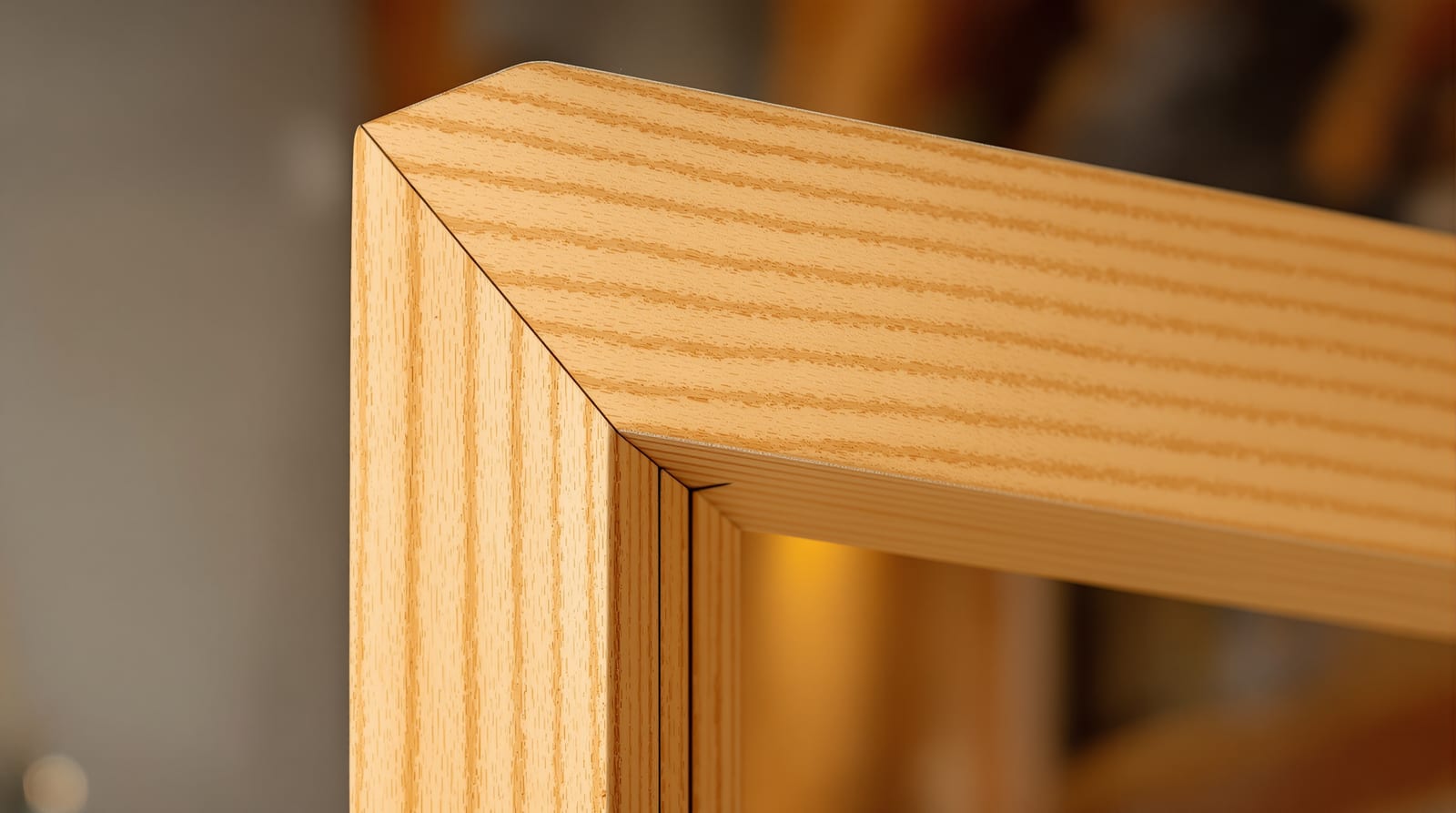
The single most important thing about a door frame (chowkhat) is not its timber species or its finish — it is the door frame joinery at the corners. The joint where the head meets each jamb decides whether the frame stays square under daily slamming, monsoon swelling and decades of wall movement, or whether it racks out of true so the leaf rubs, sticks and refuses to latch. A beautifully polished teak frame with a weak corner is a failure waiting to happen; a modest hardwood frame with a true haunched tenon will outlast the building. This guide unpacks how the head joins the jambs across timber, steel and uPVC, so you (or your carpenter) get a corner that is strong, square and built for Indian conditions.
What the corner joint has to do
A door frame is essentially a three- or four-sided rectangle that must resist racking — the parallelogram distortion that happens when one corner is pushed sideways. Internal frames usually have a head and two jambs (an inverted U, no sill); external and bathroom frames often add a sill to close the rectangle. The corner joint carries three jobs at once:
- Hold the angle square (90 degrees) against the leaf's weight and the door being slammed.
- Resist pull-apart when the frame is wrestled into the opening and grouted.
- Stay tight through moisture cycles — Indian timber swells in the monsoon and shrinks in summer, so the joint must accommodate movement without opening up or splitting.
IS 4021 (timber door, window and ventilator frames) is the relevant Indian Standard for timber frame joinery; IS 4351 covers pressed-steel frames. A corner that meets these in spirit — full bearing, mechanically locked, glued or welded — is what separates a frame that lasts from one that loosens in a year.
Timber joints: mortise-and-tenon, dowel and mitre
Haunched mortise-and-tenon — the gold standard
The traditional and strongest corner for a wooden chowkhat is the haunched mortise-and-tenon (M&T). The head is shaped into a tenon (a projecting tongue) that slots into a mortise (a matching slot) cut into the jamb. Because the head sits at the very top of the jamb, a plain tenon would leave a weak short-grain shoulder, so a haunch — a short secondary stub — is left to fill the gap and stop the head twisting. The joint is then draw-bored and dowel-pinned: a hardwood dowel (or two) is driven through the cheek of the jamb and through the tenon, mechanically locking the two members together. Modern shops also add a waterproof adhesive (phenolic/PU or melamine) so the joint is both glued and pinned.
Why it wins: the interlocking faces give a large glue area and resist racking in every direction, and the dowel means the joint holds even if the glue line fails in damp. It is the joint IS 4021 effectively assumes, and the one a skilled carpenter will reach for on any teak or sal frame.
Dowel-only and biscuit joints
Factory WPC and lower-cost timber frames sometimes skip the cut tenon and use dowel joints alone — two or three glued hardwood dowels register the head into the jamb end-grain. It is faster and machine-friendly but relies far more on glue, so it is only as good as the adhesive and the moisture sealing. For internal, dry-area frames it is acceptable; for a heavy main door or a wet area, insist on a true tenon.
Mitre and butt joints — when to avoid them
A mitre joint cuts both members at 45 degrees so the corner shows no end-grain — visually clean, used for architraves and decorative casings. Structurally it is weak in a frame: end-grain to end-grain has almost no glue strength and racks easily, so a mitred frame must be reinforced with a spline, dowels, or a corner cleat. A plain butt joint (one member simply abutting the other, screwed or nailed) is the weakest of all and should be limited to throwaway temporary frames. Use mitres for trim, not for the load-bearing frame corner.
| Timber corner joint | Strength against racking | Best use | Notes |
|---|---|---|---|
| Haunched mortise-and-tenon, dowel-pinned | Excellent | Main doors, all hardwood/teak frames, wet areas | IS 4021 standard; glue + dowel; needs a skilled carpenter |
| Dowel-only (glued) | Good (glue-dependent) | Internal dry frames, factory WPC frames | Fast, machine-made; weak if glue fails in damp |
| Mitre (splined/cleated) | Fair if reinforced | Architraves, decorative casings | Looks clean; structurally poor without a spline/dowel |
| Butt (screwed) | Poor | Temporary/site-made cheap frames | Avoid for any permanent door |
Steel and uPVC frames: welded and mechanical corners
Pressed-steel frames (IS 4351)
Galvanised or mild-steel pressed frames are made from a folded sheet profile. The corner is mitre-cut and welded, then ground and filled flush so the joint disappears under paint. A well-made GI steel frame corner is extremely rigid — it cannot rack — and is fire-, termite- and water-proof, which is why it dominates government, institutional and commercial work. The weak point is corrosion: if the frame is plain MS (not galvanised) and the weld or cut edge is left unprimed, rust creeps from the corner outward. Specify galvanised sheet, ensure cut edges and welds are primed before grouting, and the corner will outlast a timber one. Steel frames are built into the wall and back-grouted with 1:3 cement mortar, which itself stiffens the corner.
uPVC and aluminium frames
uPVC frame corners are thermally welded — the two profile ends are heated to melting and fused into a single homogeneous corner, then the bead is cleaned off. This is a factory process (you cannot weld uPVC properly on site) and produces a sealed, weatherproof, multi-chamber corner; the steel reinforcement inside the chambers carries the structural load. Aluminium frames instead use mechanical corner cleats — an internal corner bracket is crimped or screwed into both mitred ends, sometimes with a corner-key adhesive. Both rely on factory precision; the homeowner's job is to verify the welds/joints are clean and the diagonals are square on delivery.
| Frame type | Corner method | Squareness | Climate verdict (India) |
|---|---|---|---|
| Timber (hardwood/teak) | Haunched M&T + dowel + glue | Excellent if well cut | Good; treat the foot, keep off wet floors |
| WPC | Dowel + glue (factory) | Good | Excellent for bathrooms — waterproof, termite-proof |
| Pressed steel (GI) | Mitre-cut, welded, ground | Rigid (cannot rack) | Excellent if galvanised; rusts if plain MS unprimed |
| uPVC | Thermally fusion-welded | Excellent (factory) | Excellent — sealed, weatherproof, steel-reinforced |
| Aluminium | Mechanical corner cleat | Very good | Good for glass/wet; check cleat tightness |
Joint anatomy at a glance
The diagram below shows a haunched mortise-and-tenon corner with the dowel pin and the rebate (the recess the leaf shuts into).
Making sure the frame is actually square
A perfect joint is wasted if the frame is assembled out of square. Before the glue sets and before fixing, check the corner with these field tests:
- Diagonals must match. Measure corner-to-corner both ways; equal diagonals mean a true rectangle. A difference of more than 2-3mm means the frame is racked — clamp diagonally to pull it square.
- 3-4-5 method for a single corner: mark 300mm along the head and 400mm down the jamb; the diagonal between them should read 500mm for a true right angle.
- Hold the joint with a clamp and a temporary corner brace (a diagonal batten screwed across the back) while transporting and fixing, so the frame cannot rack before it is built in.
- Pack behind hinge and lock points when fixing so the jamb does not bow and force the joint open.
| Squareness check | Tool | Pass criterion |
|---|---|---|
| Diagonal equality | Tape measure | Both diagonals within 2-3mm |
| Right angle | 3-4-5 marks or large set square | Diagonal = 500mm at 300/400 marks |
| Corner tightness | Visual + feeler | No open gap at the joint line |
| Frame plumb after fixing | Spirit level / plumb bob | Within 1-2mm over the height |
Cost and when to call a carpenter
As a rule of thumb, the joinery itself is folded into the frame price rather than billed separately. Seasoned hardwood frame section runs about ₹250-600 per running foot, teak ₹700-1,200/rft, WPC ₹180-400/rft; a pressed-steel frame is ₹1,200-3,000 per standard frame. Hand-cut haunched M&T joinery is skilled labour — a true tenon and draw-bored dowel are not a DIY job, and a poorly cut mortise weakens the jamb. For factory WPC, uPVC and steel frames the corner is made in the plant; your role is to inspect squareness and weld quality on delivery. GST is 18% on hardware and joinery. If a frame arrives already racked, reject it — re-squaring a glued or welded corner on site rarely works.
For the full picture of frame anatomy, the parts the joinery connects, and how the finished frame is fixed and detailed, read the door frames phase pillar and the complete door guide. To go deeper on the connected members and details, see door frame anatomy, the door frame rebate, door frame materials and wooden door frames; for how the squared frame then enters the wall, see door frame fixing methods and door frame installation. Estimate the section and corners you need with the door frame timber calculator, and price the whole frame with the door frame cost calculator.
Frequently asked questions
Which door frame joint is strongest?
The haunched mortise-and-tenon, glued and dowel-pinned, is the strongest timber corner — it interlocks the head and jamb, resists racking in every direction, and holds even if the glue weakens in damp. It is the joint IS 4021 effectively assumes for quality timber frames.
Are mitre joints good for door frames?
For the structural frame corner, no. A mitre joins end-grain to end-grain with almost no glue strength and racks easily, so it needs a spline, dowel or corner cleat to be reliable. Mitres are right for architraves and decorative trim, not for the load-bearing frame corner.
How are steel and uPVC frame corners joined?
Pressed-steel frame corners are mitre-cut, welded and ground flush (rigid, but rust-prone if plain MS is left unprimed). uPVC corners are thermally fusion-welded in the factory into a single sealed corner, with internal steel reinforcement; aluminium uses mechanical corner cleats. None can be properly remade on site.
How do I check a frame is square?
Measure both diagonals corner-to-corner — they should match within 2-3mm. Use the 3-4-5 method on a corner (300mm and 400mm marks should give a 500mm diagonal), keep a temporary corner brace on during transport and fixing, and pack behind hinge and lock points so the jamb cannot bow.
Will a wooden frame joint survive Indian monsoons and termites?
A well-cut, glued and dowel-pinned joint accommodates seasonal swelling without opening, but the timber still needs help: keep the frame foot off wet floors on a DPC or stone block, anti-termite treat the ground-contact end, and use a waterproof adhesive. In bathrooms and wet areas, prefer WPC, uPVC, aluminium or RCC frames over timber.
Can I assemble a chowkhat myself?
You can assemble a factory dowel-jointed WPC or kit frame with care, but hand-cutting a haunched mortise-and-tenon is skilled carpentry — a sloppy mortise weakens the jamb and a racked corner is hard to fix once glued. For a heavy main door or any structural frame, use a skilled carpenter or a factory-made frame.
Export this guide
Related Guides — Deep-dive reading
Wooden Door Frames in India: Species, Cost & Care (India 2026)
How to choose, season and treat a timber chowkhat that survives India's termites, monsoon and heat — and what it costs per running foot.
Home Doors & EntrancesDoor Frame Security in India (2026): Anchoring the Chowkhat Break-Ins Actually Exploit
A homeowner's guide to the real weak point behind most forced entries: the frame, not the leaf or the lock, and how to anchor, pack and reinforce a chowkhat so a strong door genuinely stays in the wall.
SecurityDoor Frame Materials in India: Cost & Comparison (India 2026)
Compare teak, hardwood, WPC, uPVC, aluminium, steel and RCC door frames on cost, durability, termite and water resistance for every room.
Home Doors & EntrancesRelated Tools — Try Free
Door Frame Cost Calculator
Estimate door frame (chowkat) cost from the opening size and frame material — sal, teak, WPC, steel, RCC or granite.
Door CalculatorDoor Material Comparison Tool
Compare 2–4 door materials on cost, durability, maintenance, security and moisture resistance.
Comparison ToolWindow Cost Calculator
Estimate window price plus installation by type, frame material, size, glass and quantity.
Window Calculator