
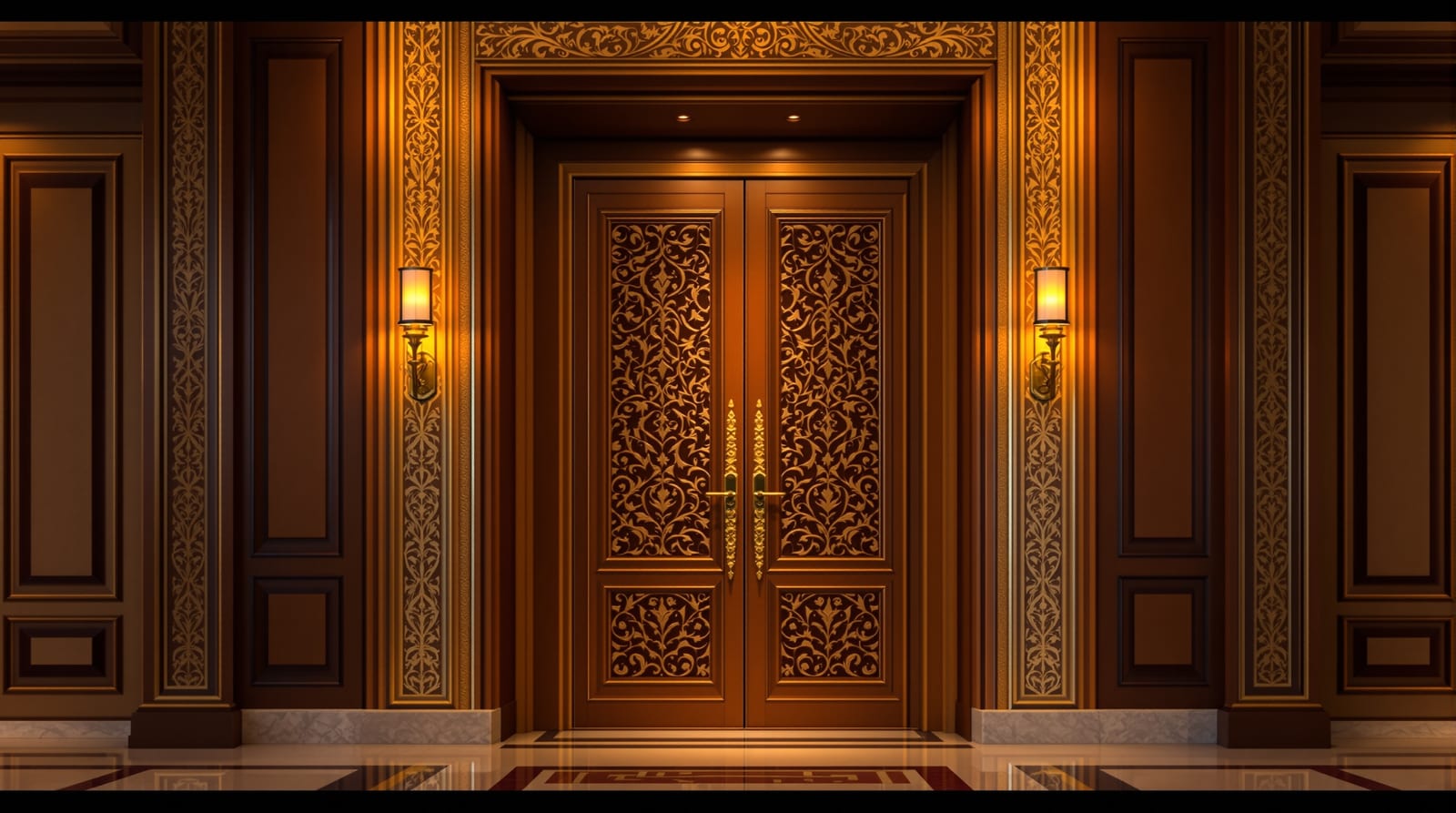
Designer Door Price in India 2026: Premium & Statement Door Cost Guide
What it really costs to move from a plain shutter to a statement door — tier-by-tier prices for CNC, carved teak, veneer, PU-Duco, fluted, brass-inlay, pivot and glass designer doors.
A plain flush door costs a few thousand rupees. A statement door — the kind that makes a guest pause at the threshold — can cost twenty to forty times that. The gap is not magic or markup; it is a stack of specific, addable costs: the substrate, the hours a carver or a CNC machine spends shaping it, the finish that is sprayed and sanded six times over, and the hardware that carries it. This 2026 guide breaks the designer-door market into clear price tiers, shows you exactly what drives the jump, and works a real example so you can budget a premium door without being quoted into the dark.
All figures here are indicative and vary by city, vendor, season and the exact spec you sign off. Treat them as planning ranges, not quotations. Prices are for the door leaf plus its primary make/finish; frame (chowkat), installation labour, hardware and 18% GST are usually extra unless a vendor explicitly bundles them. For the master benchmark across every door type, keep the door cost guide for India 2026 open alongside this one.
What makes a door a "designer" door — and why price explodes
A door becomes a designer or statement door when it stops being a commodity shutter and starts being a custom-made object. Three things happen to the price at that moment:
1. The substrate gets better. You move from a hollow-core flush blank to solid engineered wood, marine MDF, full teak, or a steel/aluminium frame holding toughened glass.
2. Geometry becomes labour. A flat door is fast. The moment you add carving, CNC routing, fluting, inlay grooves or a moulded profile, you are buying hours — and hours are the single biggest variable in the whole quote.
3. The finish becomes a process. A laminate is pressed once. A PU-Duco high-gloss finish is primed, sprayed, sanded, re-sprayed and buffed across multiple coats, often in a dust-free booth. That booth time is real money.
Stack those three and a Rs 6,000 door becomes a Rs 60,000 door. The rest of this guide is just naming the tiers and the drivers so the explosion is predictable rather than alarming.
Designer door price tiers in India (2026)
The table below groups the main designer-door categories by what you typically pay for the leaf plus its signature make/finish in a standard main-door size (roughly 3.5 ft x 7 ft, ~24 sq ft) unless noted. Internal feature doors at 3 ft x 7 ft sit at the lower end of each band.
| Designer door category | What you are paying for | Indicative price (leaf + finish) |
|---|---|---|
| CNC / laser-cut MDF or HDHMR feature door | Machine-routed pattern on a board substrate, painted/laminated | Rs 8,000 – 25,000 |
| Veneer feature door (book-matched / designer veneer) | Premium natural veneer on engineered core, melamine/PU sealed | Rs 9,000 – 30,000 |
| Fluted / louvered designer door | Machined slats or fins glued to a frame, finished | Rs 12,000 – 40,000 |
| PU-Duco high-gloss door | Multi-coat sprayed polyurethane on MDF/ply, mirror finish | Rs 18,000 – 55,000 |
| Hand-carved teak / rosewood door | Solid hardwood, fully hand-carved by a craftsman | Rs 35,000 – 1,50,000+ |
| Brass / metal-inlay designer door | Wood or PU base with inset brass strips, jali or motifs | Rs 40,000 – 1,50,000+ |
| Pivot designer door (oversized) | Large solid/clad leaf on a pivot system, any premium finish | Rs 45,000 – 2,00,000+ |
| Frameless glass statement door | Toughened/laminated glass, patch fittings, no frame | Rs 35,000 – 1,20,000+ |
Notice the pattern: machine work (CNC, fluting) sits in a tight, predictable band because the labour is automated. Anything hand-made or oversized — carving, inlay, pivot — has an open top end, because you are buying an artisan's time or an engineer's load calculation, and those scale with ambition.
The two ends explained
Entry designer (Rs 8,000 – 25,000). A CNC-cut MDF or HDHMR door, a clean veneer feature door, or a simple fluted internal door. These read as designer because of pattern and finish, but the substrate is affordable and the labour is largely machine-driven. This is where most Indian homeowners get the biggest visual return per rupee, especially for internal doors. See veneer doors, laminate doors and louvered doors.
Luxury (Rs 1,00,000+). A fully hand-carved Burma-teak main door, a brass-jali inlay door, or an oversized pivot leaf clad in book-matched veneer with concealed hinges. Here the leaf alone can cross a lakh before frame and hardware. This is the territory of the main door design and carved door designs pages, and it is almost always the front door — the one Vastu says should be the largest in the house.
The cost drivers: where every rupee goes
Two doors of the same size can differ 10x in price. The table below shows the five drivers that explain almost all of that spread, ranked by how much swing each one creates.
| Cost driver | Why it moves the price | Swing it creates |
|---|---|---|
| Custom carving / detailing labour | Hand-carving is paid by the hour/day; a deep relief can take a craftsman days per leaf | Largest single variable — can double or triple a quote |
| Material / substrate | Burma teak vs CP teak vs MDF vs glass differ wildly per sq ft | Very high (teak ~Rs 800-1,500/sq ft vs MDF a fraction) |
| Finish process | Laminate (one press) vs PU-Duco (6+ sprayed/sanded coats in a booth) | High — PU can add Rs 5,000-20,000 alone |
| Hardware & system | A pivot system, concealed hinges, brass handles, smart lock | Medium-high (Rs 5,000-40,000+) |
| Size & weight | More sq ft of premium material; heavier leaf needs stronger fittings | Medium, scales linearly with area |
Why carving is the biggest variable. Machine processes (CNC routing, lamination, veneer pressing) have a fixed, knowable cost — the machine takes the same time whatever the pattern. Hand-carving does not. A shallow, simple motif might add Rs 8,000–15,000; a deep, traditional temple-style relief covering the whole leaf, carved by a skilled artisan over several days, can add Rs 50,000 or more by itself. Because it is sold as days of skilled labour, carving has no fixed ceiling — which is precisely why two "teak carved doors" can be quoted at Rs 40,000 and Rs 1,40,000 and both be fair. When you compare quotes, always ask: machine-routed or hand-carved, and how many days of carving? For the design vocabulary, see carved door designs and traditional Indian doors.
Worked example: carved teak main door vs CNC-cut MDF feature door
Putting numbers to two real choices makes the gap concrete. Both are common in Indian homes in 2026; both are "designer", but they live in different price universes.
Option A — Hand-carved Burma teak main door (3.5 ft x 7 ft, ~24.5 sq ft)
| Line item | Indicative cost |
|---|---|
| Solid teak leaf (~24.5 sq ft @ ~Rs 1,300/sq ft) | ~Rs 32,000 |
| Hand-carving (traditional relief, ~3 days skilled labour) | ~Rs 35,000 |
| Melamine / PU sealing finish | ~Rs 8,000 |
| Teak chowkat (frame) + threshold | ~Rs 9,000 |
| Premium brass handle set + heavy-duty hinges | ~Rs 7,000 |
| Fitting labour | ~Rs 2,500 |
| Subtotal (before 18% GST) | ~Rs 93,500 |
With GST this lands around Rs 1,10,000 — and a deeper, full-leaf carving could push it well past Rs 1,50,000. The carving and the teak together are roughly two-thirds of the cost. See teak door cost in India and main door cost in India for deeper teak-specific budgeting.
Option B — CNC-cut MDF internal feature door (3 ft x 7 ft, ~21 sq ft)
| Line item | Indicative cost |
|---|---|
| HDHMR / MDF blank | ~Rs 3,500 |
| CNC routing (one set-up, machine time) | ~Rs 4,000 |
| PU paint finish (matte) | ~Rs 6,000 |
| WPC / pine frame | ~Rs 2,500 |
| Standard handle + hinges | ~Rs 1,500 |
| Fitting labour | ~Rs 1,200 |
| Subtotal (before 18% GST) | ~Rs 18,700 |
With GST, roughly Rs 22,000 — a genuine designer look for under a quarter of Option A. The lesson: the substrate and the labour type, not the "designer" label, decide the price. A CNC machine gives you pattern cheaply; a human carver gives you soul expensively. Many homeowners spend on one carved statement front door and use CNC/veneer/fluted designer doors everywhere inside — see interior doors by room.
How to control a designer-door budget
- Spend on the front, save on the rest. Put the carving budget into the main door; use CNC, fluted or veneer designer doors for bedrooms and study.
- Ask machine vs hand on every carved quote. It is the difference between a fixed and an open-ended price.
- Pick finish deliberately. PU-Duco high-gloss looks luxurious but adds real booth cost and shows scratches; matte PU or premium laminate is cheaper and tougher. Compare in modern door designs.
- Match hardware to the leaf. A heavy pivot or carved teak leaf needs proper hinges/pivots and a good lock — see the door hardware guide and smart door locks. Skimping here ruins an expensive door.
- Mind the climate. For coastal or high-humidity homes, confirm the substrate and finish resist swelling and salt before paying premium money — see best door material for India.
- Get sizes right first. A custom designer door is costly to remake; lock dimensions against door size standards before fabrication.
For a fast first estimate, the door cost calculator and door material comparison tools let you test tiers before you call vendors.
Frequently asked questions
How much does a designer door cost in India in 2026?
Entry designer doors (CNC-cut, veneer, simple fluted) typically run Rs 8,000–25,000 for the leaf and finish. Mid-tier PU-Duco and quality veneer feature doors sit around Rs 18,000–55,000. Luxury hand-carved teak, brass-inlay, pivot and frameless-glass statement doors start near Rs 35,000 and routinely cross Rs 1,00,000–2,00,000+. Frame, hardware, fitting and 18% GST are usually extra. All figures are indicative and vary by city and vendor.
Why is one carved teak door Rs 40,000 and another Rs 1,40,000?
Almost always the carving. A shallow, partly machine-routed motif adds far less than a deep, full-leaf relief carved by hand over several days. Carving is sold as days of skilled labour, so it has no fixed ceiling. The teak grade (CP vs Burma) and door size also move the price. Always ask whether the pattern is machine-routed or hand-carved, and how much of the leaf is covered.
Is a CNC-cut MDF door really a "designer" door?
Yes, visually — CNC routing gives crisp, repeatable patterns that look high-end, and with a good PU finish the result is genuinely designer. The difference is the substrate and labour: an MDF/HDHMR board and machine time cost a fraction of solid teak and hand-carving. For internal feature doors, CNC is often the smartest spend; reserve carved hardwood for the front door.
What is the single biggest cost driver in a designer door?
Custom carving labour, followed closely by the substrate material. Machine processes (CNC, fluting, lamination, veneer pressing) have fixed, knowable costs. Hand-carving is paid by the day and can double or triple a quote on its own, which is why it is the largest variable in any premium-door budget.
Are designer-door prices the same across Indian cities?
No. Metro vendors, premium showrooms and dust-free PU booths cost more than a local carpenter in a smaller town. Teak and brass prices also fluctuate. Use the ranges here as planning figures, get two or three itemised quotes that separate leaf, finish, frame, hardware and GST, and verify against the door cost guide for India 2026.
Export this guide
Related Guides — Deep-dive reading
Main Door Cost in India 2026: Teak, Wood, Pivot & Steel All-In Prices
What a main entrance door really costs in India in 2026 — by material (teak, solid wood, engineered, steel, pivot), the full all-in maths of leaf + frame + carving + hardware + smart lock + fitting + GST, worked budget and premium examples, what drives the price, and the kerb-appeal return.
Home Doors & EntrancesModern Door Design for Indian Homes: 9 Contemporary Looks That Still Work in the Monsoon
Minimalist flush-and-groove leaves, vertical and horizontal slats, flush-with-frame reveals, handle-less pulls, glass accents and statement pivots - the contemporary door styles that look right in a 2026 Indian home, and what each one costs and demands.
Home Doors & EntrancesThe Complete Home Door Guide for Indian Homes (2026): Types, Materials, Cost, Security & Vastu
Everything an Indian homeowner needs to specify the right door for every opening — from main entrance to bathroom — with real 2026 prices, IS/NBC standards and Vastu sense.
Home Doors & EntrancesRelated Tools — Try Free
Door Material Comparison Tool
Compare 2–4 door materials on cost, durability, maintenance, security and moisture resistance.
Comparison ToolDoor Cost Calculator
Estimate the all-in cost of a door — leaf, frame, hardware, fitting and GST — by type, material and size.
Door CalculatorWindow Hardware Cost Calculator
Estimate window hardware cost — hinges, handles, locks, rollers and multipoint gears.
Window Calculator