
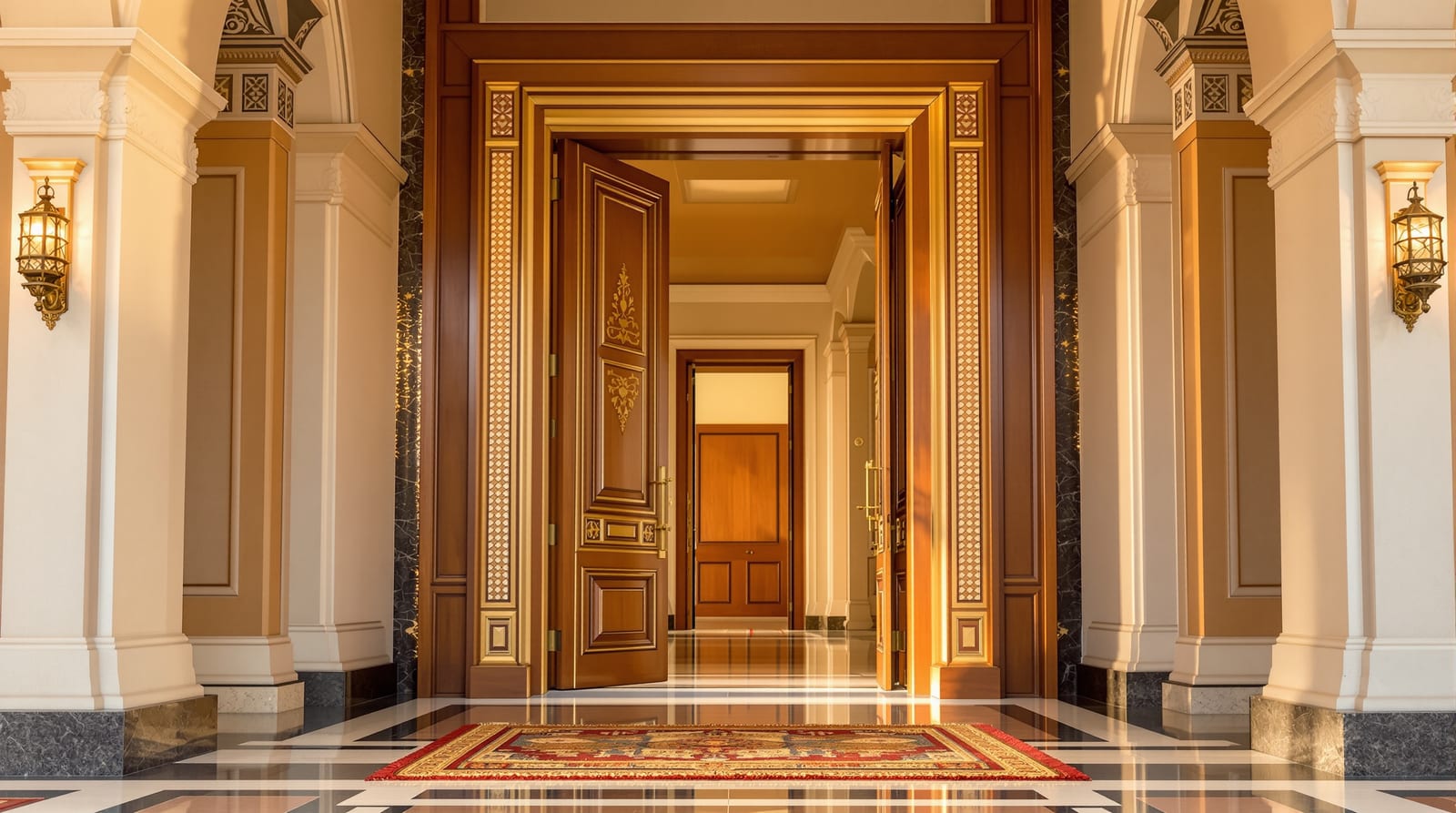
Single vs Double Door (2026): Which to Choose for Indian Homes
A head-to-head decision guide for Indian homes: how opening width, grandeur, cost, security, furniture movement, Vastu and maintenance settle whether you fit one leaf or two, plus where the leaf-and-a-half option wins.
Stand in front of any opening in your home and you have one of two answers: fill it with a single leaf, or split it into two shutters that meet in the middle. Most of the time the right answer is obvious from the width alone, but for a main entrance, a formal hall or a pooja room the decision gets tangled up with grandeur, budget, Vastu and how often you actually move a sofa through the door. This guide puts the two side by side and walks the deciding factors, so you choose for the right reason rather than fitting a double door just because it looks expensive.
If you have already decided you want two leaves and just want to specify them well, the deep double doors guide covers active and inactive leaves, astragals and hardware in detail. This page is the head-to-head: single versus double, factor by factor. For the wider map of door types, start with the complete guide and the types of doors hub.
The one factor that usually decides it: opening width
Before grandeur, cost or Vastu, look at the structural opening. Width settles most of these decisions on its own.
- Up to about 1200 mm: single leaf, every time. A shutter up to 900-1100 mm wide stays light, hangs square, and weather-seals against a solid frame on one side. This covers almost every internal door — bedrooms (900 mm), kitchens and utility (800-900 mm), bathrooms (700-750 mm). See door size standards.
- 1200-1500 mm: the grey zone. A single 1100-1200 mm leaf is possible but becomes heavy, needs four hinges, sags over the years and swings a deep arc. A double here gives two narrow 600-750 mm leaves. This is where the leaf-and-a-half option (below) earns its keep.
- 1500 mm and above: double, almost always. Splitting the opening into two 750-900 mm leaves keeps each shutter light, square and easy to hang, and gives you a symmetrical pair. A single leaf this wide is impractical except as a sliding or pivot door.
A single leaf wider than roughly 1100-1200 mm is the classic mistake: it looks generous on paper, then droops on its hinges and binds in the monsoon. If your opening pushes past that and a slim profile is not an option, two leaves is the structural answer, not just the decorative one.
Single versus double: the factors at a glance
| Factor | Single leaf | Double leaf (two shutters) |
|---|---|---|
| Best opening width | 700-1200 mm | 1500-2400 mm (1.5 m-plus) |
| Everyday clear passage | ~700-720 mm | ~700-720 mm (active leaf only) |
| Clear passage, fully open | ~700-720 mm | 1300 mm-plus (both leaves) |
| Relative cost | Baseline | Roughly 1.8-2.4x a single |
| Security weak point | Lock stile (one, against solid frame) | Meeting stile / inactive-leaf bolts |
| Weather sealing | One stile gap | Central meeting joint needs astragal |
| Maintenance | Simple; one set of hinges/lock | Two leaves to keep aligned; central line shows drift |
| Vastu (main door) | Acceptable | Even leaves preferred — auspicious by default |
| Grandeur / symmetry | Off-centre, informal | Balanced, formal, welcoming |
| Where it wins | Bedrooms, baths, kitchens, narrow or budget openings | Main entrances, halls, pooja rooms, master suites |
The row people miss is everyday clear passage. A double door gives you no more daily width than a single, because in normal use you open only the active leaf — the other stays bolted. You buy the second leaf for symmetry and for the occasional wide clearance, not for everyday flow. If width for walking through is your only worry, a single 900 mm leaf is cheaper and tighter.
Cost: a double is close to two singles, plus hardware
A double door is not exactly twice a single, but it is close, and the extra hardware widens the gap. Budget roughly 1.8 to 2.4 times the cost of an equivalent single leaf. The premium comes from four things: two shutters instead of one (you pay twice for edge-banding, finishing and any carving), extra hardware (flush bolts on the inactive leaf, an astragal at the meeting stile, an extra set of hinges, usually a multi-point lock), a wider and stronger frame, and longer fitting labour to align two leaves on a dead-straight central line.
| Item | Single door (indicative) | Double door (indicative) |
|---|---|---|
| Shutter(s) | One leaf | Two leaves (~1.8-2x leaf cost) |
| Frame / chowkat | Standard width | Wider, heavier (sal/teak ₹350-900 per running ft) |
| Extra hardware | Lockset only | Flush bolts ₹400-2,000/pair + astragal + multi-point lock; adds ₹3,000-15,000 |
| Fitting labour | ₹800-2,000 | ₹1,500-4,000 (two leaves to align) |
| Mid-range main door, fitted | ₹15,000-45,000 | ₹35,000-90,000 |
| Carved teak main door | from ₹25,000 | ₹1,50,000-plus |
All figures are indicative, vary by city and vendor, and most quotes carry 18% GST. Pressure-test any quote against the door cost benchmark and, for entrances, main door cost, or run the numbers in the door cost calculator. The blunt rule: if budget is tight and the opening allows it, a single leaf is the value choice.
Security: where each is vulnerable
A single door is pinned to a solid frame on the lock side, so its only real weak point is the lock stile, which a good mortice or multi-point lock handles. A double door has a subtler weakness: the meeting stile at the centre. The active leaf latches against the inactive leaf, which is itself only held by flush bolts top and bottom. If those bolts are shallow or the leaves just butt edge-to-edge, a pry-bar at the centre can spring the pair.
This does not make a double door less secure — it makes the centre the part you cannot cheap out on. Specify a rebated (overlapping) meeting stile or a T-astragal so there is no straight slot for a tool, deep flush bolts (20 mm-plus throw) into metal strikes, and a multi-point lock on the active leaf. Done that way, a double main door is as secure as a single. For either choice, layering a safety grill or collapsible gate outside and a good lock matters more than the leaf count; see door security and smart door locks.
Furniture movement and clear width
This is the honest case for a double door beyond looks. An everyday single 900 mm leaf clears roughly 700-720 mm — fine for people, tight for a double-door fridge, a wardrobe carcass, a three-seater sofa or a hospital bed. A double door, with both leaves swung open, clears 1300 mm-plus. You keep the inactive leaf bolted for daily use and release it only when something wide has to pass. If your main entrance, hall or master-suite door will see large furniture move through it even occasionally, that one-off clearance is a genuine reason to choose two leaves. For everyday internal rooms, it almost never is. For measuring swing and clearance, see how to measure a room.
The Vastu note: even leaves are auspicious
Vastu Shastra treats the main door as the mukhya dwar through which energy enters, and it specifically prefers an even number of leaves — so a two-leaf door is considered auspicious by default, which is one reason grand traditional entrances are so often double. Even panel counts per leaf (two, four, six) are likewise preferred over odd. A single leaf is not "inauspicious," but for a main door where you want to honour the count preference, a double satisfies it without effort.
Treat this as tradition layered with sensible practice — a symmetric pair simply looks balanced and welcoming. Direction (north/east/north-east best), the threshold or dehleez, and inward clockwise opening apply to either choice and are covered fully in vastu for the main door and entrance vastu; we do not repeat them here. The narrow takeaway: if Vastu count weighs on your main-door decision, that nudges you towards double, but only once the opening is wide enough to carry it.
Maintenance and the leaf-and-a-half middle path
A single door is simpler to live with: one set of hinges, one lock, one stile to seal, nothing to drift out of alignment. A double door asks for more care — two leaves whose meeting line must stay dead straight, and a wide solid-timber leaf can swell and bind at the centre in the monsoon, throwing the line off. Engineered or well-seasoned timber and a rebated stile with a small clearance gap reduce this. If you dislike fuss, that tilts the call towards a single.
When the opening sits awkwardly in the 1200-1500 mm grey zone, or you want occasional wide clearance without full double-door cost and maintenance, consider the leaf-and-a-half (also called "one-and-a-half") door: a wide active leaf for daily use plus a narrow inactive leaf (typically 300-450 mm) opened only for large items. You get most of the practical clearance benefit and a touch of symmetry, with one everyday leaf to maintain and lock. It is a common, sensible compromise for wide-but-not-grand openings.
So: single or double? A quick decision
- Choose single for internal rooms (bedroom, bath, kitchen, utility, store), any opening up to ~1200 mm, a tight budget, low-maintenance priorities, or wherever symmetry does not matter.
- Choose double for a main entrance, formal hall, master suite or pooja room with an opening of 1500 mm-plus, where you want grandeur and symmetry, occasional wide furniture clearance, and the even-leaf Vastu preference satisfied — and where you will pay for proper meeting-stile hardware.
- Choose leaf-and-a-half for a 1200-1500 mm opening, or when you want the wide-clearance option without full double cost and upkeep.
For the design language once you have chosen, see main door design, modern door designs and traditional Indian doors; for a grand pooja entrance, pooja room door.
Frequently asked questions
Is a double door always better than a single?
No. A double door is better only when the opening is genuinely wide (about 1.5 m-plus) and you want grandeur, symmetry or occasional wide clearance, such as a main entrance or pooja room. For bedrooms, bathrooms, kitchens and any opening up to ~1200 mm, a single leaf is cheaper, more secure, easier to weather-seal and lower-maintenance. Choose for the opening and use, not for looks.
How much more does a double door cost than a single?
Budget roughly 1.8 to 2.4 times an equivalent single leaf. The premium comes from two shutters, a wider stronger frame, flush bolts, an astragal and usually a multi-point lock, plus longer fitting labour. A mid-range double main door lands around ₹35,000-90,000 fitted versus ₹15,000-45,000 for a single; carved teak pairs run past ₹1,50,000. Figures are indicative, vary by city and vendor, and usually carry 18% GST.
Does a double door give more everyday walking width?
No, and this surprises people. In daily use you open only the active leaf, which clears about 700-720 mm — the same as a single 900 mm door. The inactive leaf stays bolted and is released only to move furniture or for a formal occasion. So a double door buys symmetry and occasional wide clearance (1300 mm-plus with both leaves), not extra everyday passage.
Is a single or double door more secure?
A single door is pinned to a solid frame and its only weak point is the lock stile. A double door's weak point is the central meeting stile, where the active leaf latches against a bolted inactive leaf. Specified properly — rebated stile or astragal, deep flush bolts into metal strikes, a multi-point lock — a double is as secure as a single. Done cheaply, the centre is the obvious target. See door security.
What is a leaf-and-a-half door?
It is a double door with unequal leaves: a wide active leaf for daily use plus a narrow inactive leaf (about 300-450 mm) opened only for large items. It suits awkward 1200-1500 mm openings or anyone who wants occasional wide clearance and a hint of symmetry without the full cost and maintenance of two equal leaves. You maintain and lock one everyday leaf, the way you would a single.
Export this guide
Related Guides — Deep-dive reading
Double Doors in India (2026): Two-Leaf Entrances, Proportions, Hardware & Cost
When a double-leaf door makes sense for Indian main entrances, pooja rooms and master suites, plus active/inactive leaf hardware, the Vastu note on even panels, security at the meeting stile and the rupee premium over a single door.
Home Doors & EntrancesThe Complete Home Door Guide for Indian Homes (2026): Types, Materials, Cost, Security & Vastu
Everything an Indian homeowner needs to specify the right door for every opening — from main entrance to bathroom — with real 2026 prices, IS/NBC standards and Vastu sense.
Home Doors & EntrancesGuest Room Door in India: Privacy, Quiet and Smart Picks Without Overspending (2026)
How to choose a guest bedroom door for an Indian home - privacy and acoustics so visitors feel comfortable, but budget-sensible for a room used only now and then: solid-core flush for quiet, panel or laminate for looks, the right privacy lock, simple soundproofing, and a finish that matches the rest of your doors - with picks ranked and indicative rupee costs.
Home Doors & EntrancesRelated Tools — Try Free
Window Hardware Cost Calculator
Estimate window hardware cost — hinges, handles, locks, rollers and multipoint gears.
Window CalculatorDoor Security Rating Calculator
Score your main door out of 100 across leaf, frame, lock and hardware — and see the top upgrades.
Security ToolVastu Shastra Compliance Checker
Score your home across 21 Vastu criteria with a weighted score, compliance band, and remedial guidance.
Vastu Scoring