
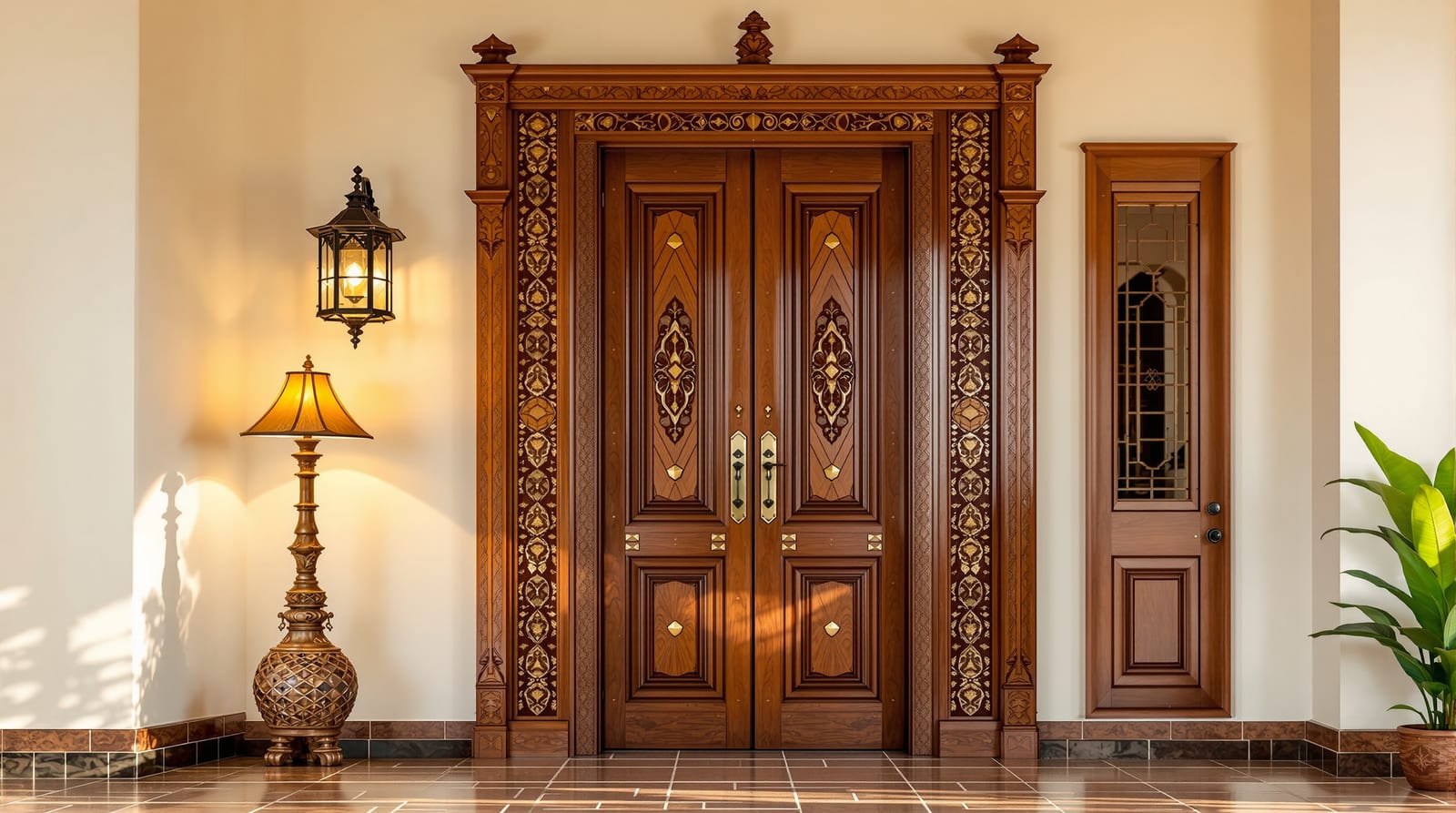
Kerala Traditional Doors: The Nalukettu Padippura & Carved Main Door Explained (2026)
The heritage door style of the Kerala tharavadu, from the padippura gateway to the carved teak and aanjili main door, its motifs, brass studs and panel proportions, and how it is revived in modern Kerala homes.
In a Kerala tharavadu, the ancestral joint-family house, the door is never just an opening. It is a sequence: you cross the padippura, the roofed gateway in the compound wall, walk the path, and only then reach the heavy carved main door (mukhya vaathil) set deep in a laterite or timber wall. Built of dense local aanjili or imported Burma teak, studded with hand-forged brass, and carved in deep relief with lamps, lotus and Lakshmi, this door is the most worked single object in the whole house. This guide goes deep on that specific Kerala tradition, what it is made of, why it looks the way it does, and how to revive it honestly in a modern Kerala home.
For the pan-Indian picture of carved and ceremonial doors, read traditional Indian doors; for the carving craft itself, carved door designs; and for the timber that makes a Kerala door last, teak wood doors. This page stays regional and specific.
The padippura and the main door: a two-stage threshold
Kerala traditional architecture (the system codified in the Thachu Shastra and Vastu Vidya texts followed by the thachan, the master carpenter) treats entry as a journey, not a single line. There are two doors that matter, and they do different work.
The padippura is the gatehouse, a small tiled roof over the gap in the compound wall (the matil). In a real tharavadu it has its own little wooden door or low shutter, a step you must climb over, and often a seat-niche on either side. It frames the house from the road, marks the boundary between the public lane and the family's land, and was historically where visitors paused and were received. Even in compact modern Kerala plots, the padippura survives as a roofed gate feature, often the first thing a builder is asked to keep "traditional".
The main door sits well inside, usually opening into the verandah (the poomukham) or directly into the central hall. It is the deep, carved, brass-studded leaf people picture when they think "Kerala door". Its proportions are set by tradition: tall and relatively narrow, with a high threshold (the padi or dehleez) you step over, and a frame that is itself a carved object. The whole point is that you slow down, step up, and enter with intention.
What the door is made of: aanjili, teak and rosewood
Kerala's door tradition is built on three timbers, chosen for what the wet coastal climate does to wood.
| Element | Typical material / motif | Note for a Kerala home |
|---|---|---|
| Main door leaf (premium) | Burma teak / old salvaged teak | The gold standard; tight grain, oil-rich, resists termite and monsoon swelling; salvaged teak from demolished tharavadus is prized and stable |
| Main door leaf (local) | Aanjili (wild jack, Artocarpus hirsutus) | The classic Kerala house timber, durable, dimensionally steady in humidity, traditionally cut and seasoned for years before use |
| Carved panels / detailing | Rosewood (eeti) inlay or accents | Dense and dark; used for fine relief and contrast against teak |
| Frame (kattila / chuttu) | Same timber as leaf, often jackwood (plavu) | A massive carved frame is half the design; jackwood is common for frames and is termite-resistant |
| Studs and bosses | Hand-forged brass, sometimes bronze | Rows of domed brass studs (nails) on the rails; both structural and decorative |
| Lock and pull | Brass mortise or traditional bolt; brass ring/loop pull | A long brass slide-bolt or a carved wooden latch; modern revivals add a hidden mortise lock |
| Lamp niche / motif | Carved Bhadradeepam (lamp), lotus, Gajalakshmi | The auspicious vocabulary, lamps and Lakshmi at the entry invite prosperity |
| Threshold (padi) | Solid timber or stone step | Raised sill you step over; kept clean, often marked with a kolam/floral kani |
Aanjili is the unsung hero. Where North Indian carved doors lean on sheesham (rosewood) and teak, the everyday Kerala tharavadu door was aanjili, a timber that holds its shape through the south-west monsoon's relentless damp and resists the termites that thrive in warm wet soil. Teak was the aspirational and temple-grade choice; rosewood appears as accent and inlay. A genuinely "traditional" Kerala door specified today should name its species, "teak" or "aanjili", not just "wood".
The carving vocabulary: lamps, lotus and Lakshmi
Kerala relief carving is deep, rounded and figural, distinct from the geometric jali-led work of Rajasthan or the temple-dense panels of Chettinad. On a main door you will typically find a layered grammar:
- Gajalakshmi / Lakshmi above or on the upper panels, the goddess of prosperity, often flanked by elephants pouring water, placed at the entry to bless those who enter.
- The Bhadradeepam (nilavilakku), the traditional lamp, carved or as a motif, echoing the real brass lamp lit at the threshold during Onam and Vishu.
- Lotus (thamara) and creeper borders, deep-cut petals and flowing vine running the stiles and rails.
- Brass studs in disciplined rows, the domed nail-heads that read as both ornament and the honest fixing of a heavy plank door.
- Pancha-loha or brass medallions and sometimes a carved kalasam (auspicious pot) on the central rail.
The carving is the work of the thachan and the wood-carver, and on heritage doors it is genuinely hand-cut in solid timber, not pressed or stuck on. That depth is the tell: a real Kerala carved door has shadow and undercut you can hook a finger into, where a mass-market "Kerala-style" door has shallow router work or a stuck-on MDF appliqué.
Panel proportions and the elevation
A traditional Kerala main door is built to a recognisable proportion: tall and narrow, divided into a small number of large panels framed by broad carved stiles and rails, with the auspicious carving concentrated at the top and centre where the eye and the blessing land. The leaf is heavy, often 50-75 mm thick solid timber, and swings on a pivot or massive brass hinges. The frame around it is frequently as elaborate as the leaf.
Note how the proportion reads as a door, not a window: it is roughly twice as tall as it is wide, with the threshold and frame as integral as the leaf. If you only "modernise" the leaf and drop the high padi and the deep frame, the result stops being a Kerala door and becomes a flush door with carving glued on.
How it is revived in a modern Kerala home
Most people building today do not want a literal heavy tharavadu door on a small plot, and that is fine, the tradition adapts well. The honest revivals fall into a few patterns.
- Salvaged-door reuse. Old tharavadu doors and frames are bought from heritage-timber dealers (Thrissur, Ernakulam, Kozhikode have active markets) and re-hung as the main door of a new house, the most authentic and most sustainable route. The timber is already decades-seasoned and stable.
- New carved teak main door, traditional frame. A solid teak or aanjili leaf is newly carved with the Lakshmi-lamp-lotus grammar and set in a deep traditional frame with a real padi, but paired with a concealed modern mortise lock and good hinges for security and smooth swing.
- Reduced, contemporary "Kerala-modern". A simpler tall solid-wood leaf with restrained brass studs, a single carved lamp motif and clean panels, married to a flat-roof modern house, the look you now see across Kochi and Thiruvananthapuram. It keeps the proportion and the timber honesty while losing the dense figural carving.
- The padippura kept, the door updated. Many compact homes retain a tiled padippura at the gate (it carries the "Kerala" identity for the street) and use a more practical main door inside.
The pitfall to avoid is the printed or appliqué imposter: an MDF or membrane door with a "Kerala carving" laminate, or a shallow router-cut panel sold as traditional. In Kerala's humidity these fail fast and never carry the depth of real relief. If you want the tradition, specify solid timber by species and insist on hand carving; the carved door designs guide explains how to read genuine carving from fake.
A note on belief and orientation: Kerala tradition (Thachu Shastra, aligned with broader Vastu) places weight on the main door's direction, its size relative to other doors, and the threshold ritual, the kani and lamp at the padi during Vishu. Treat this as living tradition with practical sense (a generous, well-lit, well-drained entry is good design in any reading); the door-direction reasoning is covered separately in main door direction Vastu and entrance Vastu.
Sourcing and cost band
A genuine Kerala traditional door is a craft commission, not a catalogue buy. You will typically work with a heritage-timber dealer, a traditional carpenter/thachan, or a workshop in the Thrissur-Ernakulam-Kozhikode belt that specialises in carved doors. Lead times of several weeks to a few months are normal for new carving.
| Option | Indicative price (₹, +18% GST; varies by city/vendor) | What you get |
|---|---|---|
| Salvaged tharavadu door + frame | 25,000 - 1,50,000+ | Old seasoned teak/aanjili leaf and frame; price by age, timber, carving depth |
| New carved teak main door (leaf + frame) | 60,000 - 2,50,000+ | Solid teak, hand-carved Lakshmi/lotus, deep frame, brass studs |
| New aanjili / jackwood carved door | 35,000 - 90,000 | The traditional everyday Kerala timber, durable in humidity |
| Reduced "Kerala-modern" solid-wood door | 25,000 - 70,000 | Tall solid leaf, restrained motif and studs |
| Brass studs / fittings / slide-bolt set | 3,000 - 20,000 | Hand-forged brass; price by count and weight |
| Carving labour (if supplying own timber) | 15,000 - 80,000+ | By panel count and relief depth |
| Re-hanging / fitting labour | 2,000 - 6,000 | Frame fixing, pivot/hinge, threshold |
These are indicative and move with timber prices and carving complexity, confirm with your dealer. For budgeting the door against the rest of the house, the door cost calculator and the broader teak wood doors page help set expectations; salvaged teak in particular can swing wildly with provenance and size.
Maintenance in Kerala's humid, coastal climate
This is where a Kerala door is won or lost. The south-west monsoon, year-round humidity and, near the coast, salt-laden air are hard on timber and brass. A traditional door survives because of the timber choice and ongoing care, not magic.
- Oil, do not just varnish. Traditional practice favours periodic oiling (linseed or a teak/wood oil) that feeds the timber and lets it breathe, over a hard polyurethane film that can trap moisture and blister in the damp. Re-oil at least once or twice a year, more for a coastal house.
- Manage swelling. Even stable teak and aanjili move a little in the monsoon. A door that binds in July should be eased by the carpenter, not forced; never plane it down so far that it rattles in the dry months. See fix a sagging door practices and keep hinges tight.
- Guard against termites and fungus. Warm wet soil makes termites a constant threat. Keep the timber off direct ground contact, ensure the threshold drains, and treat the frame; the teak wood doors guide covers timber-specific protection. Wipe down mildew early.
- Care for the brass. Coastal salt tarnishes brass studs and bolts quickly. Clean gently with a mild brass cleaner or the traditional tamarind/lime paste, then a thin wax; avoid harsh abrasives that wear the patina many owners actually prize.
- Protect the carving from rain. A deep verandah (poomukham) or a roof overhang is the original, and best, protection. A carved door taking direct monsoon rain will weather fast; shade it.
- Restore, do not replace. A neglected heritage door is usually salvageable, deep cleaning, re-oiling, careful re-carving of lost detail and re-fixing brass. The heritage door restoration guide covers the conservation approach in depth.
Cared for this way, a Kerala teak or aanjili door comfortably outlasts the people who commission it, which is exactly why so many survive to be salvaged and re-hung generations later.
Frequently asked questions
What wood is a traditional Kerala door made of?
The two classic timbers are Burma teak (the premium, oil-rich, termite- and monsoon-resistant choice, often used in salvaged form) and aanjili or wild jack (Artocarpus hirsutus), the everyday Kerala house timber that stays dimensionally stable in humidity. Rosewood (eeti) appears as dark inlay and accent, and jackwood (plavu) is common for frames. A genuine traditional door should name its species rather than just say "wood".
What is a padippura, and is it the same as the main door?
No. The padippura is the roofed gateway in the compound wall, the first threshold from the lane into the family's land, often with its own small door and a step. The carved, brass-studded main door (mukhya vaathil) sits much further in, usually opening onto the verandah. Traditional Kerala entry is a two-stage sequence, gate then door, and many modern homes keep the padippura at the gate even when the main door is updated.
What do the carvings on a Kerala door mean?
The vocabulary is auspicious. Gajalakshmi or Lakshmi (often with elephants) invites prosperity at the entry; the Bhadradeepam or nilavilakku lamp motif echoes the real brass lamp lit at the threshold during Onam and Vishu; lotus and creeper borders signify purity and growth; and rows of brass studs are both ornament and honest fixing. The carving is concentrated at the top and centre where the blessing and the eye land.
How do I tell a real carved Kerala door from a fake?
Look for depth. Genuine work is hand-cut in solid timber with shadow and undercut you can hook a finger into, set in a deep frame with a raised threshold and a door taller than it is wide. Fakes are shallow router-cut, or worse, a printed or appliqué "carving" laminate on MDF or a hollow leaf, which also fail fast in Kerala's humidity. Specify solid timber by species and insist on hand carving.
How do I maintain a Kerala wooden door in the monsoon?
Oil it rather than relying only on hard varnish, twice a year or more near the coast, so the timber breathes. Keep it shaded by a verandah or overhang, drain the threshold, treat against termites, and clean the brass gently. Ease, do not force, a door that swells in the rains. A neglected heritage door is usually restorable rather than beyond saving, see heritage door restoration.
Export this guide
Related Guides — Deep-dive reading
Double Doors in India (2026): Two-Leaf Entrances, Proportions, Hardware & Cost
When a double-leaf door makes sense for Indian main entrances, pooja rooms and master suites, plus active/inactive leaf hardware, the Vastu note on even panels, security at the meeting stile and the rupee premium over a single door.
Home Doors & EntrancesThe Complete Home Door Guide for Indian Homes (2026): Types, Materials, Cost, Security & Vastu
Everything an Indian homeowner needs to specify the right door for every opening — from main entrance to bathroom — with real 2026 prices, IS/NBC standards and Vastu sense.
Home Doors & EntrancesCarved Door Designs in India (2026): Motifs, Regional Styles, Hand vs CNC & Costs
A design-led guide to ornamental carved wooden doors for Indian homes — regional traditions, motifs, hand-carving vs machine carving, wood choice, where they belong and what they cost.
Home Doors & EntrancesRelated Tools — Try Free
Cross-Ventilation Analyzer
Estimate airflow and air changes per hour (ACH) from room size, window areas, layout, and local wind — with NBC 2016 Part 8 compliance check.
Ventilation CalculatorDoor Cost Calculator
Estimate the all-in cost of a door — leaf, frame, hardware, fitting and GST — by type, material and size.
Door CalculatorWindow Hardware Cost Calculator
Estimate window hardware cost — hinges, handles, locks, rollers and multipoint gears.
Window Calculator