
Apartment STP Planning Guide: Sizing, Space & Compliance
How to plan a sewage treatment plant for an apartment complex — sizing it from occupancy, choosing the right technology, finding space for it, plumbing it for reuse, and keeping it compliant and running for years.
An apartment complex is, from a wastewater engineer's point of view, one of the most predictable buildings there is. A known number of flats, a known number of people, a morning shower peak, an evening kitchen peak, and almost nothing nasty in the pipe. That predictability is exactly why apartment STP planning is so learnable — get the occupancy right and most of the rest of the design falls into place. This guide walks a developer, consultant or apartment association through the whole decision chain: how big, which technology, where to put it, how to reuse the water, and how to keep it compliant and alive for a decade.
The most expensive mistake in an apartment STP is not choosing the wrong technology — it is sizing the plant from the flat count on the brochure instead of the people who will actually live there. Everything downstream inherits that number.
If you are new to what a plant even is, start with what is a sewage treatment plant and how does an STP work, then come back here for the apartment-specific decisions.
The wastewater an apartment actually produces
Residential sewage is the friendliest wastewater an STP will ever see. It is almost entirely domestic — bath, toilet, kitchen and laundry — with none of the oils, chemicals or shock loads that make hotel, hospital or industrial effluent difficult. Its profile:
- Predictable flow, sharp peaks. Flow is low overnight, spikes hard at the 7–9 a.m. shower rush, dips midday, and rises again for evening cooking and washing. A properly sized equalisation tank is what absorbs these swings so the biology sees a steady feed.
- Moderate organic strength. Raw domestic sewage typically runs a BOD of about 200–300 mg/L and TSS in a similar band — well within what any standard biological process handles. See wastewater characteristics: BOD, COD, TSS, pH for what those numbers mean.
- Kitchen grease is the one real nuisance. Hundreds of kitchens add fats, oils and grease. A good oil-and-grease trap ahead of the plant is non-negotiable; skip it and you foul the aeration system within months.
That benign profile is why apartment STPs are forgiving — but it does not make them foolproof. The failure modes here are about sizing, siting and neglect, not chemistry.
Sizing: start from people, not flats
Every apartment STP design starts with one number — sewage generated per day, in kilolitres per day (KLD). The chain is simple:
1. Estimate occupancy. A common planning figure is roughly 4–5 persons per flat, but a 1BHK and a 4BHK are not the same. Use bedroom-based occupancy, not a flat headcount.
2. Apply a per-person water demand. Residential planning typically uses around 135 litres per person per day (LPCD) for domestic supply.
3. Convert supply to sewage. About 80% of water supplied returns as sewage. So sewage flow ≈ persons × 135 × 0.80.
4. Add a design margin. Plants are usually sized 10–20% above the calculated peak, and increasingly for future full occupancy, not day-one.
Do not do this on the back of an envelope. The sewage generation calculator turns occupancy into a KLD figure, and the STP capacity calculator converts that into a rated plant capacity. Cross-check both against the water consumption calculator so your supply, demand and sewage numbers tell one consistent story.
| Complex size | Approx. residents | Rough sewage flow | Typical STP band |
|---|---|---|---|
| 50 flats | ~225 | ~24 KLD | 25–30 KLD |
| 150 flats | ~675 | ~73 KLD | 75–90 KLD |
| 300 flats | ~1,350 | ~145 KLD | 150 KLD |
| 600 flats | ~2,700 | ~290 KLD | 300 KLD |
Treat these as directional starting points, not design values — your actual occupancy, LPCD and local norms move the number.
Choosing the technology: why MBBR usually wins
For apartments, the technology contest is really between a handful of biological processes, and one tends to win on the practical criteria that matter to a residential society: compact footprint, low operator skill, tolerance of variable load, and reasonable running cost.
- MBBR (Moving Bed Biofilm Reactor) is the workhorse choice for most apartment complexes. Plastic carrier media grow a fixed biofilm, so the plant is compact, absorbs the morning peak gracefully, and needs less hands-on operator judgement than older methods. For a 50–500 flat project it hits the sweet spot.
- SBR gives excellent, consistent effluent from a small footprint and is popular in larger, premium complexes, but its automation demands reliable power and competent service.
- MBR produces the cleanest water of all and the smallest footprint, ideal where reuse quality or space is critical — but capital cost, membrane replacement and fouling risk make it overkill for a routine mid-range society.
- Conventional ASP works but wants more space and steadier operation than most associations can sustain.
The heart of all of them is the same aeration tank biology; the sewage treatment process flow guide shows how the stages connect. For a fuller comparison across building types, the gated communities and high-rise buildings guides go deeper on scale.
Where it goes: basement vs external
Space is where apartment STP planning meets architecture, and the decision has to be made early — retrofitting a plant into a finished building is painful and expensive.
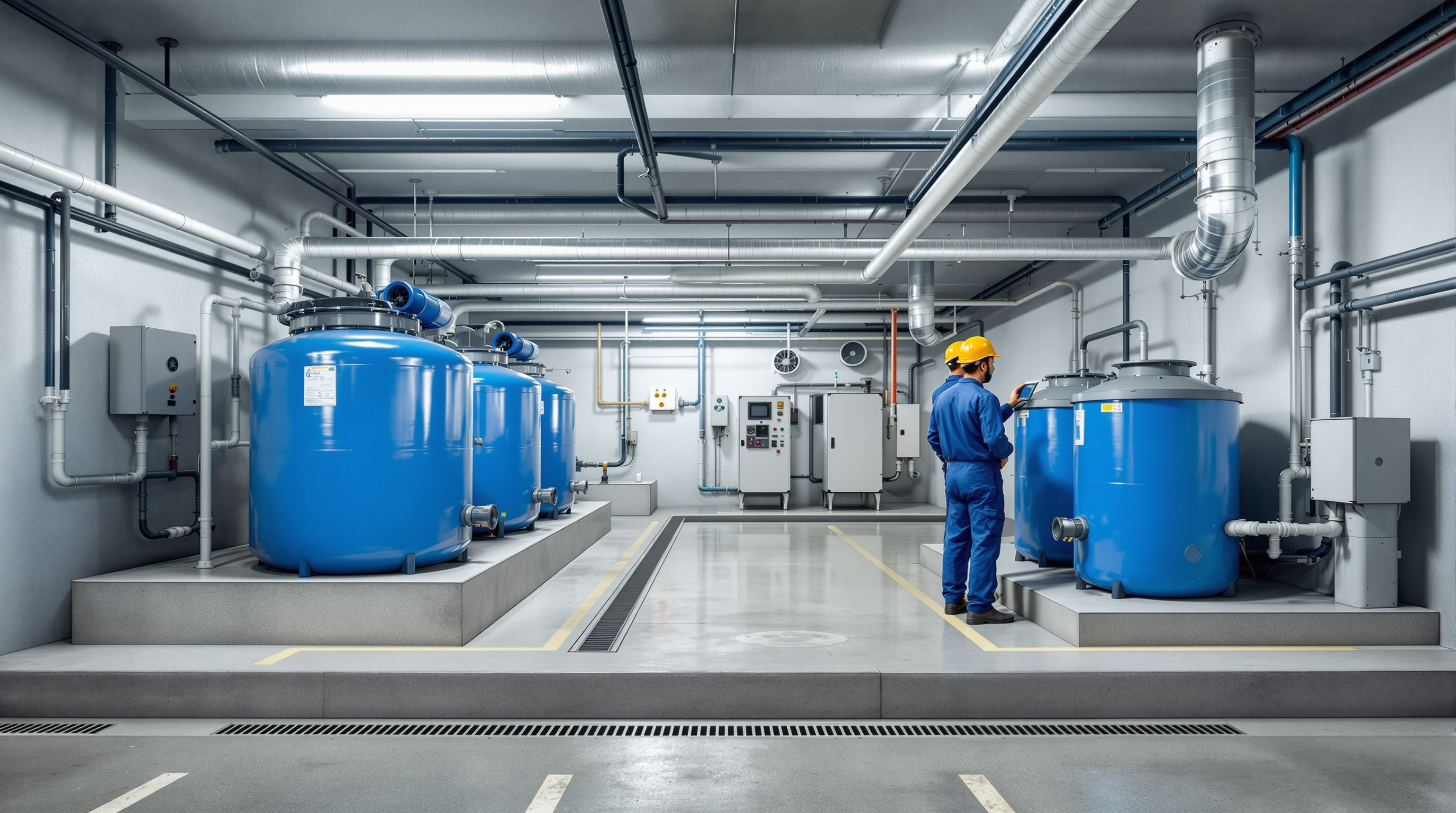
Basement / underground. The default in land-scarce cities. Tanks sit below the podium or parking level, out of sight and quiet. The costs are real: mechanical ventilation and gas detection are mandatory (sewage produces hydrogen sulphide and methane), you need pumped rather than gravity flow, and access for de-sludging and equipment replacement must be designed in, not bolted on. Odour control and acoustic isolation from flats above are recurring complaints when this is done cheaply.
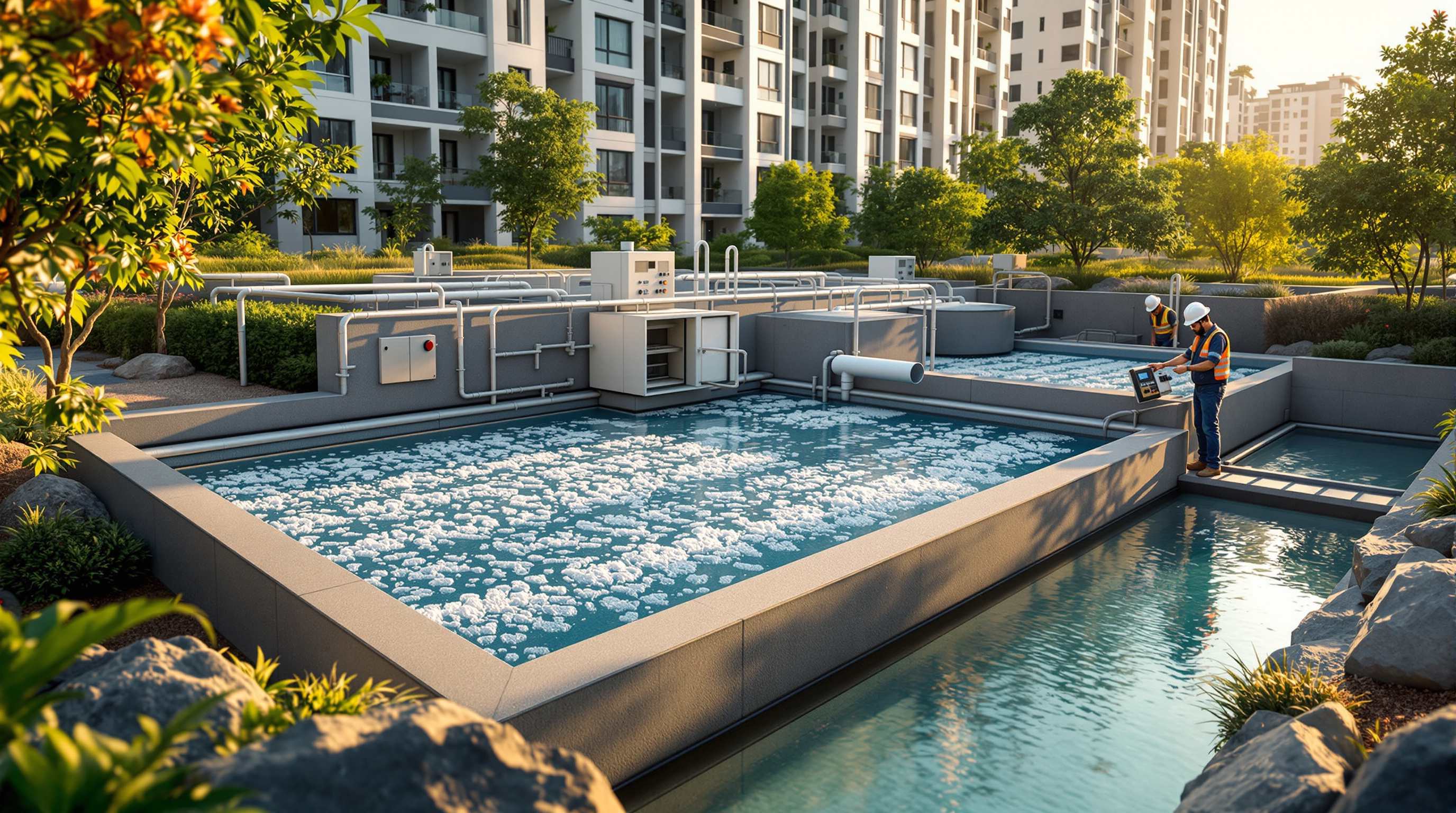
External / above-ground. Where the plot allows, a landscaped external plant is easier to ventilate, service and expand, and separates the noise and smell from homes. It costs open land and needs screening. Many well-planned layout-style projects prefer it — see STP for housing layouts.
Either way, plan the plant's location, ventilation, drainage and truck access on the first architectural drawing, not the last.
Plumbing for reuse: the dual line

The entire economic case for an apartment STP rests on reuse, and reuse only works if the building is plumbed for it. A well-run plant recovers 80–85% of the water the complex consumes. In a residential setting that treated water goes to:
- Toilet flushing — the single largest reuse, and the reason a dual-plumbing system (a separate non-potable line to every flat's cisterns) must be designed in from day one.
- Landscape and garden irrigation.
- Common-area washing — driveways, parking, vehicles.
- Groundwater recharge for the surplus.
Dual plumbing is nearly impossible to retrofit, so this is a design-stage decision, full stop. Where flushing reuse is not plumbed, associations end up discharging good treated water and buying fresh water for flushing — the worst of both worlds. The home greywater recycling and rooftop water recycling integration guides show how reuse extends beyond the STP itself.
Compliance: what the approvals actually require
STPs are a condition of occupancy, not optional paperwork. Directionally, apartment projects above a defined size must install an STP and demonstrate the treated water meets discharge and reuse standards to obtain and keep their approvals from the state pollution-control board (under CPCB's framework). Practical planning notes:
- Size threshold. Most states require on-site treatment for residential projects above a built-up or occupancy threshold — confirm the current local trigger with your consultant rather than assuming.
- Effluent standards. Treated water must meet prescribed limits (BOD, TSS, and others) for reuse and discharge; MBBR/SBR/MBR all clear these when run properly.
- Monitoring. Larger plants may need flow meters and periodic testing; keep records — associations get penalised for missing logs, not just for bad water.
Why this matters at all is covered in why every modern building needs an STP; the contrast with the old approach is in STP vs septic tank.
O&M: the part that actually fails
An apartment STP rarely fails because the design was wrong. It fails because, two years after handover, nobody is running it. The biology is alive — starve it of power, skip the de-sludging, ignore the blower, and it dies, the water turns septic, and neighbours complain of smell.
- Sign an annual O&M contract with a qualified operator from handover — do not wait for the first crisis.
- Budget for it in the monthly maintenance charge; power and operator cost are ongoing, not one-time.
- Keep the log book and test reports current for both compliance and troubleshooting.
- Never run it dry or idle — a plant sized for full occupancy but fed by a half-occupied building needs careful management so the biology stays fed.
The bottom line
Good apartment STP planning is a short, ordered chain: size it from real occupancy, choose a technology that a residential society can actually operate (usually MBBR), decide basement-versus-external before the architecture is frozen, plumb the dual line for flushing reuse, satisfy the pollution-board norms, and lock in O&M from day one. Get those six right and the plant becomes what it should be — invisible infrastructure that quietly cuts the water bill and keeps the society compliant.
Start with the numbers: run your headcount through the sewage generation calculator and the STP capacity calculator, then browse the full Sewage Treatment Plants guide library for the technology and building-type deep dives.
Export this guide
Related Guides — Deep-dive reading
STP for Hotels: High Per-Guest Loads, FOG & Water Reuse Explained
Why hotel wastewater is heavier and swingier than an apartment's, which STP technology (MBBR vs MBR) actually fits, how to size for peak occupancy, and where the treated water pays for itself — in laundry, cooling and landscape.
Sewage Treatment PlantsSTP for High-Rise Buildings: Solving the Vertical Challenges
Why an STP in a tower is a different animal from one in a low-rise block — sharp peak flows, a basement site starved of air and light, treated water that has to be pumped forty floors up, and odour and fire clearances that decide whether the plant gets signed off at all.
Sewage Treatment PlantsSTP for Villas: Do You Need One, and Which Type Fits a Single Home?
When an individual villa actually needs a sewage treatment plant instead of a septic tank, the tiny capacities involved, and how to choose a compact MBBR or extended-aeration package that fits the plot, the budget and the garden.
Sewage Treatment PlantsRelated Tools — Try Free
Rainwater Tank Sizer
How big should your rainwater tank be? Computes annual harvest, recommended tank capacity in litres, water-bill savings, and payback — for 10 Indian cities.
RWH CalculatorLandscape Cost Calculator
Estimate a garden's cost — hardscape, softscape, lawn, irrigation, lighting and annual upkeep — by area, tier and city.
Budget CalculatorSewage Generation Calculator
Estimate the daily sewage a building generates and its peak flow in KLD from occupancy, LPCD, sewage return factor and peak factor.
STP Calculator