
Activated Sludge Process (ASP): How It Works, Pros & Cons
The classic suspended-growth biological treatment behind most large sewage plants — how microbial floc forms and settles, the control parameters that keep it alive (MLSS, F/M, SRT, DO), where ASP fits, and how it stacks up against MBBR, SBR and MBR.
If you point at the biological heart of almost any large sewage treatment plant in the world and ask what technology it uses, the answer is more often than not the same one: the activated sludge process. Invented in England in 1914 and refined for over a century since, it remains the workhorse of municipal and large-building wastewater treatment. When engineers talk about the "conventional" way to treat sewage, this is what they mean.
This guide explains the activated sludge process the way a designer or plant operator actually thinks about it — not just the tanks, but the living culture inside them and the handful of numbers that keep that culture alive and settling. If you are new to sewage treatment altogether, start with what a sewage treatment plant is and how an STP works first; this guide zooms into the secondary-treatment stage those articles describe.
The activated sludge process does something quietly remarkable: it grows a dense city of bacteria, lets them eat the pollution in your sewage, then persuades them to clump together and sink so the clean water can be poured off the top. Master the settling, and you have mastered the process.
What "activated sludge" actually means
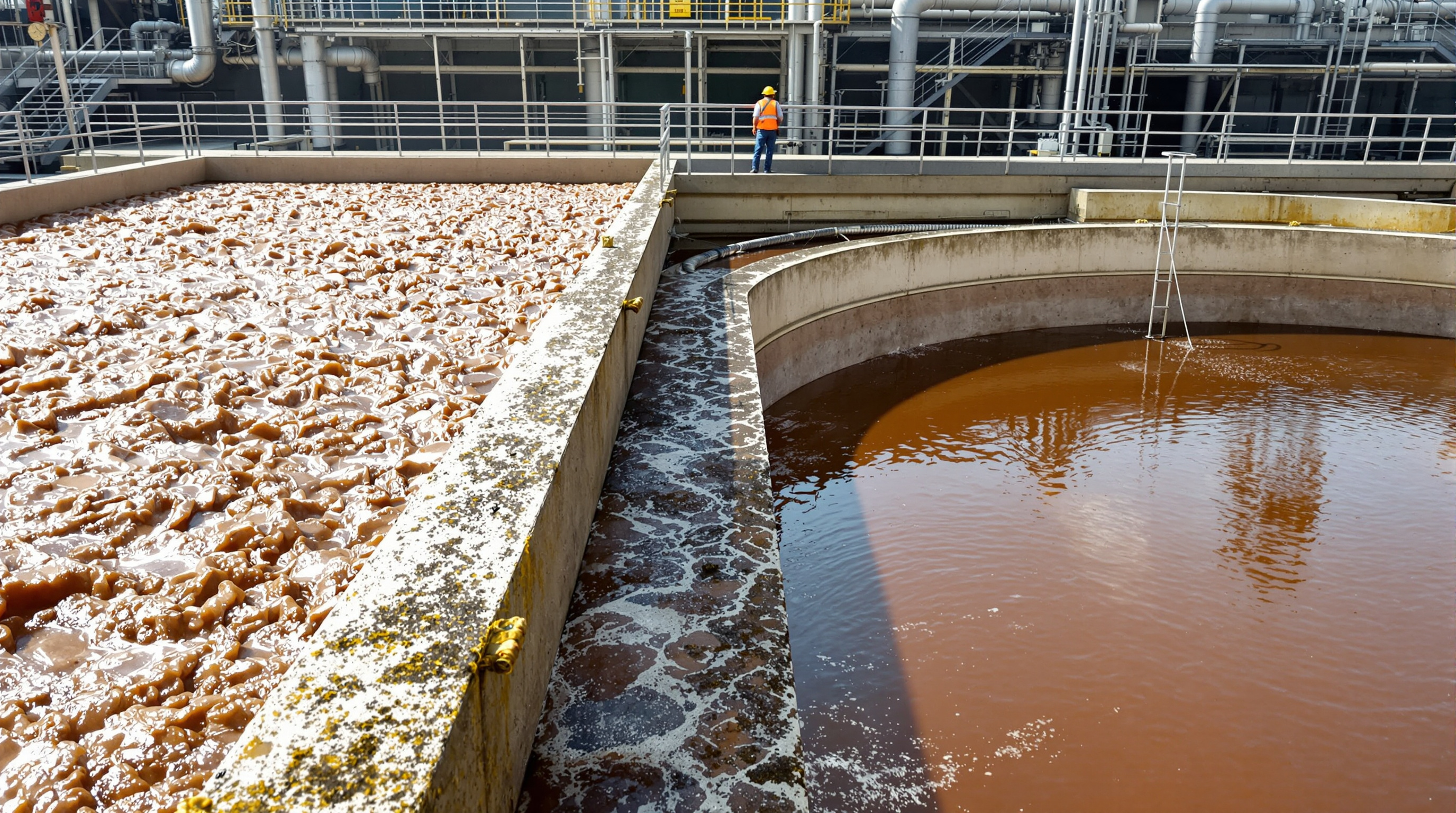
The name is oddly poetic once you unpack it. Sludge here is not waste — it is the thick, brown, living mass of microorganisms that does the cleaning. It is called activated because it is kept biologically active: continuously fed with incoming sewage and continuously supplied with oxygen, so the bacteria stay in a hungry, fast-growing state.
The activated sludge process belongs to a family engineers call suspended-growth systems: the microbes float freely, suspended throughout the water as tiny clusters, rather than growing as a film on fixed media (that is the rival attached-growth approach used by MBBR and RBC systems). Those free-floating clusters are the single most important object in the whole process. They are called floc.
How it works: the aeration tank and the clarifier
Strip away the branding and every activated sludge plant is built from just two tanks working as a pair, plus a recycle line that connects them.
The aeration tank — where the eating happens
Screened, equalised sewage enters a large aeration tank (also called the biological reactor). Here it mixes with the returning activated sludge, so the water is instantly seeded with billions of hungry bacteria. Blowers push air — and therefore oxygen — through diffusers on the tank floor, filling the water with fine bubbles. That oxygen does two jobs at once: it feeds the aerobic bacteria, and it keeps the whole mixture stirred so no floc settles prematurely.
Inside this churning brown soup, the bacteria absorb the dissolved and suspended organic pollution as food. They use it to breathe and to reproduce, converting BOD into more bacterial cells, carbon dioxide and water. In a well-run tank, the sewage's BOD, COD and TSS fall dramatically in a matter of hours. The individual bacteria also secrete sticky substances that make them clump together into that all-important floc.
The secondary clarifier — where the settling happens
The mixed liquor then flows gently into the secondary clarifier (a settling tank). Calm at last, with no more aeration to keep it suspended, the heavy floc sinks slowly to the bottom, leaving genuinely clear water above it. That clear water spills over the weirs at the top as treated effluent, bound for tertiary polishing — filtration and disinfection — before reuse.
The settled sludge at the bottom is the treasure. And here is the clever loop that gives the process its name and its power.
RAS and WAS — the two sludge streams
The floc that collects at the bottom of the clarifier is pumped out and split two ways:
- Return Activated Sludge (RAS) — the majority is pumped straight back to the head of the aeration tank. This is the recycle that keeps the population dense: instead of growing bacteria from scratch, the plant continuously re-seeds itself with a mature, hungry culture. RAS is why an activated sludge plant works so much faster than a river.
- Waste Activated Sludge (WAS) — because the bacteria keep multiplying, the population would grow without limit if you recycled all of it. So a controlled fraction is deliberately wasted — removed from the system and sent to sludge handling (thickening, dewatering, and often anaerobic digestion that can yield biogas). Wasting is not a failure; it is the deliberate lever operators use to control the age and health of the culture.
That is the entire process in one sentence: aerate to feed and grow the microbes, settle to separate them, return most of them to keep the culture strong, and waste the surplus to keep it balanced.
The control parameters that keep it alive
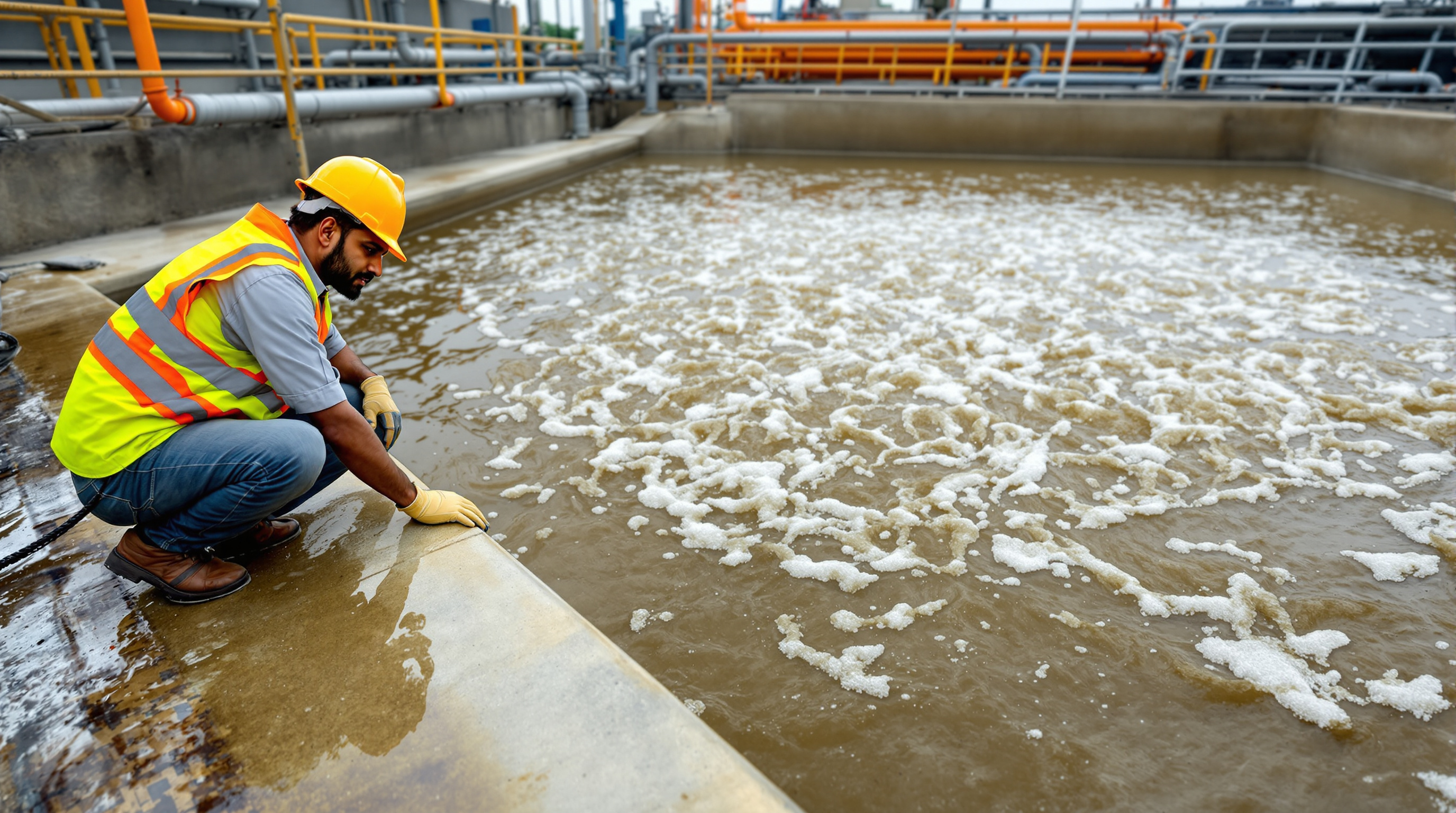
An activated sludge plant is a living system, and running it well means keeping four numbers in their comfortable ranges. This is what separates a plant that produces clear water from one that spills murky, foaming effluent.
| Parameter | What it is | Why it matters |
|---|---|---|
| MLSS (Mixed Liquor Suspended Solids) | The concentration of floc in the aeration tank, in mg/L (typically ~2,500–4,000 for conventional ASP) | Too low and there are too few microbes to do the work; too high and the clarifier cannot settle it all |
| F/M ratio (Food-to-Microorganism) | How much incoming BOD is fed per unit of microbe mass | The appetite balance. Too high starves the tank of microbes; too low over-starves the bugs and worsens settling |
| SRT (Sludge Retention Time / sludge age) | The average number of days a microbe stays in the system before being wasted | The master control. Sets which species dominate; longer SRT gives cleaner water and stabler sludge |
| DO (Dissolved Oxygen) | Oxygen available in the aeration tank, usually held around 1.5–2.0 mg/L | Too little and the good aerobic bugs suffocate; too much wastes electricity and can break up floc |
Two failure modes haunt every operator. Bulking is when filamentous bacteria take over and the floc refuses to settle, drifting over the clarifier weir into the effluent. Foaming is a thick brown scum on the tank surface. Both are usually traced back to these four numbers drifting out of range — which is why activated sludge plants demand competent, attentive operation more than most alternatives.
Variants of the process
"Activated sludge" is a family, not a single design. The main variants trade footprint, power and simplicity against each other:
- Conventional ASP — the classic plug-flow layout described above, suited to large, steady flows.
- Extended aeration — a very long aeration time and long SRT that produces a stable, low-volume sludge and tolerates flow swings. Popular for Indian apartment and campus STPs because it is forgiving to operate, at the cost of a bigger tank and higher power.
- Sequencing Batch Reactor (SBR) — the same biology, but fill, aerate, settle and decant all happen in one tank on a timed cycle, so no separate clarifier or RAS pumping is needed.
- Oxidation ditch — a looped channel where the mixed liquor is circulated by surface aerators; a robust, low-maintenance extended-aeration variant.
Where the activated sludge process suits
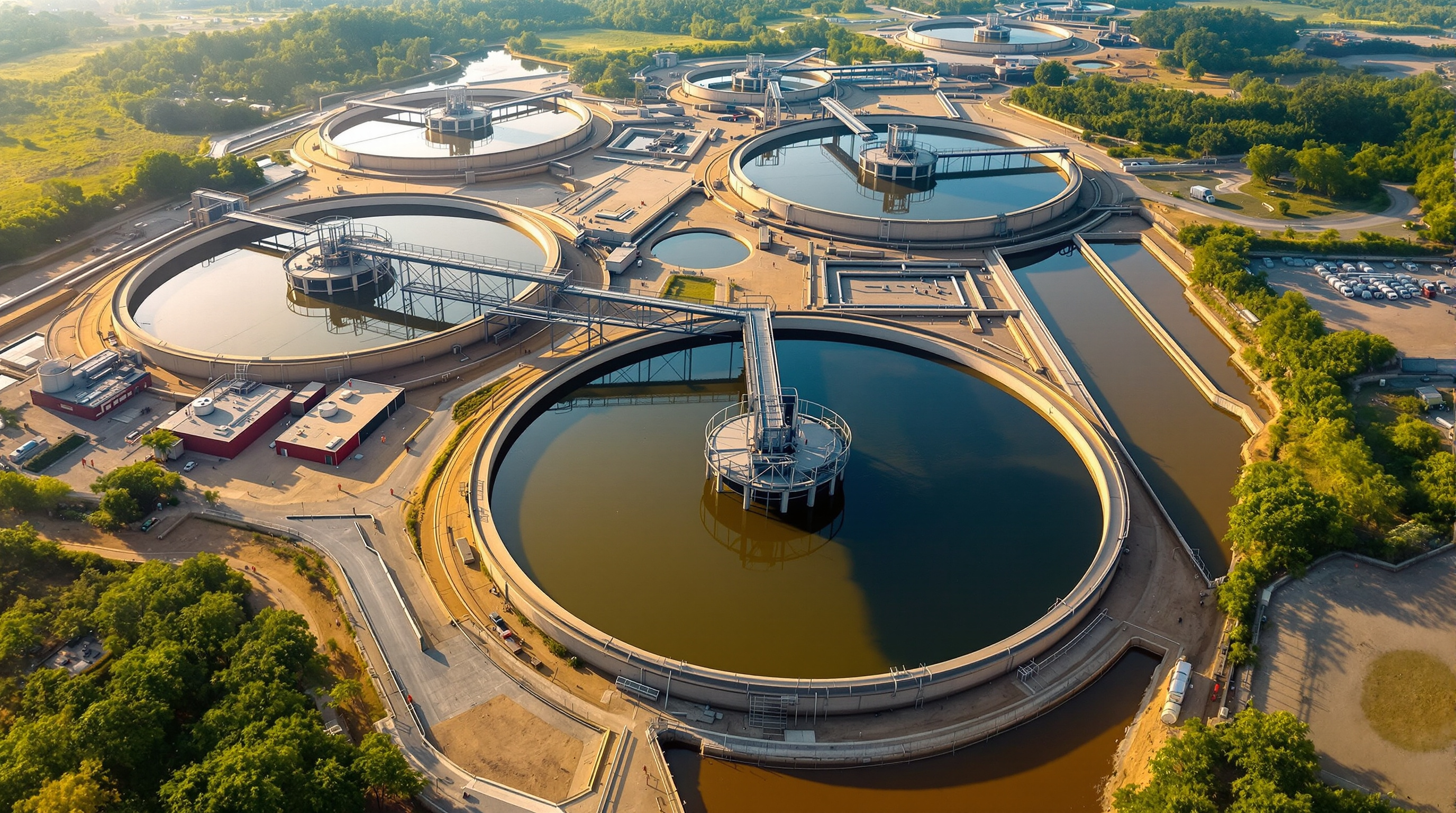
The activated sludge process shines at scale. Its strengths and weaknesses are worth stating plainly.
| Pros | Cons |
|---|---|
| Proven over a century; the most understood process in the world | Large footprint — needs a big aeration tank plus a separate clarifier |
| Excellent, reliable BOD and TSS removal | High power demand for continuous aeration (the biggest running cost) |
| Scales beautifully to very large flows (MLD-scale municipal plants) | Sensitive to shock loads and needs skilled, attentive operation |
| Relatively low capital cost per litre at large scale | Produces a large volume of sludge that must be handled and disposed |
| Sludge can feed anaerobic digestion and generate biogas | Prone to bulking and foaming if control parameters slip |
In practice, ASP is the natural choice for large, relatively steady flows — municipal sewage plants, large townships, and big institutional campuses running into the MLD range — where its footprint is affordable and skilled operators are on site. For a smaller building squeezed for space, the calculus often shifts to a more compact technology. To see roughly what capacity your own project needs before choosing a technology, the STP Capacity Calculator turns a headcount into a design flow in KLD, and the Sewage Generation Calculator estimates the daily load feeding it.
How ASP compares to MBBR, SBR and MBR
Every modern alternative is, in a sense, an answer to one of ASP's weaknesses:
- MBBR attacks the footprint problem. By growing bacteria as a biofilm on floating plastic carriers, it packs far more microbes into a smaller tank and eliminates the RAS recycle — no sludge return to manage. It is a common choice for space-tight Indian building STPs.
- SBR attacks the clarifier problem. It does everything in one tank on a timed cycle, saving the separate settling tank and RAS pumps, and handles variable flows gracefully — at the cost of more sophisticated automation.
- MBR attacks the effluent-quality problem. It replaces the clarifier entirely with ultrafiltration membranes, so settling is never the bottleneck. The result is superb, near-reuse-grade water in a very small footprint — but at the highest capital and power cost, with membranes to clean and replace.
None of these has retired the activated sludge process. For very large flows with land available and skilled operation on hand, plain ASP remains the most economical, best-understood answer in wastewater engineering — which is exactly why, a hundred years on, it still treats more of the world's sewage than anything else.
The bottom line
The activated sludge process is the biological engine at the centre of conventional sewage treatment: an aeration tank that grows and feeds a dense floating culture of microbes, a clarifier that settles them out, and a recycle loop (RAS) that keeps the culture strong while wasting (WAS) keeps it balanced. Run its four vital signs — MLSS, F/M, SRT and DO — within range and it delivers clear, low-BOD water reliably and at scale. Let them drift and it bulks or foams. It is not the most compact or the most hands-off technology, but for large, steady flows it remains the benchmark every other process is measured against.
To place ASP in the wider map of treatment technologies, browse the Sewage Treatment Plants guide library, or brush up on the vocabulary with the complete STP terminology guide.
Export this guide
Related Guides — Deep-dive reading
Biological Culture Management in an STP: The Heart of Good O&M
The microbes in your aeration tank do the actual work of cleaning sewage. Keep them healthy — the right MLSS, food, oxygen and nutrients — and everything else falls into place. Here is how operators manage the living culture, diagnose bulking and foaming, and recover after a crash.
Sewage Treatment PlantsAeration Tank: The Biological Heart of an STP
The tank where blowers push oxygen into billions of microbes that eat the sewage's organic load — how it works, what DO, MLSS, F/M and HRT mean, and why it quietly runs up the biggest electricity bill in the plant.
Sewage Treatment PlantsMoving Bed Biofilm Reactor (MBBR): Media, Working & Benefits
The most popular STP technology in Indian apartments, explained: how thousands of free-floating plastic carriers grow a living biofilm, why that packs high treatment into a small tank, what the media fill ratio means, and how MBBR compares to ASP and MBR.
Sewage Treatment PlantsRelated Tools — Try Free
Apartment STP Planner
Plan an apartment complex sewage treatment plant from flats and occupancy — get population load, sewage flow, recommended STP capacity in KLD, treatment technology and approximate space.
PlannerSewage Generation Calculator
Estimate the daily sewage a building generates and its peak flow in KLD from occupancy, LPCD, sewage return factor and peak factor.
STP CalculatorSTP Technology Selector
Weight your priorities — footprint, effluent quality, cost, power and simplicity — and get a scored recommendation between Extended Aeration, MBBR, SBR and MBR.
Selector