
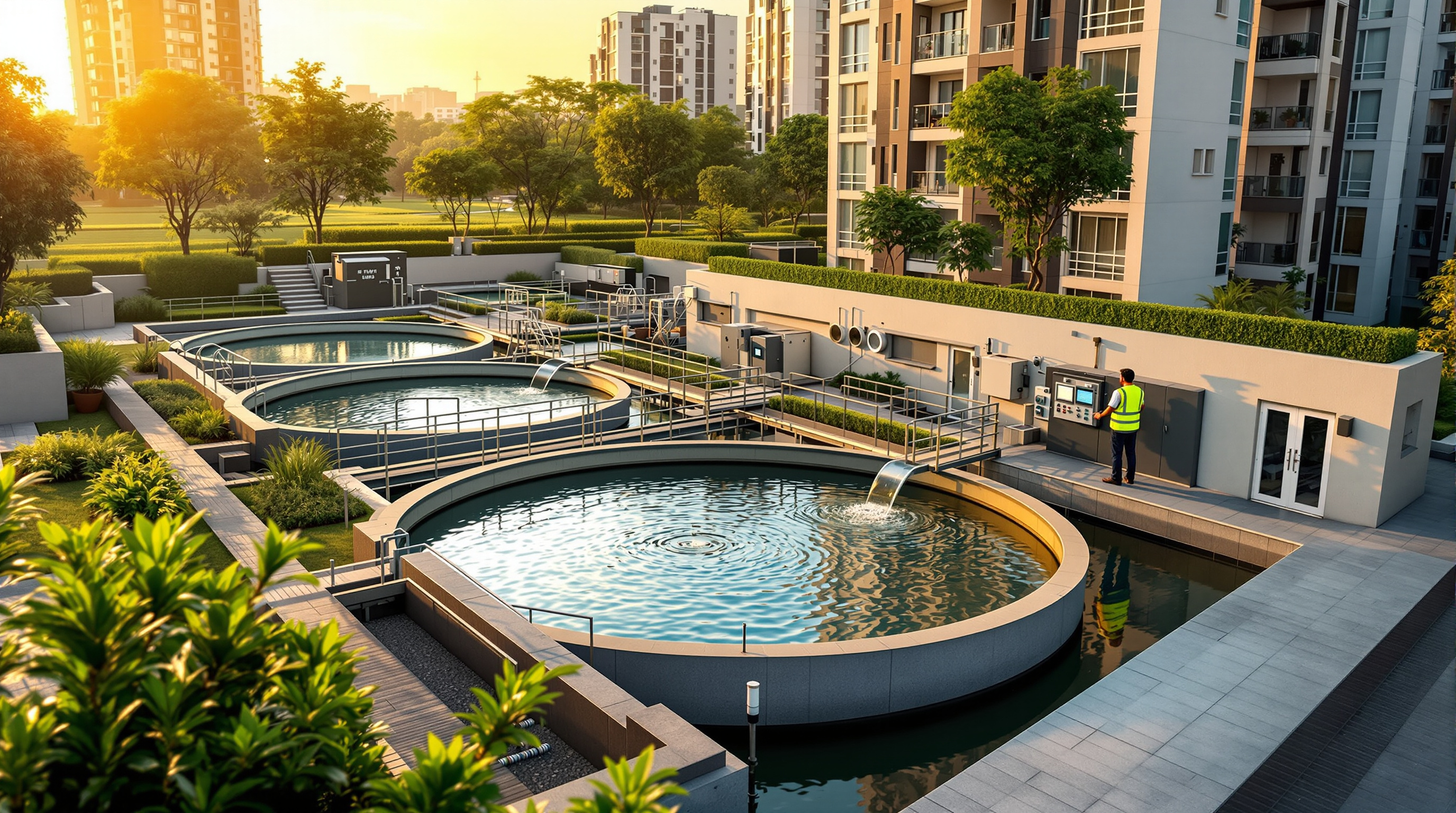
Why Every Modern Building Needs an STP: The Legal, Water & Money Case
Why buildings need an STP is no longer an open question in urban India — it is a condition of occupancy, a water-security strategy, and a public-health duty rolled into one. Here is the full case, in plain language.
Ask a builder in 2015 why their project had a sewage treatment plant and the honest answer was often "because the file wouldn't move without it." A decade later that grudging box-tick has quietly become one of the smartest pieces of infrastructure a building owns. The rules that made STPs compulsory have hardened — but so has the business case. A well-run STP now pays for itself in water it never has to buy, protects a property's approvals and resale value, and keeps the building on the right side of a pollution regime that has real teeth.
This guide lays out the full case for on-site sewage treatment: why the law now insists on it, why your water bill quietly begs for it, and why the environment and your own asset value are on the same side of the argument. If you are still learning the basics, start with what a sewage treatment plant actually is; this piece is about why the machine has become non-negotiable.
An STP used to be treated as a cost of getting permission. Today it is closer to a small water utility that a building owns — one that turns a monthly liability into a monthly asset.
The short answer, in four words
Legal. Water. Environment. Money. Those are the four forces pushing every serious building in urban India toward its own STP, and they reinforce each other. Here is the case at a glance before we take each one apart.
| Driver | What it means for the building | Why it is no longer optional |
|---|---|---|
| Legal / regulatory | On-site treatment is a condition of occupancy and operation for most medium and large developments | Pollution-control boards tie your occupancy and consent approvals to a working STP meeting discharge norms |
| Water security | 80–85% of the water the building consumes is recovered and reused | Freshwater is rationed, tankered and rising in price; reuse cuts demand at source |
| Environment / public health | Sewage is cleaned before it can reach drains, lakes and groundwater | Untreated sewage is the largest source of urban water pollution in India |
| Cost / asset value | Lower water bills, lower tanker dependence, a compliant, future-proof asset | A non-compliant building faces fines, sealing risk and a discount at resale |
1. The legal mandate: it is a condition of occupancy
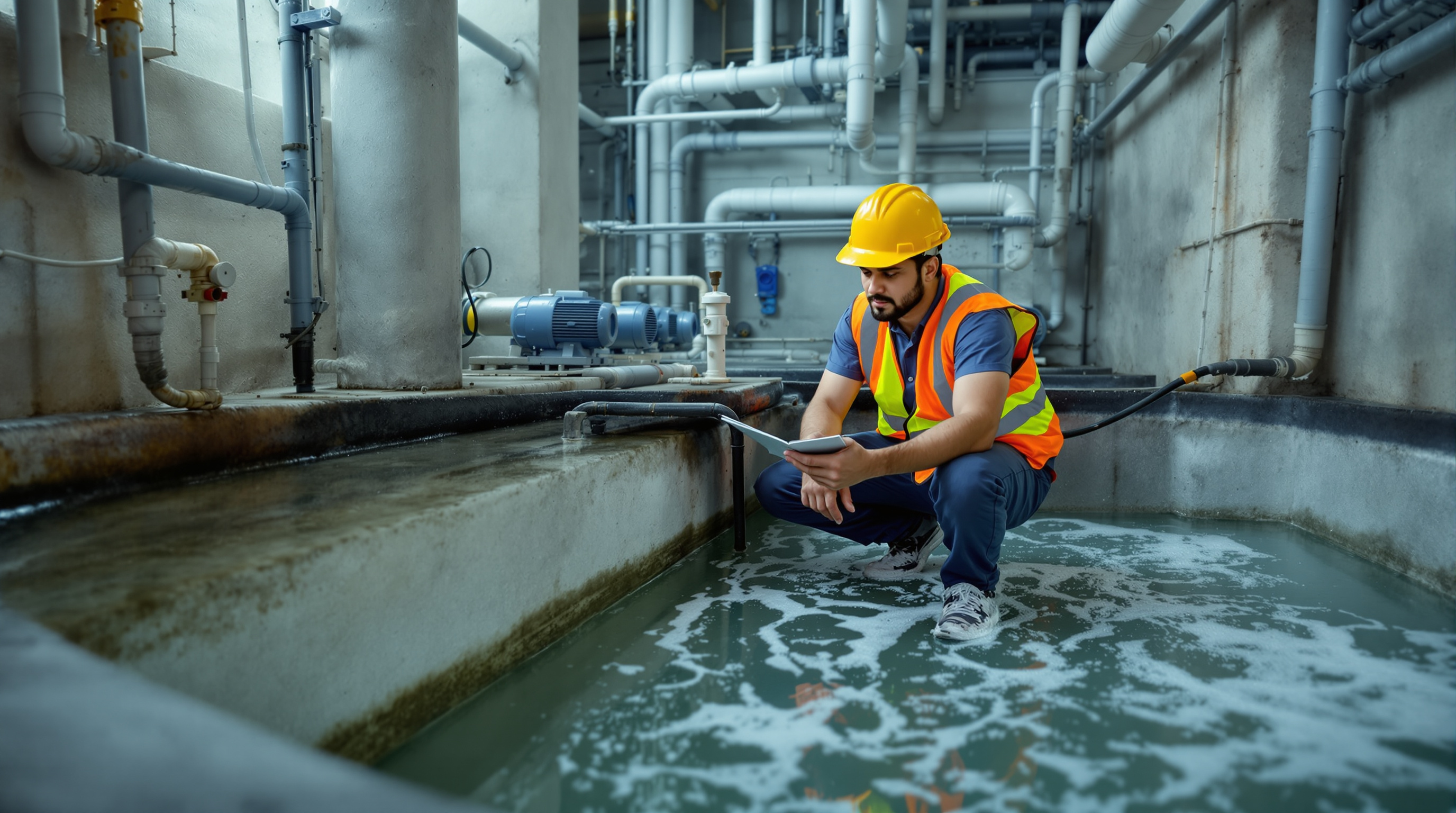
This is the driver that ends most arguments. India's environmental framework — administered through the Central Pollution Control Board (CPCB) and the State Pollution Control Boards, and reinforced by the National Building Code and local building bye-laws — now treats on-site sewage treatment as standard infrastructure for medium and large buildings, not an optional green upgrade.
The practical mechanics matter more than the exact clause numbers:
- Apartment and township projects above a certain size threshold are generally required to install an STP as a condition of environmental clearance and the occupancy certificate.
- Commercial, institutional and hospitality buildings — offices, malls, hotels, hospitals, IT parks — are expected to treat their own sewage and demonstrate that the treated water meets prescribed discharge or reuse standards.
- Consent to Operate from the state board is typically contingent on the plant being not just built, but running and meeting outlet norms on parameters like BOD, COD and TSS.
In other words, the STP is no longer paperwork you file once. It is a live compliance obligation. A plant that exists on the drawing but sits idle in the basement is, from the regulator's point of view, roughly as good as no plant at all — and buildings have been penalised and even sealed on exactly that basis. (For the specific numbers your building must hit, the wastewater characteristics guide explains BOD, COD, TSS and pH in plain terms.)
The direction of travel is one-way. Thresholds have tightened, monitoring has moved toward online sensors, and enforcement has grown less forgiving. Designing an STP in from day one is dramatically cheaper than retrofitting one into a finished building under a compliance notice.
2. Water security: the 80–85% you stop buying
Here is the number that turns the STP from a cost into an investment. A typical domestic STP recovers 80–85% of the water a building consumes and hands it back as treated water fit for non-potable uses. Every one of those litres is a litre you do not have to buy.
Think about where a building's water actually goes. A large share of daily demand is not drinking or cooking — it is flushing, gardening, cooling and cleaning, none of which need fresh municipal water. Treated STP water covers all of them:
- Toilet flushing, piped back up a dedicated dual-plumbing line — usually the single biggest reuse.
- Landscape and garden irrigation, including large podium gardens and lawns.
- Cooling-tower make-up water in air-conditioned commercial buildings, a heavy and continuous demand.
- Common-area, driveway and vehicle washing.
- Groundwater recharge of the aquifer beneath the site.
In an Indian city where freshwater arrives partly by tanker at a price that spikes every summer, this reuse is money. For a large complex, recovered water can run into lakhs of litres a month — demand that would otherwise show up as tanker invoices and rising municipal charges. To size the opportunity for your own project, the sewage generation calculator estimates how much wastewater a given occupancy produces, and the STP capacity calculator turns that into a plant size in litres per day.
There is a second-order benefit too: a building that meets most of its non-potable demand internally is insulated from the next water crisis. When the municipal supply is cut or a borewell runs dry, the STP keeps the gardens green and the toilets flushing. That is water security, and it is increasingly a selling point rather than an afterthought.
3. Environment and public health: the duty you cannot outsource

For most of the twentieth century a building's sewage was somebody else's problem — it vanished into a municipal sewer. The uncomfortable truth is that in much of urban India, "the sewer" often meant the nearest drain, lake or river, barely treated or not at all. Untreated domestic sewage is the single largest source of water pollution in urban India, and its consequences are not abstract: contaminated lakes, foaming rivers, polluted groundwater and the waterborne disease that follows.
An on-site STP breaks that chain at the source. Instead of exporting the problem downstream, the building takes responsibility for the waste it creates and returns clean water to the environment. This is the core logic of decentralized wastewater treatment — treat the sewage where it is produced, rather than trusting an overloaded central system that may not exist or may not cope.
The public-health dividend is direct. A building whose sewage is properly treated is not seeding the neighbourhood's borewells with pathogens, not feeding the algae blooms that kill the local lake, and not contributing to the mosquito-breeding, foul-smelling drains that make dense neighbourhoods unliveable. In a country urbanising as fast as India, that collective responsibility scales into something that genuinely determines whether cities remain habitable.
4. Cost and asset value: the case even a sceptic accepts
Strip away the idealism and the STP still wins on the balance sheet. The recurring savings are real: lower municipal water charges, reduced or eliminated tanker purchases, and — where local rules reward reuse — a lighter effective load. Against that sit the running costs (power for blowers, chemicals, sludge disposal and an operator), which a competently designed and maintained plant keeps modest relative to what it saves.
But the larger financial argument is about the asset itself:
- Approvals and saleability. A building with a compliant, working STP holds a clean occupancy certificate and consent to operate. A non-compliant one carries a latent liability — fines, retrofit costs, even sealing risk — that a serious buyer or auditor will price in as a discount.
- Future-proofing. Norms only tighten. A plant sized and specified with headroom today avoids an expensive, disruptive upgrade tomorrow.
- Reputation and tenancy. Corporate tenants, hotel chains and hospitals increasingly demand demonstrable environmental compliance from the buildings they occupy. An STP is table stakes for that conversation.
None of this requires believing in green idealism. It requires believing in avoided costs, protected approvals and preserved resale value — and on all three, the STP earns its footprint in the basement.
So which building needs one — and what kind?
Almost every medium and large building in urban India now falls inside the mandate: apartment complexes above the threshold, and effectively all commercial, institutional and hospitality developments. A standalone bungalow may still rely on a septic tank, and an industrial unit with chemical effluent needs an ETP rather than an STP — but for the mainstream of modern construction, the STP is now standard equipment.
The remaining questions are how big and which technology — extended aeration, MBBR, SBR, MBR and others each suit different footprints, budgets and reuse targets. Those choices are the subject of the rest of this series.
The bottom line
Why does every modern building need an STP? Because four independent arguments all point the same way. The law makes it a condition of opening your doors. Water scarcity makes the 80–85% it recovers too valuable to throw away. The environment and public health make treating your own sewage a duty you can no longer outsource downstream. And the economics — lower bills, protected approvals, preserved value — make it pay. An STP stopped being a reluctant compliance cost and became what it always should have been: a small, quiet, water utility that your building owns.
From here, learn how an STP actually works stage by stage, or browse the full Sewage Treatment Plants guide library — and when you are ready to size a plant for your own project, the STP Capacity Calculator turns your headcount into a treatment capacity in litres per day in about a minute.
Export this guide
Related Guides — Deep-dive reading
MoEFCC Rules Affecting STPs: How the EIA Notification 2006 Brings Sewage Treatment Into the Approval Net
The Ministry of Environment's EIA Notification 2006 is the law that decides whether your building needs environmental clearance at all — and it makes a working STP a condition of getting it. Here is how the thresholds, the clearance process and the contested discharge standards actually fit together.
Sewage Treatment PlantsBuilding Bye-laws for STPs in India: What Your Occupancy Certificate Depends On
How municipal building bye-laws and India's Model Building Bye-Laws / NBC turn an on-site sewage treatment plant, dual plumbing and treated-water reuse into a legal condition for occupying a building above a plot or built-up-area threshold.
Sewage Treatment PlantsCPCB Guidelines for STPs Explained: Discharge Standards & the 2017/2019 History
What the Central Pollution Control Board actually prescribes for sewage treatment plants — the effluent parameters, the contested 2015–2017–2019 notification history, the NGT interventions, and which numbers your plant is really held to today.
Sewage Treatment PlantsRelated Tools — Try Free
Landscape Cost Calculator
Estimate a garden's cost — hardscape, softscape, lawn, irrigation, lighting and annual upkeep — by area, tier and city.
Budget CalculatorSTP Technology Selector
Weight your priorities — footprint, effluent quality, cost, power and simplicity — and get a scored recommendation between Extended Aeration, MBBR, SBR and MBR.
SelectorStamp Duty Calculator — All Indian States
Stamp duty + registration charges for all 28 states and 8 UTs — gender concessions, urban/rural variants, metro cess built in.
Stamp Duty