
How Does an STP Work? A Step-by-Step Explanation
Follow a single drop of sewage from the building drain to reusable water — through screening, settling, the living microbial heart of the plant, and final polishing — with every stage explained in plain language and no engineering background assumed.
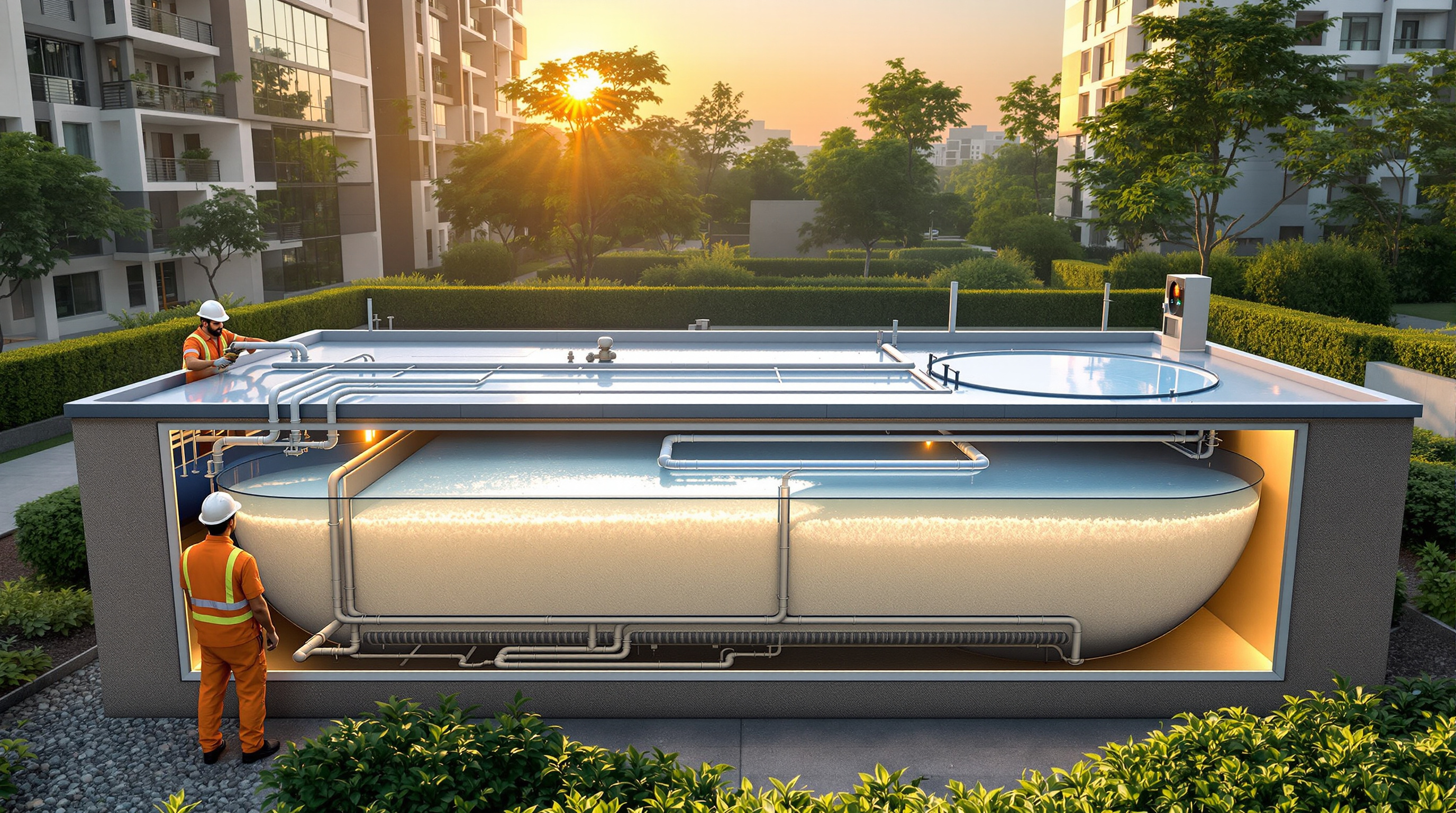
Pull the flush in a modern apartment and the water that leaves the bowl begins a short, remarkable journey. In an hour or two it will pass through screens, tanks, blowers and filters, be eaten by billions of microbes, settled, filtered and disinfected — and emerge clear enough to flush that same toilet again. The machine that pulls off this trick is the Sewage Treatment Plant, or STP, usually tucked into a basement or a corner of the plot.
This guide answers one question directly: how does an STP work? We will follow a single drop of sewage the whole way through, stage by stage, and at each step explain not just what happens but why that stage exists and what it removes. If you have not yet met the basics, the pillar guide What is a Sewage Treatment Plant? is the gentler starting point; this one goes deeper into the process itself.
An STP is really a race against rot. Left alone, sewage would clean itself in a river over many kilometres and several days. The STP compresses that same natural process — screening, settling, microbes, sunlight — into a few hours inside a handful of tanks.
The big picture: two lines, one plant
Before the drop-by-drop tour, hold one idea in your head. An STP runs two parallel lines at once:
- The water line — the main journey, where dirty water is progressively cleaned until it is reusable.
- The sludge line — the side journey, where all the solids pulled out of the water are collected, thickened and dried for disposal.
Everything the water line removes has to go somewhere — and that somewhere is the sludge line. Keep both in mind and the plant stops looking like a maze of tanks and starts looking like a sensible assembly line.
The water line has four stages, always in the same order: preliminary, primary, secondary, tertiary. Each hands the water to the next, a little cleaner each time. For a fuller map of how these connect, the companion guide Sewage Treatment Process Flow lays out the whole diagram.
Stage 1 — Preliminary treatment: catch the junk
Our drop arrives from the building's drains carrying company it picked up on the way: hair, rags, sanitary waste, plastic wrappers, grit washed off floors, and a slick of oil and grease from kitchen sinks. None of this can be allowed near the delicate machinery downstream, so preliminary treatment is pure defence.
- Bar screen. The sewage first flows through a grille of closely spaced metal bars. Rags, plastics and large solids are caught and raked out. Skip this and pumps clog and impellers jam within days.
- Grit chamber. The flow slows just enough for heavy inorganic grit — sand, silt, coffee-ground-sized particles — to settle out. Grit is abrasive; left in, it grinds away pumps and pipes like sandpaper.
- Oil and grease trap. Fats float, so a baffled chamber skims the greasy layer off the top. Grease is the enemy of the microbes further along — it coats them and starves them of oxygen.
- Equalisation tank. Finally the sewage collects in a large buffer tank. Real buildings produce sewage in surges — a flood at 7 a.m. when everyone showers, a trickle at 3 a.m. The equalisation tank stores the peaks and releases a steady, even flow to the rest of the plant, which can only work well at a calm, constant pace. A gentle mixer keeps solids from settling here too early.
Notice that nothing is truly "cleaned" yet. Preliminary treatment removes the junk that would wreck the plant, and it smooths the flow — but the water leaving this stage is still foul. Its job is to protect the stages that do the real work.
Stage 2 — Primary treatment: let gravity do the first cleaning
Now the evened-out sewage sits still, and physics takes over. In a quiet primary settling tank, with no turbulence to keep them suspended, the heavier solids sink slowly to the bottom as a soft layer of primary sludge, while lighter scum floats to the top to be skimmed.
This single, free step — just gravity and patience — removes a large share of the suspended solids and a useful chunk of the organic load before any energy is spent. What sinks is scraped to the sludge line; what floats is skimmed off; the partly cleared water flows on.
Many compact packaged STPs in Indian apartments quietly fold this stage into the equalisation or aeration tank rather than giving it a dedicated vessel — but the principle is always present somewhere: let the easy solids drop out by gravity before you ask the microbes to do the hard part.
Stage 3 — Secondary treatment: the microbes eat
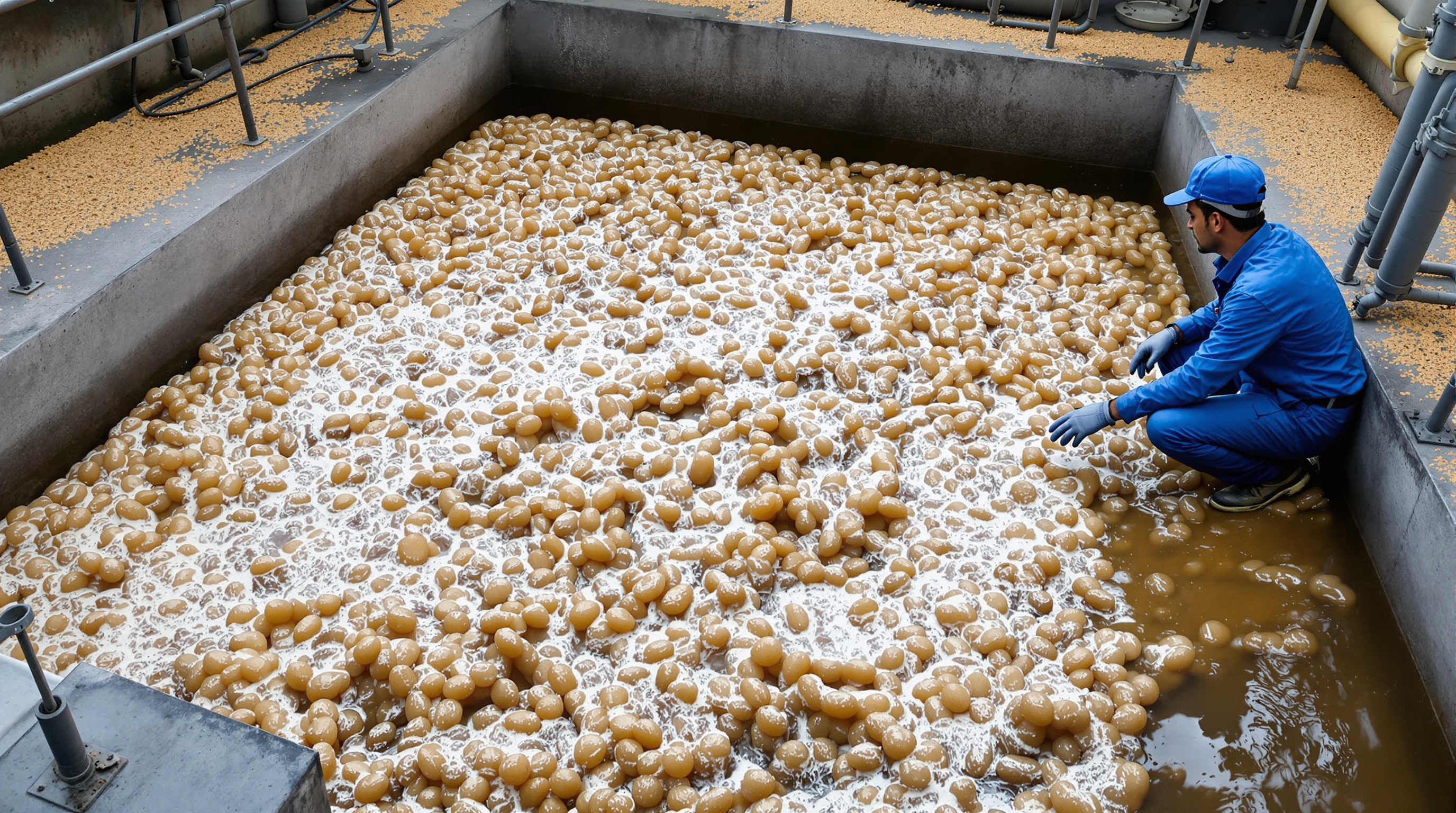
This is the living heart of the plant, and where most of the pollution is actually destroyed. Everything before it was preparation.
Our drop now enters the aeration tank, and the scene changes completely. Air blowers pump a constant stream of fine bubbles up through the water, so it churns and froths. That oxygen feeds an enormous, invisible population of bacteria and other microbes — engineers call it the biological culture or "mixed liquor." These microbes treat the dissolved organic waste in the sewage as food: they eat it, grow, and multiply. This is exactly what happens in a healthy river, only here it is concentrated, warmed by its own activity, and supercharged with oxygen so it runs many times faster.
Why the relentless air? Because these are aerobic microbes — they need oxygen to eat cleanly and without stink. Starve them of air and the tank turns septic and foul. The blowers running day and night are, in effect, the lungs of the plant, and usually its single biggest electricity bill.
After the microbes have feasted, the water — now full of well-fed, clumped-together microbes — flows into a secondary clarifier, a calm circular settling tank. Here the microbe clumps (biological sludge) settle to the bottom, leaving genuinely clear water on top for the first time. A clever twist: much of that settled sludge is pumped back into the aeration tank to keep the microbe population strong — this returned biomass is why the classic version is called the Activated Sludge Process. The surplus is sent to the sludge line.
This oxygen-and-microbes principle underlies almost every STP technology you will hear named — Activated Sludge (ASP), MBBR, SBR, MBR. They differ in how they hold and settle the microbes, but the core deal is identical: feed the bugs oxygen, let them eat the waste, then separate them from the water.
Stage 4 — Tertiary treatment: polish and disinfect
The water leaving secondary treatment looks clean, but it is not yet safe to reuse. It still carries fine haze, faint colour or odour, and — crucially — living pathogens. Tertiary treatment is the final polish.
- Filtration. The water is pushed through a pressure sand filter to trap the last fine suspended particles, then an activated carbon filter that adsorbs residual colour, odour and dissolved organics. What emerges is visibly sparkling.
- Disinfection. Finally the water is disinfected to kill the surviving bacteria and viruses — usually by dosing chlorine, or by passing it under ultraviolet (UV) lamps that scramble microbial DNA. This is the step that makes the water genuinely safe to handle.
What comes out the far end is clear, odourless and safe — ready to be piped back up for toilet flushing, gardening, cooling towers, or groundwater recharge. In a typical building an STP recovers roughly 80–85% of the water that went in, and by law any surplus discharged off-site must meet the treated-water standards set by pollution-control authorities (CPCB and the state boards) first.
The parallel sludge line: where the solids go
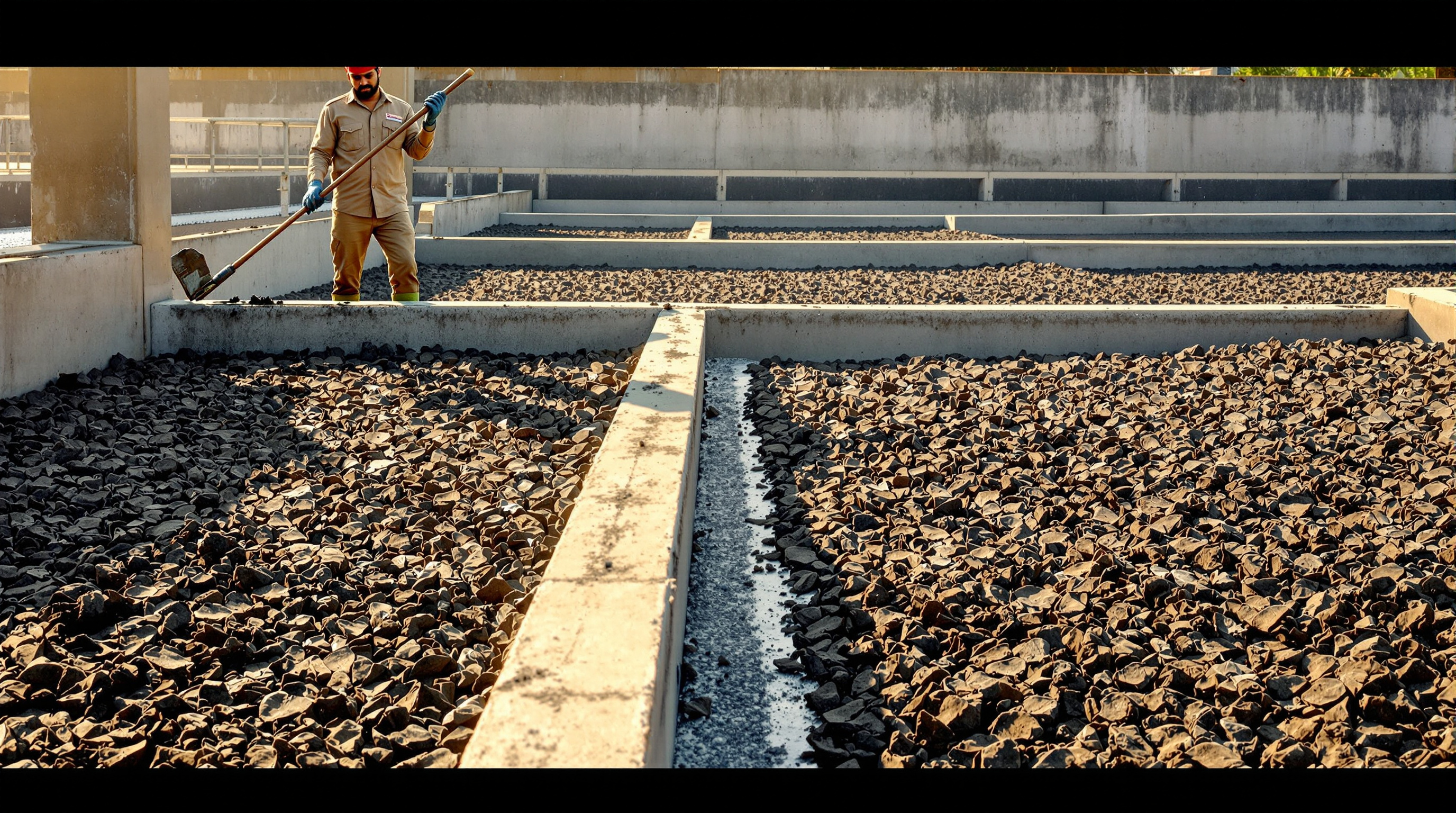
Every stage above removed something solid, and all of it converges on the sludge line — the plant's quiet second act.
Primary sludge (from settling) and excess biological sludge (from the clarifier) are collected in a sludge holding tank, gently aerated to stop it turning foul. From there it is thickened to reduce its water content, then de-watered — spread on open drying beds in smaller plants, or squeezed through a filter press or centrifuge in larger ones. What remains is a stable, cake-like solid, periodically carted away by an authorised handler for safe disposal or use as manure.
This sludge is the one genuine "waste" an STP produces. A well-run plant makes little of it and disposes of it responsibly; a neglected plant lets it build up and smell — the single most common cause of STP complaints in apartments.
The whole journey at a glance
| Stage | What it does | What it removes | Key equipment |
|---|---|---|---|
| Preliminary | Catches junk, steadies flow | Rags, grit, oil & grease | Bar screen, grit chamber, oil trap, equalisation tank |
| Primary | Gravity settling | Settleable suspended solids | Settling tank, skimmer |
| Secondary | Microbes eat the waste | Dissolved organic matter (BOD) | Aeration tank, blowers, clarifier |
| Tertiary | Polish & disinfect | Fine solids, colour, pathogens | Sand & carbon filters, chlorine/UV |
| Sludge line | Handles the solids | Water from the removed solids | Holding tank, drying beds/press |
If those pollutant terms — BOD, COD, TSS, pH — are unfamiliar, the guide on Wastewater Characteristics explains exactly what each one measures and why the whole plant is built to drive them down.
Why the order matters
The four stages are not interchangeable — the sequence is the design. Cheap physical steps go first (screening and settling remove the easy load with almost no energy), the expensive biological step goes in the middle (microbes handle what gravity cannot), and the finishing steps go last (you only polish and disinfect water that is already mostly clean). Reverse any of it and you would either wreck the machinery or waste enormous energy. An STP works precisely because each stage hands the next a problem it is well suited to solve.
The bottom line
So, how does an STP work? It catches the junk, settles the easy solids, feeds the rest to hungry microbes in an oxygen-rich tank, settles the microbes out, then filters and disinfects what remains — while a parallel line quietly dries and removes all the solids pulled out along the way. Dirty water in, reusable water out, in a couple of hours.
From here, three useful next steps. To see how an STP differs from the tank it replaced, read STP vs Septic Tank. To understand why kitchen and toilet water are treated differently, see Greywater vs Blackwater. And to size the plant your building would need, the STP Capacity Calculator turns a headcount into a treatment capacity in litres per day — the number every STP design begins from. For the full library, browse the Sewage Treatment Plants hub.
Export this guide
Related Guides — Deep-dive reading
The Sewage Treatment Process Flow, Explained: Every Stage From Inlet to Reuse
Follow a drop of sewage through a typical STP — inlet, screening, aeration, clarifier, filtration, disinfection and reuse — as one connected flow, with a block diagram and a unit-by-unit table, in plain language.
Sewage Treatment PlantsAeration Tank: The Biological Heart of an STP
The tank where blowers push oxygen into billions of microbes that eat the sewage's organic load — how it works, what DO, MLSS, F/M and HRT mean, and why it quietly runs up the biggest electricity bill in the plant.
Sewage Treatment PlantsOil & Grease Trap in an STP: Why It Matters (FOG Removal Explained)
The quiet chamber that skims fats, oils and grease out of kitchen-heavy sewage before it ever reaches the biology. What an oil and grease trap does, how its baffles work, how often it must be cleaned, and why skipping it wrecks an STP.
Sewage Treatment PlantsRelated Tools — Try Free
Population Equivalent (PE) Calculator
Convert an organic pollution load into Population Equivalent from flow and BOD concentration — the BOD load in kg/day and equivalent number of people.
STP CalculatorApartment STP Planner
Plan an apartment complex sewage treatment plant from flats and occupancy — get population load, sewage flow, recommended STP capacity in KLD, treatment technology and approximate space.
PlannerSTP Technology Comparison Matrix
Compare Extended Aeration, MBBR, SBR, MBR and UASB across six criteria, set your priority, and see the best-fit STP technology instantly.
Comparator