
STP vs Septic Tank: Which Is Better for Your Building?
A plain-language decision guide comparing a modern sewage treatment plant against a traditional septic tank — how each works, whether the water becomes reusable, and which one your building actually needs, from an isolated bungalow to a regulated apartment complex.
Every building that houses people has to deal with the same unglamorous problem: the used water from its toilets, kitchens and bathrooms has to go somewhere. For generations, the answer in most of India was a septic tank — a quiet concrete box buried in the ground that you never thought about until it overflowed. Today, for anything larger than a single home, that answer is increasingly a sewage treatment plant, or STP.
So which is right for your building? The honest answer is: it depends on how big it is, where it sits, and what the law expects of it. This guide compares the two side by side — how each works, whether the water comes out reusable, what they cost to build and run, and who must legally have which — so you can make the call with confidence.
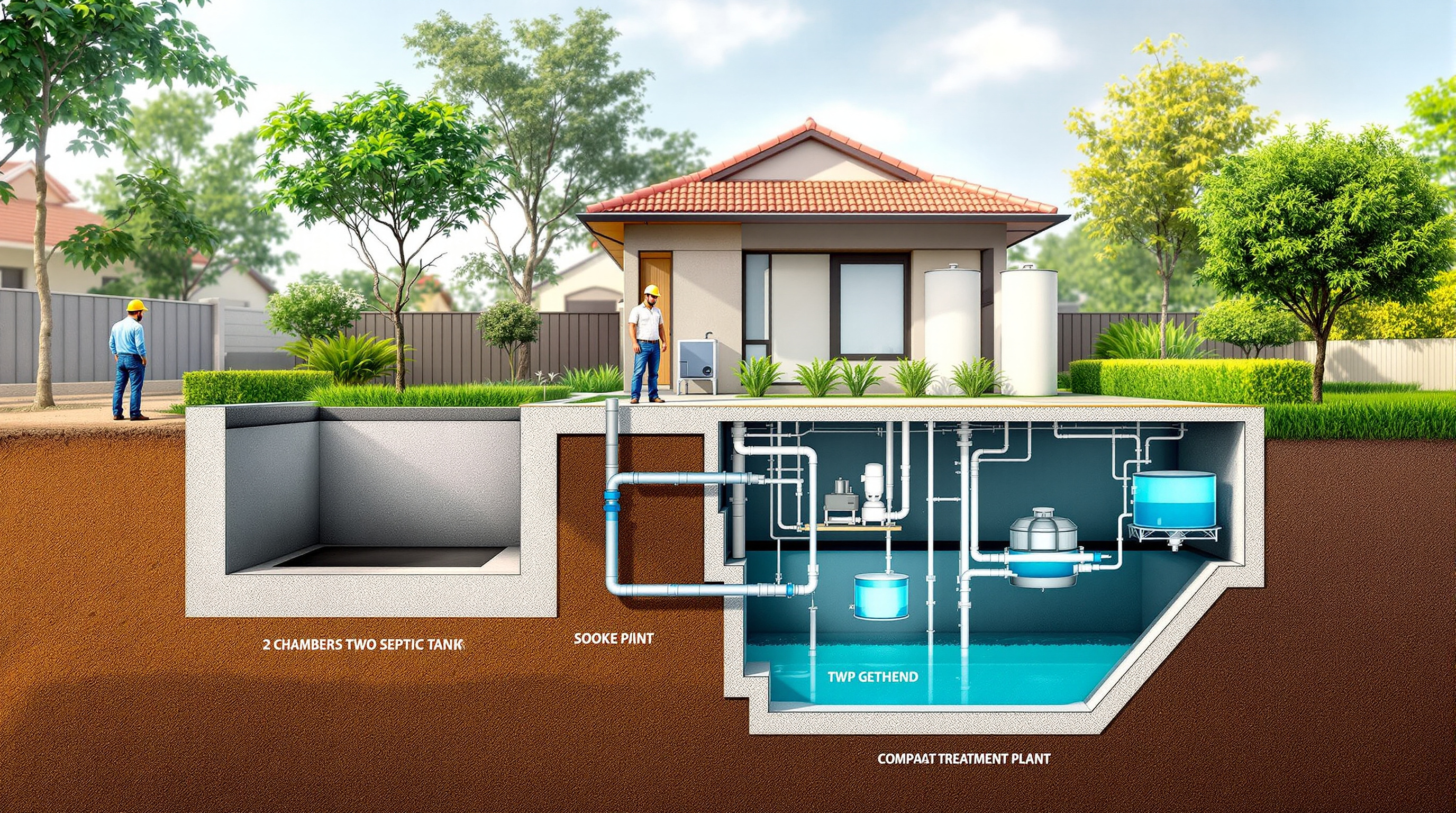
A septic tank stores and partly digests sewage; an STP actively cleans it. That single distinction — storage versus treatment — is what separates a system you can flush from one you can drink your garden's water back from.
How a septic tank works
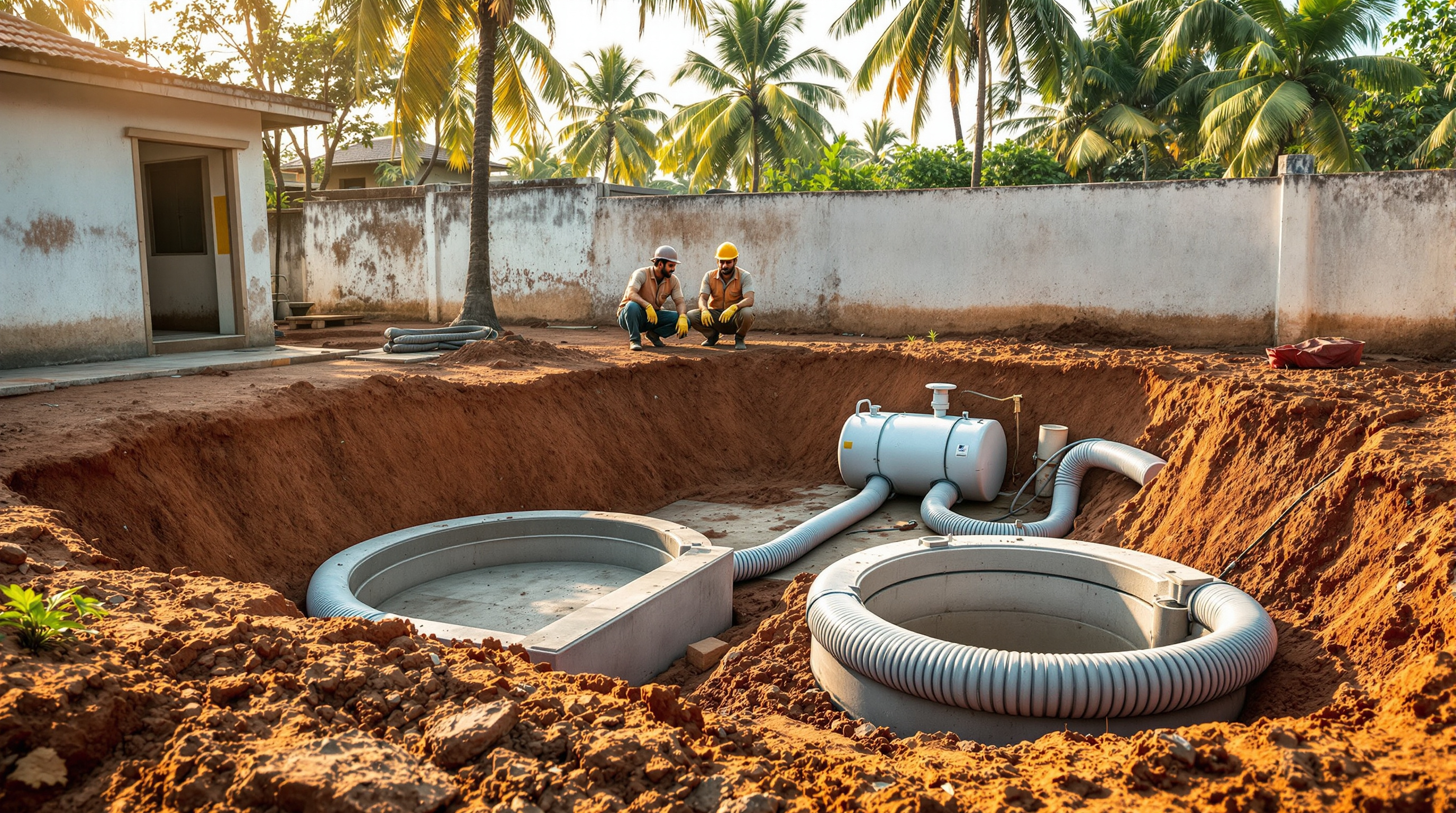
A septic tank is beautifully simple, which is exactly why it survived for a century. It is a sealed underground tank, usually with two chambers, that the house's drains empty into. Inside, three things happen, all of them passive:
- Solids settle. Heavy waste sinks to the bottom and forms a layer of sludge.
- Scum floats. Oils, fats and lighter matter rise to the top.
- Bacteria digest, slowly. In the oxygen-starved (anaerobic) middle layer, naturally occurring microbes partly break down the waste over days.
The murky liquid in the middle — still full of pollution and pathogens — then flows out into a soak pit or leach field, where it slowly seeps into the surrounding soil. The soil, over time, filters some of what remains. Every few years, a tanker comes to pump out the accumulated sludge.
That is the whole system. There are no pumps, no electricity, no blowers. It is cheap, silent, and — for one house on a large plot with permeable soil — perfectly adequate. What it is not is a machine that produces clean, reusable water. To understand the biology it leans on, see greywater vs blackwater, since a septic tank makes no distinction between the two.
How an STP works
An STP takes the same incoming sewage and does something a septic tank never attempts: it cleans the water to a legal standard so it can be reused. It does this in stages, and the crucial difference is that it works with oxygen, not against it.
Where a septic tank lets a small anaerobic population digest waste slowly in the dark, an STP pumps air into an aeration tank, feeding a vast, hungry population of aerobic bacteria that devour the dissolved waste far faster. The water is then settled again, filtered, and disinfected with chlorine or UV light. What comes out is clear, odourless water fit to flush toilets and irrigate gardens. The full stage-by-stage journey is covered in how does an STP work and the complete sewage treatment process flow; the pillar guide on what a sewage treatment plant is is the best starting point if the concept is new to you.
The trade-off is obvious: all that active cleaning needs pumps, blowers, power, and someone to look after it. An STP is a small piece of live infrastructure, not a buried box you forget about.
The one difference that matters: treatment quality
Everything else flows from a single question — does the water become reusable?
A septic tank does not clean water. Its outflow still carries a heavy load of organic waste and disease-causing bacteria; it is only made safe by being buried in soil, out of human contact. You cannot pump it back up to flush toilets or water a lawn. Engineers measure sewage strength with numbers like BOD, COD and TSS (explained in wastewater characteristics); a septic tank barely moves them, while a well-run STP drives BOD from the hundreds down into single digits.
An STP, by contrast, is designed to hit reuse-grade quality. It typically recovers 80–85% of a building's water as treated water good enough for flushing, landscaping, cooling towers and groundwater recharge. In a water-scarce Indian city, that recovered water is not a nicety — it is lakhs of litres a month you do not have to buy from tankers.
If a septic tank is a way to dispose of sewage, an STP is a way to recycle it.
Side-by-side comparison
| Factor | Septic Tank | Sewage Treatment Plant (STP) |
|---|---|---|
| What it does | Stores and partly digests sewage | Actively cleans sewage to reusable standard |
| Process | Passive, anaerobic (no air, no power) | Active, aerobic (blowers, pumps, electricity) |
| Treated water quality | Poor — not safe for contact or reuse | High — reusable for flushing, gardens, cooling |
| Water recovery | None; outflow soaks into ground | 80–85% recovered and reused |
| Space | Compact tank + a soak pit / leach field | Larger footprint; tanks, plant room, filters |
| Capital cost | Low (₹ tens of thousands for a home) | High (scales with capacity; ₹ lakhs upward) |
| Running cost | Near zero + periodic desludging | Power, chemicals, operator, AMC |
| Maintenance | Pump-out every few years | Daily monitoring, skilled operator, regular servicing |
| Legal status (larger buildings) | Not acceptable for medium/large projects | Required for most apartments & commercial buildings |
| Best for | Isolated single homes on large plots | Apartments, hotels, offices, hospitals, any regulated build |
Space, cost and maintenance in plain terms
Space. A septic tank is compact, but it needs land around it — a soak pit or leach field for the outflow to disperse into, which only works if the plot is large and the soil drains well. An STP has a bigger built footprint (tanks, a plant room, filters) but does not depend on porous surrounding soil, so it suits dense sites where a soak pit would simply flood.
Cost. Here the septic tank wins on paper. For a single house it costs a fraction of an STP to build and next to nothing to run. An STP is a real capital investment that scales with the number of people it serves — you can get a feel for the size your building needs, in litres per day, using the STP Capacity Calculator, and capacity is what drives cost. But the STP earns some of that back: every litre of water it recycles is a litre you do not buy.
Maintenance. A septic tank asks almost nothing of you until it is full — then a tanker empties it and you forget it again. An STP is the opposite: it is living infrastructure that needs power, chemicals, a trained operator and a service contract. Neglect an STP and it fails quietly, discharging dirty water and inviting regulatory trouble; neglect a septic tank and it simply overflows.
What the law expects in India
This is often the deciding factor, and it is where the choice stops being about preference.
India's pollution-control and building norms — directionally, the framework set by the CPCB and reflected in the National Building Code and state building bylaws — treat on-site treatment as the standard for anything beyond a small individual home. A single bungalow on its own plot may still legally use a septic tank. But:
- Apartment projects above a certain size are generally required to install an STP and prove the treated water meets discharge norms to receive occupancy approval.
- Virtually all commercial, institutional and hospitality buildings — offices, malls, hotels, hospitals, schools — fall under the same expectation.
- A septic tank is simply not accepted as compliance for these larger, regulated developments.
The exact size thresholds and conditions vary by state and are periodically tightened, so treat the specifics as something to confirm locally rather than a fixed national number. The direction of travel, though, is unambiguous: as a building gets larger and its occupancy grows, the septic tank stops being an option and the STP becomes a condition of being allowed to open.
The verdict: which should you choose?
Strip away the detail and the decision comes down to scale and setting.
Choose a septic tank if you have a single, isolated home on a generous plot with well-draining soil, no municipal sewer to connect to, and no regulatory requirement to treat and reuse water. For that specific case it remains the sensible, low-cost, low-hassle answer — and it always has been.
Choose an STP if your building is anything larger — an apartment complex, a group housing project, a hotel, an office, a hospital or a school — or if it is regulated, sits on a dense urban plot, or stands in a city where water is scarce and every recycled litre counts. In all of these, the STP is not just better; it is usually the only lawful and practical choice.
The honest summary is that these two are not really rivals competing for the same job. A septic tank disposes of sewage for one household; an STP recycles it for a community. Match the tool to the building, and the answer picks itself.
From here, the natural next steps are the pillar guide to what an STP is and the wider Sewage Treatment Plants guide library. And if you have decided an STP is in your future, spend a minute with the STP Capacity Calculator to see how large a plant your building would need — the number every design begins from.
Export this guide
Related Guides — Deep-dive reading
Greywater vs Blackwater Explained (And Why It Matters for Reuse)
The used water your building produces is not all the same. Separating the lightly dirty water from the truly foul water is the single trick that makes on-site water reuse cheap, safe and practical — explained in plain language, with no engineering background assumed.
Sewage Treatment PlantsSTP for High-Rise Buildings: Solving the Vertical Challenges
Why an STP in a tower is a different animal from one in a low-rise block — sharp peak flows, a basement site starved of air and light, treated water that has to be pumped forty floors up, and odour and fire clearances that decide whether the plant gets signed off at all.
Sewage Treatment PlantsUnderground vs Above-Ground STPs: The Complete Comparison Guide
Space, cost, maintenance, odour, aesthetics, ventilation and flood risk — a plain, honest comparison of underground and above-ground sewage treatment plants, and how to choose the right one for your Indian project.
Sewage Treatment PlantsRelated Tools — Try Free
Rainwater Tank Sizer
How big should your rainwater tank be? Computes annual harvest, recommended tank capacity in litres, water-bill savings, and payback — for 10 Indian cities.
RWH CalculatorPool Maintenance Cost Calculator
Monthly and yearly running cost of a home pool — chemicals, electricity, water and service, DIY vs AMC.
Pool CalculatorApartment STP Planner
Plan an apartment complex sewage treatment plant from flats and occupancy — get population load, sewage flow, recommended STP capacity in KLD, treatment technology and approximate space.
Planner