

STP for Gated Communities: Community-Scale Sewage Treatment Explained
How large gated communities of villas and apartments treat their own sewage — centralised versus cluster STPs, phased capacity, reusing treated water in common areas, and sharing the cost and governance fairly among residents.
A gated community is not one building — it is a small town behind a single boundary wall. A few hundred villas here, a cluster of apartment towers there, a clubhouse with a swimming pool, acres of landscaped avenues and a water feature at the entrance the marketing brochure loved. All of it shares one master plan, one set of internal roads, and — critically — one sewage problem. Every kitchen, bathroom and toilet across that township feeds a single question: where does the used water go, and who pays to clean it?
For any development of this scale in India, the answer is an on-site Sewage Treatment Plant, or STP — usually a large one, sometimes several working together. Getting it right is not just an engineering decision; it shapes the community's water bills, its landscape, and how neatly the residents' association sleeps at night.
A gated-community STP is judged twice: once by the pollution board on the day it is commissioned, and every single day after that by residents who notice the moment a garden goes brown or a lift lobby smells. Designing for both is the whole art.
If you are new to the machine itself, start with what a sewage treatment plant is and how an STP works; this guide assumes you know the basics and focuses on what changes at community scale.
The wastewater profile of a gated community
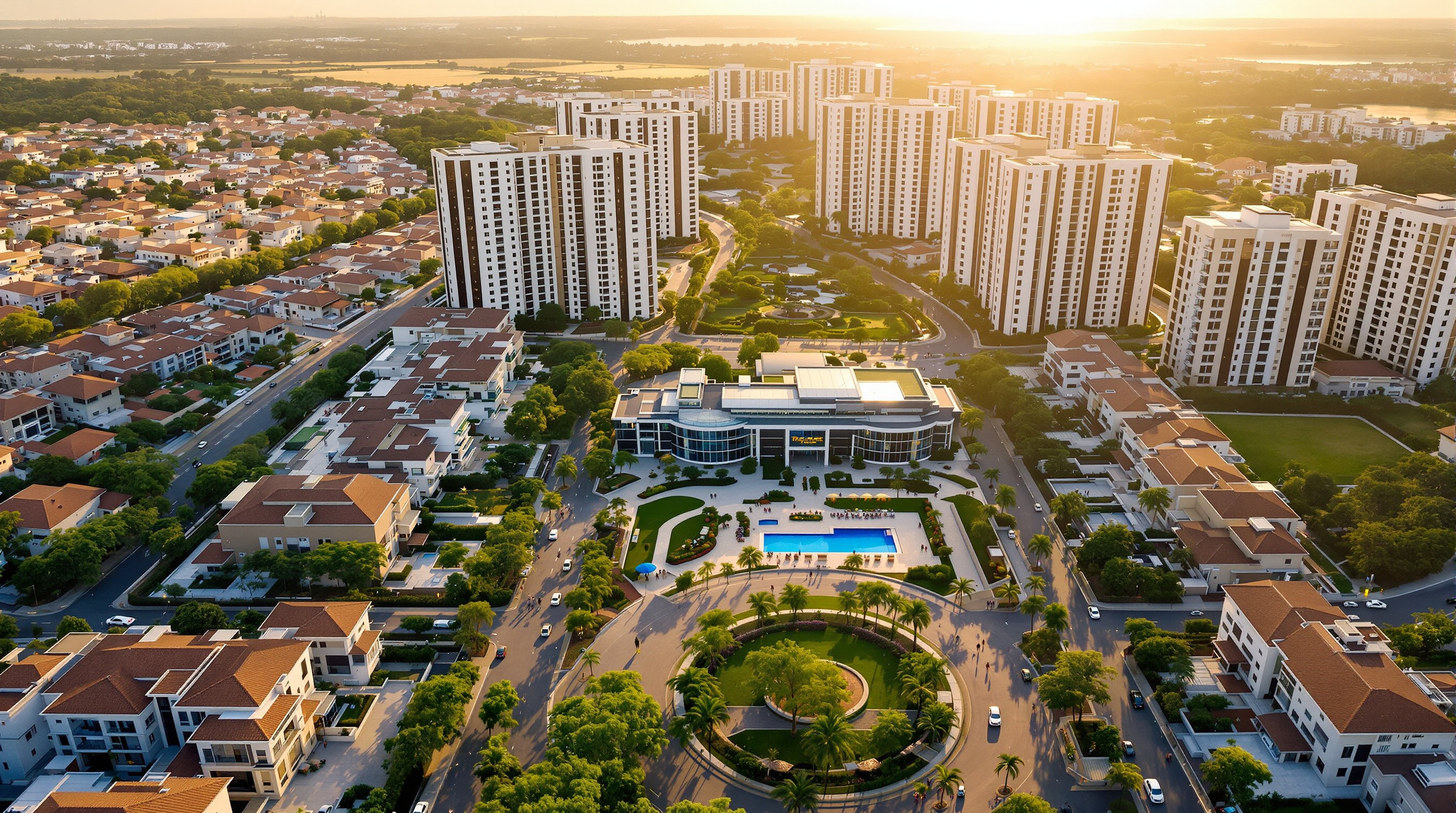
A township's sewage is, chemically, ordinary domestic wastewater — but its pattern is what makes design interesting.
- Large but predictable volume. Hundreds or thousands of residents produce a steady, well-understood load. Unlike a hotel or a mall, occupancy does not swing wildly week to week, which makes sizing more reliable.
- Sharp daily peaks. Residential flow is famously peaky: a heavy morning surge (6–9 a.m. showers and toilets), a lighter midday lull, and an evening bump. The plant must absorb these swings without choking, which puts a premium on a generous equalisation tank.
- A mixed footprint. Villas are spread out and low-density; apartment towers are concentrated and high-density. The same community produces sewage in two very different geographic patterns, which is exactly why the centralised-versus-cluster question below matters.
- Clubhouse and amenity loads. Swimming-pool backwash, gym showers, a banquet kitchen and a salon add smaller, spikier streams — including some grease from the kitchen that needs an oil-and-grease trap before it reaches the biology.
Typical domestic sewage here runs a BOD of around 250–350 mg/l and TSS in a similar band — the standard stuff most STP technologies are built to handle. (For a refresher on these numbers, see wastewater characteristics: BOD, COD, TSS, pH.) The design challenge in a gated community is rarely the strength of the sewage — it is the volume, the peaks and the geography.
Sizing: from headcount to KLD
Every community STP begins with one number — how much sewage the township will generate on a full-occupancy day, measured in KLD (kilolitres per day).
The standard first-principles method: take the design population, multiply by per-capita water consumption (commonly assumed around 135 LPCD for residential use under Indian norms), and treat roughly 80% of that supplied water as sewage returning to the plant. A community of 4,000 residents at those assumptions lands somewhere near 430 KLD of raw sewage — before you add the clubhouse and a safety margin.
Two shortcuts save time and errors:
- The sewage generation calculator converts population and usage into a raw-sewage figure.
- The STP capacity calculator turns that into a design plant capacity in KLD, and the water consumption calculator helps you sanity-check the supply side.
A few sizing rules specific to communities:
- Design for full occupancy, commission for phase one. A township sold and built in phases will sit at 20–30% occupancy for its first couple of years. A plant sized for day-one full load will run starved of food — bad for the microbes and the electricity bill. This is the single strongest argument for phased or modular capacity (below).
- Add a real peak factor. Residential peaking factors of 2.5–3x on the average flow are normal; the equalisation tank and pumps must swallow them.
- Keep a margin for reuse demand. In a community, treated water is not a disposal problem — it is a landscape asset. Size the treatment and the treated-water storage around how much the gardens and water features will actually drink.
Centralised vs cluster: the core decision
This is the defining choice for a gated community, and it turns almost entirely on layout and topography.
| Centralised (one large STP) | Cluster (2–4 smaller STPs) | |
|---|---|---|
| Best for | Compact sites, apartment-heavy layouts | Sprawling villa plots, sites split by a road, valley/ridge terrain |
| Sewer network | Long collection lines, deeper cuts, more pumping stations | Short local runs, shallower, gravity-friendly |
| Capex | Lower plant cost per KLD (economy of scale) | Higher plant cost, but lower piping/pumping cost |
| Opex & manning | One skilled operator team, one set of blowers | Duplicated equipment and monitoring; higher running cost |
| Reuse | Treated water pooled centrally, then redistributed | Water treated near where it is reused — less pumping back out |
| Phasing | Harder to right-size early | Naturally phased — build one cluster per development phase |
Neither is universally correct. A dense apartment-tower community on a flat 10-acre plot almost always wants one centralised plant — it is cheaper per KLD and simpler to run. A 100-acre villa township draped over a ridge, where pumping everything to one low point would be absurd, is a textbook case for cluster STPs, each serving a pocket of villas and discharging reuse water into that pocket's own landscape.
Many large projects end up hybrid: a centralised plant for the apartment zone plus a satellite unit for a far-flung villa cluster. The housing-layouts STP guide and the specialist notes on STP for villas and apartment STP planning go deeper on each sub-type.
Which technology, and why
For community-scale domestic sewage, three technologies dominate, and the choice is a trade-off between footprint, power and operator skill.
- MBBR (Moving Bed Biofilm Reactor) — the workhorse for mid-to-large residential communities. Compact, tolerant of the load swings that phased occupancy throws at it, and forgiving of a less-than-perfect operator. A safe default for many gated communities. See MBBR explained.
- SBR (Sequential Batch Reactor) — excellent effluent quality and a small footprint, well suited to large single-plant communities that want tight, consistent numbers and can support skilled operation. See SBR.
- MBR (Membrane Bioreactor) — produces the cleanest, most reliably reusable water in the smallest space, ideal where treated water feeds water features or where land is scarce and premium. It costs more in capex and membranes and demands disciplined operation. See MBR.
Older ASP (Activated Sludge Process) plants still appear on very large townships where land is cheap, but most new community STPs lean MBBR or SBR. Whatever the badge, the biological heart is the same oxygen-and-microbes process happening in the aeration tank — the technology mainly changes how compact, how automated and how forgiving the plant is.
Reuse: turning sewage into a common-area asset

This is where a gated community STP earns its keep. A township with acres of landscape, water features and common washing needs is the ideal consumer of its own treated water — an STP typically recovers 80–85% of consumption, and a community can genuinely reuse most of it:
- Landscape and avenue irrigation — usually the single biggest demand, and a perfect match for treated water.
- Water features and fountains — the entrance lake and courtyard fountains, best fed by the highest-grade (often MBR) effluent.
- Toilet flushing via a dual-plumbing line back to apartments and common toilets.
- Common-area washing — driveways, clubhouse, basement floors and the community's own vehicles.
- Groundwater recharge of the surplus, topping up the aquifer under the township.
The discipline is to match treated-water quality to its end use: fountain and dual-flush water must be near-odourless and well disinfected, while avenue irrigation can accept a slightly lower grade. For communities layering in greywater or rooftop capture, home greywater recycling and rooftop water-recycling integration show how to stack sources so the STP is not the only tap.
Compliance, in one breath
A community STP must meet the pollution-control board's discharge and reuse norms — directionally, treated water with BOD below ~10 mg/l, TSS below ~10 mg/l and reliable disinfection for reuse-grade water. Practically, that means: obtaining consent to establish and operate, installing online monitoring on larger plants, maintaining a proper sludge-handling and disposal trail, and keeping the operation logs a surprise inspection will ask for. NBC and CPCB direction, plus local water-board rules, set the envelope — confirm the current thresholds with your consultant rather than a brochure, because they tighten over time.
Common mistakes at community scale
- Sizing for day one, not full occupancy — or the reverse. Both hurt. The fix is phased, modular capacity that grows with the sales book.
- One centralised plant forced onto a sprawling villa site. Endless pumping and deep sewers that a cluster layout would have avoided.
- Under-built equalisation. Ignoring the morning peak starves the plant at night and floods it at dawn.
- No plan for the odour and buffer. Site the STP with a landscaped setback from the nearest homes; residents remember a smelly plant forever.
- Treating reuse as an afterthought. If the dual-plumbing and treated-water storage are not designed in from the start, the recovered water has nowhere to go and gets wastefully discharged.
- Governance left vague. The most common non-technical failure — see below.
Governance and cost-sharing
At community scale the STP is as much a governance object as an engineering one, and this is where residents' associations most often come unstuck. A few principles keep the peace:
- Split capex through the master budget, opex through maintenance charges. The plant is built into the project cost; its running cost — power, chemicals, operator, sludge disposal — belongs in the monthly maintenance the RWA collects.
- Apportion fairly by load, not just by count. A fair split ties each unit's share to the sewage it generates (broadly, by size or occupancy), so a large villa does not pay the same flat share as a compact 1-BHK.
- Fund a sinking reserve. Blowers, pumps, membranes and diffusers wear out; a dedicated replacement fund prevents an emergency levy five years in.
- Insist on a proper AMC and a trained operator. A community STP is not a fit-and-forget asset. The cheapest plant with no maintenance contract becomes the most expensive one.
- Meter the reuse. Tracking how much treated water offsets fresh-water purchase turns the STP from a grudging cost into a visible saving residents can see on the balance sheet.
The bottom line
A gated community's STP succeeds when three decisions line up: the right architecture (centralised for compact, apartment-heavy sites; cluster for sprawling villa layouts), the right capacity plan (phased to track occupancy, not over-built on day one), and the right governance (fair cost-sharing, a real maintenance contract, and reuse designed in rather than bolted on). Get those three right and the plant fades into the background — quietly watering the avenues, feeding the fountains and cutting the water bill.
From here, browse the full Sewage Treatment Plants guide library for technology deep-dives, and put your own township's numbers through the STP capacity calculator — the KLD figure it returns is where every community STP design begins.
Export this guide
Related Guides — Deep-dive reading
STP for Hotels: High Per-Guest Loads, FOG & Water Reuse Explained
Why hotel wastewater is heavier and swingier than an apartment's, which STP technology (MBBR vs MBR) actually fits, how to size for peak occupancy, and where the treated water pays for itself — in laundry, cooling and landscape.
Sewage Treatment PlantsSTP for High-Rise Buildings: Solving the Vertical Challenges
Why an STP in a tower is a different animal from one in a low-rise block — sharp peak flows, a basement site starved of air and light, treated water that has to be pumped forty floors up, and odour and fire clearances that decide whether the plant gets signed off at all.
Sewage Treatment PlantsApartment STP Planning Guide: Sizing, Space & Compliance
How to plan a sewage treatment plant for an apartment complex — sizing it from occupancy, choosing the right technology, finding space for it, plumbing it for reuse, and keeping it compliant and running for years.
Sewage Treatment PlantsRelated Tools — Try Free
Rainwater Tank Sizer
How big should your rainwater tank be? Computes annual harvest, recommended tank capacity in litres, water-bill savings, and payback — for 10 Indian cities.
RWH CalculatorLandscape Cost Calculator
Estimate a garden's cost — hardscape, softscape, lawn, irrigation, lighting and annual upkeep — by area, tier and city.
Budget CalculatorPool Maintenance Cost Calculator
Monthly and yearly running cost of a home pool — chemicals, electricity, water and service, DIY vs AMC.
Pool Calculator