
Home Greywater Recycling Systems: Simple Reuse at Home
How a single house can recycle its bath, basin and laundry water for flushing and gardens — without a full sewage treatment plant. What to build, how to size it, where to reuse it, and the mistakes that turn a clever system into a smelly one.
A typical Indian household pours away something it has already paid for. The water that runs off after a bath, drains from a washbasin or empties from a washing machine is only lightly dirty — soap, a little hair, some lint — yet it usually vanishes into the same drain as toilet waste and is gone. In a city where the tanker arrives twice a week and the borewell runs a little lower every summer, that is a habit worth breaking.
You do not need a sewage treatment plant to break it. A single home can reclaim its greywater — the used water from everywhere except the toilet and, usually, the kitchen — with a small, cheap system that filters and disinfects rather than fully purifies. This guide is the practical playbook: what a home greywater recycling system actually is, how big to build it, where the treated water can safely go, and the handful of mistakes that quietly ruin the whole idea.
Greywater is dirty but not dangerous. That single fact is why a home can recycle half its water with a filter and a lamp, instead of the aeration tanks, blowers and biology of a full sewage plant.
The household wastewater profile
Before sizing anything, it helps to know what a home actually produces. Indian domestic water use runs at roughly 100–135 litres per person per day (LPCD) — you can pin down your own household's figure with the Water Consumption Calculator. Of the wastewater that comes back out, the split matters enormously:
- Greywater — roughly 50–70% of the flow. Baths, showers, washbasins and the washing machine. Low pathogen load, modest organic strength, mostly soap, detergent, hair and grit.
- Blackwater — the rest. Toilets (faeces, urine, pathogens) and, in most designs, the kitchen sink (grease and rotting food solids). This stream is hazardous and needs full biological treatment.
The greywater from a home has a gentle pollution profile — a low-to-moderate BOD, low suspended solids, and few pathogens (see the wastewater characteristics guide for what those numbers mean). Its two quirks, though, dictate the entire design:
| Trait of home greywater | Why it matters for the system |
|---|---|
| Bursty flow | Almost all of it arrives in a morning and evening surge (everyone bathes at once), so the system needs a small buffer, not steady sizing |
| Soap and detergent | Alkaline, high in phosphates/surfactants — harmless to flush with, but harsh detergents can harm sensitive garden plants |
| Turns septic fast | Left standing more than about a day, the organics rot and it smells like sewage — so you treat and use it quickly, never hoard it |
| Hair and lint | Clogs filters and pumps if not screened at the very front end |
Why a home does not need a full STP
An STP exists to fight the dissolved organic pollution and pathogens in blackwater — which is why it needs an aeration tank full of oxygen-hungry microbes doing biological work. Home greywater simply does not carry that load. Cleaning it is closer to polishing than purifying: catch the solids, drop the fine stuff, kill the germs, done.
That is also why a home greywater unit is not the same thing as a septic tank. A septic tank passively holds and partially digests blackwater; a greywater system actively treats a separate, cleaner stream so the water comes out reusable rather than merely settled. The two solve different problems and, in a well-planned home, run in parallel.
What a simple home system looks like
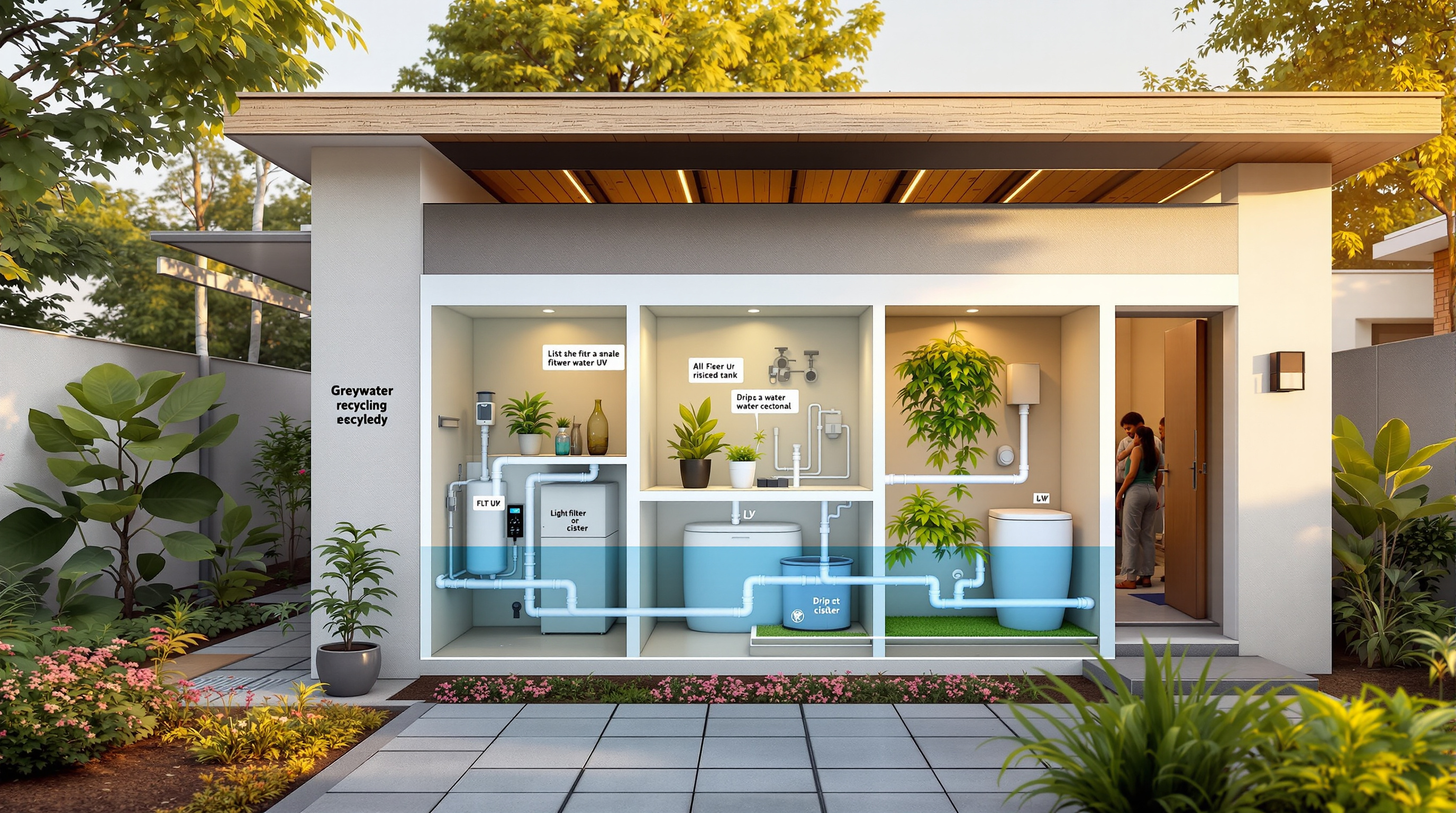
A home greywater recycling system is deliberately lightweight. In flow order:
1. Diversion and screening. The greywater line is tapped away from the blackwater line and passed through a simple hair-and-lint screen or basket filter. This protects everything downstream and is the part people most often skip — and most often regret.
2. Collection with a short buffer. A small tank absorbs the morning/evening surge. Keep it small on purpose: greywater that sits too long goes septic. Many designs oversize this and create a stink.
3. Filtration. The heart of the unit. Options scale with budget and space:
- A sand + gravel media filter or a pressure sand filter for basic homes.
- A small planted reed bed / constructed wetland where there is garden space and appetite for a low-energy, natural look.
- A membrane (UF) filter for a compact, high-clarity output in an apartment-scale setup.
4. Disinfection. A chlorine dosing pot or, cleaner and chemical-free, a small UV lamp to make the water hygienically safe to handle and store briefly.
5. Treated-water storage and pumping. A clearly marked, colour-coded tank feeds a dedicated pump that sends the water back up to toilet cisterns and out to garden taps.
That is the whole machine — no blowers, no biological culture to keep alive, minimal power. For most homes it fits in a corner of the utility yard or a shaft.
Dual plumbing: the part you cannot retrofit cheaply
None of the above works unless the house is plumbed for it. A conventional home has one waste network that mixes everything. A greywater-ready home has three pipe sets:
- A greywater line collecting baths, showers, basins and the washing-machine outlet, routed to the treatment unit.
- A blackwater line collecting toilets and the kitchen, routed to the septic tank or STP.
- A treated-water line — separate, clearly colour-coded, and never cross-connected to the drinking supply — carrying recycled water back to cisterns and garden taps.
India's building code (the National Building Code, directionally) increasingly encourages exactly this dual-plumbing arrangement. The honest catch: designing it into a new home costs very little; retrofitting it into a finished house is expensive and disruptive, because it means opening walls and shafts to run new pipe. If you are building or renovating, insist on the separate lines now — it is the cheapest moment you will ever get.
Sizing a home system
You are sizing to the greywater half of your generation, not the whole. A quick way to a number:
- Estimate wastewater from headcount and LPCD — the Sewage Generation Calculator does this in a minute.
- Take 50–65% of that as greywater.
- Size the buffer tank to hold roughly half a day of that greywater, not more, so it never goes stale.
As a rough feel: a four-person home using ~120 LPCD generates on the order of 480 litres/day of wastewater, of which perhaps 250–300 litres/day is recyclable greywater — comfortably enough to cover all toilet flushing plus a modest garden, with the surplus going to groundwater recharge. Match the quality of treatment to the risk of the reuse; you are not making drinking water, so do not pay for it.
Where the treated water goes — do's and don'ts

The guiding rule is fit-for-purpose: put the right grade of water on the right job.
Do reuse home greywater for:
- Toilet flushing — the single biggest and safest reuse, a perfect match.
- Garden and landscape irrigation — ideal, and the mild nutrients can even help; prefer sub-surface or drip delivery.
- Floor, driveway and vehicle washing.
- Groundwater recharge for any surplus.
Do not:
- Do not drink it or connect it to any potable tap — keep the recycled line physically and visibly separate.
- Do not spray it on edible leaves or fruit you eat raw — irrigate at the roots, not the salad.
- Do not store it untreated for more than a day — treat first, then store only briefly.
- Do not divert kitchen water into the greywater line unless you have added grease handling — its fat and food load rots fast and fouls filters. When in doubt, send the kitchen to the blackwater side.
- Do not tip harsh detergents, bleach or hair dye down the greywater drains if the output waters plants; switch to plant-safe, low-phosphate products.
Compliance and safety notes
For a single house, greywater reuse is generally treated as good practice rather than a heavy regulatory obligation — the formal STP mandates from India's pollution-control authorities kick in for larger apartment and commercial projects. Even so, three principles keep a home system on the right side of both safety and any local by-law:
- No cross-connection. The treated-water line must never touch the drinking supply. Colour-code it and label the taps.
- Disinfect anything people will contact. Flushing and hand-adjacent uses need the chlorine or UV step; skipping it is the classic false economy.
- Do not discharge untreated greywater to a storm drain or open ground as a dumping route — reuse it or recharge it deliberately.
Common mistakes at home scale
- No front-end screen. Hair and lint clog pumps and media within weeks. The cheapest component prevents the most expensive failures.
- An oversized holding tank. Storing greywater "to be safe" turns it septic and makes the whole yard smell. Small buffer, quick turnover.
- Retrofitting as an afterthought. Trying to separate the lines after the house is built usually costs more than the treatment kit itself. Plan the plumbing first.
- Sending kitchen water into the grey line without grease management, then wondering why the filter keeps blocking.
- Buying an STP-grade system for a house. A home does not need aeration, blowers or a biological culture for greywater; that is over-engineering you will pay to run forever.
The bottom line
A home greywater recycling system is one of the highest-return water moves a household can make: divert the bath, basin and laundry water, screen it, filter it, disinfect it, and pipe it back for flushing and the garden. Done at the design stage it costs little, needs almost no power, and can quietly recycle half or more of a home's water — easing the tanker bill, the borewell and the pressure on a stressed city, all at once.
To size the streams behind it, start with the Water Consumption Calculator and the Sewage Generation Calculator. And to understand how the blackwater half of the house is handled — the part a greywater unit deliberately leaves alone — browse the full Sewage Treatment Plants guide library.
Export this guide
Related Guides — Deep-dive reading
Treated Water for Toilet Flushing: The Complete STP Reuse Guide
How dual plumbing, a dedicated flush tank and pump, colour-coded lines, and residual chlorine turn STP effluent into the single biggest water saving a building can make — done safely, without a single cross-connection.
Sewage Treatment PlantsGreywater Recycling India: Reusing Bathroom Water for Flushing & Gardens
How to recycle the basin and shower greywater from an Indian bathroom — simple diversion versus filtered and disinfected systems, the separate drainage you must plan at construction, storage, dual-plumbing to the WC cistern, and honest numbers on cost, payback and health.
BathroomsGreywater vs Blackwater Explained (And Why It Matters for Reuse)
The used water your building produces is not all the same. Separating the lightly dirty water from the truly foul water is the single trick that makes on-site water reuse cheap, safe and practical — explained in plain language, with no engineering background assumed.
Sewage Treatment PlantsRelated Tools — Try Free
Sewage Generation Calculator
Estimate the daily sewage a building generates and its peak flow in KLD from occupancy, LPCD, sewage return factor and peak factor.
STP CalculatorWater Reuse Savings Calculator
Estimate the money you save by reusing STP-treated water instead of buying fresh supply, with daily, monthly and annual savings.
STP CalculatorGreywater Calculator
Estimate how much greywater a home generates for reuse from occupants, per-person use and the reusable share.
Plumbing Calculator