
Curtain Sensors in India (2026): Drop an Invisible Detection Curtain at Windows and Doors
How a curtain sensor casts a thin vertical sheet of PIR detection just inside a window or across a doorway, so you can arm the perimeter of a room at night while the family and pets move freely inside.
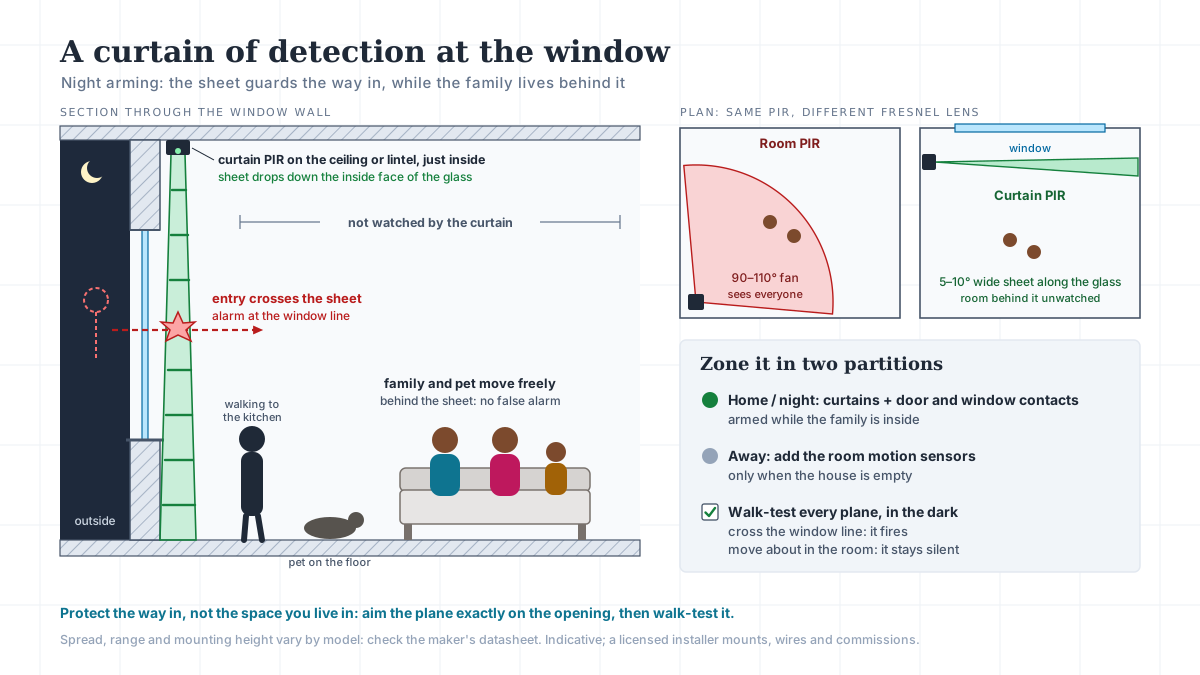
A normal room motion detector throws a wide fan of coverage across the whole space — brilliant when the house is empty, useless the moment someone is home and moving about. That is the problem a curtain sensor solves. Instead of a fan, it projects a thin, tall sheet of detection — a "curtain" — that you can hang just inside a window, down a wall, or across a doorway. An intruder crossing that plane is caught, yet the sensor never looks into the middle of the room, so the family (and the dog) can sit, walk and sleep behind it all night.
That single trick — protecting the way in without watching the space you live in — is why curtain sensors are one of the most useful and least understood detectors in home security. This guide explains how the narrow pattern is made, where to place it, its honest limits, and how it fits a night-armed Indian home with large windows. It is part of Studio Matrx's burglar and intrusion alarm library and the complete guide to burglar alarms in India.
Scope & safety. This guide helps you choose and place a curtain sensor to protect windows, doors and facades. It is strictly about how detection works and where to aim it — never about defeating a sensor. Mounting at height, running cable, or wiring anything to the mains is a licensed professional's job; keep any device clear of fire-escape routes. Where a sensor "sees" a public path or a neighbour's window, that touches privacy under the Digital Personal Data Protection Act, 2023. This is educational guidance, not legal advice.
What makes the pattern a "curtain"
Every curtain sensor is, at heart, a PIR (passive infrared) sensor: it senses the moving heat of a human body. What separates it from an ordinary motion sensor is the plastic lens on the front. A PIR does not "see" a picture — it watches a set of narrow zones carved out by a Fresnel lens, a thin moulded plastic sheet stamped with dozens of tiny lens segments. When warm skin crosses from one zone to the next, the sensor fires.
A standard room detector uses a lens that spreads those zones out into a wide, room-filling fan — typically 90 to 110 degrees horizontally. A curtain sensor uses a completely different lens that focuses all its zones into a single, slim vertical plane: very narrow from side to side (often just 5 to 10 degrees wide) but tall and reaching outward. The result is a flat sheet of detection standing on edge, like a curtain hanging in the air. Walk through the plane and you are detected instantly; stand a metre to either side of it and the sensor is blind to you.
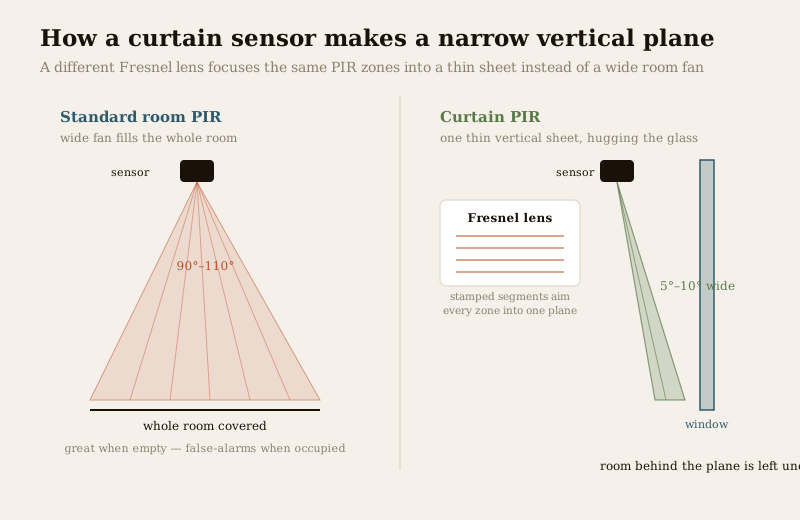
Because the coverage is a thin plane rather than a volume, a curtain sensor is a tripwire you place in the air. That geometry is the whole point, and it is what makes the detector behave so differently from a room sensor once the house is occupied.
The killer use case: arm the perimeter, live in the interior
Here is the scenario every Indian family knows. It is night, everyone is home, and you would love the alarm on — but a room PIR covering the living room would scream the moment someone gets up for water or the dog crosses the floor. So the alarm stays off, and the house is unprotected all night. This is called perimeter-of-interior protection, or simply night arming, and it is exactly what a curtain sensor is built for.
Mount curtain sensors so their planes hang just inside your windows and across your entry doors. Now:
- An intruder trying to come through a window or door crosses the curtain and triggers the alarm at the moment of entry.
- Everyone inside the room — walking to the kitchen, sitting on the sofa, a pet on the floor — stays well behind the curtains, in space the sensors cannot see. No false alarm, no waking the house.
You get the security of an armed home with the freedom of an unarmed one. Compared with an ordinary pet-friendly motion sensor, which tolerates a small animal but still watches the whole room, the curtain sensor takes a cleaner approach: it simply does not look where the family lives. That is a decisive false-alarm and convenience win, and it is the single best reason to add curtain sensors to a home that wants to be armed while occupied.
| Room motion sensor (wide fan) | Curtain sensor (vertical plane) | |
|---|---|---|
| Coverage shape | Wide volume filling the room | Thin sheet hugging a window/wall/door |
| Best job | Whole-room cover when house is empty | Perimeter/night arming while occupied |
| Family moving inside at night | Triggers false alarms | Ignored — they stay behind the curtain |
| Pets indoors at night | Needs pet-immune tuning, still risky | Ignored if they stay behind the plane |
| Catches entry at | Deep inside the room, after entry | The window/door line, at entry |
| Weak point | Sees everything, hard to occupy-arm | Must be aimed exactly at the entry plane |
This is why a well-planned system pairs both: room sensors for away mode when the house is empty, and curtain sensors (plus door and window sensors) for home/night mode. The burglar alarm system selector helps you decide which mix suits your layout.
Where to place a curtain sensor
The curtain only works if its thin plane lands exactly on the line you want to protect. A few centimetres of aim is the difference between a wall of detection and a blind spot. The common placements:
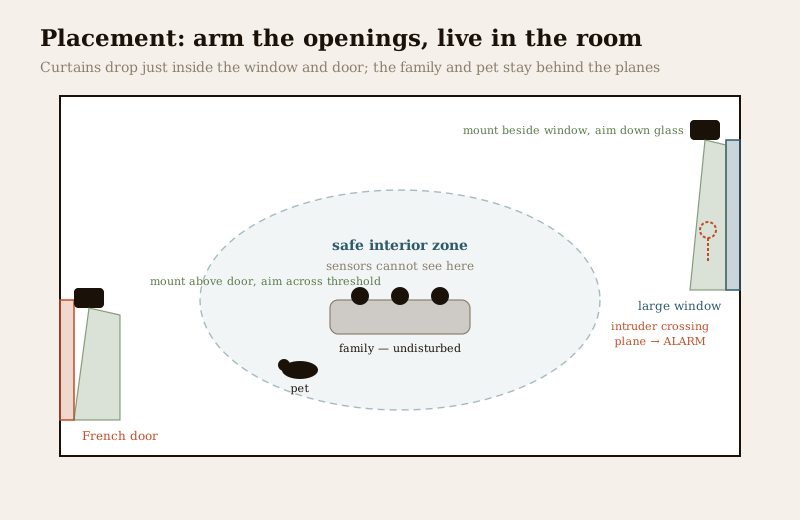
- Beside or above a window. Mount on the wall next to the window (facing across it) or on the ceiling/lintel just inside it (facing down), so the curtain drops like a sheet down the inside face of the glass. Anyone climbing in breaks the plane.
- Along an interior wall or a run of glass. For a wide picture window or a glazed facade, a curtain aimed along the wall creates a continuous vertical barrier a person must pass through to come off the glass into the room.
- Across a doorway or passage. A curtain hung across an internal doorway or the top of a stairwell catches movement between zones without watching either room — useful for protecting an upstairs while the family sleeps below.
- Down a balcony or French-door opening. Large openings that are a favourite entry point get a dedicated curtain just inside the threshold.
Indoor, semi-outdoor and beam-style variants
Curtain detectors come in a few flavours, and matching the variant to the spot matters in Indian conditions:
| Variant | Where it suits | India notes |
|---|---|---|
| Indoor curtain PIR | Inside windows, doors, stairwells | The default for night arming; keep out of direct sun and away from AC/heater draughts |
| Semi-outdoor / weatherproof curtain PIR | Verandah, balcony, porch, under a deep eave | Needs an IP-rated housing; shield from monsoon rain and dust; expect more nuisance triggers from wind-blown foliage |
| Outdoor curtain / short-range beam | Along a facade or boundary wall | Overlaps with beam sensors and perimeter alarm systems; use dual-technology or camera verification to cut false alarms |
For a true boundary line — a compound wall or long facade — a dedicated beam sensor or a full perimeter alarm system is usually the better tool; the curtain PIR shines at the building's own openings. For glass that could be smashed rather than opened, pair the curtain with a glass-break sensor so both "open it" and "break it" attacks are covered.
Honest limits, stated as design guidance
A curtain sensor is a precision instrument, and its narrowness is both its strength and its constraint. Understanding these limits is how you place it well — none of this is about evading it.
- It is not a whole-room detector. The plane only protects the line it is aimed at. Cover every vulnerable opening with its own curtain (or pair curtains with door/window contacts); do not expect one curtain to guard a whole room.
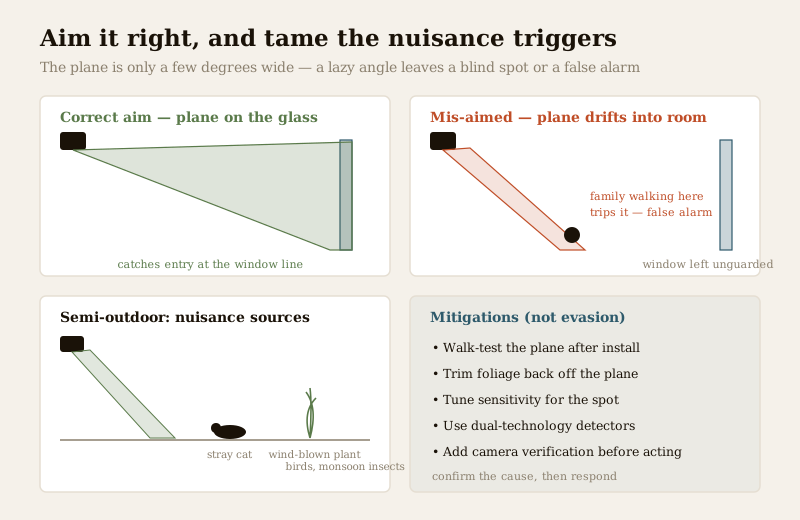
- Aim is everything. Because the sheet is only a few degrees wide, a lazy mounting angle can leave the plane sitting a foot inside the room instead of on the glass. Set it up, then walk-test: cross the window line and confirm it fires, stand in the room and confirm it does not.
- PIR still needs a temperature difference. Like any PIR, it senses the contrast between body heat and background. In peak summer, when a surface is near body temperature, sensitivity drops — a real consideration for semi-outdoor units in Indian heat.
- Outdoor placements false-alarm on nature. A semi-outdoor curtain along a verandah will see cats, birds, monkeys, wind-blown plants and monsoon insects. Tune the sensitivity, keep foliage trimmed back from the plane, and where the risk is high use dual-technology detectors or camera verification so a person can confirm the cause before anyone responds.
- Self-monitored reality. Most Indian alarms are self-monitored — a siren plus a GSM or app alert to you or the guard, not an automatic police dispatch. Plan for that, and give the panel and any outdoor sensor a battery or solar backup so a power cut does not disarm your night protection.
Good curtain-sensor design is layered design: curtains at the openings, room sensors for away mode, contacts on doors and windows, and cameras to verify. See how the pieces fit in the layered security design guide and the perimeter vulnerability assessment.
Fitting curtain sensors to an Indian home
For a typical villa or apartment that wants to be armed at night:
1. List the openings that matter — ground-floor windows, French doors, balcony openings, and any first-floor window reachable from a parapet or tree. These are your curtain locations.
2. Choose home/night vs away zoning. Put curtain sensors (plus door/window contacts) in the night partition so they arm while you sleep; put room motion sensors in the away partition only.
3. Match the variant to the spot — indoor curtains inside the glass, weatherproof ones for verandahs and balconies.
4. Walk-test every plane after install, in the dark, the way an intruder would approach — not from inside the room.
5. Back it up and verify. Battery/solar backup for power cuts, and a camera on the high-value openings so an alert can be confirmed before you or the guard act.
This layered, occupied-home approach suits villas and independent houses, apartments and gated communities alike, and slots into the wider ultimate guide to home security in India.
When to bring in a professional. You can plan the zones, choose the variants and walk-test the planes yourself. Hand at-height mounting, cable runs, mains-powered units, outdoor weatherproofing and panel wiring to a licensed installer or electrician — see the electrical hub. Ask the installer to demonstrate each curtain firing on the entry line and staying silent when you move in the room, and to show you the night-arming partition working, before they leave. For societies and larger sites, insist on a written commissioning walk-test record.
Key takeaways
- A curtain sensor is a PIR whose special Fresnel lens focuses detection into a thin vertical plane — a "curtain" you hang in the air rather than a wide room fan.
- Its killer use is night arming / perimeter-of-interior: drop the curtain just inside windows and doors so an intruder crossing the entry line is caught while the family and pets move freely behind it, with no false alarms.
- Aim is everything — the plane must land exactly on the window or door line; always walk-test it, crossing the entry line to confirm a trigger and moving in the room to confirm silence.
- Match the variant to the spot (indoor, weatherproof/semi-outdoor, or outdoor beam-style) and expect outdoor units to see cats, birds, wind and monsoon — tune sensitivity, trim foliage, and add camera verification.
- It is one layer, not the whole system: pair curtains with door and window sensors, room motion sensors for away mode, and battery/solar backup for India's power cuts.
References
- Manufacturer specifications — verify the exact detection pattern (horizontal spread in degrees, range and mount height), IP rating for semi-outdoor units, and pet/temperature-compensation features on the maker's own datasheet before buying or placing a curtain PIR.
- Digital Personal Data Protection Act, 2023 — where a semi-outdoor or facade curtain sensor is paired with a camera that captures a public path or a neighbour's property, treat any recording as personal data: limit who can view it and post notice where required.
- National Building Code of India (SP 7), Bureau of Indian Standards, and local bye-laws for any mains-powered, at-height or outdoor electrical aspect of the install; confirm the current edition via the BIS catalogue: https://www.services.bis.gov.in/
This is an educational overview, not legal advice. At-height mounting, cabling, outdoor weatherproofing and any mains-connected work are qualified professional tasks — engage licensed installers and verify any standard's current status via the BIS catalogue before relying on it.
Export this guide
Related Guides — Deep-dive reading
Glass-Break Sensors in India (2026): Catching a Smashed Pane Before Entry
How acoustic glass-break sensors listen for the twin sound of breaking glass, why they cover what door and window contacts miss, and how to place one sensor to protect a whole room of windows in an Indian home or shop.
SecurityFalse Alarm Prevention for Burglar Alarms in India: Causes & Fixes (2026)
Why home alarms cry wolf — ceiling fans, pets, heat, insects, weak batteries, power blips and poor door alignment — and how correct placement, the right sensors and simple upkeep keep the system trusted and armed.
SecurityHow to Choose a Burglar Alarm in India (2026): Sensors, Alerts and What Actually Matters
A homeowner's guide to selecting an intruder alarm that fits your flat, villa or shop and alerts you the way you want — matching the sensor mix, control panel and the big siren-versus-monitored decision to your real risk, and dodging the false-alarm traps that make people switch systems off.
SecurityRelated Tools — Try Free
Burglar Alarm System Selector
Answer a few questions about your property, cabling, coverage, monitoring and power and get the right burglar alarm — wired / wireless / hybrid, self or professionally monitored — with the design non-negotiables.
Alarm SelectorSecurity Backup Power Calculator
Size a UPS/inverter and battery to keep CCTV, NVR, router and alarm running through a power cut — load, Ah, VA and cost.
Backup PowerAccess-Control Battery-Backup Calculator
Size the standby battery so an access system keeps running through a power cut, with an egress life-safety note.
Battery Backup