
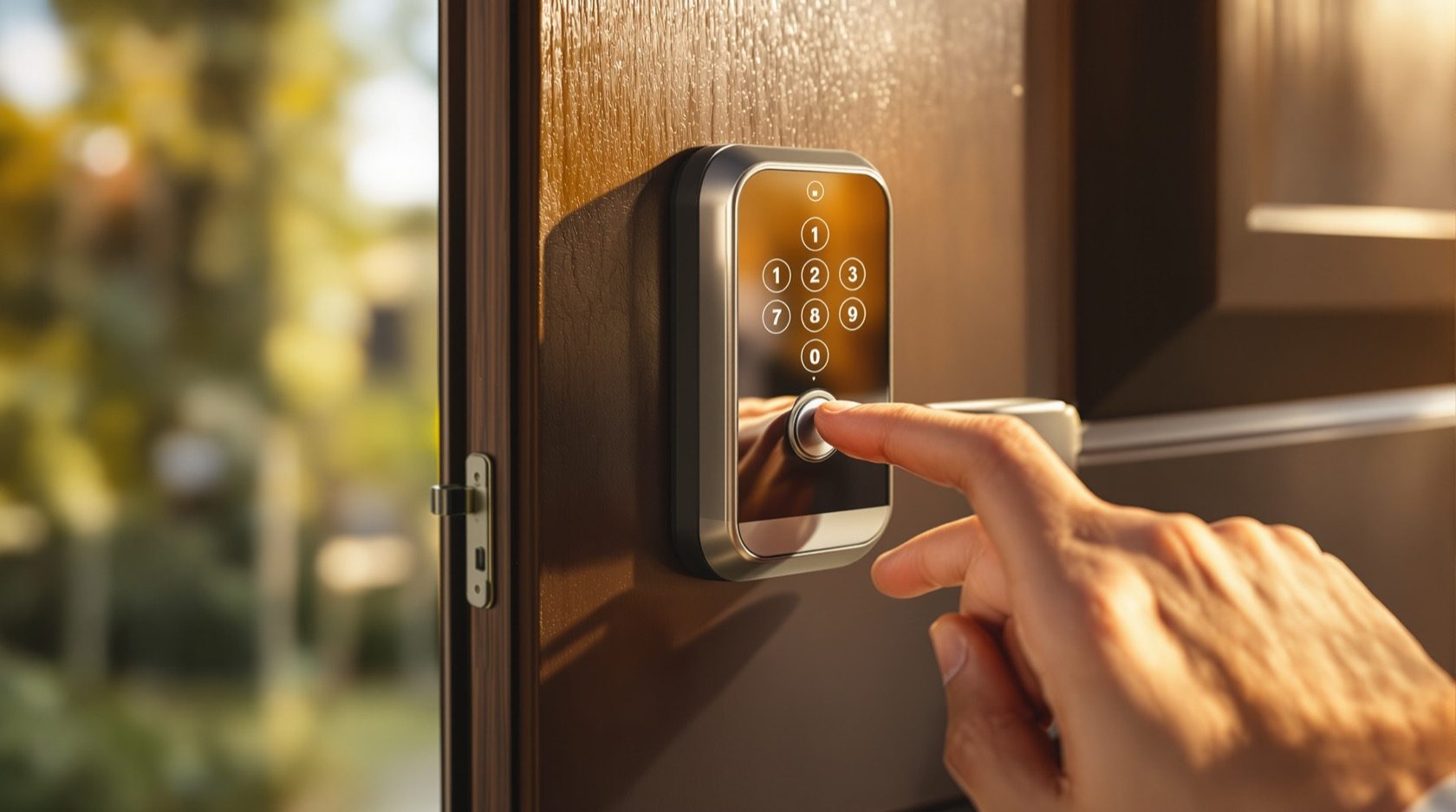
NFC Locks in India (2026): Tap Your Phone or Card to Open the Door
How NFC smart locks let you open a door with a tap of your phone, an NFC card or sticker, or an emerging wallet digital key, plus the honest India realities: phone differences, dead-battery backup, and the cyber hygiene a networked lock needs.
There is a particular pleasure in walking up to your own front door, tapping your phone against it, and hearing the bolt slide back. No fishing for keys in a bag, no remembering a PIN, no app to open and wait for. That tap-to-open experience is what an NFC lock promises, and it is quietly becoming one of the more sensible ways to carry your home key on a device you already never leave without.
NFC stands for Near-Field Communication. It is the same short-range, tap-to-pay technology that already lives in your phone for UPI and card payments, in your metro card, and in the office access card you tap at the turnstile. An NFC lock puts that same idea on your door: hold a phone, a small NFC card, or even a sticker tag a centimetre or two from the reader, and the lock recognises the credential and opens. This guide is part of Studio Matrx's smart locks and access control library and sits under the complete guide to smart locks in India; its lens is specifically the phone-tap and digital-key experience.
Scope & safety. This guide helps you understand and choose an NFC lock; it is not a fitting manual. The lock body, the door hardware, any mains wiring, and above all any interlock with a fire alarm on an escape door are a coordinated job for a licensed door-hardware fitter, electrician and, where a fire-escape route is involved, a fire-safety consultant. A door people escape through must fail-safe and must never be blocked by a lock. Always keep a mechanical key override on a home door, and never rely on a phone alone. This is educational guidance, not legal advice.
What NFC actually is (and how it relates to RFID)
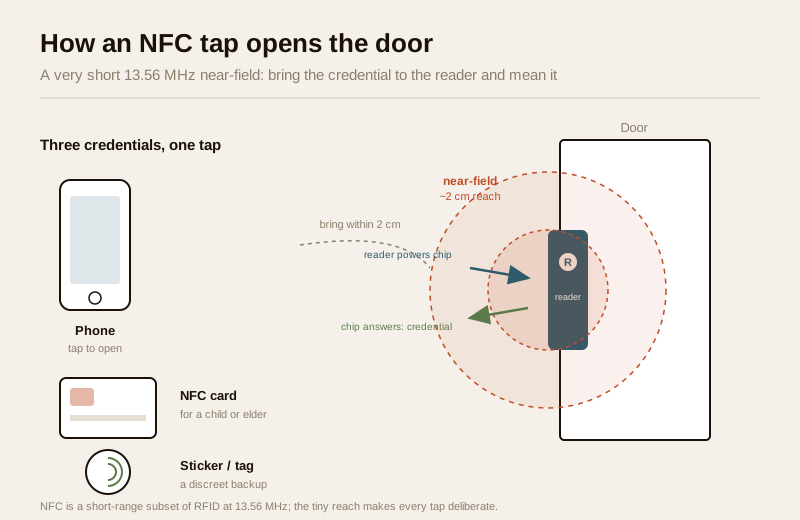
NFC is not a separate, exotic technology; it is a close cousin of RFID. Both work by a reader creating a small radio field that powers a tiny chip in the card or tag, which then answers back with its identity. The differences that matter for a lock are range and intent.
- NFC is a short-range subset of RFID operating at 13.56 MHz. Where a long-range RFID card or tag can be read from tens of centimetres or more, NFC is deliberately tiny in reach: a couple of centimetres at most. You have to bring the credential right up to the reader and mean it.
- NFC is two-way and phone-native. Modern smartphones have an NFC radio built in, which is why your phone can act as the credential itself, not just a plastic card. That is the single biggest reason to choose NFC over plain RFID for a home: the phone in your pocket becomes the key.
If your interest is mainly the plastic-card-and-fob world, the sibling RFID locks guide covers that in depth, and this guide deliberately does not repeat it. Here the focus is the tap-with-your-phone and digital-key experience that NFC uniquely enables. Because both live at 13.56 MHz, many NFC locks happily read ordinary NFC cards and stickers too, so a household can mix a phone tap for the adults with a simple card for a child or an elderly parent.
The three ways an NFC lock reads "you"
An NFC lock does not care whether the credential is glass or plastic, only that it carries a recognised NFC identity. In practice you will use one of three:
1. Your phone as the key. Once enrolled, you tap the phone against the reader and the lock opens. On some systems this works even with the screen off; on others you open an app or a shortcut first. This is the headline feature, and also where India realities bite hardest (below).
2. An NFC card. A credit-card-sized tag you tap the same way. Perfect for a family member without a smartphone, a child, an elderly parent, or a spare kept safely at home. Cheap to add and easy to revoke if lost.
3. An NFC sticker or key-fob tag. A small adhesive disc or fob you can stick inside a wallet or clip to a keyring. Handy as a discreet backup credential.
The appeal: why a deliberate tap is a feature, not a limitation
At first the ultra-short range sounds like a weakness. It is actually the point. Because you have to bring the credential within a centimetre or two and hold it there, an NFC lock is very hard to trigger by accident. A long-range system can occasionally read a card through a bag or pocket as you pass; a NFC lock does not open unless you deliberately present the credential to the reader. For a front door, that deliberateness is reassuring.
The other appeals follow from the phone being the key:
- You carry one fewer thing. The device you already never leave home without is the key. No separate fob to lose.
- Credentials are easy to give and take back. Add a card for the maid or a visiting relative, and revoke it the moment it is no longer needed, without changing the lock. (How much of this you can do depends on whether the lock is a simple standalone NFC reader or a fuller app-managed smart lock.)
- It degrades gracefully to a card. Because the same lock reads NFC cards and stickers, guests and non-smartphone users are not locked out of the household's system.
The emerging piece: wallet digital keys
The newest and most polished form of NFC unlocking is the wallet digital key — a home key that lives inside your phone's wallet, alongside your cards and metro pass, and works with just a tap even when the phone's battery is nearly flat or the screen is locked. Apple's Home Key and Google's digital-key work for compatible locks are the leading examples internationally.
Two honest caveats for India in 2026:
- Availability is patchy. The set of locks sold in India that support a true wallet digital key is still small and skewed to premium brands. Many "NFC locks" on Indian marketplaces mean card-and-sticker NFC, or a phone tap through the maker's own app, rather than a polished wallet key. Read the datasheet, not the headline.
- Ecosystem lock-in. A wallet key ties you to that phone platform's ecosystem. If your household mixes iPhone and Android, check that both are supported before you buy.
The honest India realities
This is where an NFC lock earns a clear-eyed look rather than a shrug of enthusiasm. Four realities matter.
1. Not every phone taps the same way
NFC hardware is near-universal on mid-range and premium phones now, but how the phone exposes that NFC radio to a lock differs.
- iPhone versus Android. Apple restricts general third-party NFC access; an iPhone typically unlocks either through a lock brand's own app or through the polished Home Key wallet route, and only for locks that specifically support it. Android is generally more open to third-party lock apps tapping the phone, but the experience still varies by brand and model.
- The very cheapest phones. A minority of budget handsets either lack NFC or expose it inconsistently. If a phone tap is your main reason for buying, confirm your actual phone works with the actual lock before committing — ideally test in the shop.
The safe rule: an NFC lock should be chosen around the phones your household actually owns, not the other way round.
2. A dead phone is a dead key — plan the backup
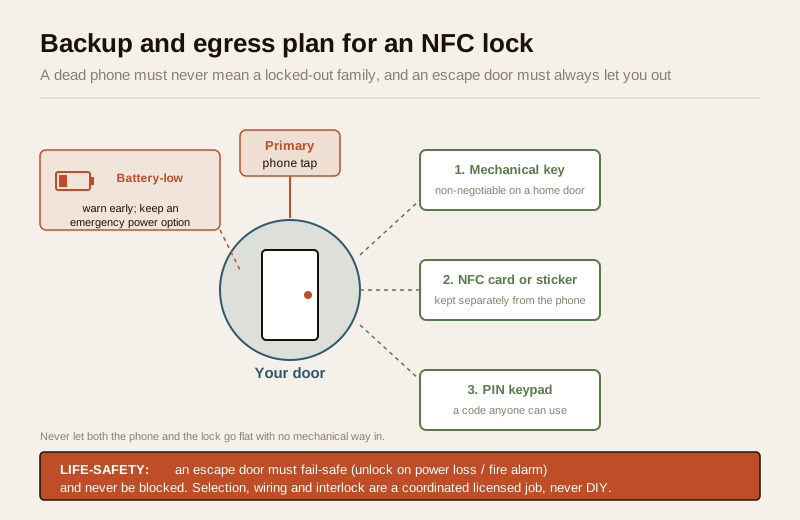
This is the single most important India reality. If the phone is your key and the phone battery is flat, you cannot tap your way in. Every NFC lock used on a home door must therefore have a backup credential that does not depend on your phone:
- A mechanical key override — a physical keyhole, so you are never locked out. On a home front door this is non-negotiable.
- An NFC card or sticker kept separately from the phone.
- Optionally a PIN keypad, which many NFC locks combine — see PIN code locks.
Separately, the lock itself runs on batteries, and India's heat and power cuts are hard on electronics. Buy a lock that warns you well before its batteries die and that has an emergency power option (many accept a power bank or 9V battery at the reader to get you in once). Never let both your phone and the lock go flat with no mechanical way in.
3. Weather and wear
An outdoor or semi-outdoor reader in India faces monsoon damp, dust and summer heat. Look for a sealed, weather-rated reader if the lock faces the elements, and prefer reputable brands whose electronics are built for the climate. A reader that mists up or corrodes will read your tap unreliably just when you are standing in the rain.
4. It is a networked device — cyber hygiene is part of the lock
The moment a lock has an app, an account or a cloud connection — which most phone-tap NFC locks do, for enrolment and remote management — it becomes a small networked target as well as a mechanical one. That does not make it unsafe; it makes account discipline part of owning it:
- Use a strong, unique password on the lock's app account, never one reused from elsewhere.
- Turn on two-factor authentication (2FA) if the app offers it.
- Keep the firmware and app updated; updates patch security flaws.
- Choose a reputable brand that actually ships security updates, over the cheapest unbranded option.
None of this makes a networked lock unsafe; it simply means account discipline is now part of owning your front door, exactly as it is for your banking app.
NFC versus Bluetooth versus a plain card: which suits you
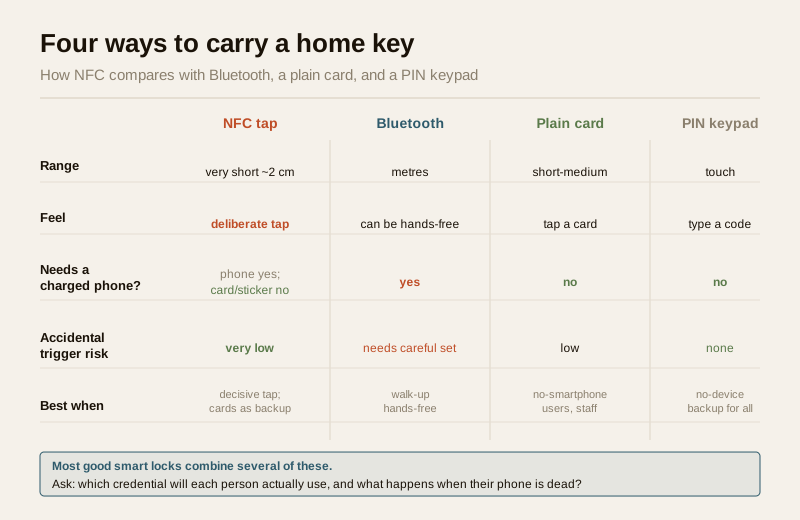
NFC is one of several ways to carry a home key, and the right choice depends on how you want the door to behave.
| Approach | How you open | Range & feel | Needs a charged phone? | Best when |
|---|---|---|---|---|
| NFC tap | Tap phone, card or sticker on the reader | Very short (~2 cm); deliberate | Phone tap yes; card/sticker no | You like a decisive tap and want cards as backup |
| Bluetooth | Approach and unlock via app, sometimes hands-free | Metres; can auto-unlock nearby | Yes, phone must be on | You want hands-free "walk up and it opens" |
| Plain RFID card/fob | Tap a card or fob | Short to medium | No phone needed | Non-smartphone users, staff, simple households |
| PIN keypad | Type a code | Touch the keypad | No | A no-device backup everyone can use |
A few rules of thumb:
- If you want a decisive, low-false-trigger tap and value having cards as an easy backup, NFC is the natural fit.
- If you want the door to open as you walk up without touching anything, that is a Bluetooth behaviour — see Bluetooth locks. Note the trade-off: hands-free convenience means the lock is deciding you are close enough, which needs careful setting.
- If some household members have no smartphone, lean on NFC cards or a PIN, and consider a lock that does all three.
Most good smart locks are not single-trick; they combine several of these. The honest question is not "NFC or Bluetooth" in the abstract but "which credential will each person in my house actually use, and what happens when their phone is dead?" To weigh a specific model against your household, the smart lock selector walks through the trade-offs against your household's phones and the credential each person will actually use.
Life-safety and egress: the rule that overrides convenience
No amount of tap-to-open convenience matters more than being able to get out. This is where an NFC lock stops being a gadget and becomes building hardware.
- Escape doors must fail-safe. A door on a designated fire-escape route must unlock so people can leave — on power loss and, where required, on a fire-alarm signal. This is governed by the National Building Code and local fire rules, and selecting, wiring and interlocking such a door is a coordinated licensed job, never a DIY fit. The difference between fail-safe and fail-secure is explained in the pillar guide and must be decided by the professionals doing the install.
- Never position a lock so it blocks or complicates an escape. The direction of egress must stay obvious and unobstructed.
- Always keep a mechanical override on a home door, as covered above. Electronics fail; a physical key must always let you and your family out.
For anything touching mains wiring or a fire-alarm interlock, the electrical hub explains why this belongs to licensed trades. If you are pairing the lock to a video door phone so you can see and admit a visitor, that integration is its own topic — see video door phones with smart locks — and this guide deliberately does not duplicate it.
Privacy: your taps are personal data
An NFC lock that logs who tapped in and when is quietly building a record of your household's movements. Under the Digital Personal Data Protection Act, 2023, that access data is personal data, and biometrics (if the same lock also uses fingerprint or face) are sensitive personal data. A few sensible habits:
- Prefer on-device storage of credentials and logs where the lock offers it, over a cloud that keeps everything indefinitely.
- Minimise and retain briefly. Do not keep access logs longer than you have a reason to.
- Manage credentials actively. Revoke a departed helper's or ex-tenant's card or phone key promptly; know who administers the lock.
- Give notice. If staff or regular visitors will be tapping in, tell them the door logs access.
Cited generically for education, this is not legal advice; for a society or a workplace deployment, take proper counsel.
What it costs in India
Prices move fast, but as a 2026 sanity-check:
| Type of NFC lock | Typical India price band | Notes |
|---|---|---|
| Basic NFC card/tag lock (no app) | ₹4,000 – ₹9,000 | Card and sticker unlock; often no phone-tap app |
| Phone-tap NFC smart lock (app-managed) | ₹9,000 – ₹22,000 | Phone tap plus cards; app enrolment and logs |
| Premium NFC lock with wallet digital key | ₹20,000 – ₹45,000+ | Home Key / digital-key support; multi-credential |
Add fitting by a door-hardware professional, and budget for spare NFC cards. A cheaper lock that reliably reads a card and has a solid mechanical override can serve a household better than an expensive one whose phone-tap does not suit your handsets — which is exactly why testing with your own phone matters more than the price tag.
When to bring in a professional. You can research, compare and choose an NFC lock yourself, and enrol your own phone and cards. Hand the door preparation, lock-body fitting, any mains wiring, and above all any fire-escape door or fire-alarm interlock to a coordinated team of a licensed door-hardware fitter, an electrician, and — for any egress-critical door — a fire-safety consultant. If you are unsure whether a door is on an escape route, treat it as if it is and get professional advice before fitting any electronic lock.
Key takeaways
- NFC locks let you tap a phone, card or sticker to open — a short-range (13.56 MHz) subset of RFID whose tiny reach makes the tap deliberate and hard to trigger by accident.
- The phone-as-key is the headline, but it is uneven in India: iPhone and Android expose NFC differently, wallet digital keys are still limited to premium locks, and a few cheap phones tap unreliably — test with your actual phone.
- A dead phone is a dead key — every home NFC lock needs a mechanical key override plus an NFC card or PIN backup, and a lock that warns before its own batteries die.
- It is a networked device: use a strong unique account password, turn on 2FA, keep firmware updated, and choose a reputable brand that ships security patches; access logs are personal data under the DPDP Act, 2023.
- Life-safety overrides convenience — an escape door must fail-safe and stay unblocked, and any fire-alarm interlock or mains wiring is a coordinated licensed job, never DIY.
References
- Digital Personal Data Protection Act, 2023 — access logs are personal data and any fingerprint or face data is sensitive personal data; apply consent, notice, minimisation and retention limits, and revoke departed users' credentials promptly.
- Manufacturer specifications and datasheets — verify the exact NFC credential types supported (phone tap, card, sticker, wallet digital key), iPhone/Android compatibility, weather rating, battery life and emergency-power options on the maker's own datasheet before ordering.
- National Building Code of India (SP 7), Bureau of Indian Standards, and local fire and municipal rules for any fire-egress door, fail-safe requirement or mains-connected install; verify the current edition via the BIS catalogue: https://www.services.bis.gov.in/
This is an educational overview, not legal advice. Door-hardware fitting, mains wiring and any fire-egress or fire-alarm interlock are qualified professional tasks — engage licensed trades and verify any standard's current status via the BIS catalogue before relying on it.
Export this guide
Related Guides — Deep-dive reading
Access Control Maintenance in India (2026): Readers, Locks and Fail-Safe Egress
How to keep a card, keypad, fingerprint or face access-control system reading reliably and locking securely — and, above everything, how to test that its doors still release on a fire alarm and on power loss, so an access-controlled door never becomes a life-safety trap.
SecurityOffline Access Control in India (2026): Standalone Locks That Work Without a Network
How standalone, non-networked access control works when the permission lives on the door or on the card, where offline is the right choice, how you manage it, and the honest trade-offs versus a live cloud system.
SecurityVideo Door Phones with Smart Locks in India (2026): See, Then Unlock
How to pair a video door phone with a home smart lock so you can video-verify a visitor and let them in without walking over or handing out keys, with a hard focus on mechanical override, power-cut behaviour and egress safety.
SecurityRelated Tools — Try Free
Access-Control Battery-Backup Calculator
Size the standby battery so an access system keeps running through a power cut, with an egress life-safety note.
Battery BackupApartment Video Door System Planner
Enter flats, entrances, floors and guard desk for a first-pass building intercom plan — door stations, indoor monitors, guard station, the right architecture and an indicative cost band.
Building PlannerBefore vs After — Cost Reality Check
Compare what you expected to pay vs what you actually paid, category by category.
Reality Check