
The Lotus Temple, Delhi: A Flower of Concrete and Marble for All Faiths
How an Iranian architect folded twenty-seven marble petals into a nine-sided house of worship open to every religion — a modern icon that cools itself with water and air, and takes its shape from a flower sacred across India
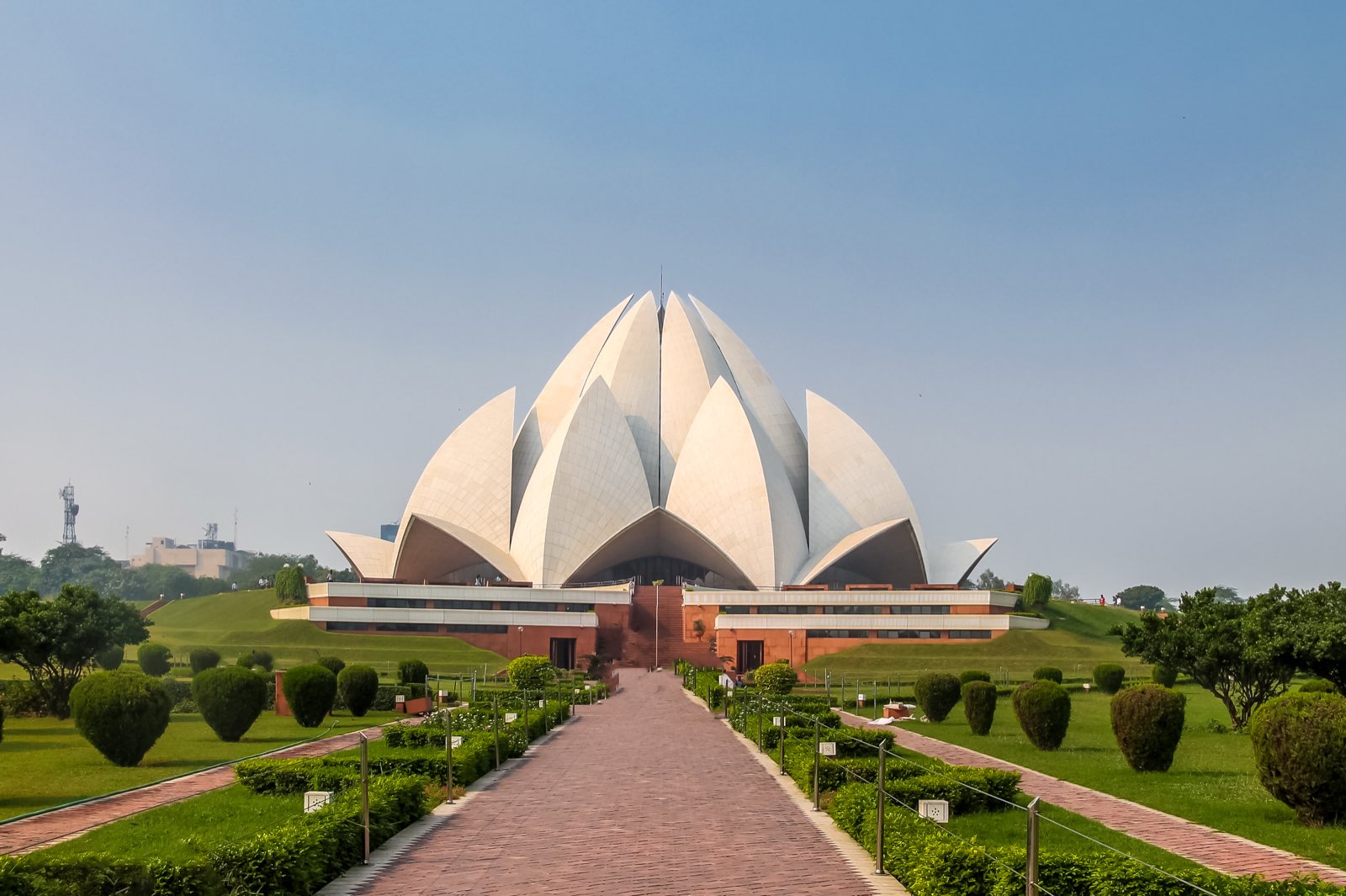
Of all the buildings in this chapter, the Lotus Temple is the youngest and, by some measures, the most visited — millions of people pass through it every year, more than the Taj Mahal. It is barely forty years old, made of the most modern materials, and yet it belongs unmistakably to India: because it takes the shape of a lotus, the flower that has been sacred in this land — to Hindus, Buddhists, Jains and others alike — for thousands of years. That is the quiet brilliance of the design. It is a thoroughly modern building that reaches back to the oldest and most widely shared symbol in Indian culture, and in doing so it says exactly what it means to say: this is a place for everyone.
For the Lotus Temple is a Bahá'í House of Worship, and the Bahá'í faith teaches the essential unity of all religions. A building expressing that idea could not belong to any one tradition's architectural language — not a temple tower, not a mosque dome, not a church spire. It had to find a form that all could recognise and none could claim. It found the lotus.
One architect, one flower, nine sides
The temple was designed by Fariborz Sahba, an Iranian architect (later Canadian), and completed in 1986 after years of extraordinary structural and craft effort. Sahba's concept was disarmingly simple to state and fiendishly hard to build: a lotus flower, caught in the moment of opening, rendered at the scale of a building. Twenty-seven great white petals, arranged in clusters of three, rise and curl outward around a central hall, set in a wide garden of pools and lawn.
Underlying the flower is a strict and meaningful geometry — the number nine.
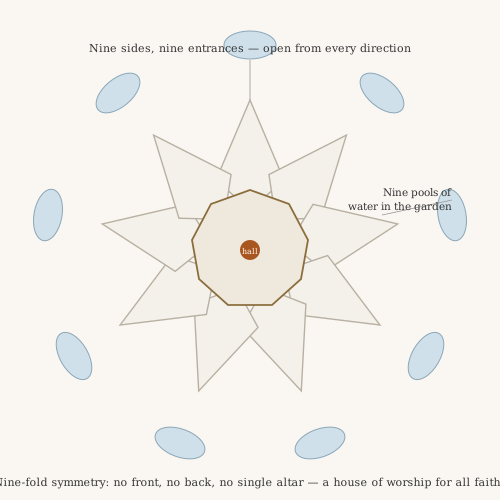
The building has nine sides, nine entrances and nine surrounding pools. Nine is significant in the Bahá'í faith as the highest single-digit number, a symbol of completeness and of the unity that embraces all the world's religions, and every Bahá'í House of Worship in the world shares this nine-sided plan. Architecturally, the nine-fold symmetry has a profound consequence: the building has no front and no back, no principal façade and no lesser side. You may approach and enter from any of the nine directions, and all are equal. Inside, there is a single great hall with no altar, no images, no pulpit — Bahá'í worship has no clergy and no ritual objects; people of any faith may enter, sit in silence, and read or pray from the scriptures of any religion. The plan is not decoration; it is theology made into geometry. Compare it with the nine-fold hasht-bihisht plan of Humayun's Tomb and you see the same ancient fascination with the nine-square, turned to a new and inclusive purpose.
The petals: thin shells in a difficult shape
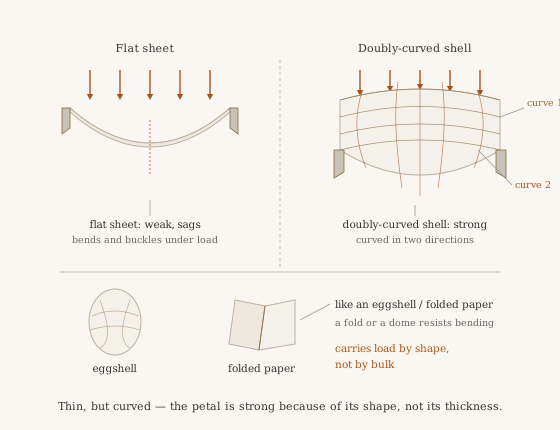
The petals look effortless, as if the flower had simply grown. In fact they are among the more difficult pieces of shell engineering ever attempted, and understanding how they stand up is the key to the building.
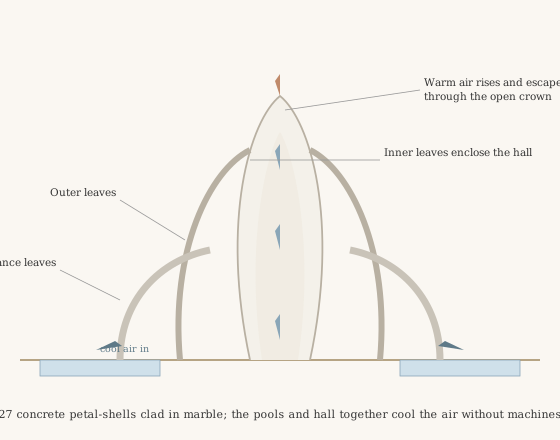
The twenty-seven petals are grouped into three ranks, each doing a different job. The nine entrance leaves curl outward low over the pools to shelter the nine doorways. The nine outer leaves rise higher around them. And the nine inner leaves stand tallest of all, folding together to enclose and roof the central hall, their tips leaving an opening at the crown. Each petal is a thin shell of reinforced concrete — a doubly curved surface that carries its loads not by bulk, like a wall, but by its shape, like an eggshell or a folded sheet of paper, which is far stronger than a flat one. Casting these compound curves accurately, in the era before routine computer modelling, required immense ingenuity and hand-craft; the geometry was worked out with the help of structural engineers (the firm that had helped realise the Sydney Opera House's shells), and built by local labour.
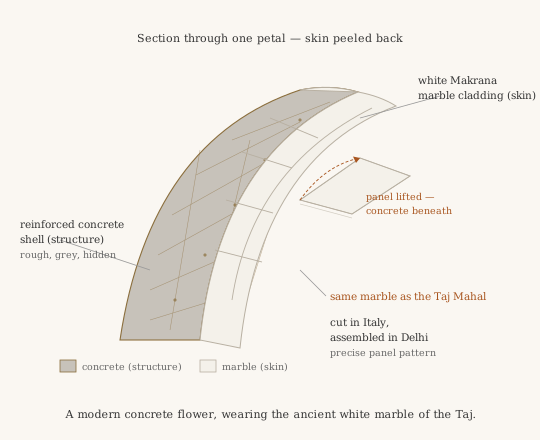
Over the raw concrete, every visible surface is clad in white Makrana marble — the same marble, from the same Rajasthan quarries, that faces the Taj Mahal. So the Lotus Temple, for all its modernity, is bound to the Mughal masterpiece by its very skin: the newest icon and the most famous old one are made of the same white stone. Cut to a precise pattern in Italy and assembled in Delhi, the marble gives the concrete flower its luminous, petal-like softness.
Cooling with water and air
There is a further layer of intelligence in the design, and it is one this series has met again and again in Indian architecture: the building cools itself, without machines. Look again at the section. The nine pools of water that ring the temple are not merely a beautiful setting echoing the lotus's pond; they are part of an environmental system. Air drawn in low, passing over the cool water and in through the base of the petals, is chilled; as it warms inside the tall central hall it rises, and escapes through the opening at the crown, drawing a continuous gentle current of fresh, cooled air through the space beneath. It is the same principle of evaporative cooling and rising warm air that the Mughals engineered into the water channels of the Red Fort and the Rajputs into the cooled pavilions of Amber — here rediscovered and rebuilt in concrete and marble for a modern building in a hot climate.
An old symbol, a new architecture
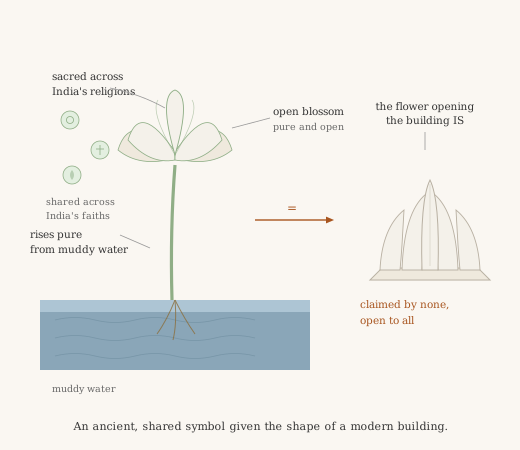
The Lotus Temple makes an illuminating bookend to this series when set against its two modern companions. Chandigarh rejected India's architectural past outright and built in raw, honest concrete, indifferent to symbol. The Victoria Memorial borrowed India's Mughal ornament as a costume over a European frame. The Lotus Temple does something different from either: it uses the most modern structural means — the thin concrete shell — to give form to one of India's oldest and most universally shared symbols, and it wears that symbol not as decoration but as its entire structure. The flower is not carved on the building; the flower is the building.
That is why it works, and why it is loved. It is modern without being alien, Indian without belonging to any one Indian religion, spiritual without being sectarian. It takes the lotus — the flower that rises pure and open out of muddy water, an image of enlightenment shared across the faiths born on this soil, the same lotus that blossoms as a pendant in the ceilings of Dilwara and beneath the thrones of the Buddha at Bodh Gaya — and lets it stand, at building scale, in white marble, open to the sky and to everyone.
Walk toward it across the lawns as its petals lift against the Delhi sky, slip off your shoes and enter in silence with people of every faith and none, and you feel what the architect intended: an old, universal symbol given new life by modern hands — a flower of concrete and marble, offered to all.
And so our chapter on the architecture of India closes where it should — at its newest building, reaching back to its oldest symbol. We began at Sanchi, before a solid mound with no way in, at the dawn of Indian monumental building; we end here, before an open flower with nine doors, welcoming everyone. Between the two lie temple-mountains and rock-cut halls, stepwells driven down into the earth and temple-cities of seven walls, garden-tombs and congregational mosques, war-forts on their cliffs and palaces upon their lakes, an observatory built of stone and a capitol of raw concrete — one civilisation building, for three thousand years, in every faith and every material, and always with genius. That is the architecture of India.
Part of the Architectural Wonders series. For its modern companion that rejected tradition, read Chandigarh; for the imperial monument that borrowed tradition, the Victoria Memorial; and for the white Makrana marble it shares with the Mughals, the Taj Mahal.
Export this guide
Related Guides — Deep-dive reading
Lotus Temple: How a Concrete Flower Became a House of Worship for Everyone
Fariborz Sahba's Bahá'í House of Worship in New Delhi folds twenty-seven thin-shell concrete petals into a nine-fold flower with no altar, no idol and no clergy — a study in pre-digital computational geometry, marble-clad shell engineering, and architecture built to hold every faith at once.
The Future of ArchitectureHumayun's Tomb, Delhi: The Blueprint for the Taj Mahal
How a grieving widow and a Persian architect planted the first great Mughal garden-tomb in Indian soil — a red-and-white rehearsal, eighty years early, for the most famous building in the world
Architectural WondersMatrimandir: A Temple to No God, Built Around a Single Ray of Light
Roger Anger's golden sphere at the heart of Auroville took thirty-seven years to build and worships nothing at all. This deep study reads its flattened-sphere geometry, its geodesic skin of 1,415 gold discs, the heliostat-lit crystal at its core, and its radical proposal for what a sacred building can be after religion.
The Future of ArchitectureRelated Tools — Try Free
Concept Generator
Get 3 AI-generated design concepts for any room with style, materials, and cost estimate.
DesignAIBefore & After Studio
Generate AI before-and-after renders to preview how your redesign could look.
DesignAIFalse Ceiling Cost Estimator
Live ₹/sqft across 8 ceiling types — POP, gypsum, designer, metal, PVC, wooden — with cove and spot lighting for 20 Indian cities.
Cost Calculator