
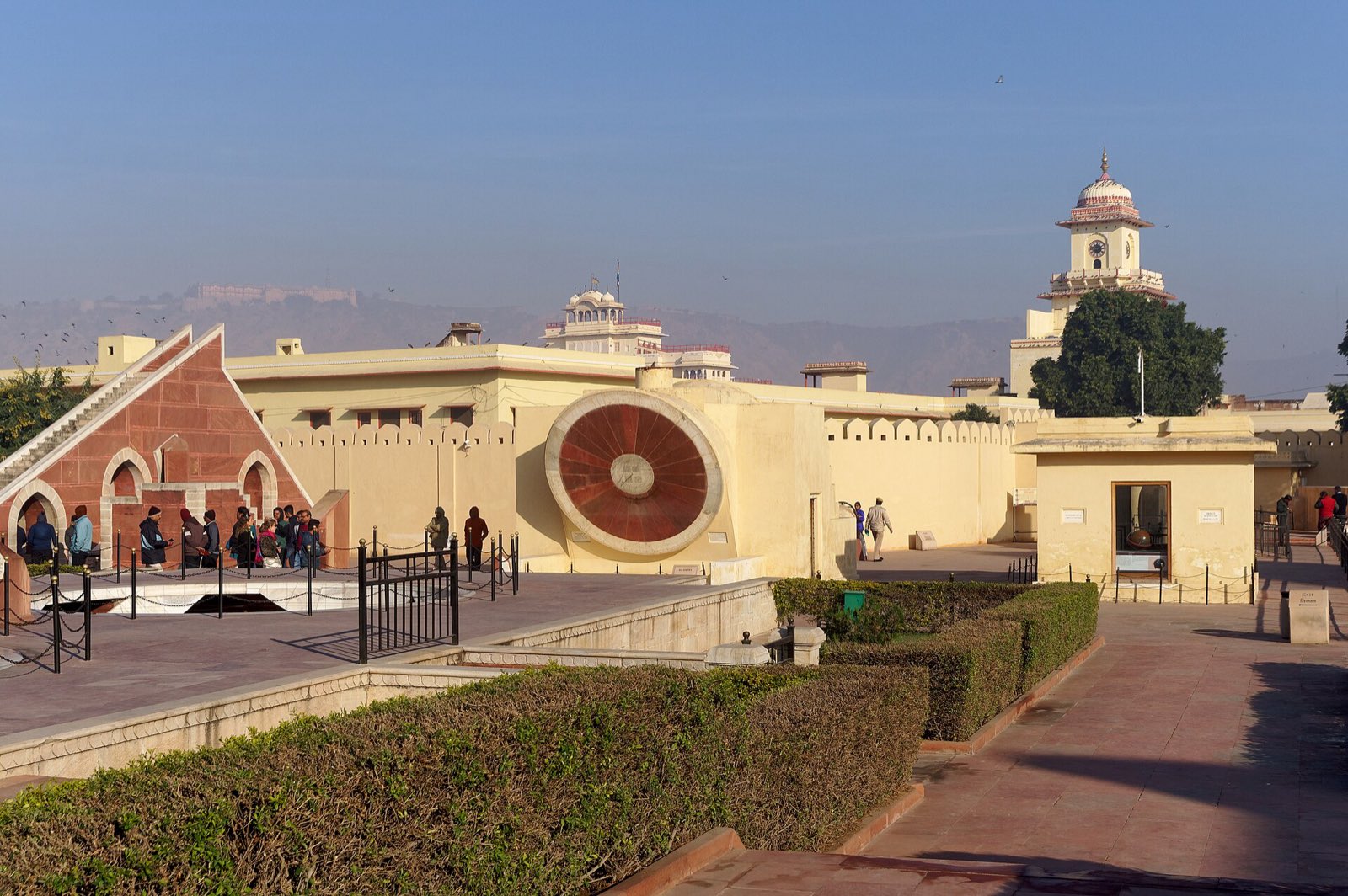
The Jantar Mantar, Jaipur: Buildings That Are Instruments for Reading the Sky
How an eighteenth-century Rajput king built astronomy at the scale of architecture — a garden of giant masonry sundials and star-measuring machines, where making the instrument bigger was the whole secret to making it precise
Every other building in this series has an inside. You enter a temple, a tomb, a palace; there are rooms, walls, roofs, a threshold between within and without. The Jantar Mantar has none of these. It is a collection of nineteen large structures standing in an open yard, and not one of them is a building in the ordinary sense — no rooms, no roofs, nothing to shelter a human body. They are instruments: scientific tools for measuring the positions of the sun, moon, planets and stars, built at the scale of architecture. To walk among them is one of the strangest and most wonderful architectural experiences in India, because you are wandering through a set of machines the size of buildings, whose only purpose is to read the sky.
It is here in the series for exactly that reason. The Jantar Mantar poses, more purely than anything else, the question of what a building is for — and answers that a structure need not enclose space to be architecture. It can, instead, be a giant instrument, and the giant part turns out to be the whole point.
A king who was also an astronomer
The Jantar Mantar was built by Maharaja Sawai Jai Singh II, the Rajput ruler who founded the city of Jaipur (having come down, as we saw, from the hill-fort of Amber). Jai Singh was that rare thing, a ruler who was also a serious working scientist, obsessed with astronomy. Dissatisfied with the small brass instruments of his day, which he found too crude and too easily bent to give accurate results, he resolved to build astronomical instruments of unprecedented size out of stone and masonry. Between about 1724 and 1735 he built five such observatories across northern India — in Delhi, Mathura, Varanasi, Ujjain and Jaipur — and the one at Jaipur, completed around 1734, is the largest, best preserved and most sophisticated of them. The name Jantar Mantar is a colloquial form of yantra mandir, "instrument temple" — a house of instruments.
Jai Singh's astronomy was itself a remarkable synthesis, drawing together the Hindu astronomical tradition, the Islamic and Persian tradition (he studied the tables of the great Samarkand astronomer Ulugh Beg), and contemporary European science, whose findings he actively sought out. The instruments in his garden encode all three inheritances in stone.
The great sundial
The largest and most famous instrument is the Samrat Yantra, the "Supreme Instrument" — a sundial so big it is essentially a small building, and understanding how it works unlocks the logic of the whole place.
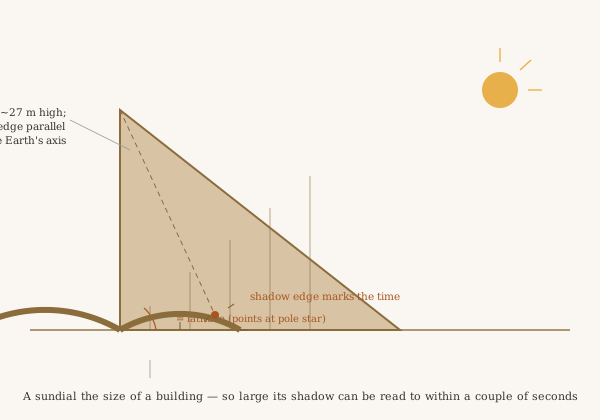
At its heart is a colossal right-angled triangular wall — a gnomon — about twenty-seven metres high, climbed by a staircase running up its sloping edge. The crucial thing is the angle of that sloping edge: it is tilted to exactly the latitude of Jaipur, which means it lies parallel to the axis of the Earth and points straight at the celestial pole (near the Pole Star). As the sun crosses the sky, this great inclined edge casts a shadow onto two curved quadrant scales set on either side, and the moving edge of that shadow, read against the finely divided scale, gives the local time. Because the instrument is so enormous, the shadow sweeps across the scale rapidly and the scale can be divided very finely — so finely that the Samrat Yantra can be read to an accuracy of about two seconds of time, a staggering precision for a sundial and a match for the best instruments of its age anywhere in the world.
Why they had to be so big
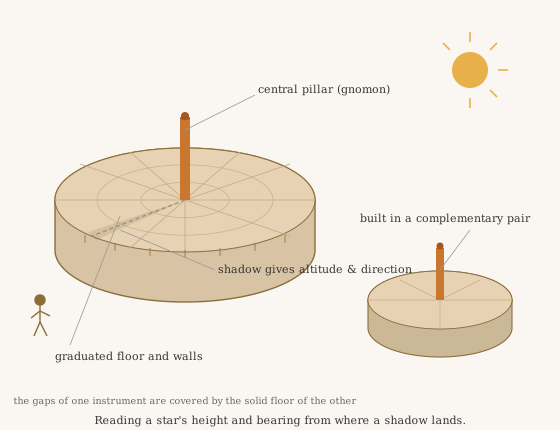
That accuracy is the key to the whole Jantar Mantar, and it explains the thing visitors most wonder about: why is everything so huge?
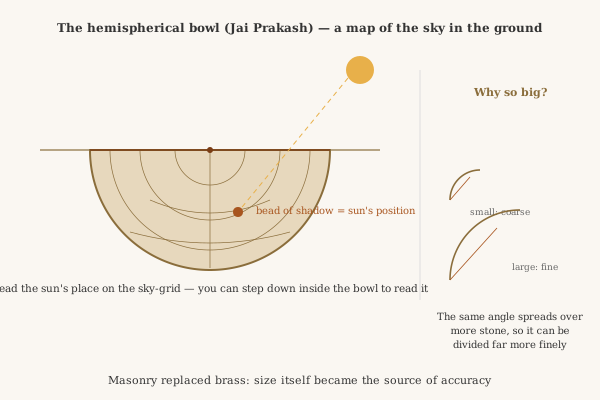
The answer is a beautiful piece of reasoning. On any measuring instrument, a given angle in the sky corresponds to an arc on the scale; the bigger the instrument, the longer that arc, and the more finely it can be subdivided into readable divisions. A tiny brass sundial can only be marked to the quarter-hour before the lines crowd together illegibly; a sundial the size of a building spreads the same hours across metres of stone, so each minute — even each second — gets its own clearly marked space. Jai Singh understood that for a fixed-scale masonry instrument, size itself is precision. So he abandoned the small, portable, warp-prone brass instruments of tradition and rebuilt astronomy in stone and marble at architectural scale, trading portability for accuracy.
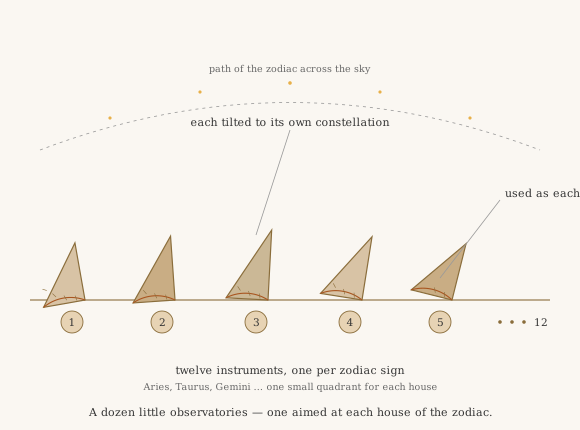
The other instruments each apply this principle to a different measurement. The Jai Prakash Yantra is a pair of great hemispherical bowls sunk into the ground, their concave surfaces marked with a coordinate grid of the sky; a small ring stretched across the top casts a bead of shadow into the bowl, and by reading where that bead falls on the grid — you can even step down inside the bowl to read it — an observer finds the exact position of the sun on the celestial sphere. The Ram Yantra measures the altitude and direction of a celestial body with a cylindrical pair of structures. The Rashivalaya is a set of twelve separate instruments, one for each sign of the zodiac. Each is an abstract, sculptural, purpose-built form, shaped entirely by the geometry of the measurement it performs.
Architecture as pure function
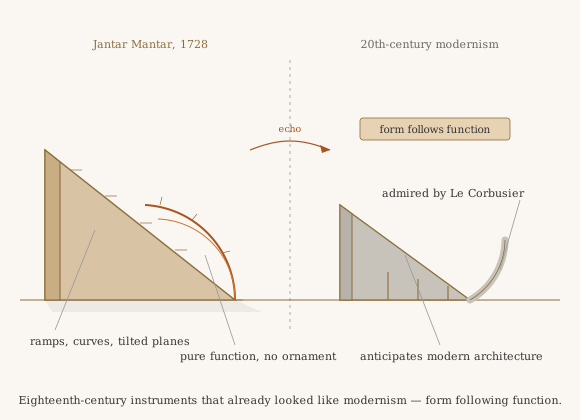
The strange beauty of the Jantar Mantar — and it is genuinely beautiful, in a way that startled twentieth-century modern architects who came upon it — is that its forms are dictated entirely by function, with no ornament, no imagery, no symbolism beyond the geometry of the heavens. The great ramps, curved scales, tilted triangles and sunken bowls look uncannily modern, even abstract or sculptural, precisely because nothing about them is decorative: every surface is the shape it is because that shape does a job. Le Corbusier, who built Chandigarh not far away and two centuries later, admired the Jantar Mantar deeply, and you can see why — it is an eighteenth-century anticipation of the modernist creed that form should follow function, executed in warm Rajasthani masonry.
Set it against its neighbours in this series and the contrast is sharp and instructive. The Sun Temple at Modhera also aligned architecture to the heavens, but as an act of worship — a temple turned to catch the equinox dawn. The Jantar Mantar aligns architecture to the heavens as an act of measurement — instruments built to pin down the sun's position to the second. Between Modhera in the eleventh century and Jantar Mantar in the eighteenth lies the shift from the sky as a god to the sky as data, and Jai Singh's astonishing garden of instruments is where that shift stands built in stone.
Walk among its ramps and bowls and the great triangular shadow of the Samrat Yantra sweeping slowly across its scale, and you are walking through the mind of a king who wanted to measure the universe — and who decided that the way to do it was to build his instruments as big as buildings.
Part of the Architectural Wonders series. For the temple that aligned architecture to the sun as worship, read the Sun Temple at Modhera; for the Rajput world Jai Singh came from, Amber Fort; and for the modern architecture that echoed its functional forms, Chandigarh.
Hero photograph: “Jantar Mantar, Jaipur” by Jakub Hałun, via Wikimedia Commons, licensed under CC BY-SA 4.0.
Export this guide
Related Guides — Deep-dive reading
The Pantheon: The Dome That Has Never Been Beaten
Nearly nineteen centuries ago the Romans poured a hemisphere of concrete 43 metres across, left a single round hole open to the sky at its summit, and walked away — and it is still, today, the largest unreinforced concrete dome on Earth. A temple to all the gods that became a church, the best-preserved building of ancient Rome, and the ancestor of every great dome from Florence to the United States Capitol.
Architectural WondersThe Lotus Temple, Delhi: A Flower of Concrete and Marble for All Faiths
How an Iranian architect folded twenty-seven marble petals into a nine-sided house of worship open to every religion — a modern icon that cools itself with water and air, and takes its shape from a flower sacred across India
Architectural WondersJawahar Kala Kendra: How Charles Correa Turned a City's Horoscope into a Building
In Jaipur, Charles Correa organised a national arts centre as nine squares of the navagraha mandala — the same cosmic diagram that laid out the eighteenth-century city around it — then prised one square loose and hollowed out the centre. A study of the plan as argument: how an 'archaic notion of the Cosmos' became a working piece of contemporary civic architecture, and what its inward, fortress-walled world tells us about where architecture goes when it stops copying tradition and starts thinking with it.
The Future of ArchitectureRelated Tools — Try Free
AI Measurement Tool
Measure your room using voice, photos, or video sweep — no tape measure needed.
DesignAIInterior Layout Planner — Printable Graph Grid
Printable graph grid to sketch room layouts to scale before committing to furniture placement.
Layout ToolVisitor Access Planner
Size visitor handling at a gate or reception — lanes needed at peak and the temporary-pass pool.
Visitor Flow