
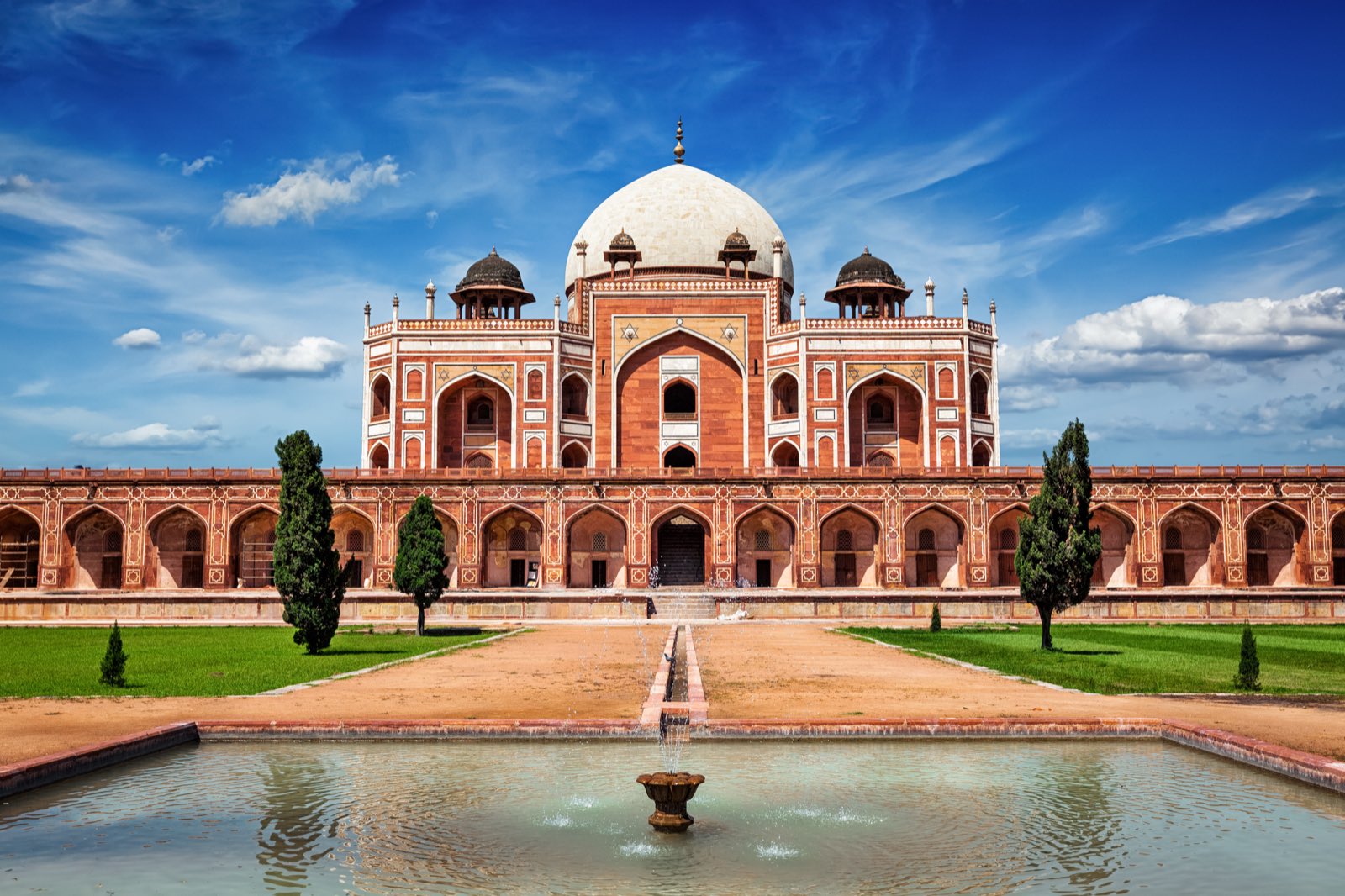
Humayun's Tomb, Delhi: The Blueprint for the Taj Mahal
How a grieving widow and a Persian architect planted the first great Mughal garden-tomb in Indian soil — a red-and-white rehearsal, eighty years early, for the most famous building in the world
Everyone knows the Taj Mahal. Far fewer people know that almost everything which makes the Taj the Taj — the great garden divided by water into four, the building lifted on a high plinth, the deep arched recesses on every face, the tall white dome floating over a red-and-white body, the relentless mirror symmetry — was worked out here, in Delhi, some eighty years earlier, in the tomb of the second Mughal emperor. Humayun's Tomb is not a lesser version of the Taj. It is the original idea, the moment the Mughal garden-tomb was invented on Indian soil, and once you have learned to read it, you understand the Taj far better than you did before.
An emperor who fell downstairs, and the widow who built for him
Humayun's own life was a chronicle of near-disasters. He inherited the young Mughal empire from his father Babur, promptly lost most of it to the Afghan ruler Sher Shah Suri, spent fifteen years in exile in Persia, clawed his way back to Delhi — and then, barely six months after regaining his throne in 1556, slipped on the stone steps of his library, fell, and died. It was, one chronicler dryly noted, the one thing he did efficiently.
The tomb was commissioned by his senior widow, Haji Begum (Bega Begum), who devoted years and a great fortune to it, and it was built through the 1560s, roughly nine years after his death. That a woman commissioned and oversaw this enormous project is itself notable; that she hired a Persian architect, Mirak Mirza Ghiyas, is the key to everything about the building. The Mughals were a Central Asian dynasty steeped in the Persian world — Humayun had spent his exile at the Safavid court — and the tomb they built for him speaks fluent Persian architecture, adapted into Indian materials.
The charbagh: paradise drawn as a square
The single most important idea at Humayun's Tomb is not the building at all. It is the garden.
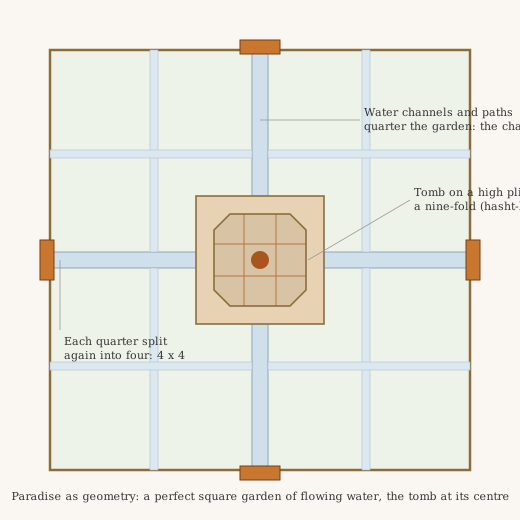
The tomb sits at the centre of a vast walled square garden, and that garden is divided by two crossing axes — causeways with channels of water running along them — into four equal quarters. Each quarter is then subdivided by narrower channels into four again, producing a grid of thirty-two plots around the central platform. This is the charbagh, literally "four-garden", the classic Persian paradise garden, and it is loaded with meaning. The Qur'anic paradise is described as a garden watered by four rivers; the charbagh renders that vision as geometry, a perfect square of flowing water and greenery with the departed at its heart. To be buried at the centre of a charbagh is to be placed, symbolically, in paradise.
This was a genuine novelty in India. Earlier Islamic tombs on the subcontinent, and there were many in Delhi, tended to be single domed chambers standing more or less alone. Humayun's Tomb is the first in India conceived as the jewelled centre of a monumental, geometrically ordered garden — and that conception, the tomb-in-a-charbagh, is exactly what the Taj Mahal would inherit and refine (with one famous twist: at the Taj the tomb is pushed to the end of the garden rather than its centre, so that it stands against the sky and the river rather than in a frame of greenery).
The building: symmetry as an argument
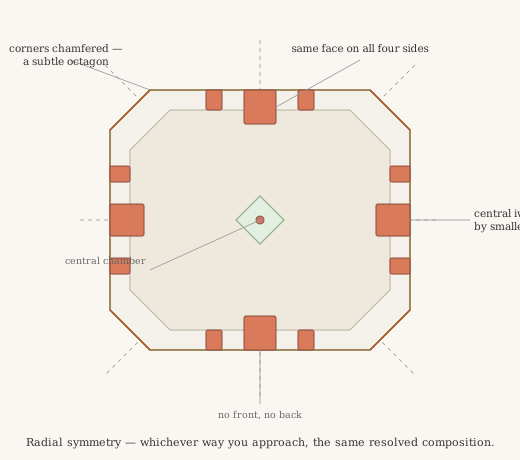
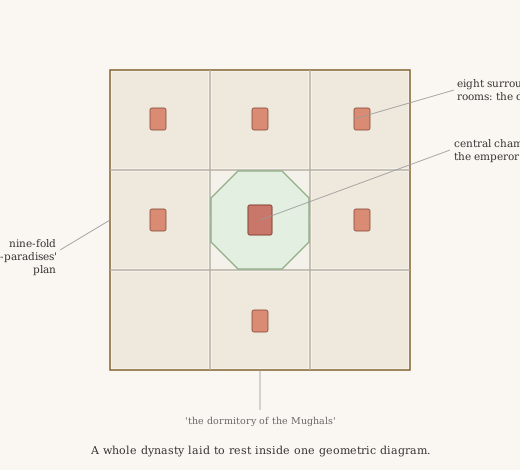
Approach the tomb and the first thing you feel is the almost fierce symmetry. The building is essentially the same on all four sides — a form architects call radial symmetry. Each face has a tall central arched recess, an iwan, flanked by smaller arched bays, and the corners are chamfered so that the square becomes a subtler eight-sided figure. Whichever way you walk around it, the tomb presents you with the same balanced, resolved composition. There is no "back".
Underlying this is a plan type the Persians called the hasht-bihisht — "eight paradises" — a nine-fold division of the square into a central chamber surrounded by eight subsidiary spaces (four corner rooms and four connecting halls). The nine-fold grid is drawn faintly in the plan above. Its logic is beautifully suited to a tomb: the central cell holds the cenotaph of the emperor, and the surrounding rooms hold other members of the dynasty, so that the whole building becomes a family mausoleum organised around geometry. It is estimated that over a hundred Mughals are buried in the complex, which later earned it the grim nickname "the dormitory of the Mughals".
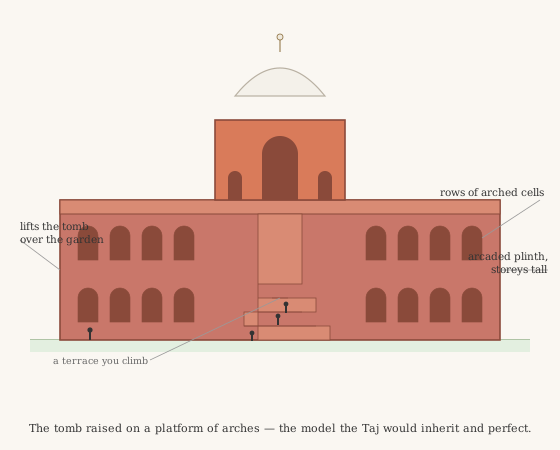
The tomb stands on a high plinth — a broad arcaded platform, storeys tall, its façades lined with rows of arched cells. This plinth does two jobs at once: it lifts the tomb into the sky so that it dominates the garden, and it turns the base itself into a monumental terrace you climb before you reach the building. The red sandstone of the walls, crisply outlined with white and black marble around every arch, gives the whole a colour and precision that Delhi had not seen before — and that, again, the Taj would take to its ultimate conclusion in all-over white marble.
The double dome: the shape you see is not the shape you stand under
Crowning the tomb is the feature that most clearly announces the arrival of Persian engineering in India: the double dome.
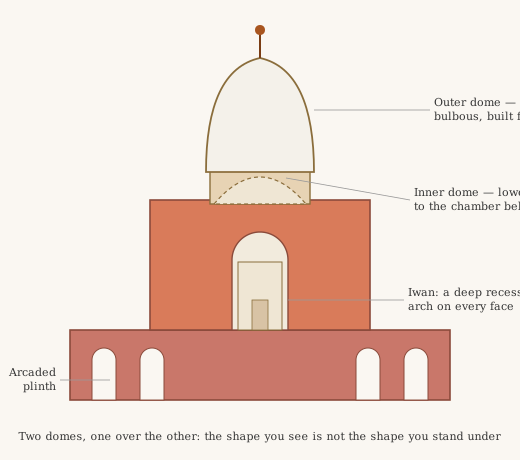
A single dome faces an impossible choice. If you make it tall and commanding on the skyline, the ceiling looms too high and empty over the room inside; if you make it comfortable over the room, it looks squat and mean from outside. The Persian solution, imported here, was to build two domes, one inside the other. The outer shell — at Humayun's Tomb a tall, faintly bulbous dome sheathed in white marble — is shaped for the skyline, rising high and proud above the garden. The inner shell is a separate, lower dome sized to feel right over the burial chamber. Between them is a hollow gap. The shape you admire from the garden is quite literally not the shape you stand beneath.
This is the first full-scale double dome in India, and it is the direct ancestor of the great swelling dome of the Taj Mahal. Everything the later Mughal builders would do — the bulbous profile, the lotus-bud finial, the marble skin — is here in prototype. Learn to spot the double dome and you will start seeing it everywhere in later Indo-Islamic architecture, from the Gol Gumbaz of Bijapur to the tombs of Agra.
A hinge in the story
It helps to place Humayun's Tomb precisely in the flow of this series. The Indo-Islamic architecture that preceded it in Delhi — the Qutb complex with its soaring victory tower — was the architecture of conquest: arches and towers raised, often literally, from the stones of demolished temples, a new faith staking its ground. Humayun's Tomb is something different and more settled. It is the architecture of a dynasty that has decided to stay, to bury its dead in Indian earth in gardens modelled on paradise, and to fuse Persian planning with Indian red sandstone and Indian craftsmen into a new synthesis.
That synthesis is the Mughal style, and it would flower for the next century and a half — through Akbar's red-sandstone city at Fatehpur Sikri, through the forts and mosques of Shah Jahan, to its perfect and final statement in the Taj Mahal. Humayun's Tomb is where that whole magnificent line begins. Stand in its garden, look up at the white dome riding above the red walls, and you are looking at the first draft of the most famous building on earth.
Part of the Architectural Wonders series. Read forward to the Taj Mahal, the masterpiece this tomb rehearses, and back to the Qutb Minar complex, the architecture of conquest that came before, and Akbar's capital at Fatehpur Sikri.
Export this guide
Related Guides — Deep-dive reading
Gol Gumbaz, Bijapur: The Deccan Tomb That Roofed a Whole Hall with One Dome
How the sultans of Bijapur raised one of the largest domes in the world over a single vast room, balanced on a net of intersecting arches, with a gallery where a whisper travels right around the sky
Architectural WondersThe Qutb Minar: The Tower That Announced a New Architecture
How a 73-metre victory tower and India's first great mosque, raised in Delhi around 1200, marked the arrival of the arch, the dome and the minaret — and the first, halting meeting of Islamic form with Indian craft.
Architectural WondersThe Red Fort, Delhi: Shah Jahan's Palace of Paradise on the River
How the emperor who built the Taj Mahal raised a whole walled palace-city in red sandstone and white marble — a fortress on the outside, a garden threaded with running water within, and the stage on which modern India was born
Architectural WondersRelated Tools — Try Free
Concept Generator
Get 3 AI-generated design concepts for any room with style, materials, and cost estimate.
DesignAIBefore & After Studio
Generate AI before-and-after renders to preview how your redesign could look.
DesignAIInterior Layout Planner — Printable Graph Grid
Printable graph grid to sketch room layouts to scale before committing to furniture placement.
Layout Tool