
Amber Fort, Jaipur: The Rajput Palace That Learned to Speak Mughal
How the warrior-kings of the desert built a fortress-palace up a hillside above a lake — half stronghold, half pleasure-house — where mirrors, lattices and running water turned defence into delight
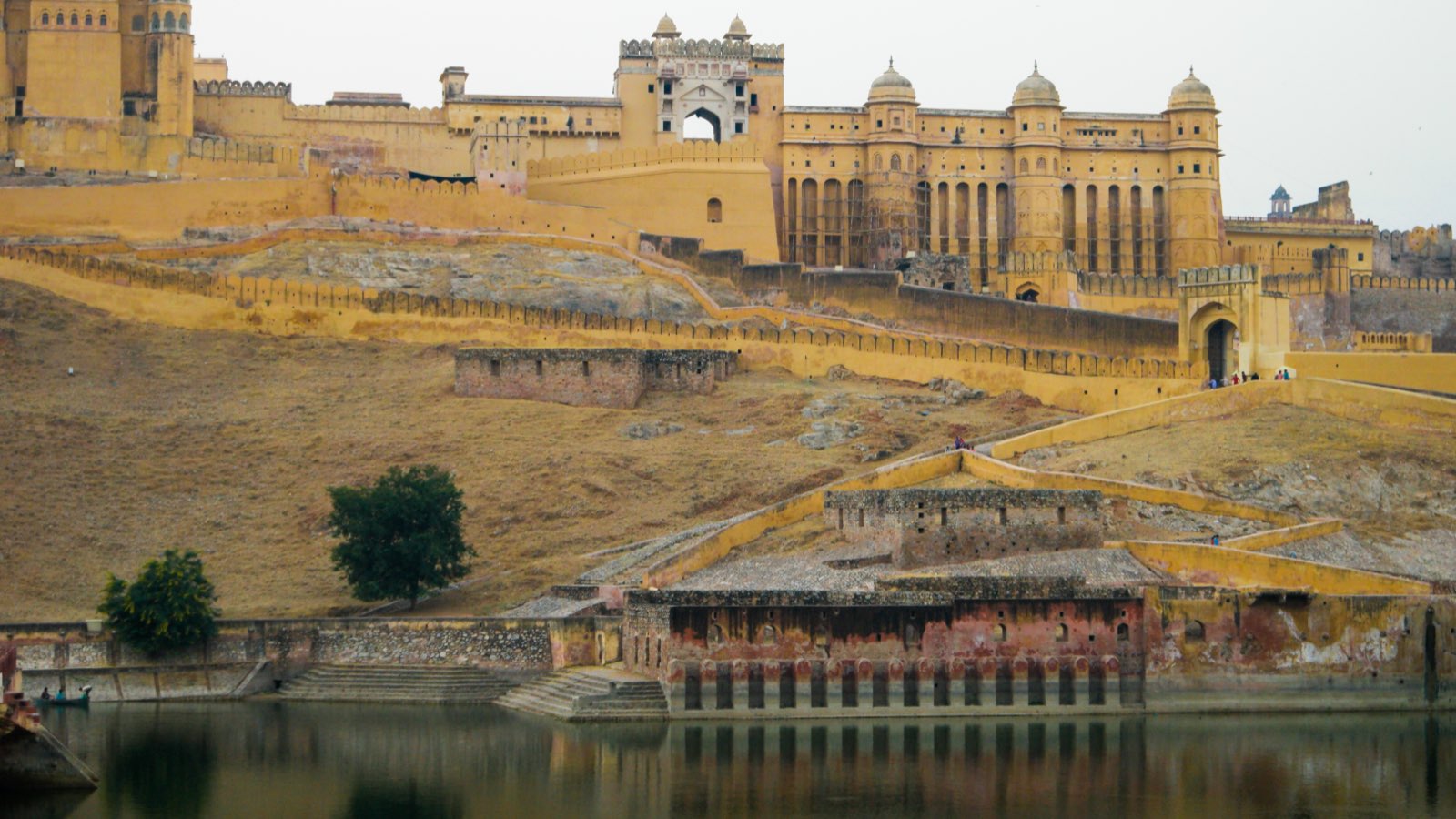
Amber Fort is two buildings pretending to be one. Seen from the lake below, it is a fortress — a mass of high honey-coloured walls climbing a barren hillside, ramparts snaking along the ridgelines to a citadel on the summit, everything about it saying keep out. Climb up and step inside, and it turns into something else entirely: a palace of cool courtyards, gardens, painted gateways, filigree screens and a chamber lined floor to ceiling with tiny mirrors. This double character — stronghold on the outside, pleasure-house within — is the essence of Rajput palace architecture, and Amber is its most complete and beautiful example.
It sits just outside Jaipur, in Rajasthan, and it was the seat of the Kachwaha Rajputs before they moved down to found the pink city of Jaipur in the eighteenth century. To read Amber is to understand a very particular moment in Indian history: when the proud warrior-clans of the desert made their peace with the Mughal empire, married into it, fought for it — and brought its architectural language home to marry with their own.
A fortress that climbs a hill
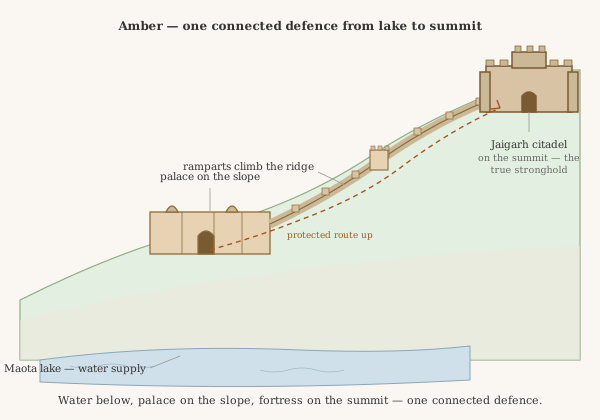
Start, as the builders did, with the land. Rajput power rested on hill-forts: defensible high ground, hard to besiege, controlling the passes and the water below. Amber is built on exactly this logic, and its section tells the whole strategic story.
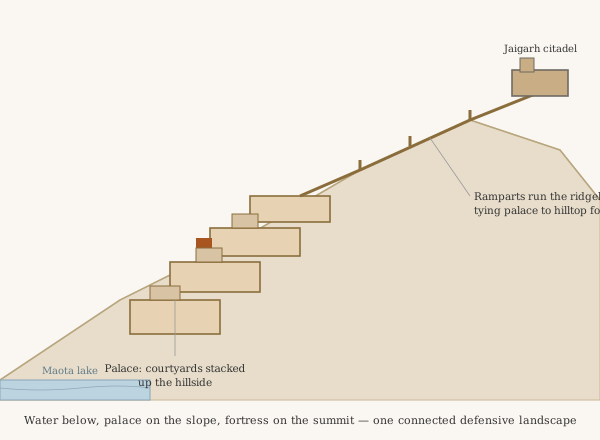
At the bottom lies the Maota lake, the fort's water supply and the source of the reflected image that makes it so photogenic. Above it the palace does not sit as a single block but climbs the slope in a stack of walled courtyards, each higher and more private than the last, linked by ramps and gates so that an attacker who breached one level still faced another above. Higher still, stone ramparts run along the ridgelines like a miniature Great Wall, connecting the palace to the far larger military citadel of Jaigarh on the hilltop behind — the true fortress, with its cannon foundry and treasury, to which the royal family could retreat. Water at the base, palace on the slope, fortress on the summit: it is one connected defensive landscape, and the palace is only its most comfortable layer.
Much of what we see was begun by Raja Man Singh I in the late sixteenth century — one of the greatest Rajput generals, a trusted commander of the Mughal emperor Akbar — and extended by his successors, especially Jai Singh I, over the following century. That timing matters, because it places Amber squarely in the era when Rajput and Mughal worlds were fusing.
The sequence of courtyards
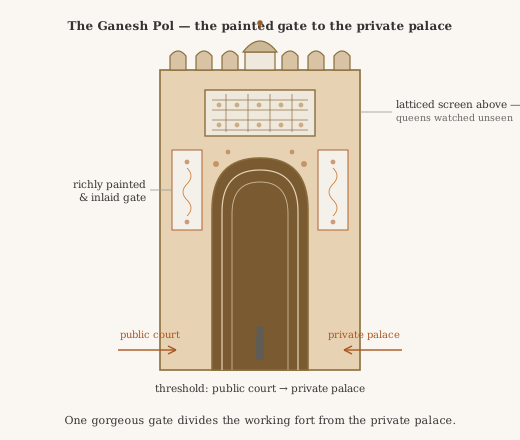
You enter and ascend through a carefully staged sequence, and the drama is in the progression from public to private. The lower courtyards are for arrival, for the assembly of retainers, for the Diwan-i-Aam, the hall of public audience — an open pillared pavilion where the ruler dealt with the business of the realm. Then comes the threshold that separates the working fort from the private palace: the Ganesh Pol, a tall gateway covered in painted and inlaid decoration, one of the most gorgeous gates in India, beyond which only the royal household could pass.
Above it opens the private heart of the palace — a formal charbagh garden, the four-quartered Mughal paradise-garden we met at Humayun's Tomb, here laid out in a courtyard high on a Rajasthan hillside, flanked by two pleasure-pavilions facing each other across the greenery. That a Mughal garden form sits at the centre of a Rajput fort is not an accident; it is the whole point of Amber.
Four devices, and the meeting of two styles
The pavilions around that garden are where Amber's architecture becomes exquisite, and where you can watch two traditions blend. Four devices repay close attention.
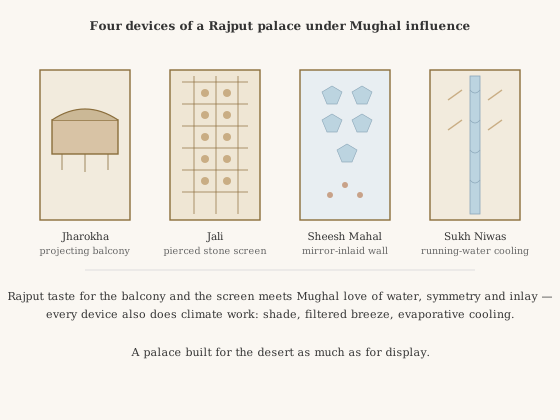
The jharokha is the projecting covered balcony, corbelled out from the wall on brackets and roofed with a little cupola — a distinctively Rajput (and broadly Indian) feature that lets a person look out, and catch a breeze, without being fully exposed. The jali is the pierced stone lattice, a screen carved so finely that it becomes a wall of holes: it filters the harsh desert light into soft patterns, lets air flow through, and allows the women of the household to see out into the public courts without being seen — privacy and climate control in one carved slab. Both of these the Rajputs shared with, and traded back and forth with, the Mughals; the jali reaches its most delicate form in Mughal marble, but its structural idea is everywhere in Rajasthan.
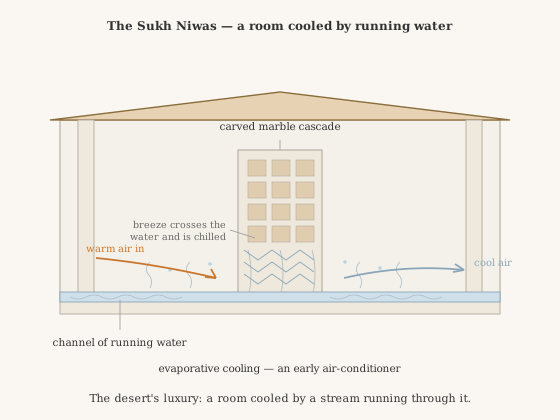
The third device is the glory of Amber: the Sheesh Mahal, the "palace of mirrors" (also called the Jai Mandir). Its walls and ceiling are inlaid with thousands of tiny pieces of mirror and coloured glass, set into fine stucco, so that the light of a single lamp or candle, multiplied across the surfaces, makes the whole room glitter like a night sky. Mirror-work of this kind came into India through Mughal and, ultimately, Persian channels, and the Rajputs took to it with delight. The fourth device is the most quietly ingenious: the Sukh Niwas, the "hall of pleasure", cooled by a channel of water running through the room over a carved marble cascade, so that a breeze passing across the flowing water is chilled by evaporation before it reaches the occupants — an early, elegant form of air-conditioning for a climate where summer is an enemy.
Notice the theme running through all four: every one of these beautiful things is also practical. The balcony shades; the screen cools and conceals; the mirrored hall makes the most of scarce lamplight in a windowless, defensible room; the water channel fights the heat. This is architecture for a hard climate and an insecure age, dressed as luxury. The Rajputs never had the peace or the resources of the imperial Mughals, and their architecture is the more resourceful for it.
Why Amber matters
Amber is the finest place to understand a synthesis that shaped much of northern Indian architecture for two centuries. The Rajputs were the Mughals' rivals, then their vassals and allies, then their in-laws; and out of that fraught, intimate relationship came a shared visual language. From the Mughals the Rajputs took the formal garden, the symmetrical audience hall, the arch, the inlay, the mirror-work; to it they added their own love of the projecting balcony, the domed kiosk (chhatri), the massive hill-fort, and a certain exuberance of colour and paint. You can trace the same fusion at the great forts of Gwalior, Jodhpur, Chittorgarh and, most famously, in the planned city of Jaipur that the rulers of Amber built when they finally came down from the hill.
Set against the other palaces and tombs in this series, Amber teaches a distinct lesson. The Taj Mahal is imperial architecture at rest — the product of unlimited resources and total security, refined to a single perfect statement. Amber is provincial architecture on its guard: cleverer, denser, more defensive, wringing beauty and comfort out of a fortress on a dry hill. Both are magnificent, but they come from opposite conditions — the difference between an emperor building a monument to grief, and a warrior-clan building a home they might have to defend.
Stand in the Sheesh Mahal at Amber as a guide lights a single flame and the whole room bursts into a thousand points of light; step out onto a jharokha and feel the hot wind turn cool as it crosses the water of the Sukh Niwas; look down through a jali at the lake far below — and you understand why the Rajput palace, half fortress and half dream, is one of the most human and inventive of all Indian building traditions.
Part of the Architectural Wonders series. For the Mughal architecture Amber absorbed, read about Humayun's Tomb and the Taj Mahal; for another fortified capital of the same era, see the ruined city of Hampi.
Export this guide
Related Guides — Deep-dive reading
Mehrangarh Fort, Jodhpur: A Citadel Grown from the Rock
How the Rathore kings of Marwar raised one of the mightiest forts in India on a sheer cliff above the blue city — a fist of stone whose brutal walls and trapped gateways guard a hidden jewel of delicate palaces
Architectural WondersThe Hawa Mahal, Jaipur: A Palace That Is Almost Entirely a Window
How the rulers of Jaipur built a five-storey honeycomb of nine hundred latticed windows — a thin pink screen that let the royal women watch the city unseen and cooled itself on the desert breeze
Architectural WondersThe Red Fort, Delhi: Shah Jahan's Palace of Paradise on the River
How the emperor who built the Taj Mahal raised a whole walled palace-city in red sandstone and white marble — a fortress on the outside, a garden threaded with running water within, and the stage on which modern India was born
Architectural WondersRelated Tools — Try Free
Cross-Ventilation Analyzer
Estimate airflow and air changes per hour (ACH) from room size, window areas, layout, and local wind — with NBC 2016 Part 8 compliance check.
Ventilation CalculatorCircadian Light Meter
Patient-centric circadian lighting visualizer for Indian healthcare design — time-of-day × intensity → CCT, melanopic lux (EML / mEDI), melatonin suppression, and an alertness curve. Calibrated against WELL v2 L03 Circadian Lighting Design, CIE S 026:2018, Brainard 2001, and Lucas et al. 2014.
Circadian ToolHome Colour Studio
Colour every room — living, bedroom, dining, kitchen, bathroom — surface by surface in any HEX/RGB/CMYK colour, or from 80+ curated Indian shades.
Colour Studio