
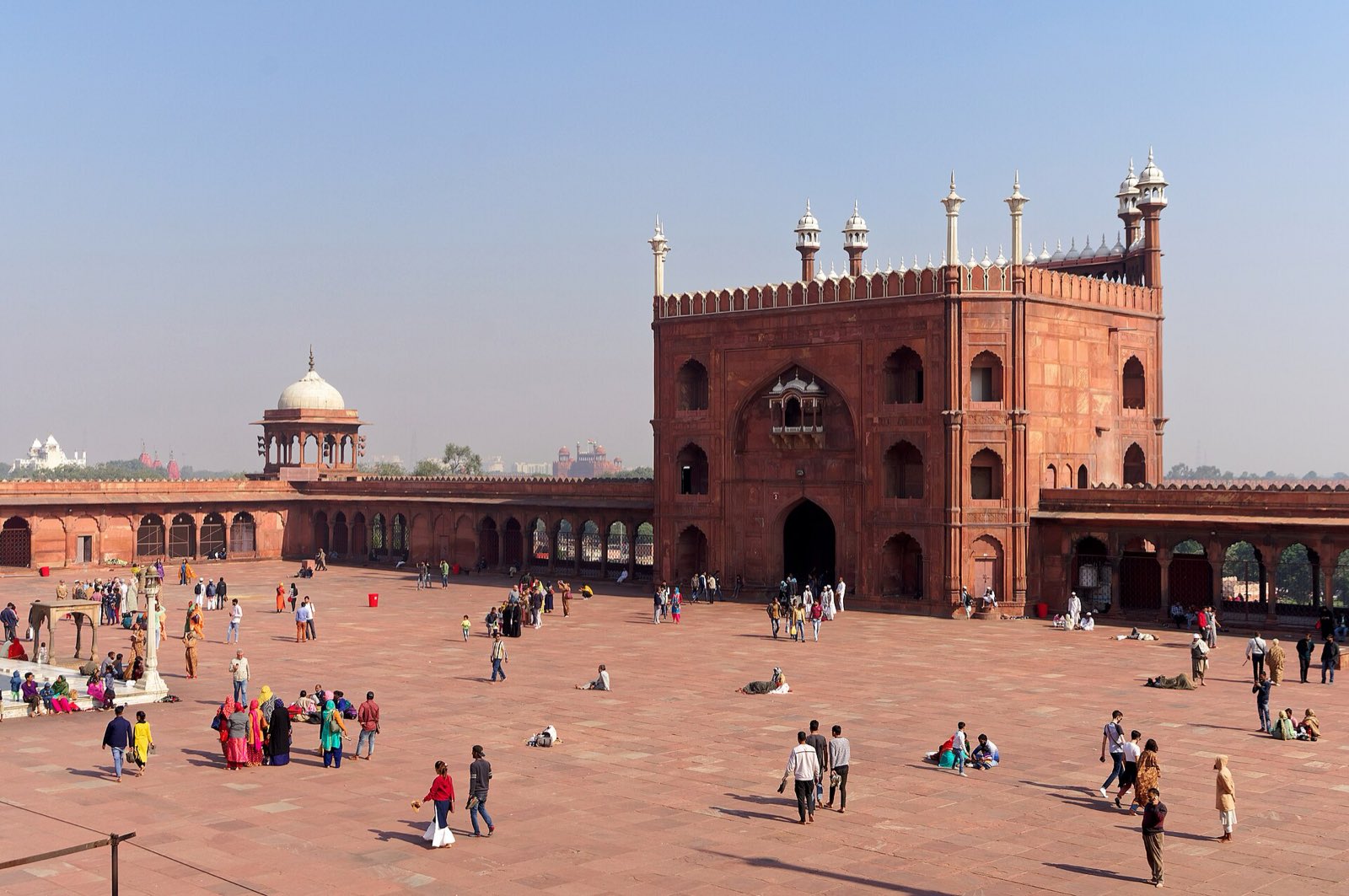
The Jama Masjid, Delhi: A Courtyard for Twenty-Five Thousand, Facing Mecca
How Shah Jahan built the great congregational mosque of his new capital — a vast raised courtyard, three marble domes and two soaring minarets — and why a mosque is a building defined not by a centre but by a direction
Across the road from the Red Fort, on a natural rise above the old city of Delhi, stands the largest mosque in India and one of the largest in the world. The Jama Masjid — the "Friday Mosque," the great congregational mosque where the whole community gathers for the main weekly prayer — was the last and grandest religious building of the emperor Shah Jahan, completed in 1656, the same decade as the Red Fort beside it. Together the fort and the mosque were the twin poles of his new capital, Shahjahanabad: the seat of worldly power and the house of God, facing each other across the heart of the city.
The Jama Masjid is the best building in this series for understanding what a mosque actually is, as a piece of architecture — because a mosque is organised on a completely different principle from a temple, and once you see that principle, the whole design falls into place.
A building defined by a direction
A Hindu temple, as we have seen again and again in this series, is organised around a centre: a dark sanctum at the heart, holding the image of the god, with the whole building — towers, halls, enclosures — arranged concentrically around that still point. A mosque is organised around something quite different: a direction.
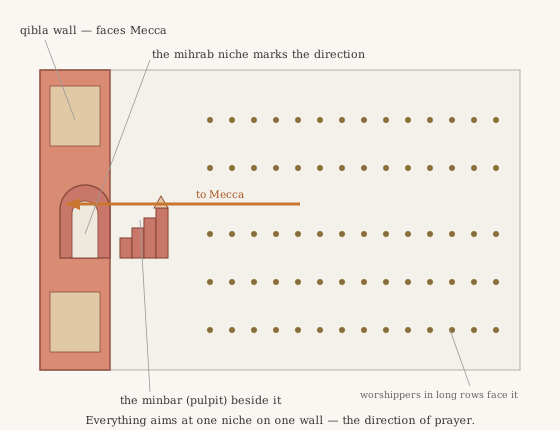
Islam requires that prayer be offered facing the Kaaba in Mecca, and everything about a mosque's plan serves that single requirement. The direction of Mecca is called the qibla, and in India it lies to the west. So the defining element of the Jama Masjid is its west wall, the qibla wall, set at right angles to the direction of prayer, with a niche at its centre — the mihrab — marking the exact direction the worshippers must face. When the mosque is full, twenty-five thousand people stand in long straight rows, all facing that wall, all oriented the same way, toward a city two and a half thousand miles away. The mosque is not a container for an object; it is a vast instrument for pointing a crowd in one direction.
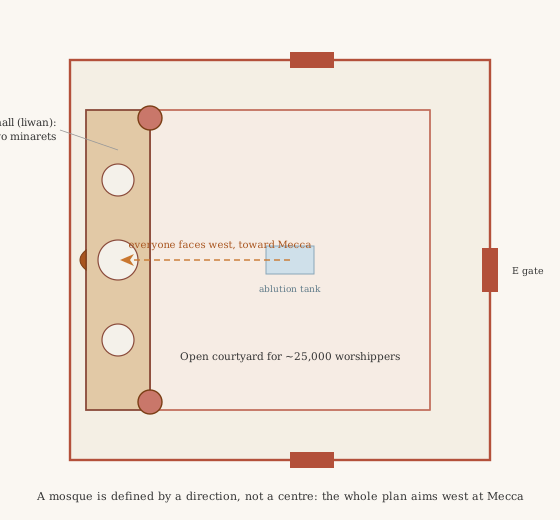
Everything else follows. On the west side stands the covered prayer hall (the liwan), sheltering the qibla wall and the mihrab. In front of it opens an enormous square courtyard (the sahn), open to the sky, big enough to hold the whole congregation when the prayer hall overflows — for Friday prayer is a mass event, and the courtyard is the real body of the mosque. At its centre is a tank for the ritual washing that must precede prayer. The courtyard is entered by three great gateways on its three other sides, raised on flights of steps, for the whole mosque sits on a high plinth lifting it above the streets. There is no hierarchy of access, no inner sanctum reserved for priests: Islam has no priesthood and no images, and the courtyard is a single, open, egalitarian space where all worshippers stand equal before God, shoulder to shoulder in their rows.
The face of the prayer hall
The architectural drama is concentrated on the façade of the prayer hall — the great composed front that faces the worshippers across the courtyard, and that you see rising above the city from far off.
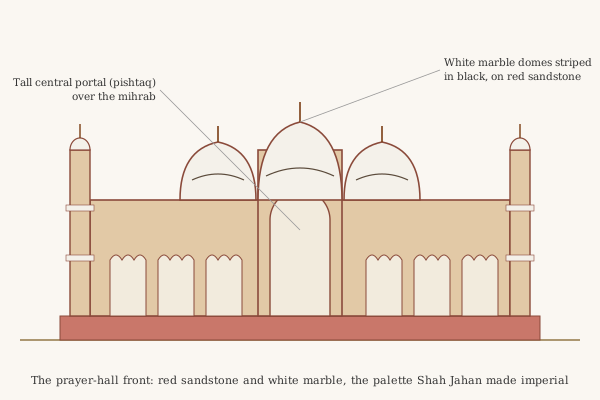
At its centre rises a tall arched portal, the pishtaq — a great recessed arch set in a rectangular frame, marking the entrance to the prayer hall and, behind it, the mihrab. To either side runs a screen of cusped arches, the scalloped Shah Jahani arch we met at the Red Fort. Above rise three great domes of white marble, banded with thin stripes of black, and at the two ends of the façade stand two soaring minarets, some forty metres tall, striped in red sandstone and white marble, each climbed by a spiral stair to a balcony from which the faithful could be called to prayer. The whole is built in the imperial Mughal palette that Shah Jahan made his signature — red sandstone as the body, white marble for the domes and the accents — the same combination as Humayun's Tomb before it and, in reverse proportion, the all-marble Taj Mahal.
The composition is a masterclass in Mughal balance: the long horizontal sweep of the arched façade, anchored at the centre by the tall vertical portal, lifted at the ends by the two minarets, and crowned by the rhythm of the three domes — the largest in the middle, echoing and gathering the whole. It is symmetrical, serene and monumental, designed to be read as a single grand image across the width of the courtyard.
Scale, and the meaning of the mass
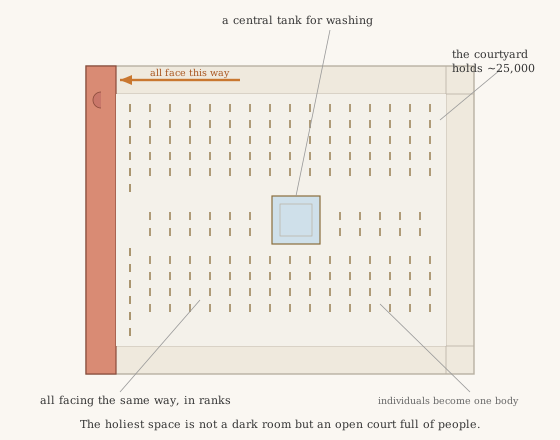
The Jama Masjid's power is inseparable from its scale, and the scale has meaning. A congregational mosque exists to hold the entire community at once, and its vast courtyard is a physical expression of that idea — a space where thousands of individuals become a single body of worshippers, all facing the same way, moving in unison through the postures of prayer. Where the Taj Mahal is intimate and elegiac, a jewel for one dead empress, the Jama Masjid is communal and public, built for the living crowd. The two are the same emperor's architecture turned to opposite human purposes: private grief and public faith.
Its position, too, is deliberate. Raised on its plinth on the high ground of the city, it dominates old Delhi's skyline; and set directly across from the Red Fort, it completes Shah Jahan's vision of the ideal Islamic capital, in which the palace of the emperor and the house of God stand in balance at the centre of the city, the temporal and the spiritual authority of the realm made visible in stone.
Why the Jama Masjid matters
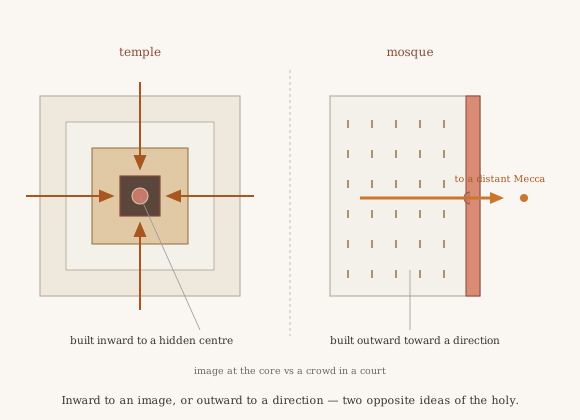
In this series the Jama Masjid does a particular job: it is the clearest lesson in the logic of Islamic architecture, the counterpart and contrast to all the temples that surround it. Read it against the Lingaraja temple or Srirangam and the two systems come into focus — the temple built inward toward a hidden image at its centre, the mosque built outward and oriented toward a distant direction, its holiest space not a dark chamber but an open courtyard filled with people. Read it against the Charminar and the Gol Gumbaz and you see the imperial Mughal version of the mosque — grander, more balanced, more marble-crowned than its Deccan cousins.
Climb the steps to one of its great gateways, look across the immense courtyard to the three domes and the twin minarets rising over the prayer hall, and imagine it filled on a Friday with twenty-five thousand people bowing together toward the west — and you understand the essential idea the whole building serves: not a god enshrined at the centre, but a community turned, as one, toward Mecca.
Part of the Architectural Wonders series. Read its twin across the road, the Red Fort; Shah Jahan's masterpiece the Taj Mahal; and the Mughal architecture that led up to them at Humayun's Tomb.
Hero photograph: “Jama Masjid, Delhi” by Jakub Hałun, via Wikimedia Commons, licensed under CC BY-SA 4.0.
Export this guide
Related Guides — Deep-dive reading
The Charminar, Hyderabad: A City Founded on a Crossroads
How the Qutb Shahi sultans marked the birth of a new capital with a four-faced arch you drive straight through — part triumphal gateway, part mosque, part the still point at the centre of a planned city
Architectural WondersGol Gumbaz, Bijapur: The Deccan Tomb That Roofed a Whole Hall with One Dome
How the sultans of Bijapur raised one of the largest domes in the world over a single vast room, balanced on a net of intersecting arches, with a gallery where a whisper travels right around the sky
Architectural WondersThe Red Fort, Delhi: Shah Jahan's Palace of Paradise on the River
How the emperor who built the Taj Mahal raised a whole walled palace-city in red sandstone and white marble — a fortress on the outside, a garden threaded with running water within, and the stage on which modern India was born
Architectural WondersRelated Tools — Try Free
Circadian Light Meter
Patient-centric circadian lighting visualizer for Indian healthcare design — time-of-day × intensity → CCT, melanopic lux (EML / mEDI), melatonin suppression, and an alertness curve. Calibrated against WELL v2 L03 Circadian Lighting Design, CIE S 026:2018, Brainard 2001, and Lucas et al. 2014.
Circadian ToolCross-Ventilation Analyzer
Estimate airflow and air changes per hour (ACH) from room size, window areas, layout, and local wind — with NBC 2016 Part 8 compliance check.
Ventilation CalculatorAI BOQ Generator
AI generates detailed Bill of Quantities with city-specific rates and labour breakdown.
ArchitectAI