
The City Palace of Udaipur: A Labyrinth of Marble Above a Lake
How the Rajputs of Mewar, driven from their war-fort, built a new capital not on a dry hill but on the shore of a lake — a palace grown over four centuries into a shimmering white labyrinth, with island palaces floating on the water below
We left the Rajputs of Mewar at Chittorgarh, their great war-fort on its dry plateau, the scene of siege and sacrifice, which finally fell to the Mughal emperor Akbar in 1568. What did a proud warrior-dynasty do when its ancient stronghold was lost? It built a new capital — but a very different kind of place. Instead of another bare hill-fortress, the Mewar rulers founded Udaipur beside a lake, and raised there a palace that trades the martial grandeur of the hill-fort for something softer and more magical: a shimmering white palace-city strung along a ridge above the water, with island palaces that seem to float on the lake before it. The City Palace of Udaipur is the largest royal palace complex in Rajasthan, and it is the most romantic building in this series — the point where Rajput architecture turns from the fortress to the mirror of the lake.
From the war-fort to the lake
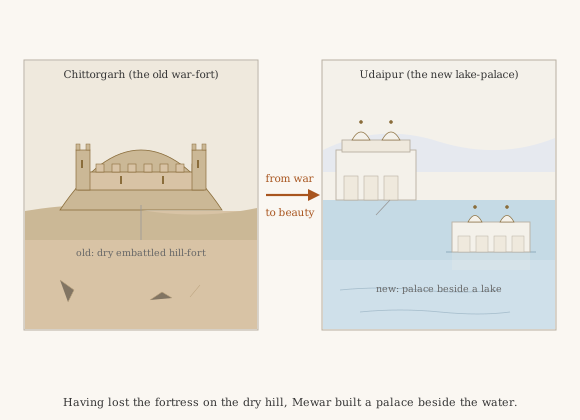
The founding of Udaipur is a direct response to the loss of Chittorgarh. Maharana Udai Singh II, ruler of Mewar, chose a new site in the hills around a lake, Lake Pichola, that offered both water and natural defence, and began building his palace there around 1559. His successors — for Mewar's line of maharanas continued, unbroken and fiercely proud, for centuries — added to it continually, so that the City Palace we see today is the work of some four hundred years and more than twenty rulers. The choice of a lakeside rather than a hilltop marks a shift in the whole character of Rajput royal life: from the embattled austerity of the war-fort to a courtly world of pleasure-palaces, gardens and water, though the palace remained, always, defensible.
The palace and the lake
The single most important thing about the City Palace is its relationship to the water.
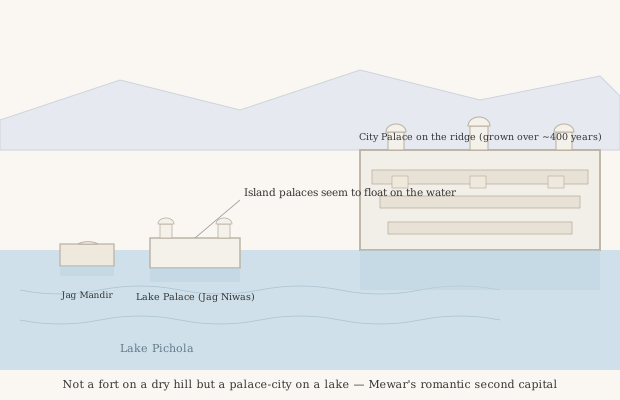
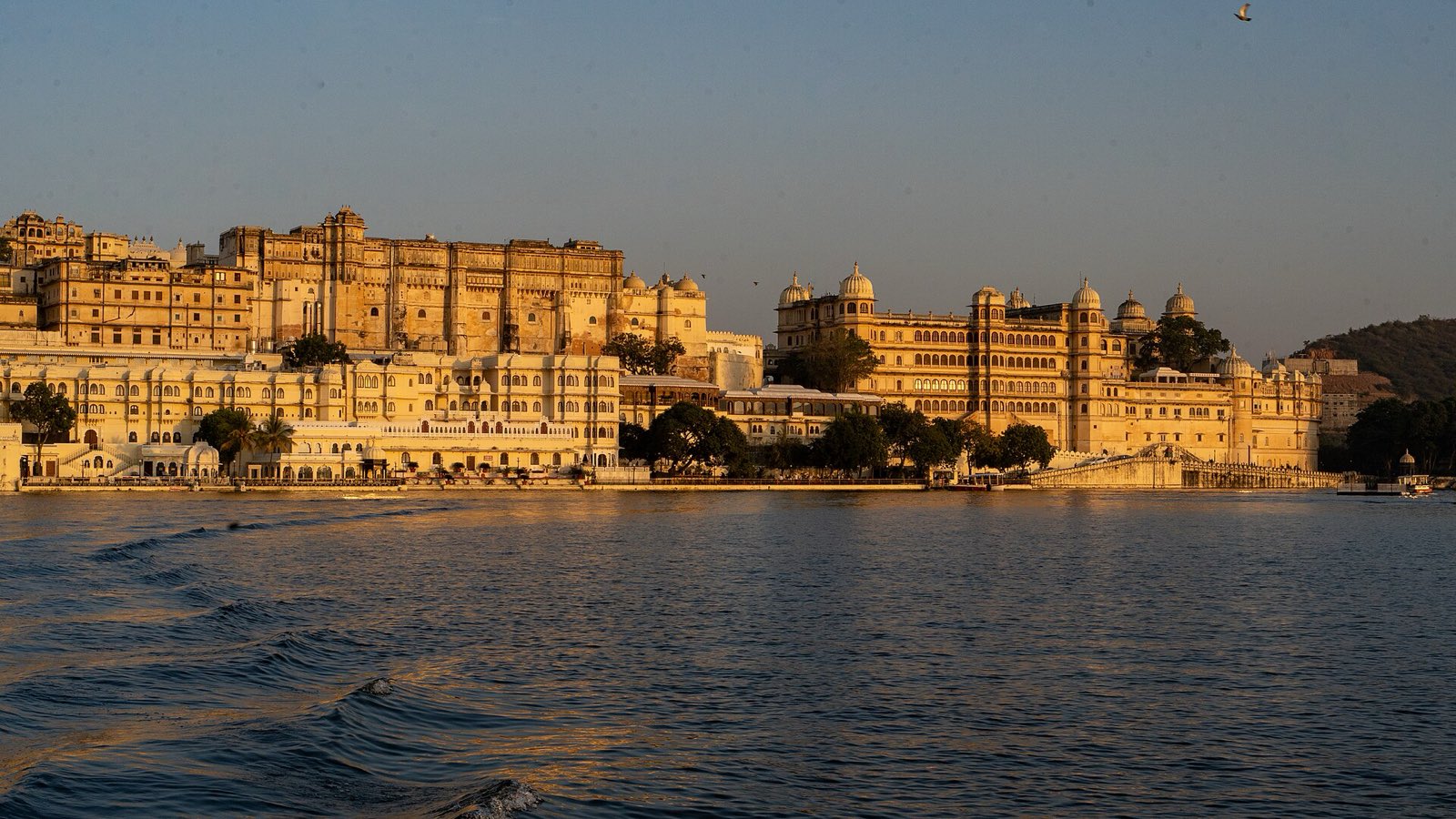
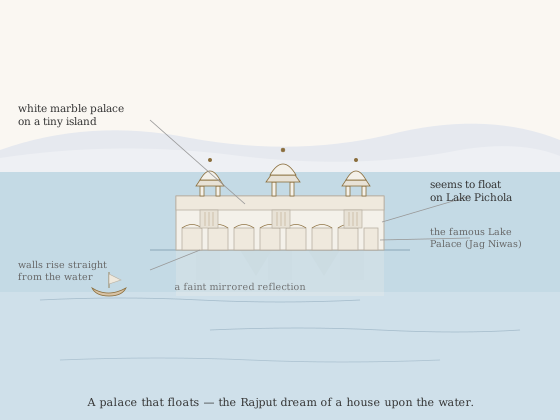
The main palace runs for a great length along a ridge on the eastern shore of Lake Pichola, rising in tiers of balconies, screened windows and cupolas, its pale granite and marble catching the light and reflecting in the still water below. It is a water-palace in conception: designed to be seen from the lake and to look out over it, its whole architecture oriented to the shimmering surface at its feet. And on the lake itself float the palace's most famous offspring — two island palaces built by the maharanas as pleasure-retreats. Jag Mandir and, most celebrated of all, Jag Niwas, the "Lake Palace," a low white palace covering its entire small island so completely that it appears to float, unsupported, on the water — one of the most photographed buildings in India, and now a hotel.
This water-architecture is a distinct branch of the Rajput tradition. Where Amber and Mehrangarh command dry heights, and even used water defensively, Udaipur makes the lake the very heart of the composition — a body of water to be lived beside, boated upon, reflected in, and dotted with floating palaces. The desert kingdom's deepest luxury was water, and at Udaipur that luxury became the organising principle of a whole royal city.
A palace that grew like a coral reef

The second thing to understand about the City Palace is that it was never designed as a single building. Walk through it and you find a bewildering, wonderful labyrinth of courtyards, corridors, staircases, terraces and rooms at many levels, and the reason is written in its history.
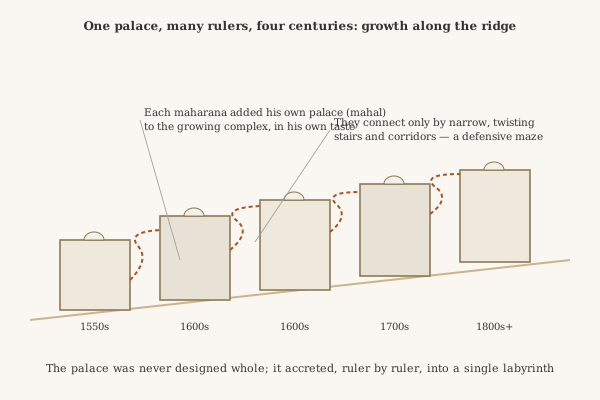
Each maharana, over four centuries, added his own palace — his own mahal — to the growing complex, in the taste of his own time, along the ridge. The result is not one palace but a chain of palaces of different dates, fused together into a single enormous structure. And they connect to one another only by narrow, deliberately twisting corridors, low doorways and winding stairs — partly because the builders had to thread new work into the awkward gaps between old, and partly, by tradition, for defence: an enemy who got inside would be lost in a maze of narrow passages and blind turns, easily blocked and easily ambushed. So the palace is at once a palimpsest of Mewar's history — each ruler's addition legible within it — and a defensive labyrinth. This is the same principle of accretion we saw in the South Indian temple-towns, where each dynasty wrapped another ring around a growing whole; here it produces not concentric enclosures but a rambling, many-levelled palace-city that no single mind ever planned.
Within this labyrinth lie some of the most beautiful interiors in Rajasthan: the Mor Chowk, the "Peacock Courtyard," its walls set with glittering mosaics of peacocks in coloured glass; mirrored halls in the manner of the Sheesh Mahals we saw at Amber and Mehrangarh; painted chambers; and countless balconies and towers looking out over the lake. And the style, as at Amber, is a rich fusion — the Rajput love of the balcony, the cupola and the screen married to Mughal arches, gardens and inlay, with later touches of European taste added by the nineteenth-century rulers.
Why Udaipur matters
The City Palace of Udaipur completes this series' long study of the Rajput fort-palace with its most romantic and most humane example. Amber gave us the refined hill-palace; Mehrangarh the impregnable war-citadel; Chittorgarh the vast fortified city of honour and sacrifice. Udaipur gives us what came after the age of great sieges: a royal architecture that could turn from war toward beauty, that chose a lake over a battlefield, and that grew, ruler by ruler and century by century, into a labyrinth of white marble mirrored in still water. It is the Rajput imagination at its most poetic — and a reminder that the same dynasty that built the grim ramparts of Chittorgarh could also, a few generations later, build a palace that seems to float, weightless and shimmering, on the surface of a lake.
Stand on a terrace of the City Palace at dusk, with the lake turning gold below and the Lake Palace floating on the water and the hills darkening beyond, and you understand why Udaipur has enchanted every traveller who ever saw it — and why the Rajputs, having lost their fortress on the dry hill, built their new home beside the water, and made of it something closer to a dream than a fort.
Part of the Architectural Wonders series. Read the war-fort the Mewar rulers left behind, Chittorgarh; and the other great Rajput palaces, Amber and Mehrangarh.
Hero photograph: “City Palace from Lake Pichola, Udaipur” by Kandukuru Nagarjun from Bangalore, India, via Wikimedia Commons.jpg), licensed under CC BY 2.0.
Export this guide
Related Guides — Deep-dive reading
Amber Fort, Jaipur: The Rajput Palace That Learned to Speak Mughal
How the warrior-kings of the desert built a fortress-palace up a hillside above a lake — half stronghold, half pleasure-house — where mirrors, lattices and running water turned defence into delight
Architectural WondersGreat Zimbabwe: The Stone City Europe Refused to Believe Africans Built
In the hills of southern Africa stand the largest ancient stone ruins south of the Sahara — a whole city of massive granite walls built without a drop of mortar, the wealthy capital of a gold-trading kingdom. For a century, colonists refused to accept that Africans had raised it, and invented every other builder they could. This is the story of that architecture, and of the lie it outlived. The article that closes our chapter on the palaces and pleasures of worldly power.
Architectural WondersSomapura Mahavihara: The Buddhist University Hidden Inside a Hill
Twelve hundred years ago in Bengal, a Pala emperor built one of the largest monasteries the Buddhist world had ever seen — a walled quadrangle a fifth of a mile across, ringed by 177 monks' cells, with a great cross-shaped, terraced temple rising from its courtyard. For four centuries scholars came from as far as Tibet to study here; then it was abandoned, and slowly buried, until villagers knew it only as Paharpur — 'the hill-town.'
Architectural WondersRelated Tools — Try Free
Circadian Light Meter
Patient-centric circadian lighting visualizer for Indian healthcare design — time-of-day × intensity → CCT, melanopic lux (EML / mEDI), melatonin suppression, and an alertness curve. Calibrated against WELL v2 L03 Circadian Lighting Design, CIE S 026:2018, Brainard 2001, and Lucas et al. 2014.
Circadian ToolConcept Generator
Get 3 AI-generated design concepts for any room with style, materials, and cost estimate.
DesignAIHome Colour Studio
Colour every room — living, bedroom, dining, kitchen, bathroom — surface by surface in any HEX/RGB/CMYK colour, or from 80+ curated Indian shades.
Colour Studio