
Khajuraho: The Temple Built to Be a Mountain
How the Chandela masons of 10th-century central India made the northern temple rise like a Himalayan peak — and why its sculpture, its engineering and its improbable survival still instruct the modern architect.
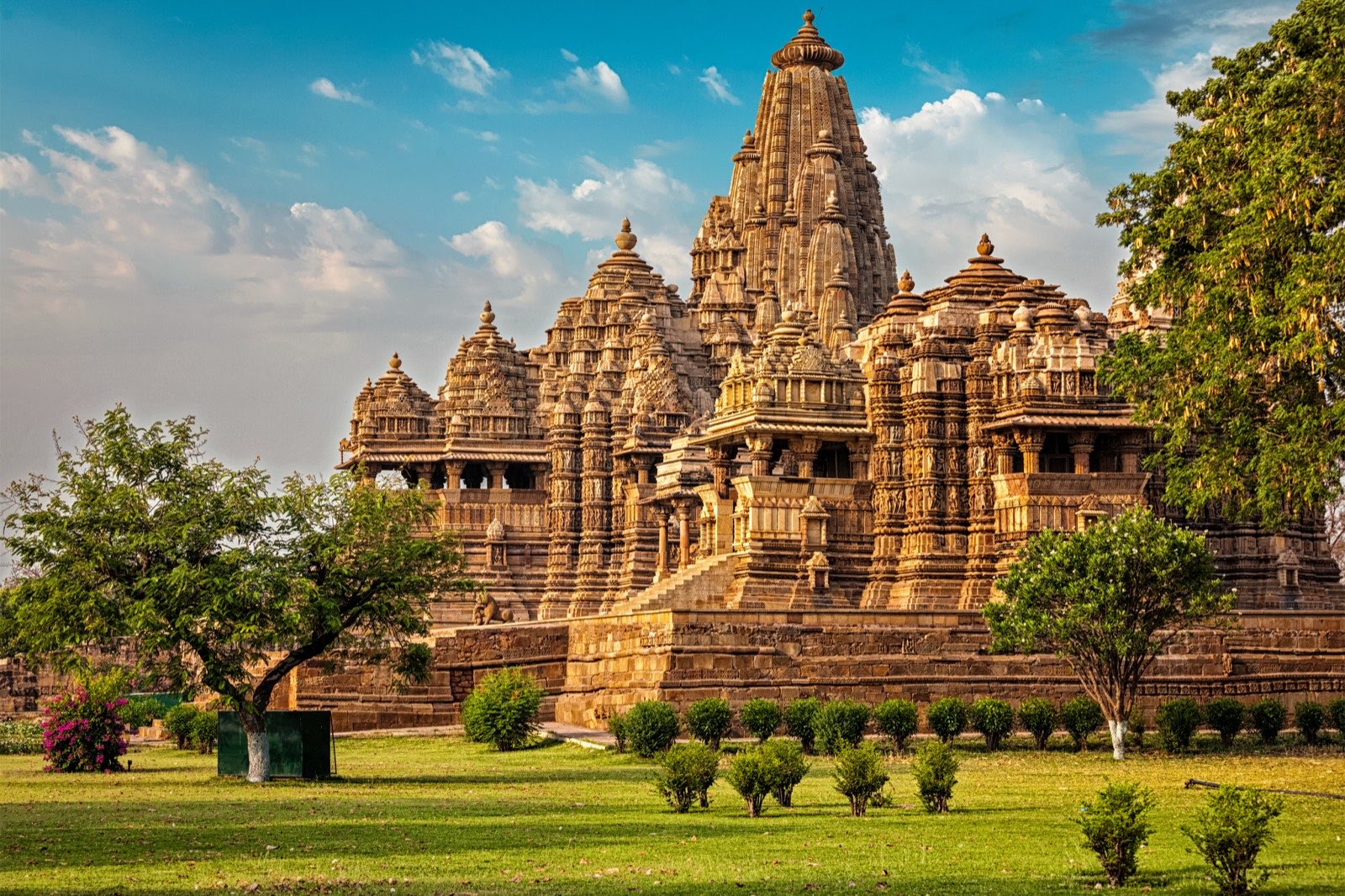
Come to the Western Group at Khajuraho a little after sunrise, when the sandstone is still cool and the light is coming in low from the east. From a distance the great temple does not read as a single building at all. It reads as a range of peaks — a central summit with a crowd of lesser summits pressing up around it, the whole mass rising in a single upward surge and then breaking, at the very top, into a clean point against the sky. Walk closer and the peaks resolve into carved stone, and the stone resolves into thousands of figures, and you realise that what looked like a mountain from the road is a mountain when you arrive too. The Kandariya Mahadeva temple was not built to sit at the foot of a sacred mountain. It was built to be one.
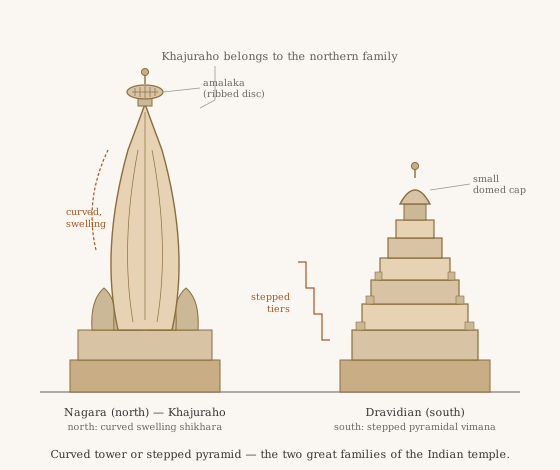
This is another article in our Architectural Wonders series, and it belongs beside three we have already told. At Konark the temple is a chariot, the sun's own vehicle made permanent in stone. At Kailasa the temple is a mountain carved out of a mountain — architecture made by subtraction, freed from the living rock. Khajuraho is the third move: the mountain assembled, block on dry block, and made to rise. Where the southern Brihadeeswara answered the same ambition with one clean pyramidal tower, the north answered it with a whole massed crescendo. This is that crescendo, explained.
1. A temple built to be a mountain
Everything about the exterior is organised to make your eye climb. Over the sanctum rises the shikhara — the tower that, in the northern Nagara tradition, is not a straight pyramid but a swelling, curving spire, gathered in at the top under a ribbed cushion-stone and a pot finial. But the true stroke at Khajuraho is what surrounds it. The main spire is clustered with dozens of urushringa — half-spires and miniature replicas of itself, growing up the flanks of the great tower in diminishing tiers. The effect is deliberate and precise: each little spire is a smaller echo of the whole, and together they build a rising rhythm that carries the eye from the low porch, up over the swelling halls, to the single culminating peak.
This is not decoration. It is cosmology drawn in stone. The clustered mass is meant to be Mount Kailasa — Shiva's Himalayan home — and, at a deeper level, cosmic Mount Meru, the axis of the universe around which everything turns. The lesser spires are the lesser peaks of the range; the summit is the world-axis; the dark sanctum beneath is the cave at the mountain's heart where the god resides. When you stand before the Kandariya Mahadeva you are standing, by design, before a model of the sacred mountain of the world.
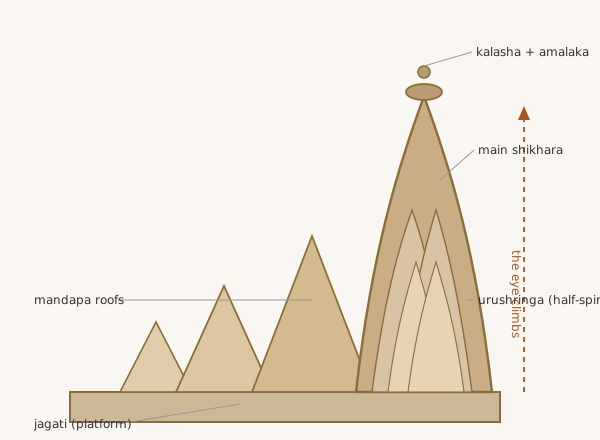
The northern shikhara: a main spire clustered with ever-smaller urushringa and rising in a single crescendo — the built form of the sacred mountain.
2. The grammar of the northern temple
Beneath the drama there is a very disciplined plan, and Khajuraho states it with unusual clarity. The temple is set high on a shared stone platform (jagati), lifted above the ground so that you must climb a steep flight of steps to enter — the ascent begins before you are even inside. It faces east, to the rising sun.
Move through it and the spaces come in a rising sequence, each taller than the last, mirroring the profile outside:
- an entrance porch (ardha-mandapa),
- a hall (mandapa),
- a great pillared hall (maha-mandapa) with balconied openings that let in light and air,
- a narrow vestibule (antarala),
- and finally the small, dark, cube-like sanctum, the garbha-griha — literally the "womb-chamber" — holding the Shiva linga.
The Kandariya Mahadeva is of the fuller sandhara type, which means an enclosed passage wraps the sanctum so the devotee can perform pradakshina, circling the deity. Look at the plan from above and you see the other secret of the northern wall: it is not flat. It steps in and out in a rhythm of projections and recesses — the sapta-ratha, "seven chariots" — so that the whole exterior is faceted like a cut gem. Those steps are what catch the low morning and evening light and throw the sculpture into deep relief. The building is, in effect, designed for raking sunlight.
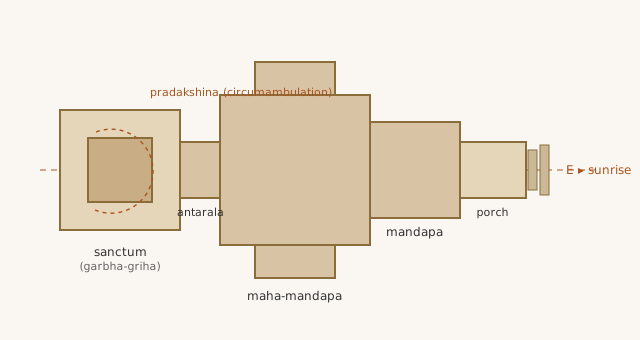
The plan rises along one east-facing axis — porch, hall, great hall, vestibule, sanctum — with a passage wrapping the sanctum for circumambulation; the outer walls step in and out to catch the light.
3. The living skin — Khajuraho's sculpture
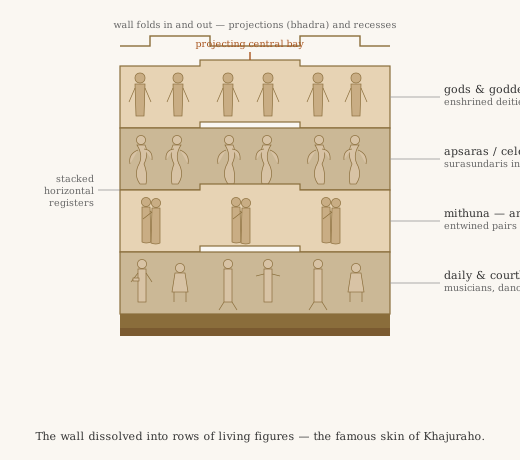
No account of Khajuraho is honest if it skips the sculpture, and none is complete if it reduces the temple to it. The exterior carries something on the order of eight hundred figures, banded in horizontal registers around the entire building: guardians and gods in their niches, but above all the surasundaris — the celestial women who are the true genius of Khajuraho. They are caught in ordinary, intimate acts: wringing water from wet hair, removing a thorn from a foot, writing a letter, applying kohl to an eye, playing with a child, glancing back over a shoulder. After a thousand years they are still absolutely alive — the finest sculpture of the female form in Indian art.
A fraction of the figures — a common estimate is under a tenth — are the erotic carvings for which the site is popularly known, the entwined mithuna couples. It is worth being clear-eyed and grown-up about them. Scholars have offered many readings and no single one is proven: that they express kama, desire, as one of the legitimate aims of a full human life, standing beside duty, prosperity and liberation; that they are auspicious and protective, guarding the thresholds; that they belong to a tantric current in which union is a spiritual metaphor; that they mark, on the outer walls, the worldly appetites the devotee is meant to set down before entering the still, unadorned sanctum. What is certain is the composition: the erotic panels are a small, integrated part of a vast celebration of the whole of life — divine, human, animal and sensual — carved as one continuous fabric.
And that fabric is not applied to the wall. It is the wall. The figures are cut from the same sandstone blocks that carry the load; sculpture and structure are a single act of building. This is the opposite of ornament stuck onto a finished shell.
4. How it stands — the engineering
Here is the fact that should stop any architect. The temples of Khajuraho are built of dry masonry — sandstone blocks laid up without mortar, held together by nothing but their own weight, the precision of their cut, and, at critical points, iron dowels and mortise-and-tenon joints locking one stone to the next. There is no cement, no binder. It is a thousand-year-old friction structure.
The soaring shikhara is not solid, and it is not a true arch — Indian masons of the period built by corbelling, each course of stone stepping slightly inward over the one below until the sides meet. Corbelling cannot span far, which is precisely why the sanctum below is kept small and cubic: the span is short, the walls are massively thick, and the clustered half-spires around the main tower are not only symbolic — they buttress it, leaning the whole mass together into one self-stabilising cone. The high platform spreads the enormous dead load onto the ground. It is a structure that works by being heavy, compact, interlocked and mutually propped.
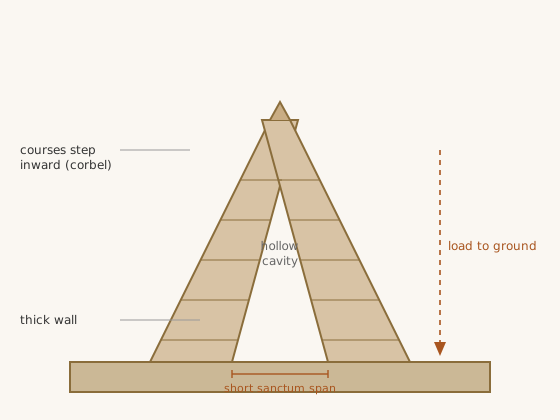
Corbelling: each course of stone oversails the one below until the walls meet, so the sanctum span is kept short and the mass leans into itself — heavy, compact and self-buttressing.
Set that beside the two towers we have already watched in this series. At Konark the Kalinga masons reached for a taller, more slender tower and it came down, defeated by its own ambition. At Brihadeeswara the Cholas raised an even taller granite tower and it has never fallen. Khajuraho is the third answer: not the tallest, but the most self-braced — a tower that survives by clustering, by keeping its spans short and its masses mutually supporting. Three temples, three solutions to the single hardest problem in pre-modern architecture: how to make stone stand tall.
5. Eighty-five temples, twenty-five survivors
Khajuraho was the religious capital of the Chandela dynasty, who ruled this part of central India — the old region of Bundelkhand — from roughly the 10th to the 12th century. In perhaps a hundred years of confident, well-funded building they raised, by the traditional count, around eighty-five temples across the site. About twenty-five survive, grouped loosely into a Western, Eastern and Southern cluster, and — tellingly of the age that made them — the temples are Hindu and Jain together, built side by side by the same masons for the same patrons.
Then the Chandelas declined, the capital moved, and Khajuraho was left alone in the forest. Its very remoteness became its preservation: too far off the main roads to be worth demolishing, too obscure to be quarried for a later city, it was slowly swallowed by jungle and by memory. The fourteenth-century traveller Ibn Battuta noted the temples in passing. Then, in 1838, a young British engineer, T. S. Burt, was carried to the overgrown site by his palanquin-bearers and reported the astonishing thing they had found; Alexander Cunningham of the Archaeological Survey documented it properly soon after. The forest had kept for four centuries what a busier location would have lost. UNESCO inscribed the Khajuraho Group of Monuments as a World Heritage Site in 1986.
6. What a modern architect can learn from Khajuraho
- Compose in a crescendo. Khajuraho's power is not in any one element but in the build-up — porch to hall to great hall to sanctum, spirelet to spire to summit, the whole thing rising to a single point. Architecture is sequence and climax, not a flat collection of parts. Design the ascent.
- Make the ornament structural. The sculpture at Khajuraho is not applied to the wall; it is cut from the load-bearing stone. Where decoration and structure are one act, ornament never reads as add-on or expense — it reads as inevitable. It is the same lesson Hampi teaches with its musical pillars: hide the working inside the beauty.
- Integrate; do not segregate. The whole of life — divine and human, ascetic and sensual — is carried on one continuous surface and resolved, at the summit, into a single form. A building can hold contradictions and still be whole. Wholeness is a design decision.
- Design for the light you actually have. The faceted, stepped walls exist so that low morning and evening sun rakes across the sculpture and gives it depth. Orientation and relief were doing, a thousand years ago, what we now try to do with lighting design.
- Remoteness can be preservation — and humility is a strategy. What saved Khajuraho was that it was left alone. Not every good thing needs to be at the centre of everything; some of the most enduring work survives precisely because it did not compete for the busiest ground.
Khajuraho makes the northern case of the argument this whole series keeps returning to: the most powerful architecture is usually one clear, total idea, carried without flinching — here, the idea of the temple as the sacred mountain of the world, pursued from the plan of the floor to the point of the final stone.
References & further reading
1. UNESCO World Heritage Centre — Khajuraho Group of Monuments (inscribed 1986). https://whc.unesco.org/en/list/240/
2. Encyclopaedia Britannica — Khajuraho and Chandela dynasty. https://www.britannica.com/place/Khajuraho
3. Archaeological Survey of India — Khajuraho Group of Temples. https://asi.nic.in/
4. Incredible India (Ministry of Tourism) — Khajuraho. https://www.incredibleindia.gov.in/en/madhya-pradesh/khajuraho
Last verified 2026-07-04. Dates, temple counts and dimensions follow standard archaeological and art-historical reference sources and are given as widely accepted approximations; the several interpretations of the erotic sculpture are presented as scholarly hypotheses rather than settled fact, and the rediscovery account follows the historical record.
Export this guide
Related Guides — Deep-dive reading
Brihadeeswara: The Chola Tower That Never Fell
How an 11th-century Tamil emperor raised a 216-foot tower of solid granite — with no mortar, no iron and no machine — and why this colossal corbelled mountain has stood for over a thousand years where Konark's fell. The engineering, the 80-tonne capstone, and the lesson.
Architectural WondersPattadakal: Where India's Two Temple Grammars Meet
How the 8th-century Chalukyas built the temple at last in the open air — and set the curved spires of the North beside the stepped towers of the South, on one riverbank, as if in a single open-air showroom of styles. The site that crowned kings, named its architects, and gave Ellora its model.
Architectural WondersBadami: The Cradle of the South Indian Temple
How 6th-century Chalukya carvers, still working into a red sandstone cliff like the cave-makers before them, designed the porch, hall and sanctum that every later South Indian temple would copy — and shared one cliff between Shiva, Vishnu and the Jain Tirthankaras. The rock-cut laboratory where Dravidian architecture was born.
Architectural WondersRelated Tools — Try Free
Window Orientation Planner
Pick the best window type, glass and shading by wall direction — north, east, south and west.
Window ToolBefore & After Studio
Generate AI before-and-after renders to preview how your redesign could look.
DesignAIFalse Ceiling Cost Estimator
Live ₹/sqft across 8 ceiling types — POP, gypsum, designer, metal, PVC, wooden — with cove and spot lighting for 20 Indian cities.
Cost Calculator