
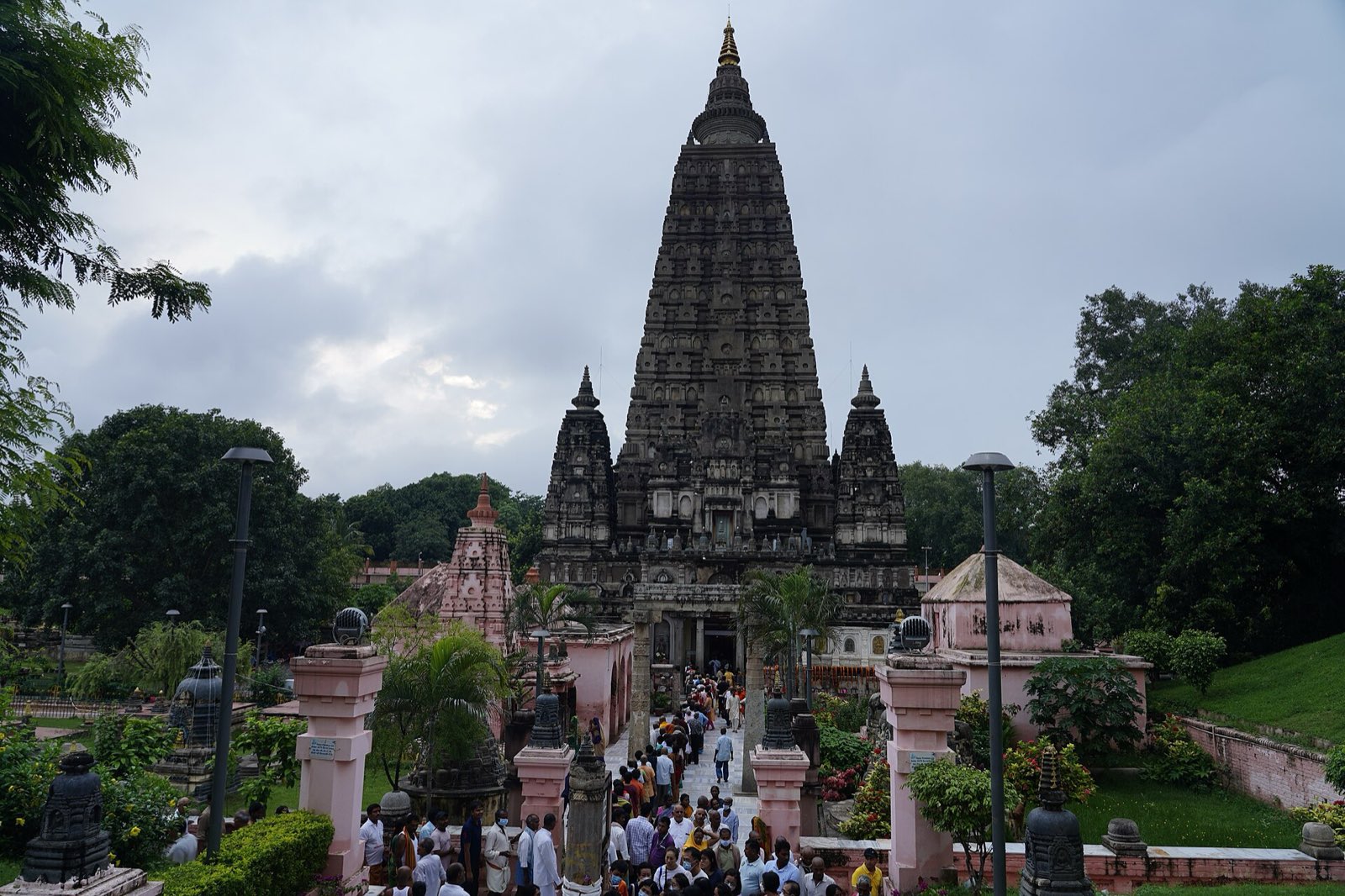
The Mahabodhi Temple, Bodh Gaya: A Building Raised Over the Exact Spot of Enlightenment
How the holiest place in the Buddhist world produced one of India's strangest towers — a straight-sided brick pyramid built not to house a god but to mark a single point of ground beneath a tree
Most temples are built to house something — an image, a relic, a god made present in stone. The Mahabodhi temple at Bodh Gaya is built to mark something: a single point on the surface of the earth, the spot where, by tradition around 2,500 years ago, a wandering prince named Siddhartha sat down under a fig tree, resolved not to rise until he understood the nature of suffering, and became the Buddha — the Awakened One. Everything about this extraordinary building follows from that one fact. It is less a container than a colossal signpost, planted over the most important patch of ground in the Buddhist world.
That gives Bodh Gaya a claim no other monument in this series can make. For hundreds of millions of Buddhists across Asia it is the single holiest place on earth, the navel of their faith — the equivalent of what Mecca is to Muslims or Jerusalem to Christians. And the temple that grew up to mark it is one of the oldest and most peculiar towers in all of Indian architecture.
The sacred geometry: a temple as a pointer
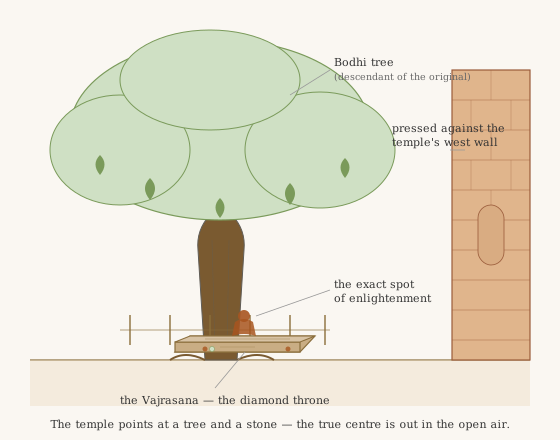
To understand the building you have to start not with the tower but with the ground behind it.
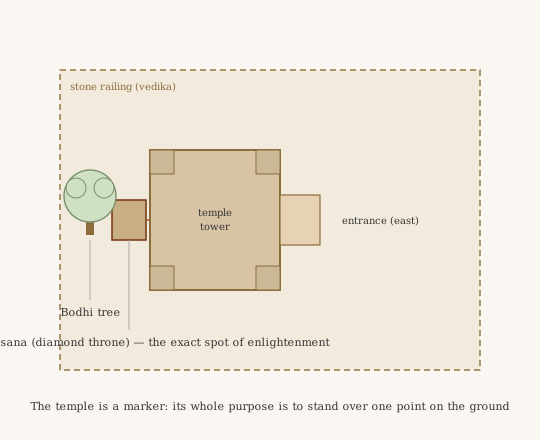
The temple faces east, and pressed directly against its western wall are the two things the whole complex exists for: the Bodhi tree — a descendant, by tradition, of the very tree the Buddha sat beneath — and beneath it the Vajrasana, the "diamond throne", a polished stone slab marking the exact place of his enlightenment. The temple does not stand over the throne; it stands immediately in front of it, so that the sacred spot and the great tower are locked together on a single east–west axis. Pilgrims circle the whole ensemble, and the tree and throne remain in the open air, touched by sun and rain, exactly where they have always been.
This is a profoundly different idea of a temple from the Hindu shrines elsewhere in this series. At Khajuraho or Madurai the sanctum is a dark inner chamber holding the deity's image, buried at the heart of the building. Here the holy thing is a tree and a spot of open ground, and the architecture arranges itself around it and points to it. The building serves the place, not the other way round.
The strangest tower in India
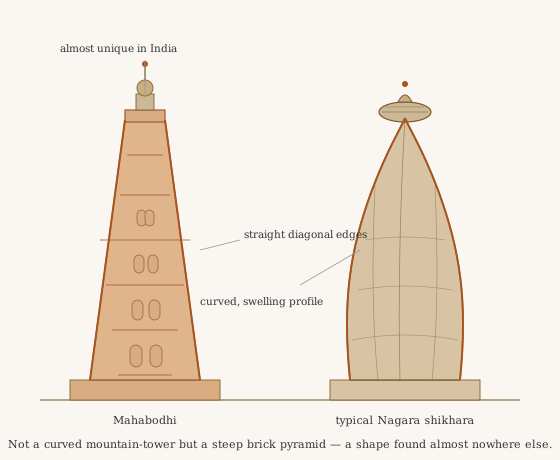
Now look up, because the tower itself is genuinely odd — a shape you will not find almost anywhere else in Indian architecture.
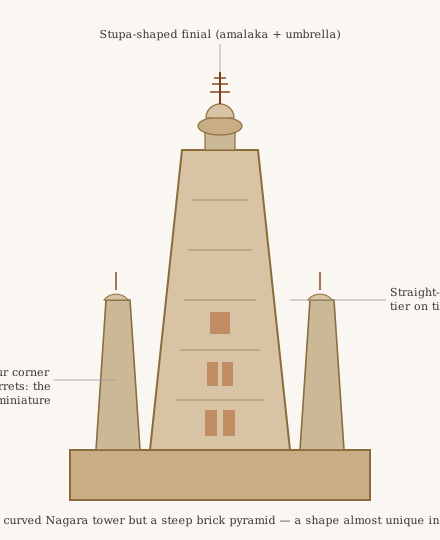
The great towers of north Indian Hindu temples — the shikharas of Khajuraho and Odisha — are curved, swelling outward and then drawing in toward the top like the profile of a mountain peak. The Mahabodhi tower is the opposite: a straight-sided truncated pyramid, its faces climbing in nearly unbroken diagonals for some fifty-five metres before stopping at a flat top crowned by a small stupa-shaped finial — a ribbed disc (the amalaka) and a tapering umbrella-mast that recalls the parasol raised over the Buddha's relics. Every face is covered in tier upon tier of small niches, once filled with images, so that the whole surface reads as a stacked grid of shrines. And at the four corners of the terrace stand four smaller towers, each a near-perfect miniature of the great one — the design repeating itself at a smaller scale, a kind of architectural echo.
Where did this shape come from? It is very old. A temple has stood on this spot in some form since the time of the emperor Ashoka in the third century BCE, but the tower we see substantially took its form in the Gupta period, around the fifth to sixth centuries CE — which makes it one of the earliest surviving large temples in India and one of the earliest anywhere built primarily of brick rather than stone. That brick construction is part of why it looks as it does: a steep, straight-sided brick pyramid is a natural and stable form to raise in fired clay, tapering for strength. Some scholars see in it a monumental descendant of the stepped brick shrines and the tall gateway-towers of early India; whatever its exact lineage, the result is a form almost unique on Indian soil.
A much-restored survivor
There is an honesty worth observing here: what you see today is heavily restored. After Buddhism declined in India from roughly the twelfth century, Bodh Gaya fell into neglect and the temple decayed for centuries, half-buried and overgrown. In the nineteenth century the British archaeologist Alexander Cunningham and later J. D. Beglar led a major restoration, rebuilding and refacing much of the crumbling brick tower, partly guided by an ancient model of the temple and by a small votive replica that had been carried to Burma centuries earlier and preserved there.
So the Mahabodhi is not a pristine Gupta original frozen in time; it is a genuine ancient monument that has been repeatedly repaired, rebuilt and reinterpreted across 1,500 years — by Ashoka, by the Guptas, by later Burmese and Sri Lankan pilgrims who made offerings and repairs, and by Victorian archaeologists. That layered history is not a flaw. It is exactly what you would expect of the single most sacred site of a living, trans-Asian religion: a building continuously kept alive by the devotion of many peoples, none of whom would let it fall.
Why it matters beyond India
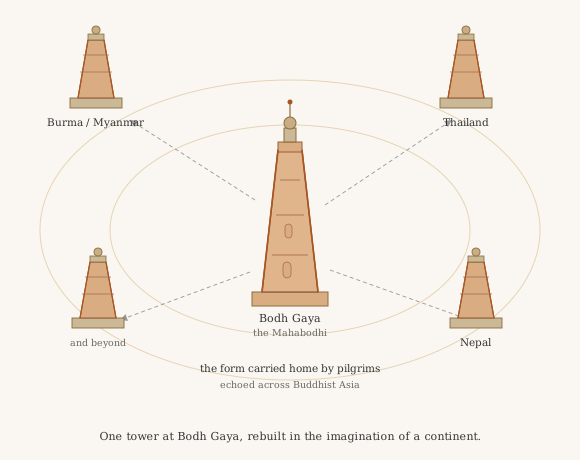
The Mahabodhi's importance is out of all proportion to its size, and for a reason that reaches far beyond Bodh Gaya. Because this was the pilgrimage destination of the Buddhist world, pilgrims came here from across Asia, worshipped before this distinctive pyramidal tower, and carried its image home. Replicas and echoes of the Mahabodhi temple were built in Burma, Thailand, Nepal and beyond, and its stepped, tapering, tiered-niche form fed into the temple-mountain traditions of Southeast Asia. When you stand before the vast tiered pyramid-temples of Pagan in Myanmar, or trace the ancestry of the great terraced monuments of the region, you are looking at ideas that passed through Bodh Gaya.
In this series, the Mahabodhi also completes the Buddhist story. At Sanchi we saw the earliest Buddhist architecture — the solid hemispherical stupa, a burial mound turned into a diagram of the cosmos, with no interior at all. At the Ajanta caves we saw Buddhist worship move indoors, into halls hollowed from rock. Bodh Gaya shows the third act: the Buddhist monument as a soaring vertical tower, a built mountain marking a sacred spot, reaching up rather than sitting solid on the ground. Stupa, cave, tower — three ways a single faith imagined the shape of the holy, and the Mahabodhi is the one the rest of Buddhist Asia would remember and rebuild.
Stand in its shadow, with the descendant of the Bodhi tree rustling behind the west wall and pilgrims in a dozen languages circling the diamond throne, and you are at the still centre of one of the world's great religions — marked, as it has been for two thousand years, by the strangest and most purposeful tower in India.
Part of the Architectural Wonders series. For the earlier Buddhist monuments this tower grew out of, read about the Great Stupa at Sanchi and the rock-cut halls of Ajanta; for the contrasting curved towers of Hindu India, see the Kandariya Mahadeva at Khajuraho.
Hero photograph: “Mahabodhi Temple, Bodh Gaya” by Amitabha Gupta, via Wikimedia Commons, licensed under CC BY 4.0.
Export this guide
Related Guides — Deep-dive reading
Sanchi: The Dome That Began Indian Architecture
How a solid brick-and-stone hemisphere raised over the Buddha's relics — a building with no inside — became India's first great monument, and fixed the form of the stupa for the whole of Asia.
Architectural WondersBoudhanath: The Great Mandala of Kathmandu
How Tibetan Buddhism built a diagram of the whole cosmos out of brick and whitewash — a colossal stupa whose plan is a mandala, whose golden tower watches all four directions at once, and which its own community dismantled and raised again after the 2015 earthquake.
Architectural WondersKhajuraho: The Temple Built to Be a Mountain
How the Chandela masons of 10th-century central India made the northern temple rise like a Himalayan peak — and why its sculpture, its engineering and its improbable survival still instruct the modern architect.
Architectural WondersRelated Tools — Try Free
Before & After Studio
Generate AI before-and-after renders to preview how your redesign could look.
DesignAIWindow Orientation Planner
Pick the best window type, glass and shading by wall direction — north, east, south and west.
Window ToolCircadian Light Meter
Patient-centric circadian lighting visualizer for Indian healthcare design — time-of-day × intensity → CCT, melanopic lux (EML / mEDI), melatonin suppression, and an alertness curve. Calibrated against WELL v2 L03 Circadian Lighting Design, CIE S 026:2018, Brainard 2001, and Lucas et al. 2014.
Circadian Tool