
Elephanta: The Temple That Is a Hole in a Hill
How 6th-century masons carved a great Shaiva sanctuary out of a basalt island in Mumbai harbour — architecture made entirely by removal — and cut from its back wall the sublime three-faced Shiva.
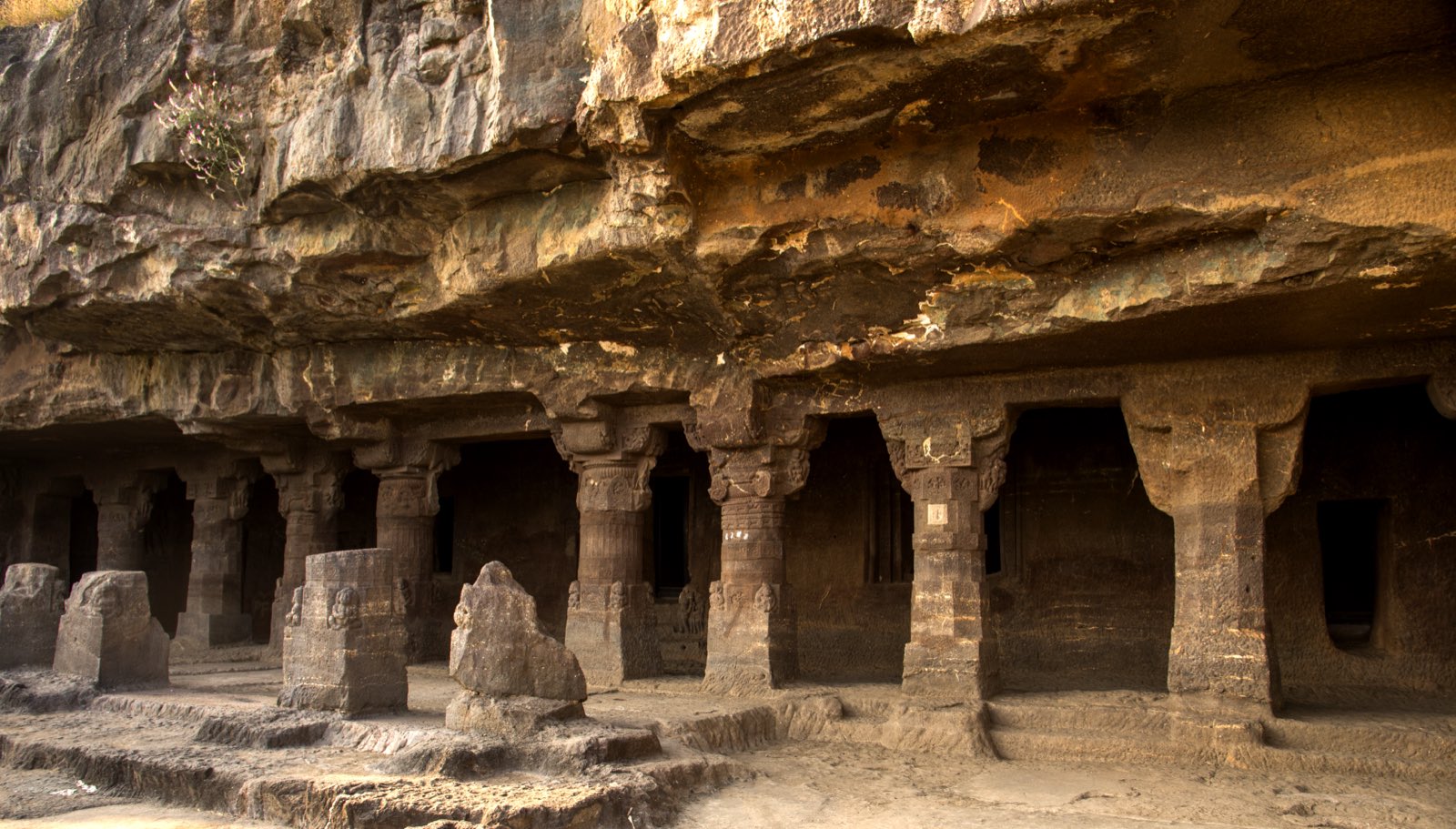
Take the boat across Mumbai harbour to the island of Elephanta and climb the hill, and you arrive at a temple that breaks the first rule you think you know about buildings: it has no outside. There is no façade to admire, no roof, no walls raised from the ground. There is only an opening in the hillside — and when you step through it you are not entering a room inside a building. You are entering a room inside a hill. The whole temple is a void, hollowed out of the solid basalt, and it is one of the most powerful spaces in India.
Elephanta belongs to the great Indian tradition of rock-cut architecture, and it makes a perfect companion, in our Architectural Wonders series, to two monuments we have already visited. At Mamallapuram we watched the Pallavas move from carving stone to building with it; Elephanta is the pure, undiluted art of carving. And where Kailasa at Ellora carried that art to its outer limit by freeing an entire temple from the hillside, Elephanta keeps its temple inside the rock — a masterpiece of the interior.
1. A building made by taking away
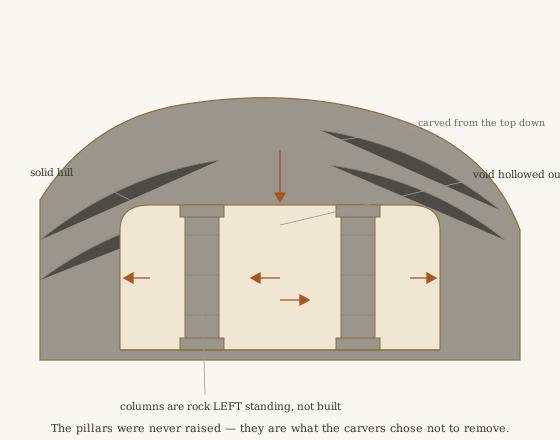
Every ordinary building is made by addition — you stack, join and raise material until a form stands and a space is enclosed. A rock-cut temple is made by the exact opposite process: subtraction. The masons started with a solid basalt hill and removed stone until a hall appeared in the space where the stone had been.
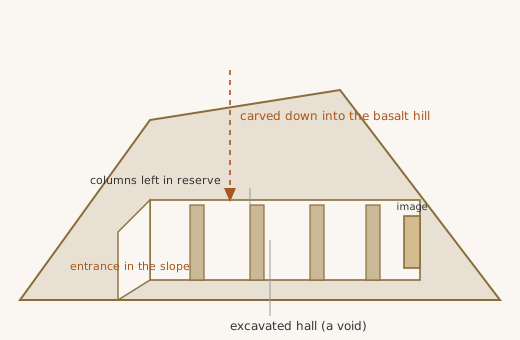
This inverts everything about how you design. There is no structure to engineer, because nothing is holding anything up — the "roof" is simply the hill that was left above the cut. And the columns are the strangest part of all: they were never built and carry nothing. They are reserved rock — pillars the carvers chose not to remove, left standing as the hall was hollowed around them. A column at Elephanta is not a support; it is a sculpture in the shape of a support, and if it vanished the ceiling would not move. To make this temple, the architects had to think in reverse — to see the building as the absence they would create, and to carry the entire design in their heads before a single mistake became permanent, because in carving there is no undo.
2. The plan: pillars, axes and the management of darkness
Step inside and the void resolves into a grand, ordered hall.
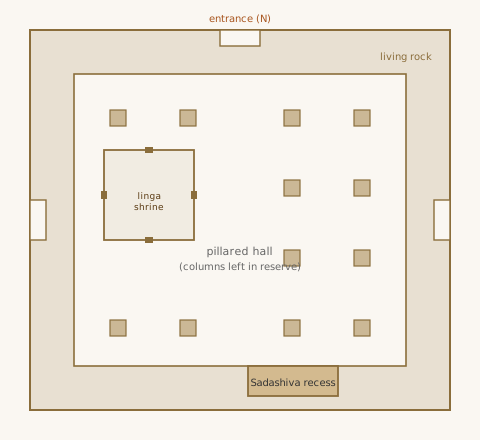
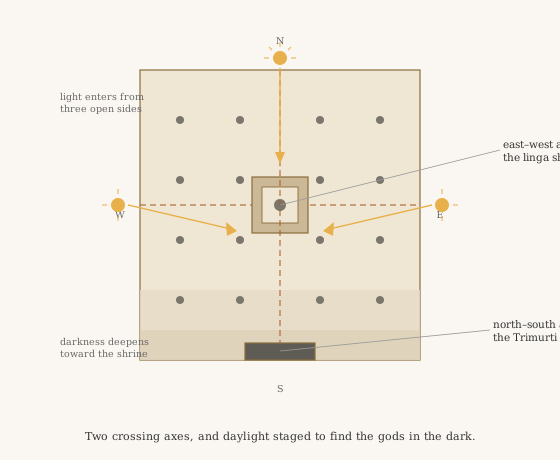
Rows of thick columns march across a roughly square hall, opening to daylight through three entrances on three sides. Set within the grid stands a free-standing square shrine — the garbhagriha — housing the Shiva linga, with a doorway on each of its four faces, each flanked by towering guardian dvarapalas. And here the design does something subtle: the hall runs on two axes at once. One, east-to-west, leads to the linga shrine and is aligned to catch the movement of the sun; the other, north-to-south, drives straight to the great recessed image on the rear wall. Because there are no windows to open in a mass of rock, light itself becomes the material the architect composes with — daylight spilling from the entrances into a deep interior gloom, so that you move from brightness into shadow and the sacred images loom out of the dark exactly where the plan wants you to meet them.
3. The Sadashiva — a god cut from the wall
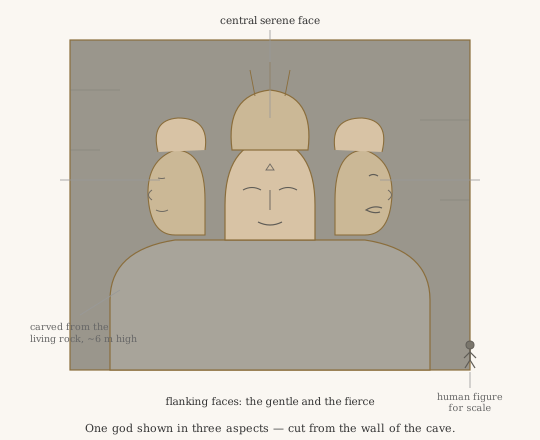
At the head of the north-south axis, filling a deep recess in the back wall, is the reason Elephanta is unforgettable: the colossal Sadashiva, often called the Trimurti — a three-faced bust of Shiva some six metres high, carved directly from the living rock. The central face is calm, meditative, eternal; the face to one side is fierce and frowning, the destroyer; the face to the other is gentle and serene, often read as the feminine, creative aspect. Three faces, one god — creation, preservation and dissolution held in a single serene head that seems to rise, half-emerged, out of the mountain itself.
It could not exist anywhere but here, because it is not a statue placed in a temple — it is the temple's own wall, become a god. The architecture and the sculpture are one continuous piece of stone, staged by the plan so that you come upon it down a long dim axis, monumental and unforgettable. It is among the supreme achievements of Indian art.
4. The island of the elephant
The cave was cut in roughly the 6th to 8th centuries, most likely under the Kalachuri rulers of the western Deccan, as a great Shaiva sanctuary. Its odd European name comes much later: the Portuguese, arriving in the 16th century, found a large stone elephant near the landing and christened the island Elephanta — though to its own people it was Gharapuri. Tradition holds that the Portuguese also used the sculptures for target practice, and some of the damage you see is real; but the great Sadashiva survived. UNESCO inscribed the Elephanta Caves in 1987.
5. What a modern architect can learn from Elephanta
- Design as removal, not only addition. Carving a building forces you to imagine the finished space — the void — before you touch the material, and to commit with no going back. It is the ultimate discipline in thinking about architecture as the shaping of emptiness, not the piling of stuff.
- Not every element must do a job. Elephanta's columns hold up nothing; they are pure articulation, rhythm and scale. It is a bracing reminder that architecture is not only structure — sometimes an element earns its place by what it does to space and the eye, not to load.
- Light is a building material. With no windows to cut, the architects composed with daylight from the openings and the darkness of the depths, staging every image in exactly the light it needed. Where you put brightness and shadow is a design decision as real as where you put a wall.
- Stage the encounter. The Sadashiva is placed at the end of a long, dim axis so that you arrive at it. How a space delivers you to its most important moment — the approach, the compression, the reveal — is often the whole art.
- Let sculpture and structure be one. The god here is the wall. The most integrated buildings erase the line between the thing that holds the space and the thing that gives it meaning.
Elephanta is the interior counterpart to this series' recurring theme: one clear idea, carried without compromise. Here the idea is a temple imagined as the inside of a mountain — and a god who is not placed within it, but carved from it.
References & further reading
1. UNESCO World Heritage Centre — Elephanta Caves (inscribed 1987). https://whc.unesco.org/en/list/244/
2. Encyclopaedia Britannica — Elephanta Island and Indian rock-cut architecture. https://www.britannica.com/place/Elephanta-Island
3. Archaeological Survey of India — Elephanta Caves. https://asi.nic.in/
4. Maharashtra Tourism — Elephanta Caves. https://www.maharashtratourism.gov.in/
Last verified 2026-07-04. Dates, attributions and identifications follow standard archaeological and art-historical reference sources and are given as widely accepted approximations; the likely Kalachuri patronage, the three aspects of the Sadashiva image, the Portuguese naming of the island, and the tradition of iconoclastic damage follow established scholarship and the historical record.
Export this guide
Related Guides — Deep-dive reading
Kailasa at Ellora: A Mountain Carved into a Temple
How 8th-century carvers made the largest monolith on earth — a complete multi-storey Dravidian temple, gateway to spire, released top-down from a single basalt hill with no scaffolding and no chance to correct a mistake. The supreme act of subtraction, and the climax of India's rock-cut story.
Architectural WondersKhajuraho: The Temple Built to Be a Mountain
How the Chandela masons of 10th-century central India made the northern temple rise like a Himalayan peak — and why its sculpture, its engineering and its improbable survival still instruct the modern architect.
Architectural WondersChurch of the Light: How Tadao Ando Built a Room Out of Nothing but a Cross
In a suburb north of Osaka, Tadao Ando took three concrete cubes, a wall tilted fifteen degrees, and a single cruciform slit in the east wall — and made one of the most powerful rooms of the twentieth century. A study of the 1989 chapel: its tatami-scaled concrete, the argument over the glass, and why a building that subtracts almost everything still tells us where architecture is going.
The Future of ArchitectureRelated Tools — Try Free
Window Orientation Planner
Pick the best window type, glass and shading by wall direction — north, east, south and west.
Window ToolCross-Ventilation Analyzer
Estimate airflow and air changes per hour (ACH) from room size, window areas, layout, and local wind — with NBC 2016 Part 8 compliance check.
Ventilation CalculatorMaterial Schedule Generator
Generate a room-wise finish schedule — walls, floors, ceilings, trim, and joinery by location.
Material Schedule