
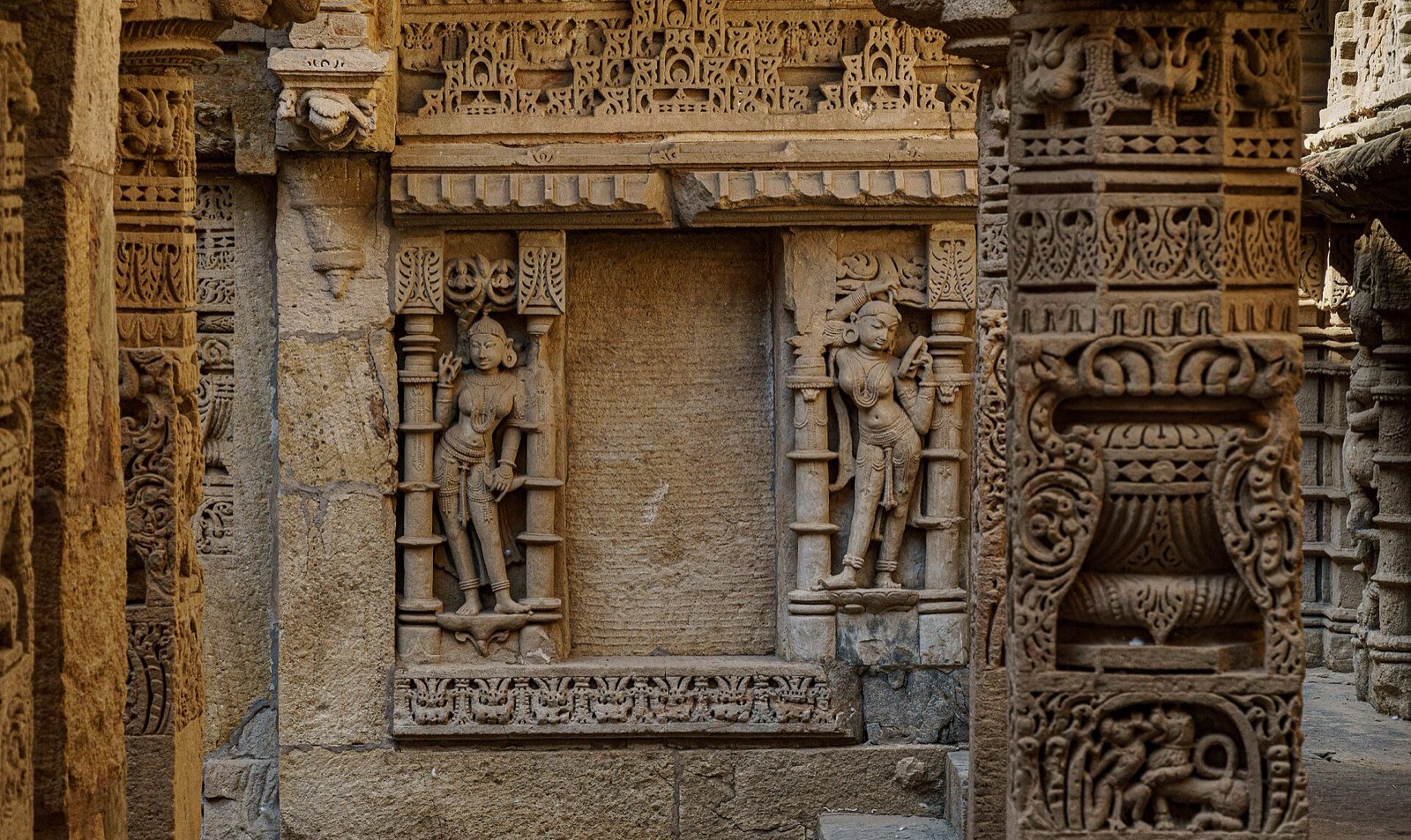
Rani ki Vav: The Temple Turned Upside-Down
How an 11th-century Gujarat queen built a stepwell as an inverted subterranean temple — seven storeys descending to the water — and made the storage of water as sacred, and as beautiful, as any shrine.
Every monument we have visited so far in this series rises. The stupa swells, the shikhara soars, the vimana climbs, the minar tapers into the sky. Now stand at the lip of Rani ki Vav at Patan in Gujarat, and everything reverses. The ground simply opens, and a great palace of carved stone plunges downward, storey below storey, into the earth. There is no tower to look up at. To reach the heart of this building you do the opposite of everything the temples taught you: you descend.
This is a stepwell — a vav — and it is the supreme surviving example of one of India's most distinctive and least celebrated architectural traditions: the art of water. It makes a beautiful counterpart, in our Architectural Wonders series, to the Golden Temple, which floats a shrine on the water; here the architecture goes down into it. And its sculpture places it firmly beside the great Nagara temples like Khajuraho — for Rani ki Vav is, quite deliberately, a temple turned upside-down.
1. An inverted temple
The people who built Rani ki Vav conceived of it, explicitly, as an inverted temple — and once you know that, the whole strange building makes perfect sense.
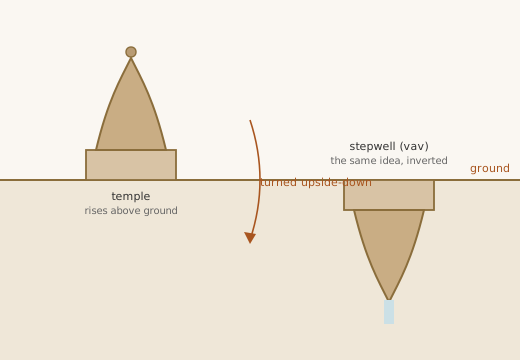
In an ordinary temple you climb a platform and pass through halls to reach the god in the sanctum; the sacred goal is up and in. At a stepwell the goal is down: the descent through the storeys is the procession, and the destination at the very bottom is the water — the source of life itself, and in an arid land the most precious thing there is. So the makers took the entire vocabulary of the temple — the pillared halls, the tiers, the deities, the ornament — and inverted it into the ground, aiming it not at a stone image in the dark but at the living water table. The most sacred point is not at the summit. It is at the bottom of the well.
2. Seven storeys down to the water
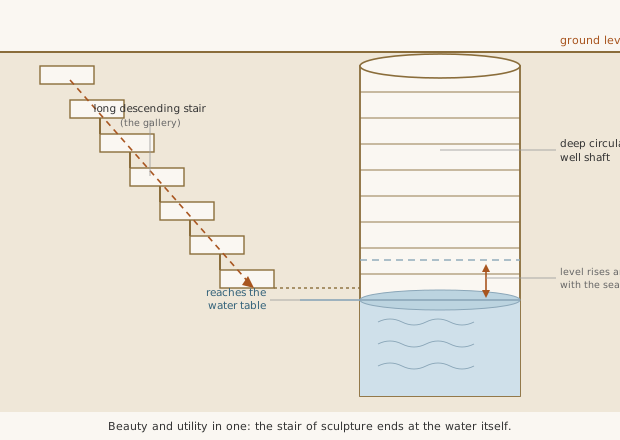
Read in section — and a stepwell can only really be understood in section — Rani ki Vav is a long, descending sequence, one of the largest and finest of its kind.
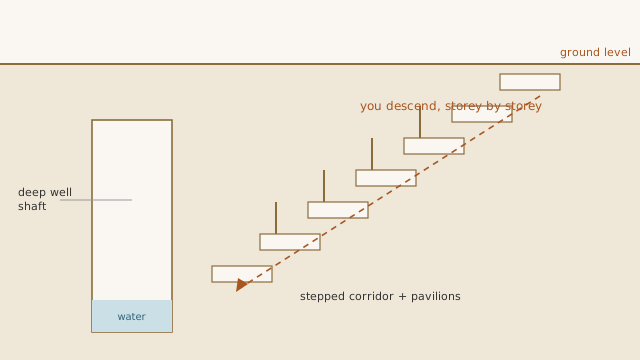
From an entrance at ground level, a long stepped corridor marches down toward the water, interrupted at intervals by multi-storeyed pillared pavilions — seven levels of them — that brace the sides and turn the descent into a series of shaded, room-like landings. At the far end the corridor arrives at a deep circular well shaft holding the water. The section does quiet, brilliant environmental work: the deeper you go, the cooler, shadier and stiller the air becomes, so that in the fierce heat of Gujarat the stepwell was not only a reservoir but a refuge — a cool subterranean place to draw water, to rest, and to gather. Function and beauty are one move: this is serious hydraulic infrastructure — reaching and storing groundwater through the long dry season — built with the care and the artistry of a cathedral.
3. A subterranean gallery of a thousand sculptures
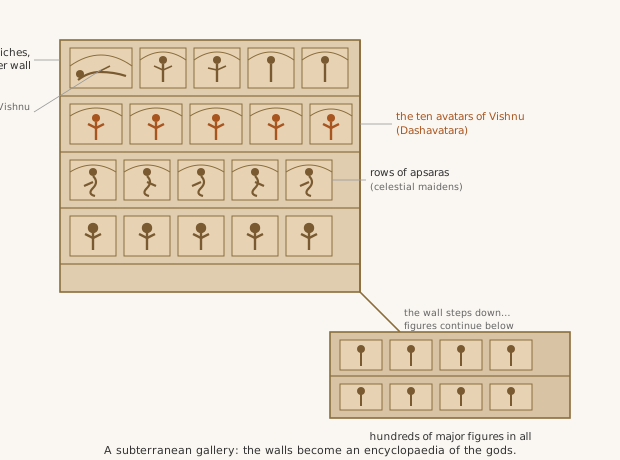
And it is carved as richly as any temple above ground. The walls of the descent and the piers of the pavilions carry hundreds upon hundreds of sculptures — by common estimate well over a thousand major figures. Vishnu presides in his Dashavatara, the ten incarnations; ranks of deities, serpent-maidens and celestial apsaras line the storeys; friezes of ornament run everywhere. It is worked in the same refined Maru-Gurjara idiom of the Solanki age that produced the marble jewels of western India. To walk down Rani ki Vav is to descend through a buried art gallery — a wall of gods and beauty that deepens as the light fades and the water nears.
4. Built by a queen, hidden by a river, recovered
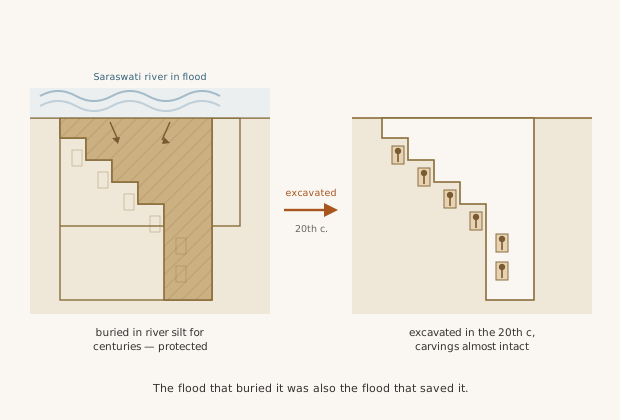
The stepwell was commissioned around 1063 by Queen Udayamati, in memory of her husband, the Chaulukya (Solanki) king Bhima I — a monumental memorial, built by a woman in her king's honour, in the form of a gift of water to her people. Then the nearby Saraswati river shifted and flooded, and over the centuries the whole vav was silted up and buried, lost from view. As at other sites in this series, the burial turned out to be a blessing: sealed under mud and out of reach, its sculptures were spared the weathering and the iconoclasm that scarred so many exposed monuments. When the Archaeological Survey of India excavated it in the later twentieth century, an almost pristine masterpiece emerged from the ground. UNESCO inscribed Rani ki Vav in 2014, and India put it on the reverse of the hundred-rupee note — a rare honour for a work of architecture.
5. What a modern architect can learn from Rani ki Vav
- You can invert the sacred gesture. Every instinct says the important thing goes up. Rani ki Vav puts it down, and is unforgettable for it. Question the default direction of your architecture — sometimes descent, compression and darkness are more powerful than height and light.
- Think in section. A stepwell is unintelligible in plan or elevation; its whole idea lives in the section. Some of the best architecture is fundamentally a sectional idea — a sequence of levels, light and air — and can only be designed by drawing the cut.
- Make infrastructure beautiful. This is, at bottom, a water tank. That a civilisation lavished its finest sculpture on a piece of civic infrastructure — treating the supply of water as worthy of art — is a standing rebuke to the idea that utility and beauty belong to different budgets.
- Design with the ground and the climate. By burying the architecture, the builders got cool, shaded, humid depths for free — passive climate control a thousand years before air-conditioning. The earth itself is a material and an ally, especially in a warming, water-stressed India.
- Water is worth an architecture of its own. The West largely forgot that reservoirs could be monuments; India did not. As cities face drought and flood, the vav is a startlingly modern reminder that how we store and reach water deserves to be a first-class architectural problem.
Rani ki Vav closes this batch by proving the series' argument from underground: one clear idea, carried without compromise. Here the idea is simply to turn the temple upside-down and give it to the water — and to make the going-down as sacred, and as splendid, as any climb toward a god.
References & further reading
1. UNESCO World Heritage Centre — Rani-ki-Vav (the Queen's Stepwell) at Patan, Gujarat (inscribed 2014). https://whc.unesco.org/en/list/922/
2. Encyclopaedia Britannica — stepwell and Solanki (Chaulukya) art and architecture. https://www.britannica.com/technology/stepwell
3. Archaeological Survey of India — Rani-ki-Vav, Patan. https://asi.nic.in/
4. Gujarat Tourism — Rani ki Vav, Patan. https://www.gujarattourism.com/
Last verified 2026-07-04. Dates, dimensions, sculpture counts and attributions follow standard archaeological and art-historical reference sources and are given as widely accepted approximations; the commission by Queen Udayamati in memory of Bhima I, the conception of the stepwell as an inverted temple, the silting by the Saraswati river, and the modern excavation follow established scholarship and the historical record.
Hero photograph: “Rani ki Vav (the Queen’s Stepwell), Patan” by Schwiki, via Wikimedia Commons_at_Patan_Gujarat_WLM22-02876.jpg), licensed under CC BY-SA 4.0.
Export this guide
Related Guides — Deep-dive reading
Borobudur: The Mountain You Climb to Reach Enlightenment
In the volcano-ringed heart of Java, around 1,200 years ago, Buddhist kings built the largest Buddhist monument on Earth — not a temple you enter but a solid stone mountain you climb: a three-dimensional map of the universe, wrapped in 2,672 carved panels and 504 Buddhas, that turns the path to enlightenment into a walk you take with your feet. Then it was abandoned, buried under ash and jungle, and rebuilt, stone by million-stone, in our own age.
Architectural WondersĠgantija: The Oldest Temple Standing, Built by 'Giants'
How a Neolithic island people on Malta — with no metal and no wheel — raised the oldest free-standing stone temples on Earth a thousand years before Stonehenge or the pyramids, moving fifty-tonne blocks on stone balls into clover-leaf sanctuaries for a faith we can trace but cannot read, then vanished, leaving stones so vast that later islanders swore only giants could have built them.
Architectural WondersKhajuraho: The Temple Built to Be a Mountain
How the Chandela masons of 10th-century central India made the northern temple rise like a Himalayan peak — and why its sculpture, its engineering and its improbable survival still instruct the modern architect.
Architectural WondersRelated Tools — Try Free
Acoustic Privacy (STC) Visualizer
Indian healthcare acoustic visualizer — compare wall assemblies and noise sources, see received SPL after STC attenuation, and check FGI 2018 / IS 1950 / NABH speech-privacy compliance with live dual-canvas waveform.
Acoustic ToolConcept Generator
Get 3 AI-generated design concepts for any room with style, materials, and cost estimate.
DesignAICross-Ventilation Analyzer
Estimate airflow and air changes per hour (ACH) from room size, window areas, layout, and local wind — with NBC 2016 Part 8 compliance check.
Ventilation Calculator