
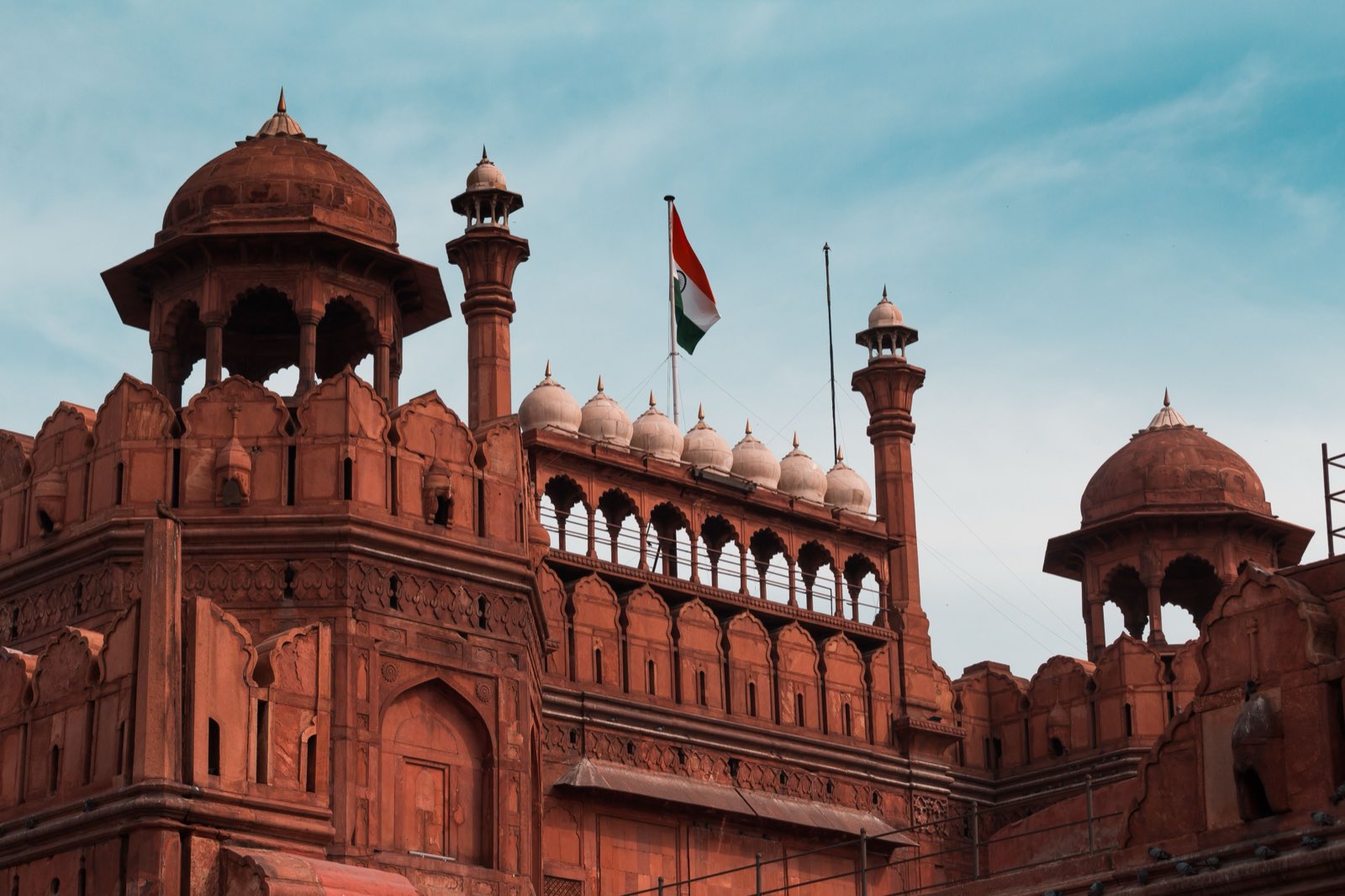
The Red Fort, Delhi: Shah Jahan's Palace of Paradise on the River
How the emperor who built the Taj Mahal raised a whole walled palace-city in red sandstone and white marble — a fortress on the outside, a garden threaded with running water within, and the stage on which modern India was born
There is a line of Persian poetry inlaid in gold on a marble wall inside the Red Fort: "If there is a paradise on earth, it is this, it is this, it is this." The emperor who wrote it into his palace was not being modest, but he was making a precise architectural claim. The Red Fort was designed, quite deliberately, as an image of paradise on earth — a walled garden of marble pavilions, cooled by running water, raised above a river — wrapped inside the grim red walls of a fortress. That double nature, fortress without and garden within, is the key to the whole place, and it is the fullest expression of Mughal architecture at the very moment of its greatest confidence.
It was built by Shah Jahan, the same emperor who built the Taj Mahal, and the two are close cousins in date and spirit. Where the Taj is a tomb — architecture in mourning, perfected into a single white jewel — the Red Fort is a palace, architecture at its most alive, built for a living court at the height of its power. Together they bracket the golden age of the style historians simply call "Shah Jahani".
A new capital, and a fort to crown it
In 1638 Shah Jahan decided to move his capital from Agra back to Delhi, and to build there an entirely new walled city, Shahjahanabad. The Red Fort — Lal Qila — was its citadel and royal palace, built between roughly 1638 and 1648 on the west bank of the Yamuna river. Its walls of red sandstone run for over two kilometres, rising in places more than thirty metres, punctuated by the great gateways of which the Lahori Gate (facing the city) and the Delhi Gate are the chief. From outside it is unambiguously a fortress: sheer, red, battlemented, forbidding.
But a Mughal fort of this period was not primarily a military machine like a Rajput hill-stronghold. It was a palace-city, a self-contained world for the emperor, his household, his court and the machinery of an empire — and its plan is organised not for defence but for ceremony and pleasure.
The plan: a ceremonial spine and a riverside of pavilions
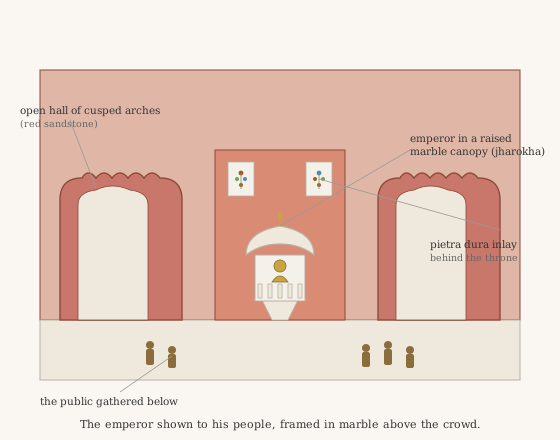
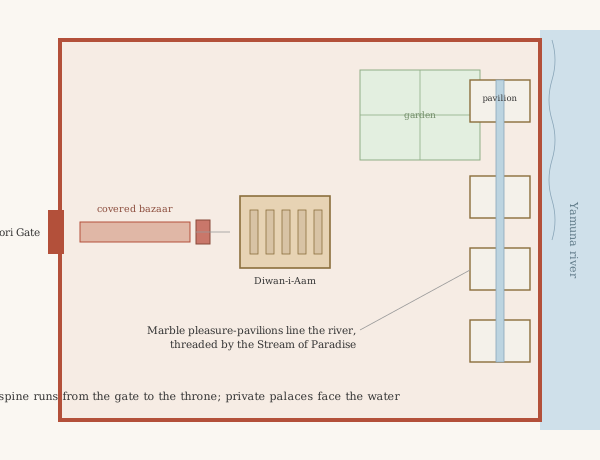
Enter by the Lahori Gate and you pass first through something unexpected in a palace: a long covered bazaar, the Chatta Chowk, an arcaded street of shops that once sold silks and jewels to the court. Beyond it a drum-house gateway, the Naubat Khana, marks the threshold where visitors dismounted, and opens onto a great courtyard containing the Diwan-i-Aam, the Hall of Public Audience — an open, arcaded hall of red sandstone where the emperor showed himself to the general public, seated in a marble canopied balcony raised above the crowd.
Behind this public zone, along the eastern wall overlooking the river, runs the private heart of the palace: a row of white marble pavilions, one after another, facing the water and catching the river breeze. These include the Diwan-i-Khas, the Hall of Private Audience, where the emperor met his inner court and where the fabled jewelled Peacock Throne once stood; the Rang Mahal, the painted "Palace of Colour" of the imperial household; and the private apartments and baths. Between the public spine of gate-bazaar-court-audience-hall and this intimate line of riverside marble lay formal charbagh gardens — the four-quartered paradise-gardens we have met at Humayun's Tomb — here laid out as courts of greenery, fountains and shade inside the fort.
The Stream of Paradise
The single most beautiful idea at the Red Fort is the way all those riverside pavilions are tied together — not by a corridor, but by water.
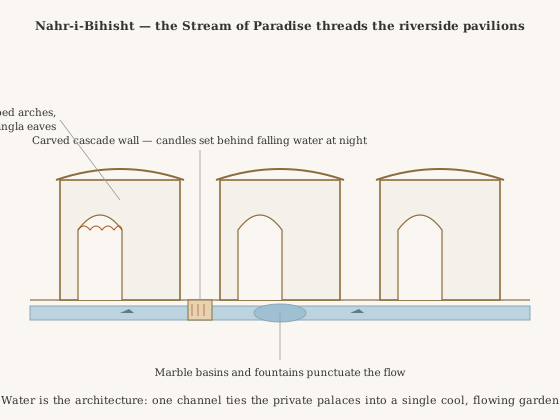
A shallow channel of water, the Nahr-i-Bihisht — literally the "Stream of Paradise" — was led into the fort and made to run in a marble runnel straight through the floors of the riverside pavilions, from one to the next, the whole length of the private palace. It widens here into a carved basin, drops there over a sculpted cascade, throws up a fountain in the centre of a hall, and flows on. The name is a direct reference to the rivers of the Qur'anic paradise, and the effect was both symbolic and intensely practical: the moving water cooled the air in the fierce Delhi summer, filled the pavilions with the sound of falling water, and physically linked the separate marble halls into a single continuous garden-palace.
The most magical detail is the cascade wall behind one of the basins, the chini khana — a marble screen carved with rows of little niches, over which the water fell in a sheet. By day the niches held flowers; by night, lamps were placed behind the falling water so that the cascade glittered with candlelight seen through moving water. This is the same civilisation of water-architecture we met, differently, in the stepwell at Rani ki Vav and the cooling channels of Amber — here refined into pure imperial luxury.
Shah Jahani style at its peak
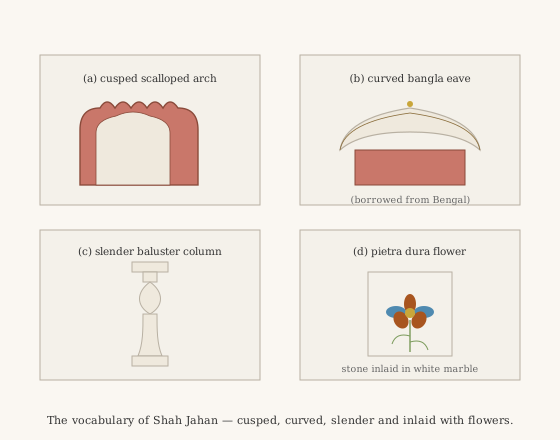
The marble pavilions of the Red Fort show the mature Shah Jahani manner in every detail, and it is worth learning to recognise it. The arches are cusped — their edges scalloped into a series of lobes, softer and more sinuous than a plain pointed arch. The pillars are slender and multifaceted. The roofs of some pavilions curve up at the eaves in the bangla form, borrowed from the thatched huts of Bengal and rendered in marble. And the surfaces are decorated with pietra dura — the inlay of coloured semi-precious stones into white marble in floral patterns, the same jewel-like technique that flowers on the Taj Mahal. Where the earlier Mughal architecture of Humayun's Tomb was bold red sandstone with restrained marble accents, and Akbar's Fatehpur Sikri was carved red sandstone throughout, Shah Jahan's work moves decisively toward white marble, curved lines and inlaid flowers — richer, softer, more sensuous.
The fort that became a nation's stage
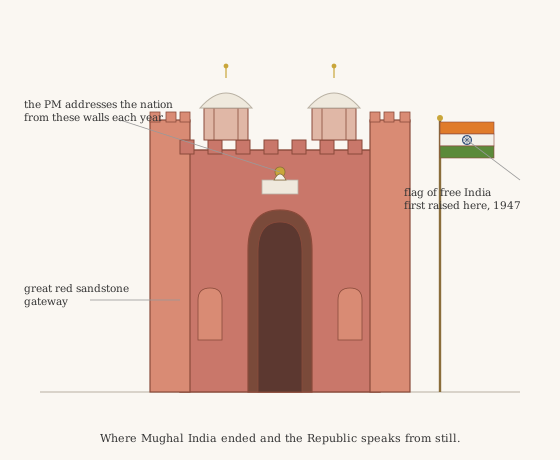
The Red Fort has one more claim on our attention, and it is not architectural but historical. After the Mughal empire declined, the fort was seized and much damaged — the British, after crushing the 1857 uprising, demolished a great part of the inner palaces and turned the fort into a military barracks, which is why so much of the interior we might expect is missing. But it remained the supreme symbol of sovereignty over India, and so, when that sovereignty passed to the Indian people, it was from the ramparts of the Lahori Gate of the Red Fort that Jawaharlal Nehru raised the flag of independent India in 1947. Every year since, on Independence Day, the Prime Minister of India addresses the nation from those same walls.
So the Red Fort is not only the finest surviving Mughal palace and the peak of the Shah Jahani style; it is the place where Mughal India ended and modern India began. That layered meaning — paradise-garden, imperial citadel, colonial barracks, cradle of the republic — makes it perhaps the most historically charged building in the country.
Stand in one of its marble pavilions with the Stream of Paradise running cool at your feet, read the golden claim about paradise on the wall, and then step out onto the ramparts where a nation was born, and you hold the whole arc of it at once: the most beautiful palace of an empire, and the birthplace of the state that replaced it.
Part of the Architectural Wonders series. Read its twin, the Taj Mahal; the Mughal architecture that led up to it at Humayun's Tomb and Fatehpur Sikri; and, for the Rajput fort-palace tradition alongside it, Amber.
Export this guide
Related Guides — Deep-dive reading
Amber Fort, Jaipur: The Rajput Palace That Learned to Speak Mughal
How the warrior-kings of the desert built a fortress-palace up a hillside above a lake — half stronghold, half pleasure-house — where mirrors, lattices and running water turned defence into delight
Architectural WondersThe Taj Mahal: A Building Made of Love and Loss
How a grieving emperor turned his sorrow into the most beautiful building on earth — a white marble tomb of flawless symmetry, set in a garden of paradise, broken by a single, deeply human flaw. The architecture of remembrance, and what it can teach anyone who builds.
Architectural WondersHumayun's Tomb, Delhi: The Blueprint for the Taj Mahal
How a grieving widow and a Persian architect planted the first great Mughal garden-tomb in Indian soil — a red-and-white rehearsal, eighty years early, for the most famous building in the world
Architectural WondersRelated Tools — Try Free
Concept Generator
Get 3 AI-generated design concepts for any room with style, materials, and cost estimate.
DesignAIDesign Style Finder Quiz
Answer 10 visual questions to discover your Indian interior style profile with materials and colours.
Interactive QuizApartment Video Door System Planner
Enter flats, entrances, floors and guard desk for a first-pass building intercom plan — door stations, indoor monitors, guard station, the right architecture and an indicative cost band.
Building Planner