
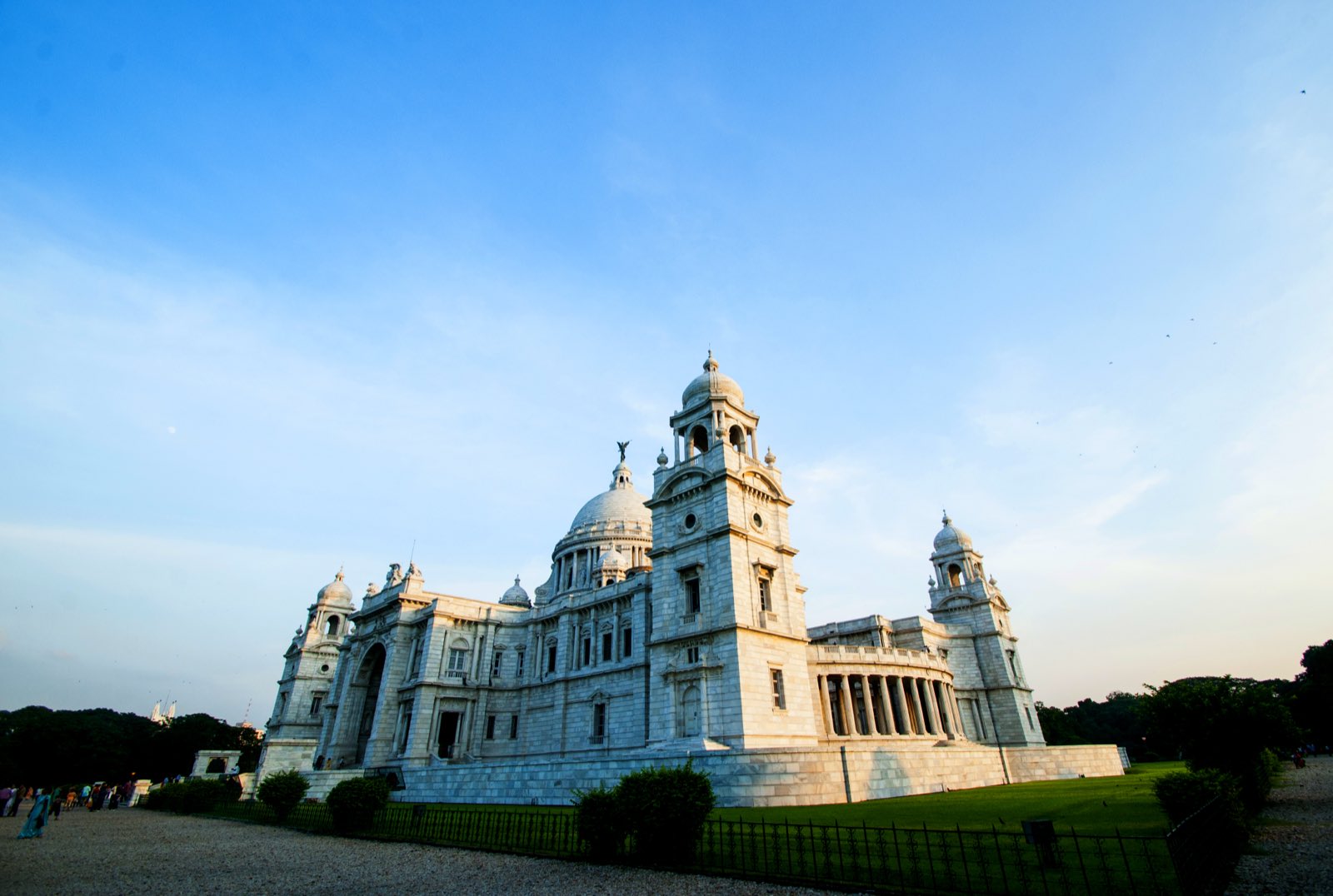
The Victoria Memorial, Kolkata: The Raj Answers the Taj
How the British Empire built its own white-marble monument in a Mughal city — a European dome dressed in Indian kiosks and arches, the grandest and most revealing statement of the Indo-Saracenic style
Every empire that rules India seems, sooner or later, to build in white marble. The Mughals did it at the Taj Mahal and the Red Fort; three centuries later the British did it too, in the same imported Makrana marble, on the banks of a river in their eastern capital. The Victoria Memorial in Kolkata is the British Empire's most deliberate architectural statement in India, and it is impossible to miss what it is trying to do. It is the Raj answering the Taj — consciously, competitively, and in a style that reveals exactly how a foreign empire tried to make itself look at home.
It is also the grandest and most legible example of a movement with an odd hyphenated name: Indo-Saracenic architecture. Learning to read the Victoria Memorial means learning to read that whole strange chapter, in which British architects built European buildings and then dressed them in Indian clothes.
A monument to a dead queen and a living empire
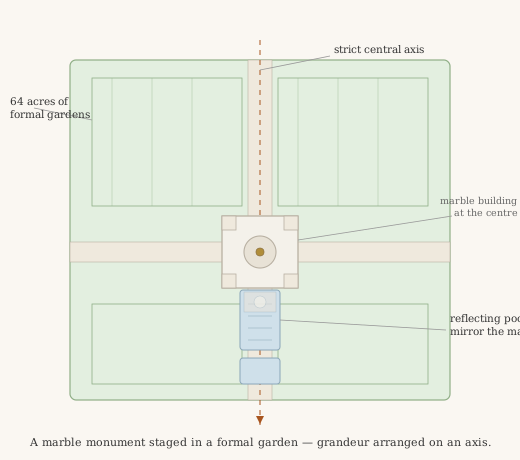
Queen Victoria died in 1901, and Lord Curzon, the Viceroy of India, proposed a great memorial to her in Calcutta — then the capital of British India and the second city of the entire empire. It was to be a monument, a museum and a symbol of British permanence all at once. The architect chosen was William Emerson, president of the Royal Institute of British Architects, and construction ran from 1906 to 1921, funded largely by "voluntary" contributions solicited across India. The result is a colossal building of white marble set in sixty-four acres of formal gardens, today one of Kolkata's most beloved landmarks and a museum of the colonial period.
The choice of white marble and formal gardens was not neutral. Curzon and Emerson knew precisely what associations they were invoking. They were building in the land of the Taj Mahal, and they wanted their monument to stand in that lineage — to say, in effect, that the British were the natural successors of the Mughals, inheritors of the same grandeur, builders in the same eternal material. The Victoria Memorial is imperial propaganda rendered in stone, and none the less magnificent for it.
The elevation: a European building at heart
Look at the building's overall shape and structure, and it is fundamentally European.
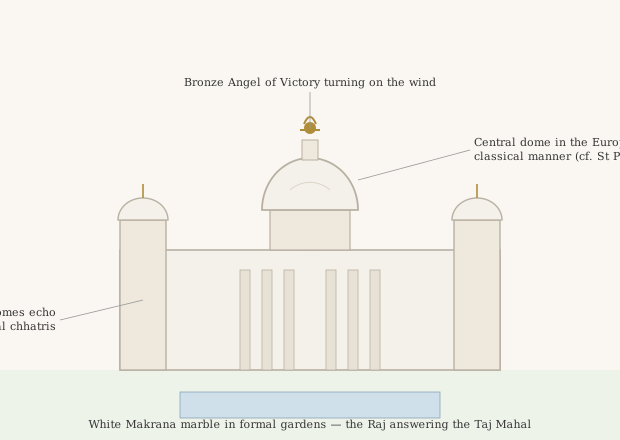
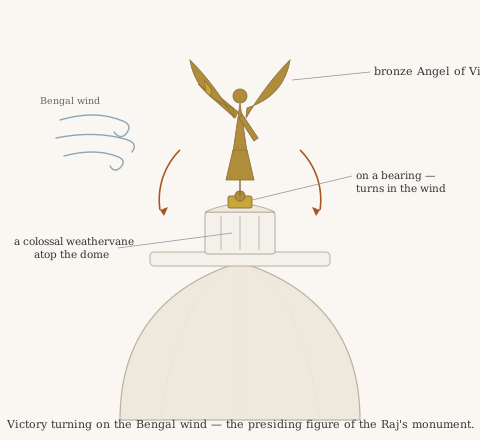
The core is a great symmetrical block with a tall central dome in the European classical tradition — the dome of the Italian Renaissance, of St Peter's in Rome and St Paul's in London, raised on a drum and crowned by a lantern. On top of the lantern turns a bronze figure, the Angel of Victory, mounted so as to swing with the wind like a colossal weathervane. The façades carry classical columns and pediments; the massing, the proportion, the whole grammar of the thing comes straight out of European academic architecture. If you stripped away the details, you would take it for a grand civic building in London or Washington — a museum, a parliament, a bank of empire.
The Indo-Saracenic idea: European bones, Indian dress
But you cannot strip away the details, and the details are the whole point. Onto that European skeleton, Emerson grafted a set of unmistakably Indian features, and the negotiation between the two is what makes the building fascinating.
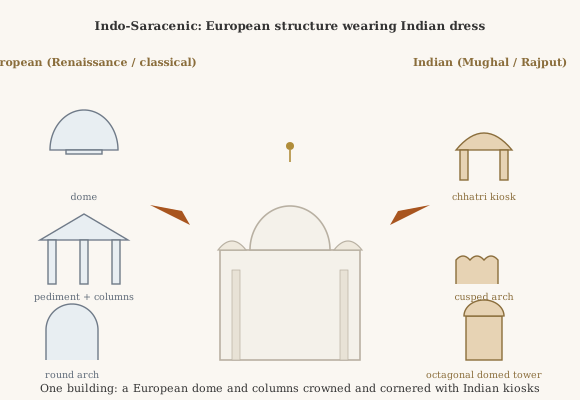
At the four corners rise domed octagonal towers, and small domed kiosks — chhatris — punctuate the roofline, exactly the umbrella-domes on slender pillars that crown Mughal and Rajput buildings across northern India. There are cusped Mughal-style arches, deep shading eaves, and octagonal corner pavilions that recall the towers of Mughal tombs. The white marble itself is the Indian material of the Taj. So the building performs a careful double act: a European dome and columns for structure and dignity, Indian kiosks and arches and marble for local legitimacy. This is the essence of Indo-Saracenic architecture — a style invented by British architects in nineteenth- and early twentieth-century India, which took European (usually classical or Gothic) buildings and applied Indian, mostly Mughal and Rajput, decorative elements to their surfaces.
The motives were frankly political. After the trauma of the 1857 uprising, the British increasingly wished to present themselves not as alien conquerors but as legitimate rulers standing in the succession of India's own great dynasties. An architecture that wrapped European civic buildings in the visual language of the Mughals and Rajputs served that fiction perfectly — railway stations, high courts, colleges and palaces across India were built in this hybrid manner. The Victoria Memorial is its imperial climax: the largest, whitest, most Taj-conscious Indo-Saracenic building of them all.
How to judge it
The Victoria Memorial poses, more sharply than any other building in this series, the question of what we should feel about a magnificent monument built to celebrate foreign rule. It is undeniably grand, beautifully sited, superbly built. It is also a piece of imperial theatre, raised by a colonial power at the expense of the colonised, to naturalise its own dominion by borrowing the architectural prestige of the very civilisation it ruled.
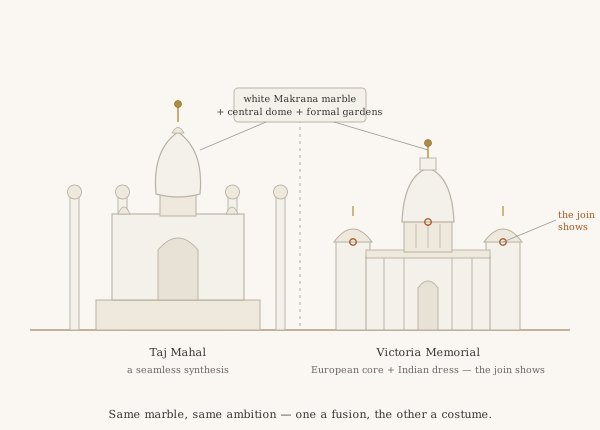
Both things are true, and the honest response holds them together. Architecturally, it is worth studying precisely because it is so revealing: no other building shows so clearly the mechanics of the Indo-Saracenic compromise — where the European structure ends and the Indian ornament begins, and how the seam between them is negotiated. Set it beside the Taj Mahal it imitates and the contrast is instructive. The Taj is a single, integral idea — Persian, Indian and Islamic traditions fused so completely that no seam shows. The Victoria Memorial is a deliberate assembly, a European core with Indian features attached, and you can always see the join. One is a synthesis; the other is a costume.
That, in the end, is the building's deepest lesson. Compare it, too, with what came next: only a few years later, at Chandigarh, independent India would reject both the borrowed Mughal dress and the imperial classicism, and build instead in raw modern concrete — a conscious refusal of exactly the game the Victoria Memorial was playing. The white marble monument on the Kolkata maidan marks the high-water line of imperial architecture in India: the last, grandest attempt by a foreign power to build itself into the landscape by wearing the landscape's own clothes.
Walk through its gardens toward that gleaming dome, watch the bronze angel turn against the Bengal sky, and you are looking at the British Empire at the height of its confidence — and, though it did not know it, near the end of its time.
Part of the Architectural Wonders series. Read the Taj Mahal it set out to rival, the Red Fort whose Mughal vocabulary it borrowed, and Chandigarh, independent India's deliberate break with imperial architecture.
Export this guide
Related Guides — Deep-dive reading
Rashtrapati Bhavan and Lutyens' Delhi: The Empire's Last Capital, Crowned by a Stupa
How the British built one final imperial city at New Delhi — a palace of 340 rooms whose great dome is a Buddhist stupa on a classical body — and how, within eighteen years, it became the house of the Indian republic
Architectural WondersIndo-Saracenic Architecture in India
The Raj-era revival that gave India its grandest landmarks
Design StylesChhatrapati Shivaji Terminus, Mumbai: A Cathedral Built for the Age of Steam
How the British raised a Gothic cathedral to the railway in the heart of Bombay — gargoyles beside peacocks, a ribbed dome over the platforms — the most exuberant and most Indian of all the empire's Victorian buildings
Architectural WondersRelated Tools — Try Free
Cross-Ventilation Analyzer
Estimate airflow and air changes per hour (ACH) from room size, window areas, layout, and local wind — with NBC 2016 Part 8 compliance check.
Ventilation CalculatorConcept Generator
Get 3 AI-generated design concepts for any room with style, materials, and cost estimate.
DesignAIHealing View Impact Calculator
Evidence-Based Design dashboard quantifying the recovery impact of nature view + daylight factor on analgesic use, length of stay, and HCAHPS patient-experience uplift. Calibrated against Ulrich 1984 (Science), Park & Mattson 2008, and the CHD EBD evidence base.
EBD Calculator