
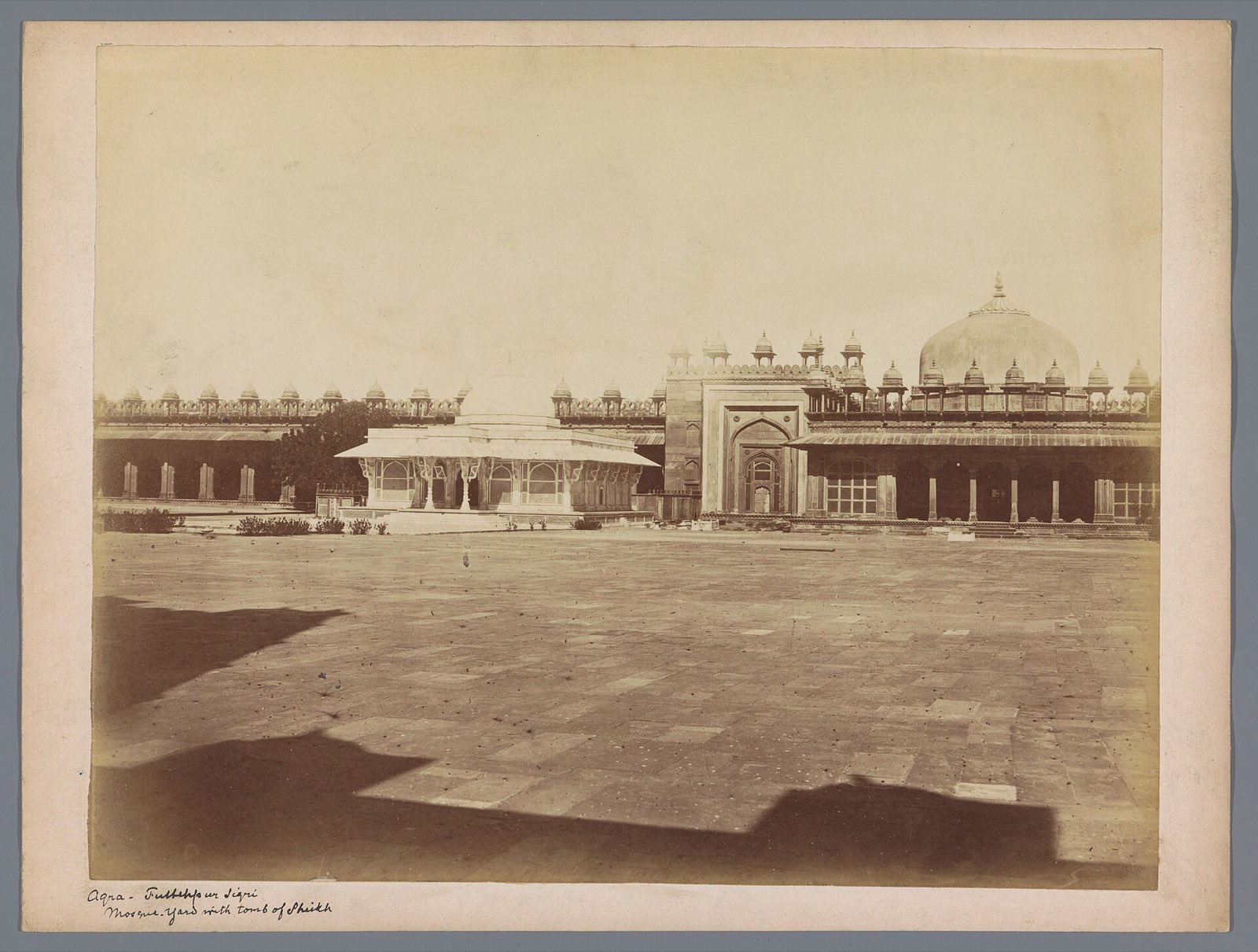
The Dilwara Temples, Mount Abu: Marble Carved Until It Turned to Lace
How a group of Jain merchants and ministers spent fortunes turning white marble so thin it glows, in temples whose plain outsides give no warning of the ceilings within
The first thing to know about the Dilwara temples is that from the outside they are almost disappointing. Set on the cool green heights of Mount Abu, the only hill station in the Rajasthan desert, they present low, plain, flat-walled exteriors — pale boxes with barely a tower, giving nothing away. Pilgrims have arrived, glanced at them, and wondered what the fuss was about. Then they step inside, look up, and fall silent. The Dilwara group is the clearest proof in all of Indian architecture that a building's whole ambition can be turned inward, spent entirely on what happens overhead once you have crossed the threshold.
What happens overhead is marble carved past the point of reason. Ceilings hang in concentric rings of sculpture so deep and so fine that the stone seems to have been spun rather than cut, closing in a central pendant that drops like a frozen chandelier. In places the marble has been worked so thin that light passes through it and it glows faintly from within. This is not carving as decoration on a surface. It is carving as the entire purpose of the building.
Jainism and the economics of merit
To understand Dilwara you have to understand who paid for it and why, because the "why" is written into every square centimetre. These are Jain temples, and they were built by two of the wealthiest and most powerful Jain laymen of medieval western India — the first, the Vimal Vasahi, by Vimal Shah, a minister and general of the Solanki (Chaulukya) kingdom of Gujarat, completed around 1031 CE; the second and even finer, the Luna Vasahi, by two brothers, Vastupala and Tejapala, ministers and merchant-princes, around 1230 CE.
Jainism places extraordinary spiritual value on the building and endowment of temples as acts of merit. For a community of merchants and financiers forbidden by their faith from violence and from many worldly indulgences, the pious deployment of enormous wealth into sacred architecture was one of the great permitted expressions of both devotion and status. The result is a peculiarly Jain kind of luxury: not gold or colour or scale, but sheer, obsessive, near-infinite labour lavished on pure white marble. The stories that the artisans were paid by the weight of the marble dust they removed — so that finer carving earned more — are almost certainly legend, but they capture a real truth: here, difficulty itself was the offering.
The plan: a ring of cells around one core
Behind the overwhelming detail lies a plan of great clarity, and it is a distinctively Jain plan.
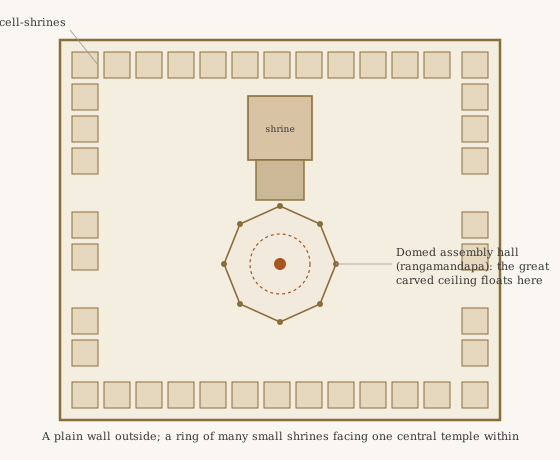
At the centre stands the main shrine housing the image of a tirthankara — one of the twenty-four enlightened teachers who are the focus of Jain veneration. Vimal Vasahi is dedicated to Adinatha, the first tirthankara; Luna Vasahi to Neminatha, the twenty-second. In front of the shrine comes a closed hall, and then the rangamandapa — an open pillared assembly hall, octagonal in arrangement, over which floats the great domed ceiling that is the temple's crowning glory.
The distinctively Jain move is the ring. The whole temple sits inside a rectangular courtyard, and that courtyard is lined on all sides by a continuous cloister of small, identical cell-shrines — forty-eight of them at Vimal Vasahi, fifty-two at Luna Vasahi — each holding its own seated tirthankara image, each opening onto the court. From outside, this ring presents the world a blank, defensible, unremarkable wall. From inside, it turns the court into a gallery of repeated devotion facing the central temple. The plan is introverted by design: it says nothing outward and everything inward, exactly like the buildings' plain shells and lavish interiors. That inward-facing cloister is also, incidentally, why the exteriors are so plain — the outer wall is literally the back of a row of cells, not a face meant to be seen.
The ceiling: how to fake a dome in a tradition that had none
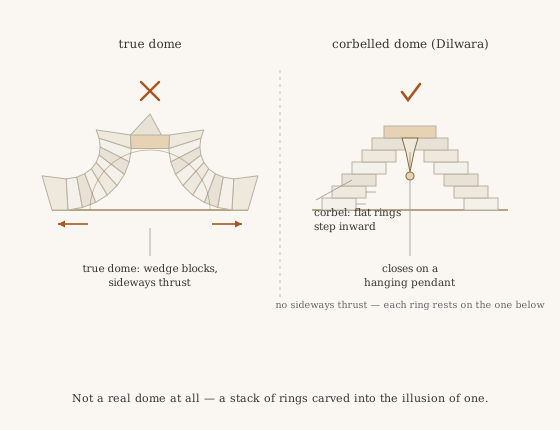
The masterpiece of each temple is the great ceiling over the rangamandapa, and it repays slow looking because it is a structural conjuring trick.
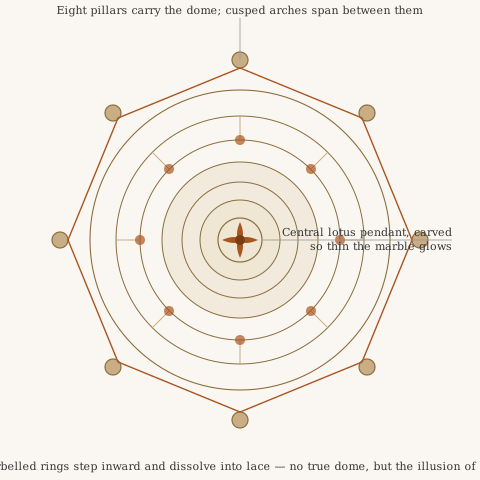
Eight pillars, arranged in an octagon, carry the ceiling. Between their tops spring cusped, scalloped arches — the famous toranas, whose lobed profile looks so much like the pointed arches of Islamic architecture that visitors often assume influence, though the technique is quite different. Above this octagonal ring the ceiling closes not with a true dome — a self-supporting shell of wedge-shaped stones pushing against each other — but with the old Indian method of corbelling: successive rings of stone, each cantilevered slightly inward over the one below, stepping up and in until they meet at the top. It is the same principle that roofed the sanctuaries at Khajuraho and, at giant scale, the assembly halls of Mount Abu's cousins across western India — a stack of horizontal rings pretending to be a dome.
What the Dilwara carvers did with that structural device is the miracle. Each ring is carved into a different band of ornament — lotus petals, dancers, elephants, the sixteen vidyadevis (goddesses of knowledge) reaching out on brackets — the bands growing finer as they rise, until the whole thing seems to spiral inward and dissolve. At the very centre, a great lotus pendant hangs down into the room, its layered petals cut so deeply and thinly that the marble is nearly translucent. Because the corbelled construction means every ring is doing real structural work while also being pure ornament, the ceiling reads as both a piece of engineering and a piece of jewellery. You cannot tell where the building stops and the decoration begins — which is precisely the intended effect.
Marble, and why it mattered
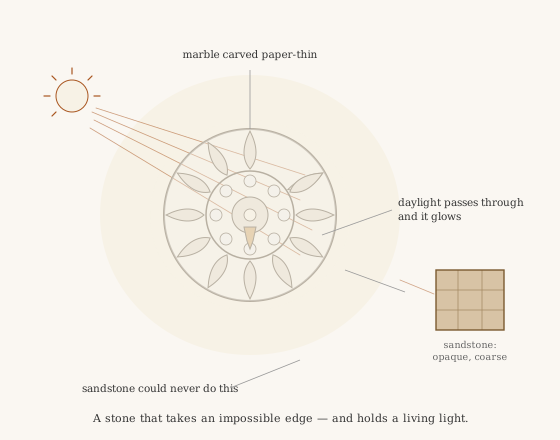
None of this would have been possible in the coarse sandstone that most of medieval north India built with. The Dilwara temples are made of a fine, dense white marble quarried in the Aravalli hills and hauled — by tradition, on the backs of elephants — up the long climb to Mount Abu. Marble takes an edge that sandstone cannot: it can be undercut, pierced, and polished into forms of a delicacy impossible in a grainier stone. The translucency that makes the thinnest carvings glow is a property of the marble itself.
This is worth setting against the other great temples in this series. The Kandariya Mahadeva at Khajuraho achieves its power through mass and rhythm — soaring sandstone towers built up like a mountain range, sculpture wrapped around a swelling structure. Dilwara achieves its power through the opposite: dissolution — hard stone made to look weightless, structure hidden behind lace, the building denying its own solidity. Both are Indian, both are medieval, both are covered in sculpture, and yet they aim at almost opposite sensations. Khajuraho wants you to feel the surge of a mountain; Dilwara wants you to disbelieve that stone can be so fine.
The quiet lesson of the plain exterior
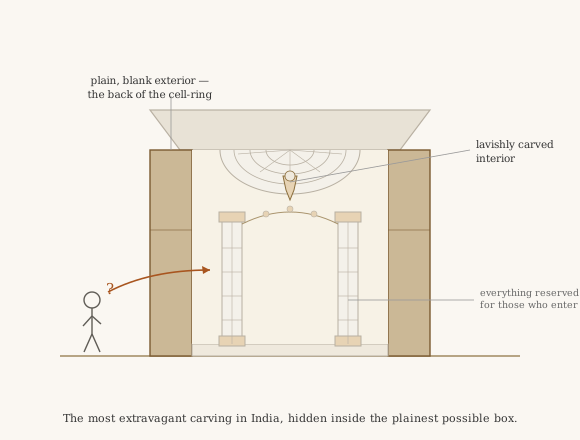
There is a final idea in the plainness of the Dilwara exteriors worth carrying away. In much of the world, and in much of India too, architecture announces itself outwardly — the tower, the dome, the gopuram, the façade competing for the sky. The towers of Madurai shout across the plain; the tower of Brihadeeswara commands the horizon. Dilwara does the reverse. It hides. It offers the passing world nothing, and reserves everything for those who enter and look up. For a faith that prizes renunciation and inwardness, that is not an accident of siting or budget — it is the architecture being the philosophy. The most extravagant carving in India sits inside the plainest possible box, and the gap between the two is the whole point.
Part of the Architectural Wonders series. For medieval temple sculpture at the opposite extreme of mass and rhythm, read about the Kandariya Mahadeva at Khajuraho; for the western Indian tradition of subterranean carving, see the stepwell at Rani ki Vav.
Hero photograph: “Ceiling of the Dilwara (Delwara) Temple, Mount Abu”, Rijksmuseum, via Wikimedia Commons,_RP-F-F02520.jpg), released under CC0 / public domain.
Export this guide
Related Guides — Deep-dive reading
Khajuraho: The Temple Built to Be a Mountain
How the Chandela masons of 10th-century central India made the northern temple rise like a Himalayan peak — and why its sculpture, its engineering and its improbable survival still instruct the modern architect.
Architectural WondersThe Ranakpur Jain Temple: A Forest of 1,444 Marble Pillars, No Two Alike
How a fifteenth-century Jain merchant raised a four-faced temple of white marble in the Aravalli hills — a hall of a thousand-odd columns and eighty domes, built with perfect symmetry around a god who faces all four directions at once
Architectural WondersBelur and Halebidu: The Hoysala Temples Carved Like Ivory
How 12th-century Karnataka masons turned soft soapstone into architecture of impossible fineness — star-shaped temples wrapped in continuous friezes and carried on pillars that look turned on a lathe.
Architectural WondersRelated Tools — Try Free
Cross-Ventilation Analyzer
Estimate airflow and air changes per hour (ACH) from room size, window areas, layout, and local wind — with NBC 2016 Part 8 compliance check.
Ventilation CalculatorCircadian Light Meter
Patient-centric circadian lighting visualizer for Indian healthcare design — time-of-day × intensity → CCT, melanopic lux (EML / mEDI), melatonin suppression, and an alertness curve. Calibrated against WELL v2 L03 Circadian Lighting Design, CIE S 026:2018, Brainard 2001, and Lucas et al. 2014.
Circadian ToolWindow Orientation Planner
Pick the best window type, glass and shading by wall direction — north, east, south and west.
Window Tool