
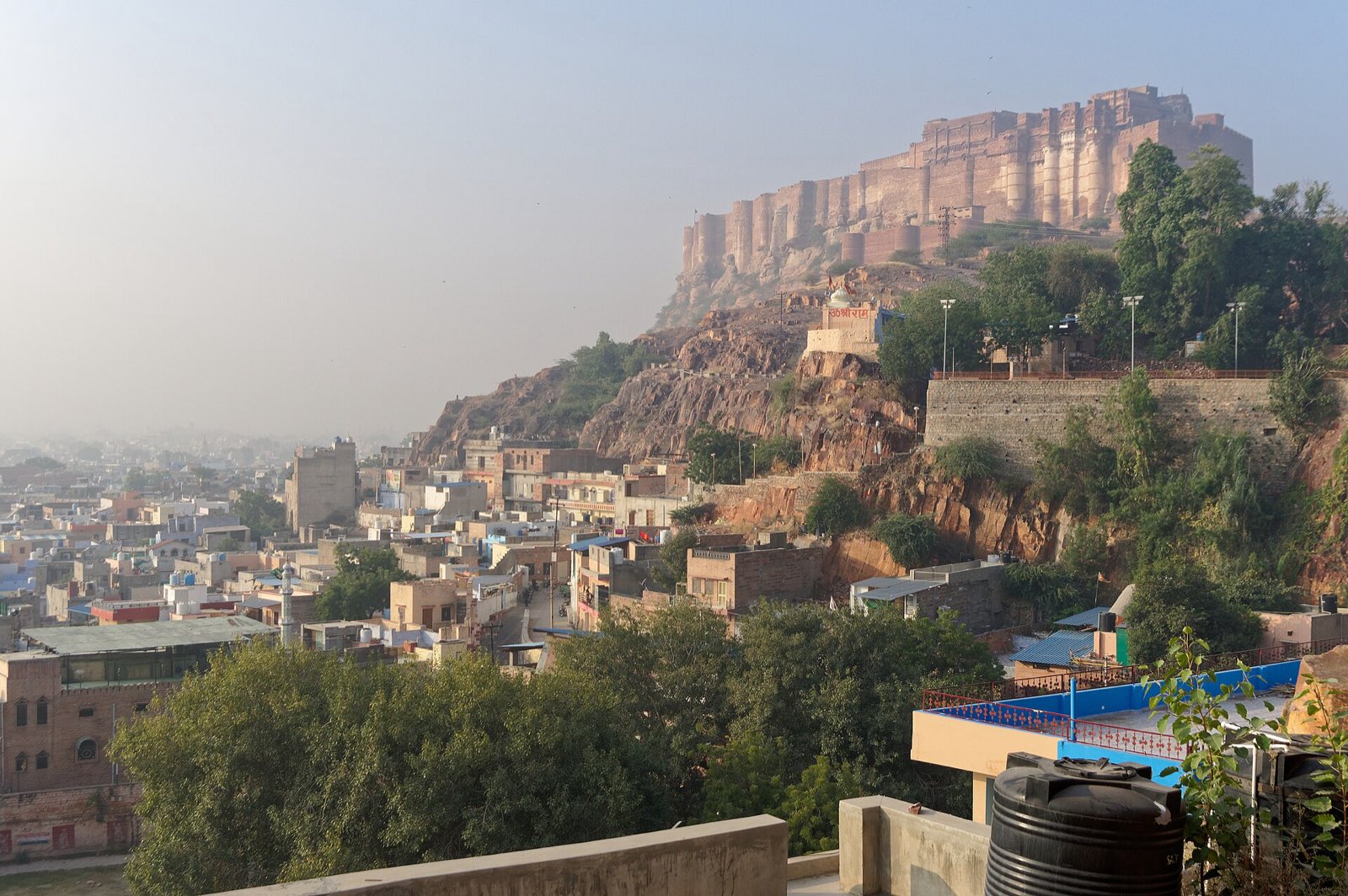
Mehrangarh Fort, Jodhpur: A Citadel Grown from the Rock
How the Rathore kings of Marwar raised one of the mightiest forts in India on a sheer cliff above the blue city — a fist of stone whose brutal walls and trapped gateways guard a hidden jewel of delicate palaces
At Amber we met the Rajput fort-palace as a place of refinement — a stronghold that had made its peace with the Mughal empire and turned much of its energy to gardens, mirrors and cooled pavilions. Mehrangarh, at Jodhpur, is the Rajput fort in a fiercer key: first and above all a war-machine, one of the largest and most formidable fortresses in India, an unmistakable statement of martial power and independence carved from the living rock. To stand beneath its walls is to feel, as few buildings can make you feel, the sheer will to be impregnable.
And yet — this is the paradox at the heart of every great Rajput fort, and Mehrangarh states it most dramatically of all — inside that brutal fist of stone are folded some of the most delicate and jewel-like palace interiors in all of Rajasthan. The fort is a hard shell around a soft, gorgeous core. Learning to read Mehrangarh means reading both: the architecture of defence on the outside, the architecture of delight within.
The fort that is a cliff
The first and most important fact about Mehrangarh is its site, because the site is the design.
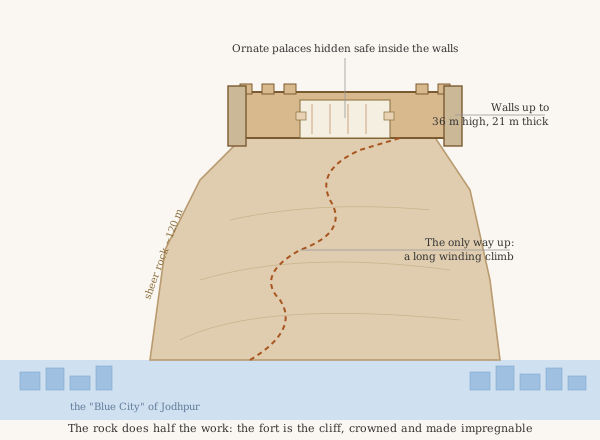
The fort stands on a steep, isolated rock that rises about 120 metres straight out of the surrounding plain, and the city of Jodhpur — famously painted blue, house after house, so that the fort seems to float above a blue sea — spreads at its foot. The builders did not fight the rock; they used it. On three sides the natural cliff is so sheer that no wall is even needed; the stone itself is the defence. Only where the ground allowed an approach did they raise their colossal man-made walls — ramparts up to thirty-six metres high and, in places, twenty-one metres thick, built of the same tawny sandstone as the rock, so that from below you cannot always tell where the cliff ends and the fortification begins. The fort appears to have grown out of the mountain.
Mehrangarh was founded in 1459 by Rao Jodha, chief of the Rathore Rajputs and founder of Jodhpur, who moved his capital to this more defensible rock; and it was extended and embellished by his successors, the Maharajas of Marwar, over the following five centuries. Its name means, roughly, "fort of the sun," the Rathores claiming descent from the sun. Unlike so many of the monuments in this series, it was never taken by storm — a fact its walls make entirely believable.
The gateway as a trap
The genius of a great fort is concentrated at its one point of weakness: the gate, the single place an enemy can actually get in. And here Rajput military architecture becomes a fascinating study in how to turn a door into a weapon.
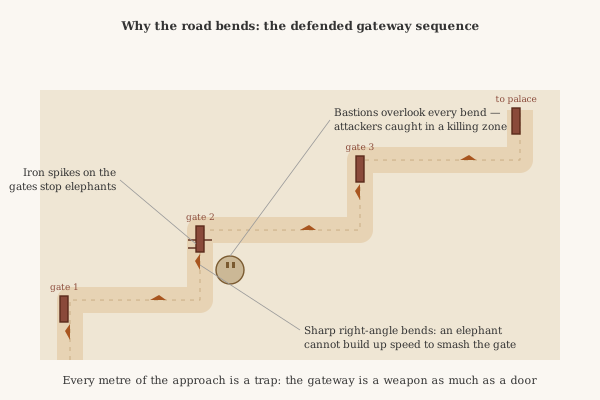
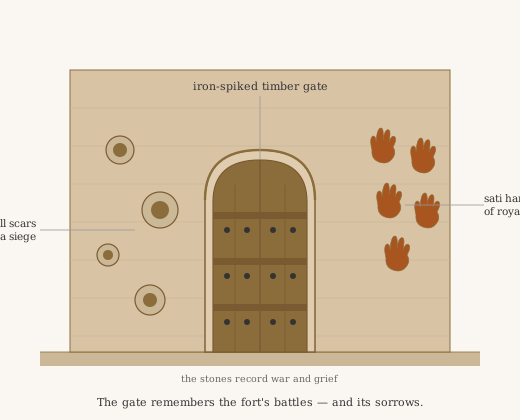
You do not simply walk up to Mehrangarh's gate. The approach is a long road that climbs the rock and passes through a series of gateways — seven of them — and the whole sequence is designed to defeat an assault. The road bends sharply, often at right angles, between the gates, for a crucial reason: the classic weapon for smashing a fort gate was a war-elephant charging head-down at the timber doors, and an elephant needs a straight run to build up its momentum. Break the approach into short, sharp, angled segments and the elephant can never get up speed. The gates themselves are faced with rows of vicious iron spikes at exactly the height of an elephant's forehead, so that even a slow push impales the animal. And every bend in the road is overlooked from above by walls and bastions, turning the entire approach into a killing zone in which attackers are trapped, slowed, and struck at from over their heads while they struggle with each gate in turn.
Read the gate sequence and you understand the whole logic of the pre-gunpowder fort: defence in depth, obstacle behind obstacle, so that breaching the outer gate only delivers the enemy into another trap. One of Mehrangarh's inner gates still bears the marks of cannonballs from a later siege, and another carries the poignant handprints of royal widows who committed sati on the funeral pyre of a maharaja — the fort's stones recording both its wars and its griefs.
The jewel inside the fist
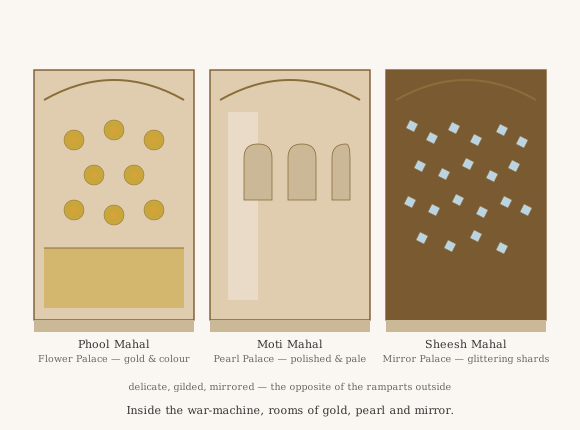
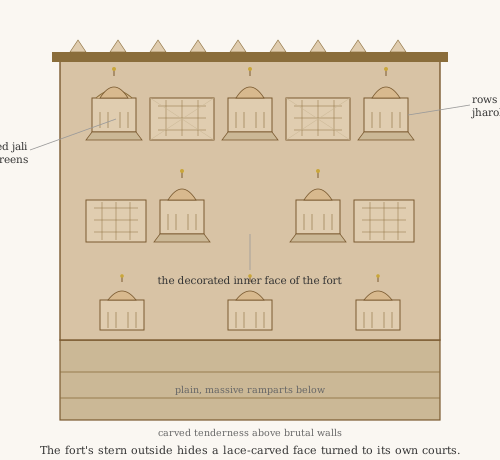
Cross the last gate and the fort transforms. The interior of Mehrangarh is a series of ornate palaces built by successive maharajas around courtyards on the summit, and they are the opposite of the walls outside in every way: intimate, delicate, exquisitely decorated. There is the Phool Mahal, the "Flower Palace," its ceiling ablaze with gold and colour, the pleasure-hall of the kings. There is the Moti Mahal, the "Pearl Palace," its walls finished in a lustrous polished lime plaster. There is the Sheesh Mahal, mirrored like its cousin at Amber; the Takhat Vilas; and the screened apartments of the zenana, the women's quarters, their windows filled with the finest jali — the pierced stone lattices that let the women see out over the courtyards and catch the breeze without being seen.
That contrast, between the sandstone brutality of the ramparts and the carved tenderness of the palaces within, is the essential Rajput idea we first met at Amber — but Mehrangarh states it at maximum intensity. Here the two halves are more extreme and more sharply opposed: the fort is more warlike and more overwhelming on the outside, and the surprise of the delicacy within is correspondingly greater. It is as if the whole culture of the Rathores were built into the stone: a people who had to be warriors to survive, and who lavished on the hidden interior of their stronghold all the beauty that the exposed exterior could never afford.
Why Mehrangarh matters
If Amber shows the Rajput fort at its most refined and Mughal-influenced, Mehrangarh shows it at its most elemental and self-reliant — architecture as the physical expression of a fierce independence. It completes this series' picture of how Indians built for defence, the counterpart to the ceremonial palace-fort of the Mughals at the Red Fort: where the Mughal fort was a walled pleasure-city whose defences were half symbolic, Mehrangarh is a fort whose defences meant, and still mean, deadly business. And it is one of the supreme examples anywhere of a building that works with its landscape — that takes a sheer natural rock and completes it into something no army could take, so that the boundary between geology and architecture simply dissolves.
Stand in the blue city at its foot and look up at the tawny walls climbing out of the cliff into the desert sky, then climb the winding, trapped, spiked road through its seven gates to the gilded flower-painted rooms at the top, and you have travelled the whole distance of the Rajput imagination — from the will to be unconquerable to the love of exquisite things — held together in one mountain of stone.
Part of the Architectural Wonders series. For the Rajput fort in its refined, Mughal-influenced mode, read Amber Fort; for the ceremonial imperial fort, the Red Fort at Delhi.
Hero photograph: “Mehrangarh Fort, Jodhpur” by Jakub Hałun, via Wikimedia Commons, licensed under CC BY-SA 4.0.
Export this guide
Related Guides — Deep-dive reading
Amber Fort, Jaipur: The Rajput Palace That Learned to Speak Mughal
How the warrior-kings of the desert built a fortress-palace up a hillside above a lake — half stronghold, half pleasure-house — where mirrors, lattices and running water turned defence into delight
Architectural WondersPersepolis: The Palace Where Every Nation Came Bearing Gifts
On a vast stone terrace in southern Iran, the kings of Persia built the grandest ceremonial capital of the ancient world — a forest of impossibly tall columns whose walls, unlike those of any conqueror before them, carved not war and captives but a peaceful procession of twenty-three nations bringing gifts. It is the gentlest image of empire the ancient world produced — until Alexander burned it to the ground. The third article in our chapter on the palaces of worldly power.
Architectural WondersThe Palace of Sennacherib at Nineveh: The Palace Without Rival
Twenty-seven centuries ago, on the Tigris opposite modern Mosul, an Assyrian king built a palace so vast he named it, in his own words, 'the Palace that has no rival' — and lined its walls, room after room, with miles of carved stone panels telling the story of his wars. It is the birthplace of narrative art, the home of the winged guardian, and a wonder destroyed not once but twice. The second article in our chapter on the palaces of worldly power.
Architectural WondersRelated Tools — Try Free
Cross-Ventilation Analyzer
Estimate airflow and air changes per hour (ACH) from room size, window areas, layout, and local wind — with NBC 2016 Part 8 compliance check.
Ventilation CalculatorCircadian Light Meter
Patient-centric circadian lighting visualizer for Indian healthcare design — time-of-day × intensity → CCT, melanopic lux (EML / mEDI), melatonin suppression, and an alertness curve. Calibrated against WELL v2 L03 Circadian Lighting Design, CIE S 026:2018, Brainard 2001, and Lucas et al. 2014.
Circadian ToolHome Colour Studio
Colour every room — living, bedroom, dining, kitchen, bathroom — surface by surface in any HEX/RGB/CMYK colour, or from 80+ curated Indian shades.
Colour Studio