
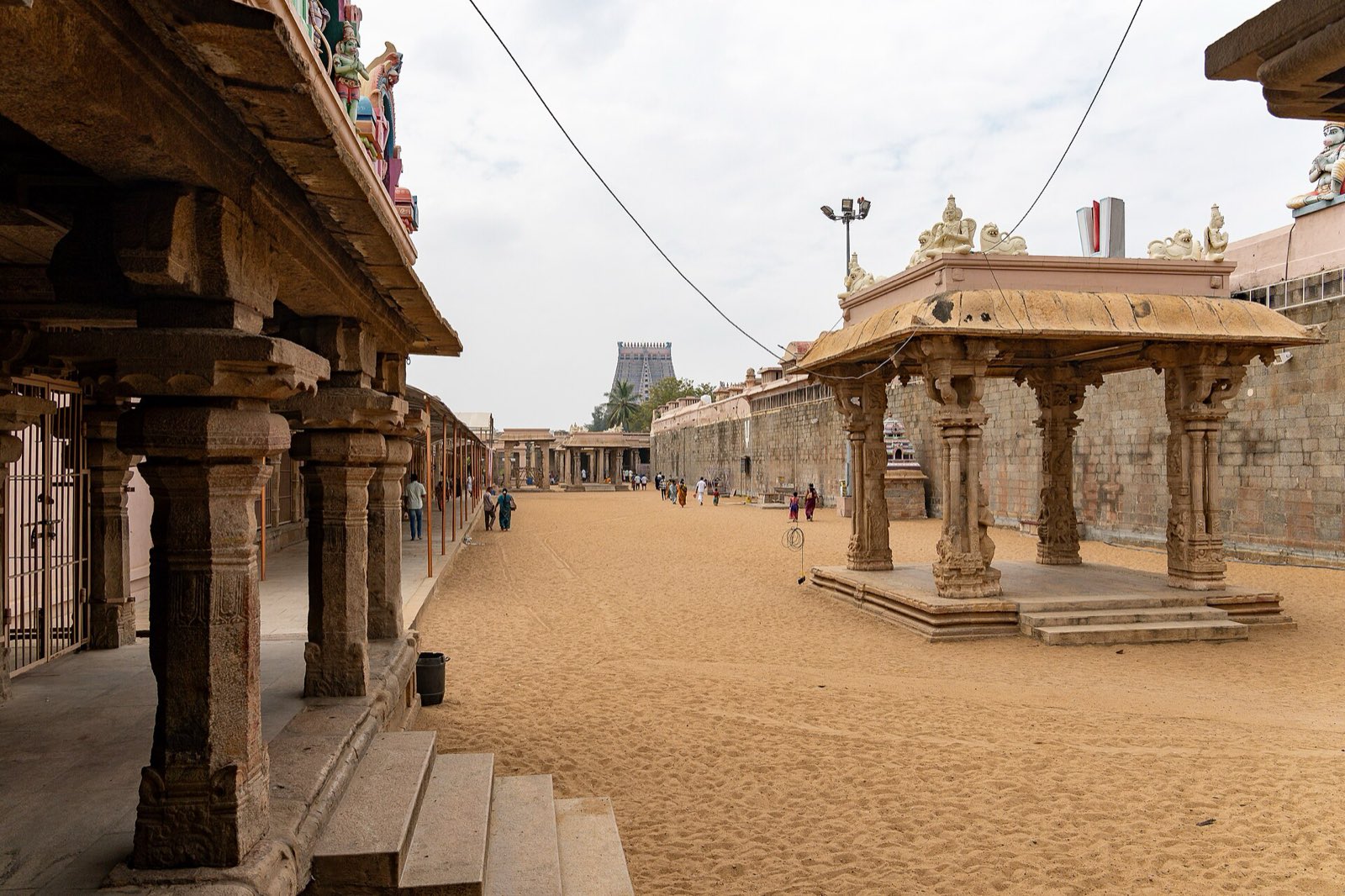
Srirangam: The Largest Working Temple in the World, a Town Built in Seven Rings
How a temple on an island between two rivers grew into a sacred city of seven concentric walls — the outer rings a living town, the innermost a dark chamber where Vishnu lies asleep — and became the greatest of all the South Indian temple-towns
If the Meenakshi temple at Madurai is a temple that became a city, Srirangam is the idea taken to its absolute limit — the largest functioning Hindu temple complex on earth, a sacred precinct so vast that a whole town lives inside its outer walls and most visitors never realise they are already deep within the temple when they think they are still in the streets outside it. Spread across an island in the Kaveri river near Tiruchirappalli in Tamil Nadu, Srirangam covers around 156 acres and is enclosed by seven concentric walls pierced by twenty-one gateway towers. It is not merely a big temple. It is a diagram of the cosmos laid out at the scale of a city, and you walk through it from the ordinary world at the edge toward the sleeping god at the centre.
To understand Srirangam is to understand the deepest logic of the South Indian temple — the idea we first met at Madurai, that the holy is reached not by climbing toward a bright climax but by passing inward, ring after ring, from the profane world to the dark sacred core. At Srirangam that logic is drawn out across seven walls and a whole townscape, and it is the most complete statement of it anywhere.
Seven rings on an island
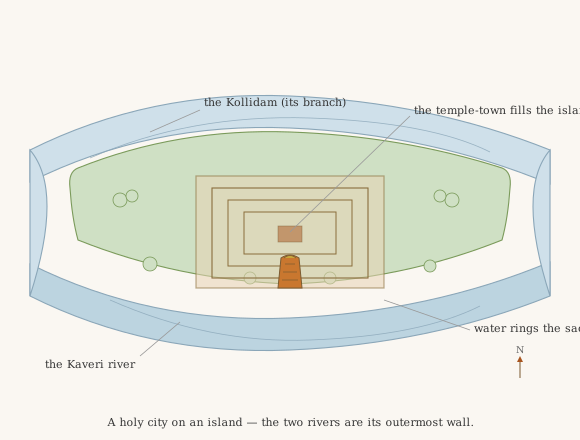
Start with the plan, because the plan is the whole idea.
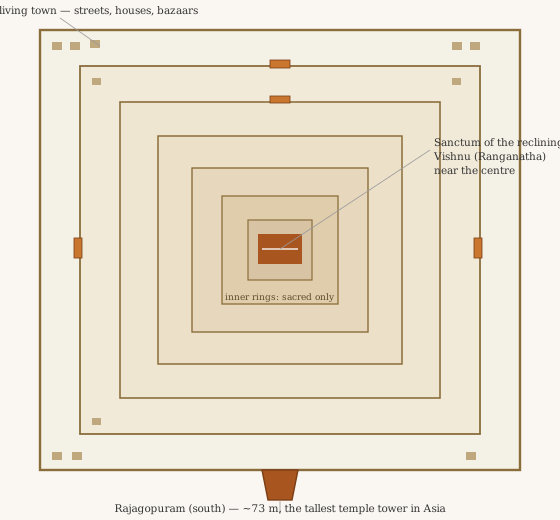
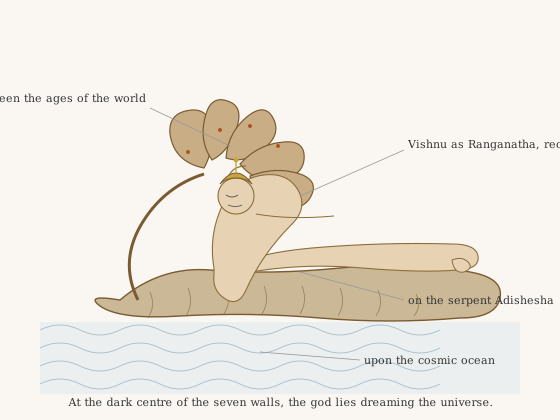
Seven rectangular enclosure walls — prakaras — are nested one inside another like the layers of an onion, each with its own set of gateways on the cardinal axes. Between each pair of walls runs a broad concentric street, so that the temple is organised as a series of rectangular ring-roads around a shared centre. At that centre, near the heart of the innermost enclosure, is the sanctum — and the deity within is unusual and important: this is Vishnu in the form of Ranganatha, shown not standing or seated but reclining, lying asleep on the great serpent Adishesha upon the cosmic ocean, in the interval between the dissolution and re-creation of the universe. The sanctum is crowned not by a soaring tower but by a modest gilded dome (the vimana), for as at Madurai the true height has migrated outward to the gateways.
And what gateways. The southern gate of the outermost wall, the Rajagopuram, rises about seventy-three metres, making it the tallest temple tower in Asia. Its base is old, but the great tower was only completed in 1987, capping a structure that had stood as a stump for centuries — a reminder that a South Indian temple is a project without end, worked on across a thousand years and more. The gopurams grow taller the further out they stand, exactly the inversion of hierarchy we traced at Madurai: the humble dome over the god at the centre, the giant towers marking the boundary with the world.
A town inside a temple
The single most striking fact about Srirangam is that the outer rings are not empty ceremonial space. They are a living town. The streets between the outermost walls are lined with houses, shops, hotels, flower-sellers, priests' quarters and the ordinary bustle of Tamil urban life. People are born, live and die within the temple's outer enclosures. As you move inward through the gateways, the character of each ring changes: the outer streets are fully secular and open to everyone; the middle rings hold subsidiary shrines, pillared halls, tanks and the apparatus of worship; and only in the innermost enclosures does the space become exclusively sacred, with access to the final chambers restricted, as in most major Hindu temples, to Hindu worshippers and, at the sanctum itself, to the priests.
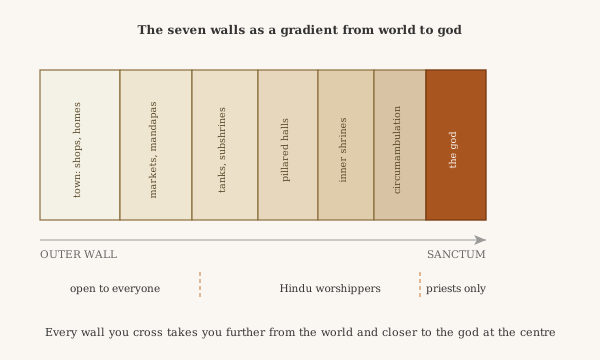
This is the genius of the seven-ring plan: it turns the journey to the god into a graded passage through space, in which the world gradually falls away. You begin among traffic and commerce, and by the time you reach the centre you have crossed seven thresholds, each one quieter, darker and more sacred than the last. The architecture does not separate the holy from the everyday with a single wall; it dissolves one into the other across a whole city, so that the sacred and the profane are not opposites but the two ends of a gradient. Nowhere else is this idea built at such scale.
Halls, water and the accretion of centuries
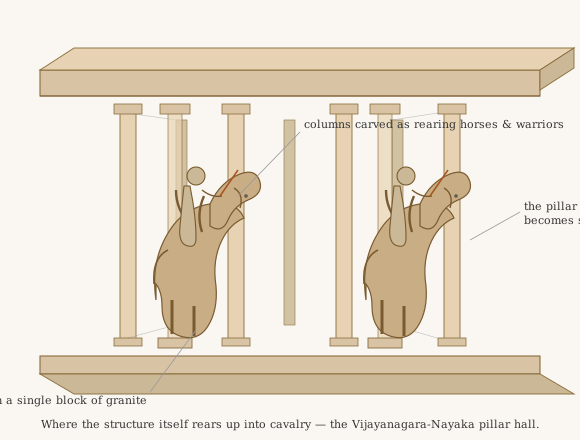
Within the enclosures Srirangam holds the full apparatus of the great Dravidian temple, developed over its long life by a succession of dynasties — the Cholas, the Pandyas, the Hoysalas, the Vijayanagara emperors and the Nayakas each adding walls, halls and gateways, just as they did at Madurai and across the Vijayanagara world of Hampi. There is a celebrated "thousand-pillared hall", a vast flat-roofed grid of granite columns of the kind the South Indian temple loved. There is the famous Sheshagiri Rayar mandapa with its rearing horses and warriors carved from single blocks of stone, the yali columns bursting with sculptural energy. And there is water everywhere — sacred tanks within the enclosures, and the two rivers, the Kaveri and the Kollidam, embracing the island itself, for the temple's very site between the waters is part of its holiness.
The long accretion is written into the fabric. No single architect designed Srirangam; it is the fossil record of more than a millennium of devotion, each ruler wrapping another ring around the growing core, so that the seven walls are also, in a sense, seven ages of South Indian history laid out in concentric stone.
Why Srirangam matters
Set beside the other temples in this series, Srirangam is the culmination of a long story. At Mamallapuram the Pallavas invented the vocabulary of the South Indian temple; at Brihadeeswara the Cholas raised the single sanctuary tower to its most sublime; at Madurai the Nayakas turned the temple inside out into a walled town of soaring gateways. Srirangam takes that final idea and pushes it to its absolute maximum — seven rings, twenty-one towers, the tallest gopuram in Asia, and a whole living city held within the temple's embrace.
It is also, crucially, a living monument, not a ruin or a museum. Its rituals have continued, more or less, for over a thousand years; its festivals still fill the concentric streets with hundreds of thousands of pilgrims; the reclining god at its centre is still woken, bathed, dressed and put to sleep each day by his priests. To walk inward through its seven walls is to make a journey that countless generations have made before, from the noise of the bazaar to the silence of the sanctum where Vishnu lies dreaming the universe. No building better expresses what the South Indian temple ultimately became: not an object to be admired from outside, but a sacred cosmos you enter and cross, ring by ring, all the way to the still centre of the world.
Part of the Architectural Wonders series. Read the South Indian temple's story through Mamallapuram, the Brihadeeswara temple at Thanjavur, and its closest cousin, the Meenakshi temple at Madurai.
Hero photograph: “Ranganathaswamy Temple, Srirangam” by Rainer Halama, via Wikimedia Commons, licensed under CC BY-SA 4.0.
Export this guide
Related Guides — Deep-dive reading
Meenakshi Temple, Madurai: The City That Is a Temple, the Temple That Is a City
How the Nayakas turned a South Indian shrine into a walled metropolis of gateways, where the tallest towers guard the edges and the holiest room is the smallest and darkest
Architectural WondersThe Mud Mosques of Timbuktu: The University Made of Earth
On the edge of the Sahara, a city that Europe turned into a byword for the middle of nowhere was in truth one of the great centres of learning in the medieval world — with a university of 25,000 students and libraries of hundreds of thousands of manuscripts. Its three great mosques are built entirely of mud, bristling with wooden beams, and must be re-plastered by the whole community every single year — which is exactly why, after seven centuries, they still stand.
Architectural WondersThe Temples of Karnak: A Sacred City Built by Thirty Kings
How thirty pharaohs across two thousand years — from the Middle Kingdom to the age of Ramesses — kept adding to a single sacred precinct at Thebes until it became the largest religious complex of the ancient world, crowned by a hall of 134 colossal stone columns raised as a petrified papyrus marsh, a forest of stone built to be the very morning of creation for the King of the Gods, Amun-Ra.
Architectural WondersRelated Tools — Try Free
Visitor Access Planner
Size visitor handling at a gate or reception — lanes needed at peak and the temporary-pass pool.
Visitor FlowBefore & After Studio
Generate AI before-and-after renders to preview how your redesign could look.
DesignAICircadian Light Meter
Patient-centric circadian lighting visualizer for Indian healthcare design — time-of-day × intensity → CCT, melanopic lux (EML / mEDI), melatonin suppression, and an alertness curve. Calibrated against WELL v2 L03 Circadian Lighting Design, CIE S 026:2018, Brainard 2001, and Lucas et al. 2014.
Circadian Tool