
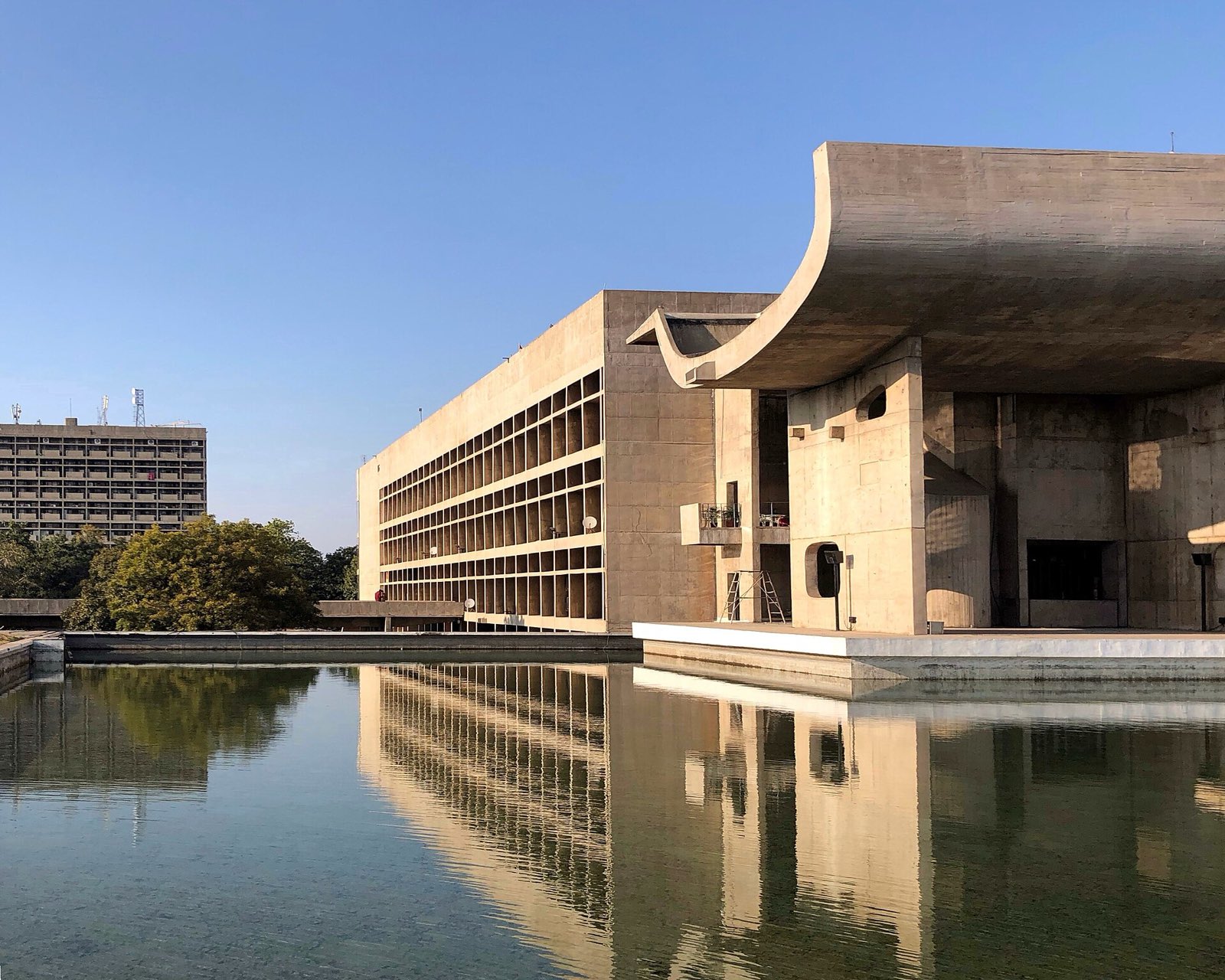
The Capitol Complex, Chandigarh: Le Corbusier's Concrete City for a New Nation
How a free India handed a Swiss-French modernist a blank plain in Punjab, and got back a landscape of raw concrete, upturned roofs and sun-breakers that argued a newly independent country need not build like its past
Every other building in this series is old. Some are very old. The Capitol Complex at Chandigarh is the exception, and it is here deliberately, because the story of Indian architecture does not stop with the Mughals or the British. In 1947 India became independent, and one of the first great architectural questions the new nation faced was brutally simple: what should a free India build like? Chandigarh is the boldest answer anyone gave — and the answer was to build like nothing India had built before.
A capital for a partitioned province
Chandigarh was born of trauma. When British India was partitioned in 1947, the province of Punjab was cut in two, and its historic capital, Lahore, ended up in Pakistan. Indian Punjab was left without a capital, and the new government of Jawaharlal Nehru decided not to expand an existing town but to build an entirely new city on open agricultural land at the foot of the Shivalik hills. It was to be, in Nehru's famous phrase, "unfettered by the traditions of the past, a symbol of the nation's faith in the future."
That sentence is the key to everything at Chandigarh. Nehru wanted a clean break — a modern, planned, forward-looking city that would announce that India was a modern nation, not a museum of its own heritage. After the first planners (an American, Albert Mayer, and the Polish architect Maciej Nowicki, who died in a plane crash) the commission passed to the Swiss-French architect Le Corbusier, the most influential and most dogmatic modernist of the twentieth century, working with his cousin Pierre Jeanneret and the British architects Maxwell Fry and Jane Drew. Le Corbusier planned the whole city as a grid of self-contained "sectors", and reserved for himself the design of its head: the Capitol Complex, the seat of government.
Three buildings and a hand, spread across a plain
The Capitol Complex is not a building; it is a landscape. Le Corbusier scattered its elements across a vast open esplanade, so far apart that you cannot comfortably walk between them, with the Shivalik hills as a permanent backdrop.
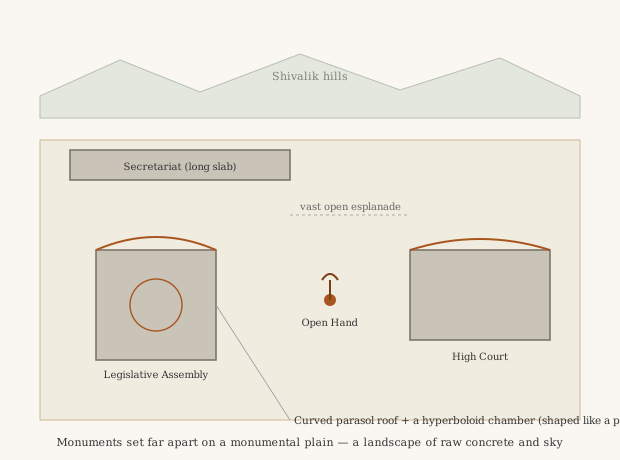
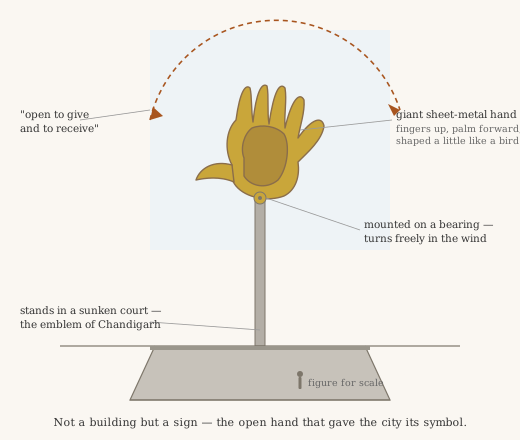
Three great buildings anchor the complex. The Secretariat is an enormous horizontal slab, a quarter of a kilometre long, housing the government offices — a wall of concrete banded with sun-breakers, deliberately low and long against the hills. The Legislative Assembly and the High Court face each other across the esplanade, each a bold sculptural object. And between and around them Le Corbusier placed a series of monuments and symbols, the most famous of which is the Open Hand — a giant rotating sheet-metal hand, "open to give and open to receive", that became the emblem of the city.
The most striking thing about this arrangement, and the most criticised, is the emptiness. Le Corbusier separated his monuments by huge distances of open, hard, shadeless ground, meaning them to be seen as isolated sculptural masses against the sky, the way you might see the monuments of an ancient acropolis. It is magnificent in photographs and, in the ferocious Punjab summer, punishing to cross on foot — a reminder that heroic modernism sometimes designed for the eye and the idea more than for the walking human body.
The material: raw concrete, and why it looks like that
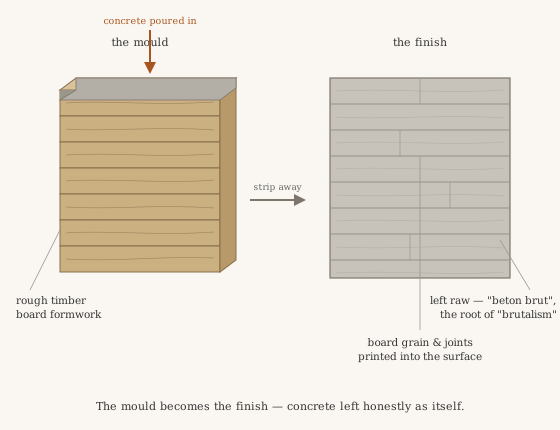
You cannot discuss Chandigarh without discussing concrete, because Le Corbusier made concrete the entire language of the place. Specifically he used béton brut — "raw concrete", poured into rough timber formwork and then left exactly as it came out of the mould, with the grain and joints of the wooden planks printed permanently into its surface. Nothing is faced with marble or stone or plaster. The structure is the finish. The word "brutalism", the name of a whole architectural movement, comes directly from this béton brut.
There were reasons beyond aesthetics. India in the 1950s had abundant unskilled labour and limited access to steel and precision finishes; concrete could be mixed and poured on site by hand, in vast quantities, cheaply. But Le Corbusier also believed, philosophically, in showing a material honestly — letting concrete be concrete, rough and grey and monumental, rather than dressing it up as something else. Set this against everything else in this series and the shock is total. The Dilwara temples hid their structure behind lace; the Mughals sheathed their brick in red sandstone and white marble; here, at last, the structure refuses to hide at all. That refusal is the modernist creed made stone — or rather, made concrete.
Designing for the sun: the parasol and the sun-breaker
For all its foreignness, Chandigarh contains real, hard-won lessons about building in India — and this is where it earns its place among the wonders. Le Corbusier could not simply transplant the glass-and-steel modernism of cool northern Europe to a place where summer temperatures pass forty-five degrees. He had to invent a modern architecture for the sun, and the two devices he developed here have been copied across the tropical world ever since.
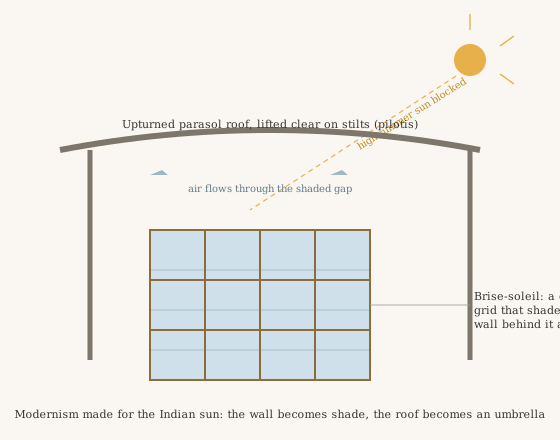
The first device is the brise-soleil — literally "sun-breaker". Instead of a flat glass wall that would turn the interior into an oven, Le Corbusier stood a deep grid of concrete fins in front of the glass, a kind of enormous egg-crate projecting a metre or more from the building. The high summer sun strikes the fins and is thrown into shadow before it ever reaches the glass, while the lower winter sun and indirect light still pass through. The whole outer wall becomes, in effect, a permanent adjustable louvre made of structure. It is the single most influential idea to come out of Chandigarh, and you can see its descendants on office buildings across hot countries today.
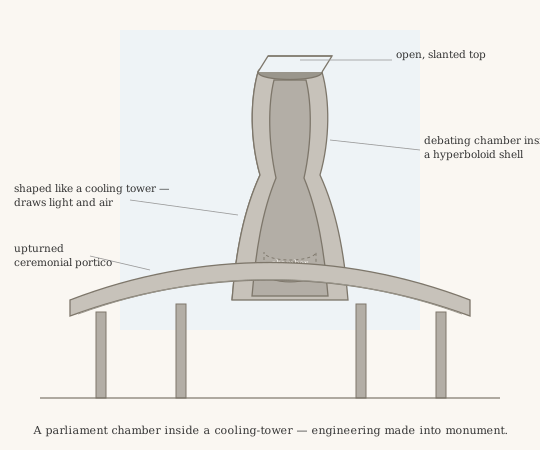
The second device is the parasol roof. On both the Assembly and the High Court, Le Corbusier lifted a great curved, upturned roof high above the building on stilts (his pilotis), leaving a ventilated gap between roof and rooms. The roof shades the building like an umbrella, and air moves freely through the shaded void beneath it, carrying heat away — cooling by shade and breeze rather than by machinery. The sweeping upturned profile of the Assembly's parasol, and the great hollow tower of its main chamber — shaped, astonishingly, like the hyperbolic cooling tower of a power station, chosen for how it draws air and light — are the sculptural climax of the whole complex.
What Chandigarh means
Chandigarh has always divided people, and it is worth being honest about that. To its admirers it is the greatest work of modern architecture in India and one of the great urban visions of the twentieth century — so much so that the Capitol Complex is now a UNESCO World Heritage Site, part of a transnational listing of Le Corbusier's work. To its critics it is a cold, foreign imposition: a European's abstract diagram dropped onto Indian soil, its vast plazas hostile to the climate and the crowd, its concrete monuments indifferent to the dense, shaded, sociable urbanism that Indian cities had evolved over millennia.
Both views contain truth, and that tension is exactly why the complex belongs in this series. Every other monument here grew out of a deep continuity — the South Indian temple evolving over a thousand years, the Mughal tomb refined across generations. Chandigarh is the great discontinuity: the moment a nation deliberately chose to break with its own architectural past and to speak an international, machine-age language instead. Whether that break was liberation or loss is a question India is still, in a sense, arguing about — in every glass tower and every revived tradition built since.
Stand on the empty esplanade at Chandigarh, with the raw concrete and the upturned roofs and the Open Hand turning slowly in the wind against the hills, and you are standing at the hinge where Indian architecture met the twentieth century head-on. It is among the newest wonders in this chapter, and in its own severe way one of the boldest.
Part of the Architectural Wonders series. For the tradition Chandigarh broke with, read about the Taj Mahal and the thousand-year evolution of the temple-town at Madurai; for another architecture of honest, unhidden structure, see the Dilwara temples.
Hero photograph: “Palace of Assembly, Chandigarh” by UnpetitproleX, via Wikimedia Commons, licensed under CC BY-SA 4.0.
Export this guide
Related Guides — Deep-dive reading
Louis Kahn's Façade Signature: Wrapping Ruins, Brick Arches, and Monumental Light
How Louis Kahn shaded the glass behind giant geometric screen walls, asked the brick to be an arch, and built monumental façades of fair-faced concrete and light — and what that hot-climate logic teaches Indian builders today.
Building FacadesAmaravati: Can You Still Draw a Capital City on a Blank Sheet?
Foster + Partners' masterplan for Andhra Pradesh's new capital proposes an entire city from scratch on the banks of the Krishna — a green-spined grid crowned by a 250-metre assembly rising from a lake. It is one of the last great tabula-rasa capitals of the twenty-first century, and a live test of whether that idea should survive at all.
The Future of ArchitectureVidhana Soudha: How a New Democracy Built Its House in Stone
Kengal Hanumanthaiah's 1956 legislature in Bengaluru is a modern steel-and-concrete government block wearing the carved grammar of the South Indian temple — India's most confident answer to the question every newly independent nation faces: whose architecture should a free people speak? A deep case study in the Neo-Dravidian synthesis, its granite craft, its contested authorship, and the cost it drew fire for.
The Future of ArchitectureRelated Tools — Try Free
Brise-Soleil Visualizer
Interactive horizontal-louvre cut-off angle calculator — sun altitude, louvre depth, and spacing inputs with a live shadow preview. Computes θ = arctan(spacing/depth) for façade shading, ECBC envelope compliance, hospital daylight design, and tropical sun-control detailing.
Sun Shading ToolCircadian Light Meter
Patient-centric circadian lighting visualizer for Indian healthcare design — time-of-day × intensity → CCT, melanopic lux (EML / mEDI), melatonin suppression, and an alertness curve. Calibrated against WELL v2 L03 Circadian Lighting Design, CIE S 026:2018, Brainard 2001, and Lucas et al. 2014.
Circadian ToolCross-Ventilation Analyzer
Estimate airflow and air changes per hour (ACH) from room size, window areas, layout, and local wind — with NBC 2016 Part 8 compliance check.
Ventilation Calculator