
Sanchi: The Dome That Began Indian Architecture
How a solid brick-and-stone hemisphere raised over the Buddha's relics — a building with no inside — became India's first great monument, and fixed the form of the stupa for the whole of Asia.
This opens a new chapter of the Architectural Wonders series — the first article in our chapter on the architecture of India. Over the pieces that follow we travel the length of the subcontinent and three thousand years of building: stupas and rock-cut caves, temple-mountains and gopuram-towns, tombs and mosques, forts and lake-palaces, an observatory of stone and the concrete capitol of a new republic — the work of many faiths and many peoples, in every material the land could give. We begin, as the story does, at the beginning.
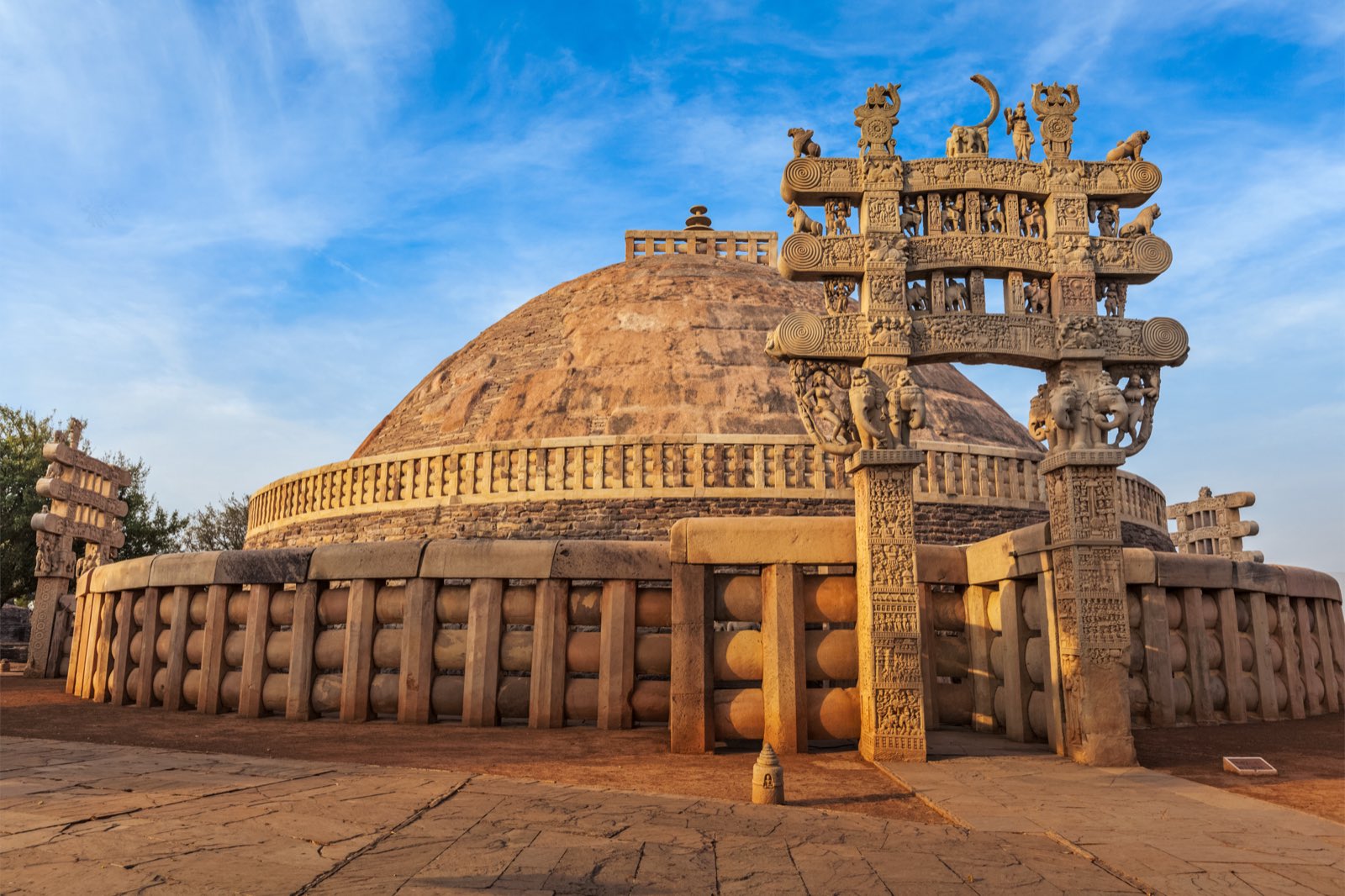
Climb the low hill at Sanchi in Madhya Pradesh and the first great monument in the history of Indian architecture is waiting at the top, and it does something no later temple will do: it offers you no way in. There is no door, no hall, no sanctum, no dark inner room. There is only a vast, solid hemisphere of brick and dressed stone, sitting on a low drum, crowned by a little stone railing and a triple parasol — and, standing guard at the four directions, four carved stone gateways. This is the Great Stupa, begun in the 3rd century BCE, and it is the seed from which almost everything else in this series grows.
It makes an instructive opening to the Indian thread of our Architectural Wonders series. At Ajanta the Buddhists carved their architecture _inward_, hollowing halls out of a cliff. Here they did the reverse: they piled a solid mountain of masonry and put the meaning entirely on its surface and in the act of walking around it. Before India had temples with soaring towers — before Khajuraho or Konark — it had this quiet, wall-less dome. Understand Sanchi and you understand where the whole tradition begins.
1. A building with no inside
A stupa is not a shelter. It is a reliquary made monumental — a burial mound raised over the physical remains, or the relics, of the Buddha or a great teacher, and enlarged until it became a focus of devotion. Everything about its form follows from that single fact: there is nothing to enter, because the sacred thing is sealed inside the solid mass, at the centre, unreachable.
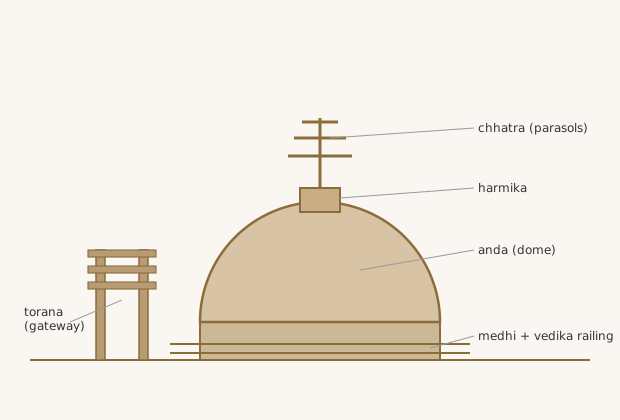
The vocabulary is worth learning, because it recurs across Buddhist Asia. The great dome is the anda — literally the "egg", the cosmic egg, the world-mountain. It rests on a raised circular terrace, the medhi, which carries an upper walkway. At the summit sits a square stone railing, the harmika, enclosing the most sacred point directly above the relic; and rising from it, a mast bearing a stack of stone parasols, the chhatra — the ancient Indian sign of royalty and honour, held now over the Buddha. Around the whole base runs a massive stone fence, the vedika. That is the entire building: dome, terrace, railing, parasol, fence. No windows, because there is no room. No façade, because every side is the front.
2. The architecture is the walking
If you cannot go in, what do you _do_ with a stupa? You walk around it — clockwise, keeping the monument on your right — in the ritual of pradakshina, circumambulation. And once you see that, the whole design snaps into focus: the ritual path is the architecture.
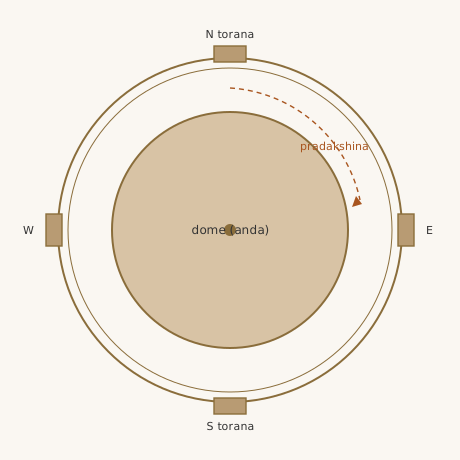
The plan is a set of concentric circles organised entirely around movement. The heavy vedika railing draws a hard line between the ordinary world outside and the sacred ground within — a boundary you cross deliberately. Inside it lies the processional path, and Sanchi has two: one at ground level and a second, raised one on the terrace, reached by a stair. There is no "entrance façade" to compose, because the design is radially symmetric — it looks the same from every side, as a thing meant to be circled must. The only interruptions in the circle are the four gateways, set precisely at north, south, east and west, so that the act of entering the sacred round is aligned to the cardinal order of the cosmos. The building does not house a rite. The building is the rite, made permanent in stone.
3. The toranas — India's first great storytelling in stone
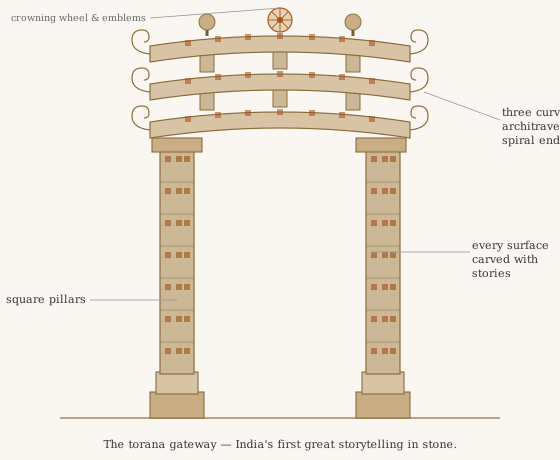
The four gateways, the toranas, are the glory of Sanchi and among the earliest masterpieces of Indian sculpture. Each is a pair of tall posts carrying three gently curved crossbars, and every inch of them is carved — with elephants and lions, guardian spirits and lotus medallions, and above all with narrative: scenes from the life of the Buddha and from the Jataka tales, the stories of his earlier births.
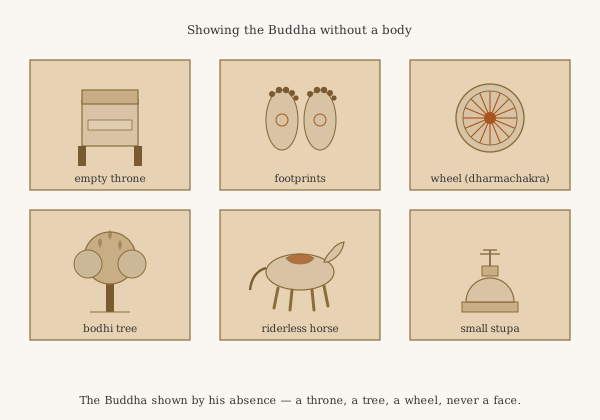
There is one detail every architect and designer should know, because it is a lesson in how meaning is made. In these early carvings the Buddha is never shown as a human figure. This is the aniconic phase of Buddhist art: his presence is indicated only by symbols — a pair of footprints, an empty throne, a parasol over an empty space, a riderless horse, the wheel of the law, the bodhi tree under which he was enlightened. The most important figure in the scene is represented by a considered absence. It is a profound piece of design thinking — presence conveyed by a sign rather than a portrait — and it would hold until the human Buddha image emerged centuries later.
4. Ashoka's brick, and the stone that clothed it
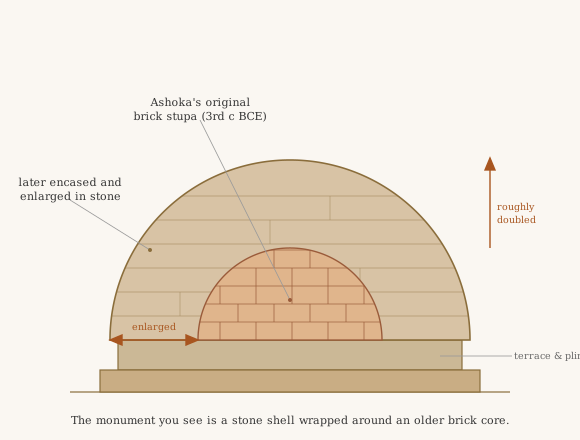
The Great Stupa is really two monuments in one. The core is the work of the Mauryan emperor Ashoka in the 3rd century BCE — a smaller stupa of brick, part of the vast wave of Buddhist building that followed his conversion. Then, in the 2nd and 1st centuries BCE under the Shunga and Satavahana rulers, it was roughly doubled in size, encased in a skin of dressed stone, given its terraces and railings, and finally crowned with the four carved toranas. What you walk around today is Ashoka's mound wrapped and elaborated by later hands — a building that grew across three centuries and several dynasties, each adding to a form they chose to honour rather than replace.
Then Buddhism receded from central India, the site was gradually forgotten, and the hill kept its secret until 1818, when British officers came upon the overgrown stupas. A century of amateur digging did real damage before the archaeologist John Marshall carried out a careful restoration in the early 1900s. Sanchi was inscribed as a UNESCO World Heritage Site in 1989. It is, remarkably, the best-preserved group of early Buddhist monuments in India — the closest we can stand to the very beginning.
5. What a modern architect can learn from Sanchi
- Not every building needs an inside. Sanchi puts all of its meaning on the surface and in the movement around it. A monument, a memorial, a marker can be solid — mass and silhouette and threshold — and be more powerful for having no interior to distract from the idea.
- Let the ritual generate the form. The circle, the railing, the two paths, the four aligned gates — every geometric decision follows directly from the act of walking clockwise. When you let use and meaning drive the plan, symmetry and order arrive on their own.
- Design the threshold, not just the object. At Sanchi the four toranas are where all the art and all the attention are concentrated — because the crossing from ordinary to sacred ground is the real event. How you enter is often more important than what you enter.
- Say it with a sign, not a picture. The aniconic Buddha — presence marked by an empty throne or a pair of footprints — is a masterclass in restraint. The most eloquent thing in a composition is sometimes a deliberate, meaningful absence.
- Pure geometry endures. A hemisphere on a drum has survived, legible, for over two thousand years. Simple primary forms outlast fashion; the clearer the idea, the longer it lasts — the same lesson Konark and Kailasa teach at the other end of the tradition.
Sanchi is where the argument of this whole series starts. Long before India learned to raise towers, it knew that one clear idea — here, a solid dome to be circled — carried without compromise, is what makes a monument.
References & further reading
1. UNESCO World Heritage Centre — Buddhist Monuments at Sanchi (inscribed 1989). https://whc.unesco.org/en/list/524/
2. Encyclopaedia Britannica — Sanchi and stupa. https://www.britannica.com/place/Sanchi
3. Archaeological Survey of India — World Heritage Site, Sanchi. https://asi.nic.in/
4. Incredible India (Ministry of Tourism) — Sanchi Stupa. https://www.incredibleindia.gov.in/en/madhya-pradesh/sanchi
Last verified 2026-07-04. Dates, dimensions and the phasing of construction follow standard archaeological and art-historical reference sources and are given as widely accepted approximations; the account of the aniconic phase and the Jataka narratives follows established scholarship, and the rediscovery and restoration history follows the historical record.
Export this guide
Related Guides — Deep-dive reading
Borobudur: The Mountain You Climb to Reach Enlightenment
In the volcano-ringed heart of Java, around 1,200 years ago, Buddhist kings built the largest Buddhist monument on Earth — not a temple you enter but a solid stone mountain you climb: a three-dimensional map of the universe, wrapped in 2,672 carved panels and 504 Buddhas, that turns the path to enlightenment into a walk you take with your feet. Then it was abandoned, buried under ash and jungle, and rebuilt, stone by million-stone, in our own age.
Architectural WondersBoudhanath: The Great Mandala of Kathmandu
How Tibetan Buddhism built a diagram of the whole cosmos out of brick and whitewash — a colossal stupa whose plan is a mandala, whose golden tower watches all four directions at once, and which its own community dismantled and raised again after the 2015 earthquake.
Architectural WondersSomapura Mahavihara: The Buddhist University Hidden Inside a Hill
Twelve hundred years ago in Bengal, a Pala emperor built one of the largest monasteries the Buddhist world had ever seen — a walled quadrangle a fifth of a mile across, ringed by 177 monks' cells, with a great cross-shaped, terraced temple rising from its courtyard. For four centuries scholars came from as far as Tibet to study here; then it was abandoned, and slowly buried, until villagers knew it only as Paharpur — 'the hill-town.'
Architectural WondersRelated Tools — Try Free
Cross-Ventilation Analyzer
Estimate airflow and air changes per hour (ACH) from room size, window areas, layout, and local wind — with NBC 2016 Part 8 compliance check.
Ventilation CalculatorWindow Orientation Planner
Pick the best window type, glass and shading by wall direction — north, east, south and west.
Window ToolDesign Brief Generator
Answer 10 questions and generate a professional interior design brief PDF for your designer or architect.
Brief Generator