

How to Design a Residential Layout
The end-to-end process — from reading the land and setting the road skeleton to plotting, open space, utilities, approvals and phasing — for an Indian residential layout
Stand at the edge of a successful residential layout on the outskirts of Pune or Hyderabad and you can read its logic in a single glance. A main road peels off the highway and becomes a broad, tree-lined spine. Off it, narrower streets branch like the veins of a leaf, each one quieter and shadier than the last, until you reach a cul-de-sac where children play cricket without a single car passing. Plots sit in neat blocks, none of them choking the road, each with a clear frontage. A green park breathes at the centre, a small commercial row hums near the entrance, and a community hall, a transformer yard and an underground sump tuck themselves discreetly into reserved corners. Nothing about it feels accidental.
Now picture its opposite — the layout that grew by accident. Plots sold first, roads squeezed in afterwards, no land set aside for a park, drains that flood every monsoon, a single 6-metre lane carrying every car, auto and cement truck for two hundred families. Both started as the same raw field. The difference is not money; it is whether someone designed the whole before selling the parts. A good residential layout is not a collection of plots that happens to have roads between them — it is a single piece of urban design, planned as a whole from raw land to approved neighbourhood, in which the plots are the last thing you draw, not the first.
What a layout actually is — and why the sequence matters
A residential layout, or what planning law in India calls a "plotted development" or "sub-division of land", is the act of taking a single parcel and reorganising it into plots, roads, open spaces, amenities and services that together function as a neighbourhood. It sits between two scales most people know better: above the single house and garden (the realm of site analysis for homeowners and individual site planning), and below the city. This is the town-planning scale, and it has its own discipline.
The single most important lesson is that the process runs in a particular order, and skipping ahead is what produces bad neighbourhoods. You read the land first. You let its constraints suggest where roads want to go. The roads, in turn, define blocks. Only then do you cut blocks into plots. Open space, amenities and utilities are reserved as you go, not scavenged from leftovers. Approvals and phasing wrap the whole thing. This guide walks that sequence end to end; each step has a dedicated sibling guide for the deep dive.
Step 1 — Read the site and its context
Before a single line is drawn, the land must be understood. A topographical survey establishes the boundary, the levels and the contours; the contours alone will tell you which way water flows and therefore where roads and drains belong. You record existing features worth keeping — mature trees, a natural nala or stream, a tank, a temple, good soil versus rock. You study what surrounds the site: the road it connects to, neighbouring development, and crucially the city's master plan or development plan, which fixes the land use (is this parcel zoned residential?) and may reserve part of your land for a future arterial road, a green belt or a public purpose.
This reading is the same discipline a buyer should apply before purchase — see how to evaluate a residential plot — scaled up to a whole field. Get it wrong and every later step inherits the error. Get it right and the land almost designs itself.
Step 2 — Read constraints and opportunities
The survey becomes a design brief once you overlay the rules and the realities. Orientation decides which way plots should face for sun and breeze in your climate zone. Drainage decides the falls of your roads. Statutory setbacks, road-widening reservations and the right-of-way the authority demands all carve into the developable area before you start — the same setback logic that governs buildings, explained in setbacks across India, applies to the layout's edges and internal roads. Opportunities matter as much as constraints: an existing avenue of trees becomes the spine of a green, a low point becomes a retention pond instead of a problem. This balancing act is the heart of layout planning principles.
Step 3 — The concept and circulation skeleton
With the site understood, you design the bones before the flesh: the roads. How traffic enters from the public road and threads through the land determines everything downstream. Good layouts use a clear street hierarchy — an arterial or sub-arterial edge, collector roads that distribute, local streets that serve plots, and quiet access lanes or cul-de-sacs at the end. Each tier has a job and a typical right-of-way width, and these widths are set by local Development Control Regulations.
This is where the great ideas of planning live. Clarence Perry's Neighbourhood Unit sized a neighbourhood around a walk to a primary school and pushed through-traffic to the edges. The Radburn layout separated cars from people with superblocks and pedestrian greenways. Kevin Lynch reminds us that people read a place through paths, edges, nodes and landmarks — a legible road network is one residents can hold in their heads. The full treatment lives in street hierarchy explained, with walkability — short blocks, eyes on the street, the 15-minute idea — covered in walkable neighbourhood design.
Step 4 — Plotting the blocks
Now, and only now, you divide the blocks created by your roads into saleable plots. This is the step everyone wants to do first and should do nearly last. The art of plotting — plot sizes and mix, frontage-to-depth ratios, corner plots, avoiding awkward odd-shaped leftovers, and tuning density (dwelling units per hectare) against the permitted FSI — is its own craft. Note the distinction worth keeping straight: density (DU/ha) is how many homes; ground coverage is how much of each plot is built upon; and FSI or FAR is total floor area allowed, computed as set out in FSI/FAR computation. The plotting craft is detailed in residential plot distribution, and the density question in residential density planning.
Step 5 — The public realm
A layout is judged not by its plots but by the life between them. Most states mandate a minimum open-space reservation — often around 10 per cent of the layout area, though it varies by state and authority — and the worst layouts treat this as a tax to be paid in a useless corner. The best treat it as the centrepiece: a real park, a children's play area, a community hall, sometimes a school or shopping site as the master plan requires. A central green that everyone passes, in the spirit of the Neighbourhood Unit, does more for plot values than another row of plots ever would. How to size, place and connect these spaces is the subject of open space planning, and the broader question of what makes the whole add up is in anatomy of a good neighbourhood.
Step 6 — Utilities and services
Under and alongside the roads runs the invisible layout: water supply and storage, sewerage or STP, stormwater drains, electricity and the transformer yard, streetlighting, and increasingly rainwater harvesting and ducting for fibre. These are easy to retrofit badly and almost impossible to retrofit well, so they are designed with the road sections, not after them. Water-sensitive thinking — letting the layout absorb its own rain rather than dumping it downstream — belongs here too. The full services discussion is in utility planning for residential layouts, and designing for what is coming — EVs, solar, water reuse — in future-ready residential layouts.
A land budget — where every square metre goes
The discipline of the whole shows up in a simple sum: every square metre of the parcel is accounted for before sale. Saleable plots are the revenue; roads, open space, amenities and utilities are the cost of being a neighbourhood rather than a field. The illustrative split below varies widely by state norms, plot mix and topography, but the habit of budgeting land like money is universal.
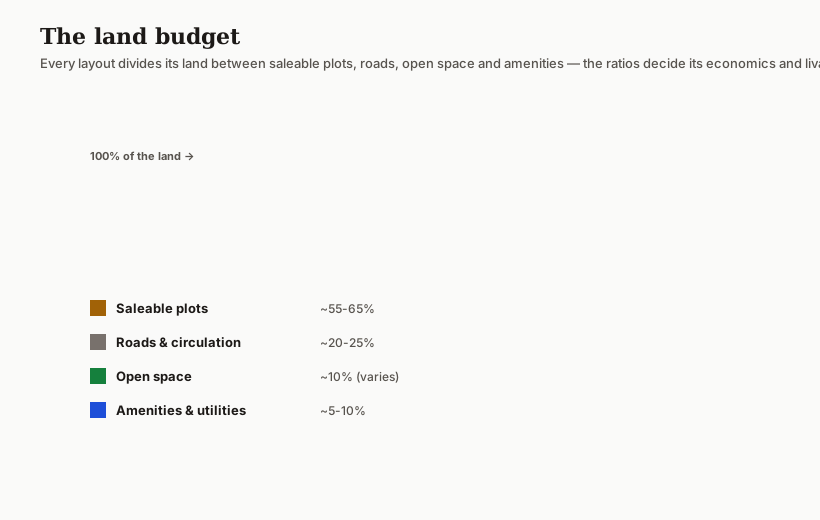
| Land component | Typical share of gross area | What it does |
|---|---|---|
| Saleable residential plots | ~55–65% (varies) | The plots sold to buyers; the layout's revenue |
| Roads & circulation | ~20–30% (varies) | Street hierarchy, footpaths & junctions |
| Open space & parks | ~10% mandated (varies by state) | Park, play area & green buffers |
| Amenities & civic | ~2–5% (where mandated) | Community hall, school site, EWS & commercial reservation |
| Utilities & services | small but reserved | Sump, STP, transformer yard & ducts |
In India — the approval reality
A layout in India is not yours to sell until it is sanctioned, and the journey is specific. It begins with the master plan / zonal plan, which must show your land as residential; if it does not, you need a land-use change first. You then apply for layout approval (also called development permission or sub-division sanction) to the local planning body — the Town & Country Planning department or the area Development Authority such as DTCP, BDA, CMDA, HMDA, MCGM and their counterparts — which scrutinises your plan against the Development Control Regulations: road widths, open-space reservation, plot standards, amenity and EWS reservations.
Along the way you collect NOCs — fire, environment, airport-height, water and others as applicable. Crucially, a plotted residential development must be registered under RERA before it can be marketed or sold, which protects buyers and binds you to your sanctioned plan. And keep the two approvals distinct: layout approval sanctions the sub-division — the roads, plots and reservations — while each plot owner later obtains a separate building-plan sanction to construct a house. The principles of legible, well-served urban form behind all of this are explored in urban design concepts.
Step 8 — Phasing and delivery
Few layouts are built in one go. The roads and trunk services for Phase 1 go in first, plots are released in tranches, and the park and amenities are best delivered early rather than promised forever — a green that exists sells the plots around it. Sound phasing keeps cash flowing without leaving early buyers stranded in a construction site, and it lets the layout absorb lessons between phases. Designed as a whole, delivered in parts: that is the closing discipline of the process this guide began with.
References
1. Clarence Perry, The Neighbourhood Unit (Regional Survey of New York and Its Environs, 1929).
2. Jane Jacobs, The Death and Life of Great American Cities (1961).
3. Kevin Lynch, The Image of the City (1960).
4. Jeff Speck, Walkable City (2012).
5. URDPFI Guidelines, 2014 — Ministry of Urban Development, Government of India.
6. Relevant State Town & Country Planning Act and Development Control Regulations (e.g. DTCP / BDA / CMDA / HMDA rules).
7. National Building Code of India (NBC), Bureau of Indian Standards.
Designing your own parcel? Start with the bones in layout planning principles, then size the public realm with open space planning — and use DesignAI to sketch and visualise the layout as you go.
Export this guide
Related Guides — Deep-dive reading
Residential Plot Distribution Strategies
How to divide land into plots — the plot-size mix, frontage-to-depth ratios, single vs double-loaded streets, corner plots, frontage efficiency and the land budget
Residential Layout DesignUnderstanding Site Planning for Residential Projects
A homeowner's landscape guide to reading your plot's sun, wind, water, soil and trees before zoning and building the grounds.
LandscapeComplete Guide to Residential Plumbing in India: Supply, Drainage, Pumps & Storage
The homeowner-and-architect deep dive into a house's plumbing — how water enters, how cold and hot water reach every tap, how waste and rain leave, and how pumps and tanks tie it all together, sized in real Indian numbers.
PlumbingRelated Tools — Try Free
Rainwater Tank Sizer
How big should your rainwater tank be? Computes annual harvest, recommended tank capacity in litres, water-bill savings, and payback — for 10 Indian cities.
RWH CalculatorCross-Ventilation Analyzer
Estimate airflow and air changes per hour (ACH) from room size, window areas, layout, and local wind — with NBC 2016 Part 8 compliance check.
Ventilation CalculatorBuilding Plan Approval Roadmap
Step-by-step building plan approval process by city with documents, timelines, and fees.
ArchitectAI