

How to Evaluate a Residential Plot in India
A practical, layered framework for assessing a plot before you buy — from clear title and the buildable-area maths to access, soil, orientation and a weighted scorecard.
Picture Meera and Raghav, a young couple in Bengaluru, standing on a 30×40 site in a peripheral layout off Sarjapur Road. The broker is warm, the price feels fair, and the trees on the plot are lovely. What they cannot see by standing there is whether the title is clean, whether the layout was ever released by the authority, how much they can actually build, or whether the road in front is legally a road at all. Every one of those invisible facts will matter more than the trees.
Buying a plot in India is not one decision; it is a stack of them — legal, regulatory, technical and financial — and a weakness in any single layer can sink the whole purchase. A plot with a beautiful aspect but a clouded title is worthless. A plot with a perfect title but a 1.0 FSI when you needed 1.75 may not fit the home you imagined. Good evaluation means scoring every layer before you part with a rupee.
Evaluate a plot like an auditor, not a romantic: prove the title, calculate the buildable area, verify the access and soil, read the orientation — and only then let yourself fall in love.
1. Legal & title due diligence comes first
No amount of design talent can fix a defective title. Before you measure sunlight, you measure paperwork. The single most useful habit is to trace ownership backwards — from the current seller, through the chain of registered sale deeds, to the original "mother deed" — and to verify approvals forwards, from land conversion to layout release to RERA. The figure below shows that twin flow.
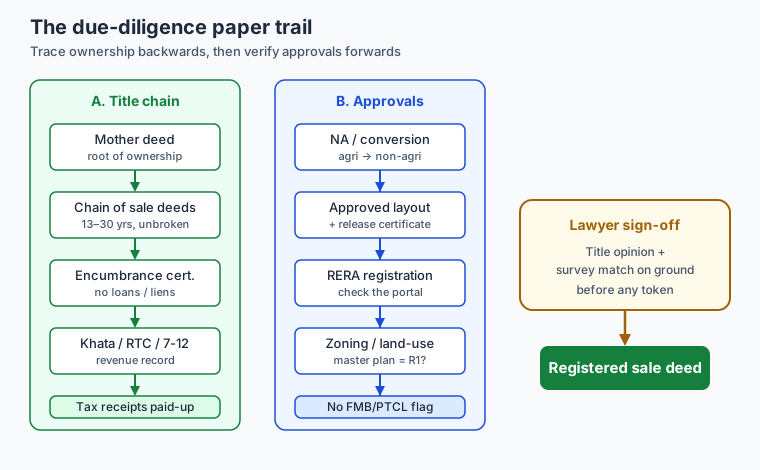
Figure 1: The due-diligence paper trail — trace ownership backwards, verify approvals forwards, and never pay a token before a lawyer's title opinion.
The documents below are the minimum set for a clean residential purchase. The exact names differ by state — Karnataka's khata and RTC, Maharashtra's 7/12 extract, Tamil Nadu's patta and chitta — but the logic is identical everywhere.
| Document | What it proves | Red flag if missing / wrong |
|---|---|---|
| Mother deed + chain of sale deeds | Unbroken ownership history (13–30 yrs) | A gap or an unregistered transfer in the chain |
| Encumbrance Certificate (EC) | No subsisting loan, lien or court attachment | Bank charge still open; recent disputed entry |
| Khata / RTC / 7-12 / Patta | The revenue record names the current owner | Name mismatch with the seller; "B-khata" only |
| Conversion / NA / DC order | Land is legally non-agricultural & residential | Still classified agricultural; no NA order |
| Approved layout + release certificate | Authority sanctioned the layout & released plots | "Revenue layout"; no release; unapproved sub-division |
| RERA registration (where applicable) | Project/plot is registered & promoter accountable | Not on the state RERA portal at all |
| Latest tax-paid receipts | Dues are clear; municipality recognises the plot | Arrears; no property-tax record exists |
| Survey sketch / FMB & physical match | Boundaries on paper match boundaries on ground | Area on deed ≠ area on survey ≠ fence line |
"The land is the only thing in the world worth working for, worth fighting for, worth dying for, because it's the only thing that lasts." Whether or not you share Gerald O'Hara's romance, the legal corollary in India is unromantic: under the Transfer of Property Act, 1882 and the Registration Act, 1908, only a registered, encumbrance-free title actually transfers that lasting thing to you.
Two non-negotiables: get an independent advocate's title opinion (not the seller's lawyer), and watch for state-specific traps — Karnataka's PTCL (granted-land) restrictions, B-khata properties that are hard to finance, and "revenue layouts" that were never approved. If a bank refuses to lend against the plot, treat that refusal as data: the bank's legal team has often spotted what you missed.
2. The buildable-area maths: what you can actually construct
A plot's area is not its capacity. What you can build is governed by three rules stacked on top of one another — setbacks, ground coverage, and FSI/FAR — and the binding constraint is whichever runs out first.
- Setbacks are the mandatory open margins on each side, set by plot size and road width under your local bylaws and the National Building Code (NBC 2016). They shrink the footprint before anything else.
- Ground coverage caps the percentage of the plot the building can occupy on any floor (commonly 50–65% for small residential plots).
- FSI / FAR (Floor Space Index / Floor Area Ratio) caps total built-up area as a multiple of plot area. FSI 1.75 on a 1,200 sq ft plot allows 2,100 sq ft of total floor area.
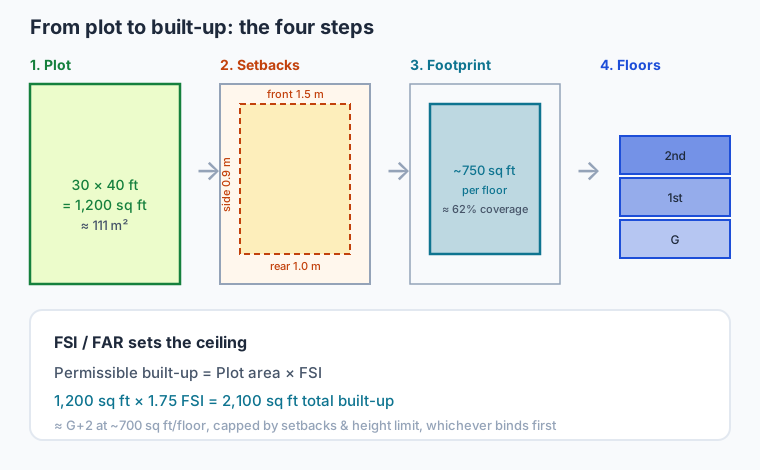
Figure 2: From plot to built-up in four steps — setbacks define the footprint, FSI sets the ceiling, and the smaller of the two governs your final home.
Here is the worked example for our 30×40 site, using illustrative small-plot figures (always confirm against your own local bylaw):
| Step | Input | Result |
|---|---|---|
| Plot area | 30 ft × 40 ft | 1,200 sq ft (≈ 111 m²) |
| Setbacks | front 1.5 m, rear 1.0 m, sides 0.9 m | usable width/length shrink |
| Max footprint | after setbacks | ≈ 750 sq ft per floor |
| Ground coverage | ≈ 750 ÷ 1,200 | ≈ 62% (within typical cap) |
| FSI / FAR | 1,200 × 1.75 | 2,100 sq ft total built-up |
| Floors | 2,100 ÷ 750 | ≈ G+2 (subject to height limit) |
Notice the two ceilings can disagree: setbacks might allow only 700 sq ft/floor, which over G+2 is 2,100 sq ft — exactly the FSI cap, so both bind. On a tighter plot, setbacks bind first and you "lose" FSI you paid for. This is precisely the sum that decides whether a plot fits your brief, and it is far too important to eyeball. Run your own numbers in our FSI/FAR calculator, then see the margins drawn to scale in the setback visualizer before you commit. If you are weighing several plots at once, the 20-parameter plot-evaluation scorer folds buildability into the overall picture.
3. Infrastructure & legal access
A plot is only as good as the road that reaches it. The most common, most expensive surprise is access: a "30-foot road" that is really an unrecorded mud track, or a plot whose only entry is across a neighbour's land with no registered right of way. Confirm the abutting road's recorded width on the approved layout, not just its present condition.
| Service | What to verify | Why it matters |
|---|---|---|
| Road width & legal status | Recorded width; metalled; public right of way | Determines setbacks, FSI slabs & resale |
| Water | Municipal line vs borewell; groundwater depth/quality | Borewell-only zones add cost & risk |
| Sewerage & drainage | UGD connection or septic; storm-water slope away | Low-lying plots flood every monsoon |
| Electricity | Nearest transformer; sanctioned-load feasibility | Far feeders mean voltage drop & delays |
| Solid waste & approach | Garbage collection; turning radius for vehicles | Affects daily livability, not just paperwork |
Walk the plot after rain if you possibly can. Drainage problems hide in dry weather and announce themselves in July. A plot that sits lower than the road, or downhill of a tank bund, will collect water no matter how good the design.
4. Soil & topography basics
You are not buying a 2D rectangle; you are buying the ground beneath it. Two factors dominate cost and safety: bearing capacity (how much load the soil can take) and slope/drainage.
- Black cotton soil (expansive clay, common across the Deccan and central India) swells when wet and shrinks when dry, cracking ordinary footings. It is buildable, but it pushes you toward deeper or raft foundations — a real budget line, not a footnote.
- Filled-up tank beds and low-lying land combine poor bearing with flooding risk. Made-up ground that was a lake a decade ago is a classic trap in fast-growing cities.
- Slope is not inherently bad — a gentle fall aids drainage — but a steep site needs retaining walls and stepped foundations that can add 10–20% to structure cost.
A simple trial pit or a small geotechnical test before purchase, where stakes are high, is money well spent. As a rule of thumb under IS 1904 (foundation design) and IS 6403 (bearing capacity), the foundation strategy — and therefore a chunk of your budget — is decided by what a soil test reveals, not by what the surface looks like.
5. Orientation at a glance
In the Indian climate, orientation is a comfort-and-energy decision you make once and live with forever. You do not need instruments at the evaluation stage — you need a compass and an understanding of which faces are kind.
- North and east light is gentle and largely heat-free; bedrooms, living spaces and study areas love it.
- West brings the harsh afternoon sun that overheats rooms across most of India; plan service spaces, staircases, toilets and buffers here.
- South is manageable with shading and is often prized in Vastu for the main mass.
A north-east or east-facing plot gives you the most design freedom; a hard west-facing plot is workable but demands shading discipline. For the deeper logic — and to test a specific plot's sun exposure through the year — see our companion guide on site orientation explained, which sits alongside the broader orientation, light & views piece. Treat orientation as one weighted criterion, not a veto: a slightly worse aspect on a clean, well-located plot usually beats a perfect aspect on a troubled one.
6. Red-flag legal checks (the deal-breakers)
Some findings should stop the deal regardless of how good the plot looks:
- Agricultural land never converted to non-agricultural/residential use — building on it is illegal and unfinanceable.
- Revenue / unapproved layout with no release certificate — you may never get a building licence.
- Subsisting encumbrance — an open bank charge or court attachment on the EC.
- Granted-land restrictions (e.g. Karnataka PTCL) — sale may be void and reversible decades later.
- Mismatch between deed area, survey sketch and the fence on the ground — you may be buying boundaries you cannot defend.
- GPA "sale" (General Power of Attorney) instead of a registered sale deed — the Supreme Court has held GPA transfers do not convey title.
When two or more of these appear together, walk away — the discount will never compensate for the litigation risk.
7. Putting it together: a weighted scorecard
No plot scores perfectly. The disciplined way to choose is to score each plot on every criterion (say /10), multiply by a weight that reflects how much it matters to you, and sum. Title weighs heaviest because it is binary — a fatal title flaw zeroes everything else.
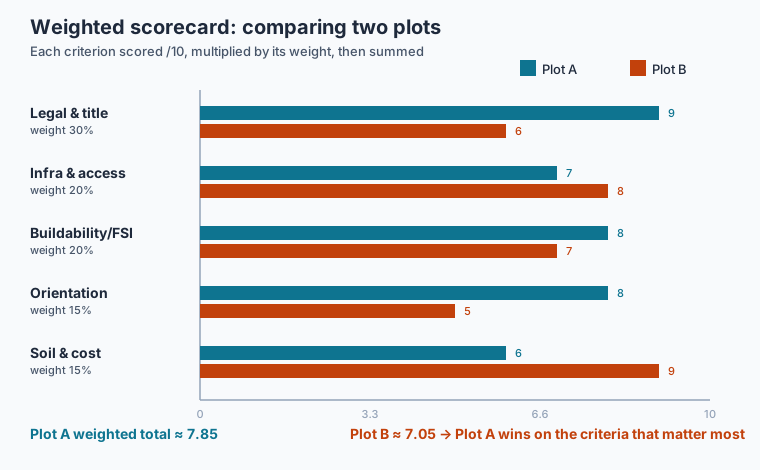
Figure 3: A weighted scorecard turns a gut feeling into a defensible decision — here Plot A's stronger title and orientation outweigh Plot B's cheaper, flatter ground.
| Criterion | Suggested weight | What "9–10" looks like |
|---|---|---|
| Legal & title | 30% | Clean chain, clear EC, approved & RERA-registered |
| Buildability / FSI | 20% | FSI & setbacks deliver the home you want |
| Infrastructure & access | 20% | Recorded wide road, water, UGD, good drainage |
| Orientation | 15% | NE/E aspect; easy to shade the west |
| Soil & cost | 15% | Firm soil, gentle slope, price within budget |
Score conservatively, document your reasons, and let the maths break ties. Our 20-parameter plot-evaluation tool automates exactly this weighting across the full checklist, so you can compare shortlisted plots side by side rather than from memory.
"Site planning is the art of arranging structures on the land and shaping the spaces between." — Kevin Lynch & Gary Hack, Site Planning. Evaluation is the first move in that art: you cannot shape what you do not first understand.
Sources & further reading
1. National Building Code of India (NBC) 2016, Bureau of Indian Standards — Part 3 (Development Control Rules & General Building Requirements), setbacks, FSI & coverage.
2. Bureau of Indian Standards, IS 1904 (Design & Construction of Foundations) & IS 6403 (Determination of Bearing Capacity of Shallow Foundations).
3. The Real Estate (Regulation & Development) Act, 2016 (RERA), and the relevant State RERA portals (e.g. RERA Karnataka, MahaRERA, TN-RERA).
4. The Transfer of Property Act, 1882, and the Registration Act, 1908 — Government of India.
5. Kevin Lynch & Gary Hack, Site Planning, 3rd ed., MIT Press.
6. Energy Conservation Building Code (ECBC) & ECBC-Residential (Eco Niwas Samhita), Bureau of Energy Efficiency — orientation & envelope guidance.
To see where plot evaluation fits in the wider workflow, start with the pillar guide on site analysis for homeowners; learn the costly errors to dodge in plot-selection mistakes to avoid; and go deeper on aspect in site orientation explained.
Export this guide
Related Guides — Deep-dive reading
Land Documents Checklist Before Buying a Plot in India (2026)
Every document to collect and verify before you buy a residential plot in India - the title chain, encumbrance certificate, khata or patta, mutation, survey and layout, land-use conversion and tax dues - what each one proves, the red flag if it is missing, and how the same record is named differently in each state.
Buying LandPlot Due Diligence in India: The Complete Pre-Purchase Check (2026)
Before you pay a rupee for a plot, run the full pre-purchase check with your lawyer and a licensed surveyor - legal title, revenue records, planning approvals, physical survey and financial dues. This guide walks through each pillar, gives you a checklist and tells you when to walk away.
Buying LandPlot Selection Mistakes to Avoid
The costly, common errors Indian buyers make when choosing a plot — twelve traps from disputed titles to water-logged corners, and exactly how to dodge each one.
Site PlanningRelated Tools — Try Free
Plot Buildability Report
How much can you build? FSI, ground coverage, setbacks and height → buildable footprint, built-up area, floors, parking and area statement, with a PDF.
Feasibility ToolBrise-Soleil Visualizer
Interactive horizontal-louvre cut-off angle calculator — sun altitude, louvre depth, and spacing inputs with a live shadow preview. Computes θ = arctan(spacing/depth) for façade shading, ECBC envelope compliance, hospital daylight design, and tropical sun-control detailing.
Sun Shading ToolPlot Evaluation Toolkit — 20-Parameter Scoring
Weighted 20-parameter evaluation of residential plots covering legal, infrastructure, and hidden costs.
Land Buying