
Future-Ready Residential Layouts
Designing a layout for the next 30-50 years — climate resilience, EV and solar readiness, water-sensitive design, mixed use, digital infrastructure and adaptability over time
Stand at the edge of a layout sanctioned in the late 1990s on the fringe of any large Indian city, and you can read its assumptions in its bones. The roads are wide and grey, sized for cars that most families did not yet own. There is a tidy children's park and not much else green. The stormwater drains are shallow concrete channels that discharge, eventually, into a nala that floods every second monsoon. There is one electricity transformer humming at the corner, never designed for the air-conditioners and induction hobs that now load it past capacity, and certainly never for a row of electric scooters charging overnight. The layout works — people live good lives here — but it is fighting its own design every day.
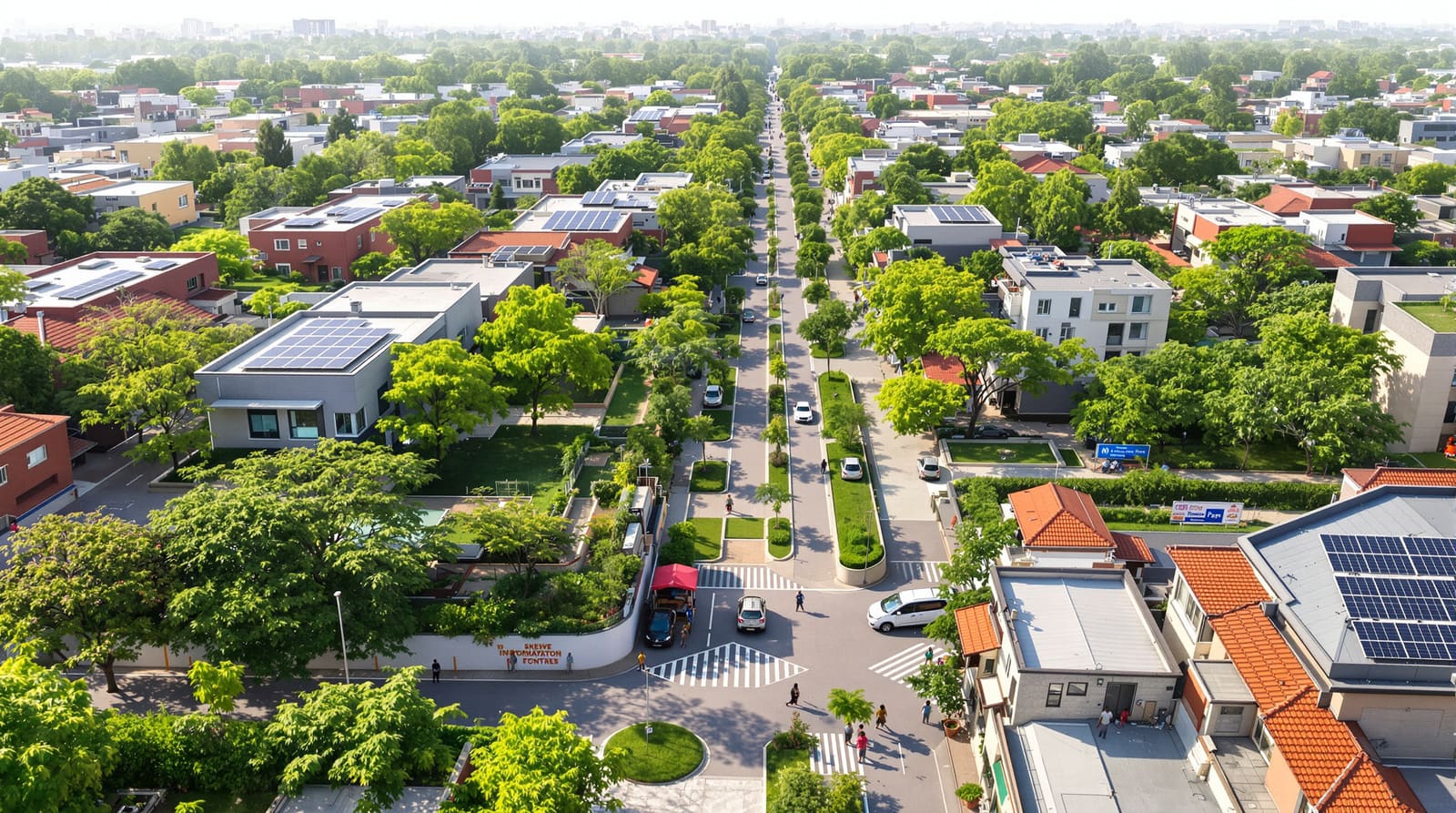
A kilometre away, a newer scheme tells a different story. The streets are narrower and tree-lined, the canopy already closing overhead. Rainwater slides off the road into planted swales rather than racing to the drain. The plot-buyer brochure mentions a rooftop-solar-ready orientation and conduits run to every plot for fibre and future metering. A small parade of shops anchors the entrance so that milk, medicine and a working day are within a walk. Neither layout could be torn down and rebuilt — a layout is a 50-year decision frozen the moment it is sanctioned — but only one of them was designed for the next 50 years. Future-proofing a residential layout is overwhelmingly about getting the slow, unglamorous bones right — drainage, trees, water, walkability and services — and only marginally about the "smart" branding bolted on top.
What "future-ready" actually means at the layout scale
A layout outlives almost every decision made inside it. Buildings get demolished and rebuilt, families churn, businesses come and go — but the road widths, the plot grid, the drainage routes and the reserved corridors are effectively permanent. That is why future-readiness is a layout-scale problem before it is a building-scale one. The companion guide on future-proof home design for Indian families handles the dwelling; this one stays firmly at the subdivision scale, on the moves that an individual homeowner can never make alone.
The honest framing is to design against the forces that are already arriving — heat, flooding, the energy and mobility transition, water stress and the slow shift to working nearer home — rather than against speculative gadgetry. The discipline of WSUD (Water Sensitive Urban Design) and the broader idea of blue-green infrastructure give us a vocabulary for the first; transit-oriented development (TOD) and the 15-minute city give us one for the rest. None of these is exotic. They are simply good planning practised with a longer time horizon.
Climate resilience: design for heat and water first
Heat and flooding are not future scenarios in India; they are the present. A layout's first duty is to keep its residents cool and dry, and almost all of that is decided by how water moves and how shade is provided.
On water, the instinct of the old layout — pipe everything away as fast as possible — is exactly wrong. A future-ready scheme slows water down. Permeable surfaces (porous paving on parking bays and access lanes, gravel verges instead of kerb-to-kerb concrete) let rain soak in. Planted swales and bioretention strips run alongside streets, holding and cleaning runoff before it reaches any drain. Low points become detention ponds or rain gardens rather than flood-prone dead ends. This is the WSUD logic set out in depth in the water sensitive urban design guide and the network thinking of blue-green infrastructure — I will not re-teach them here, but a future-ready layout treats them as the spine, not an add-on.
On heat, the cheapest air-conditioning a layout can offer is a tree. A generous, continuous canopy along every street drops surface and air temperatures measurably, and orientation matters: blocks turned so that homes and streets are shaded through the hottest afternoons, with east-west long axes where the climate demands it. Water security closes the loop — rainwater harvesting at layout and plot scale, plus treated-water reuse, so the scheme is not wholly dependent on a tanker or a falling water table. The detail of green planning sits in the open space planning guide; the point at the layout scale is that shade and water are infrastructure, budgeted and reserved like roads.
The energy and mobility transition: leave room for it
The way Indians power their homes and move around them is changing faster than any layout can be re-sanctioned, so the layout's job is to leave room. On energy, that means a rooftop-solar-ready posture — orientations and roof geometries that catch the sun, and an electrical distribution network sized for both the rising load (air-conditioning, induction cooking) and the possibility of homes exporting power back. The single transformer of the old layout is the cautionary tale here.
On mobility, the transition is twofold. First, electric vehicles: streets and parking that are EV-charging-ready, with conduit and capacity stubbed out to parking bays so that charging points can be added without digging up roads. Retrofitting charging into a finished layout is brutally expensive; designing the ducts in costs almost nothing. Second, the shift away from private cars altogether — reserving space and good access for shared and electric mobility, and siting the layout (or its higher-density edge) within a comfortable walk of transit. This is where TOD and the density logic of the residential density planning guide meet future-readiness: a layout that can support a bus or metro corridor, and that puts its homes within walking reach of it, ages far better than a low-density sprawl that locks every household into a car. The walkability foundations — short blocks, eyes on the street, a fine pedestrian grain — are covered in walkable neighbourhood design, and they are the precondition for the whole transition working.
Water, waste and the near-circular layout
A future-ready layout aims, as far as it can, to close its own loops. WSUD handles incoming rain; the other half is what the layout does with its water and waste once used. A decentralised sewage treatment plant (STP) — increasingly mandated above a threshold of dwelling units in many states — lets the layout treat its own effluent and reuse the treated water for landscape irrigation and flushing, taking load off the municipal system and the freshwater supply. Waste is segregated at source, with space reserved for wet-waste composting and dry-waste recovery rather than a single skip awaiting a truck. The detailed routing, capacities and easements for all of this belong in the utility planning guide; here the principle is simply that a layout designed as a circular system — water in, treated and reused; waste sorted and recovered — is both cheaper to run and far more resilient than one that exports everything and hopes the municipal grid keeps up.
Digital and smart: ducts before gadgets
This is where honesty matters most. The brochures sell "smart townships" — sensors, apps, dashboards — and most of it is branding that dates within a few years. The genuinely future-proof digital move is dull: lay generous ducting and conduit for fibre and for future sensor and metering cabling along every street, into every plot, before the roads are surfaced. Provide for smart metering of water and power at the layout scale. Then stop. The gadgets riding on that infrastructure will be obsolete and replaced several times over the layout's life; the conduit will not. A layout with good empty ducts is smart-ready forever. A layout sold on its app and short on ducts is neither. Services before gadgets, every time.
Mixed use, social resilience and adaptability
A layout that is only houses is fragile. Folding in some local commerce and work-near-home space — a small neighbourhood centre, a few live-work units, room for a clinic and a creche — means a working day, a daily errand and a livelihood need not require a car or a commute, and it keeps "eyes on the street" through the day in the Jane Jacobs sense. Equally, a mix of household types and tenures (plots of different sizes, some rental and some ownership, provision for ageing-in-place with step-free routes and ground-floor options) means the community does not all age, leave or churn at once.
Above all, future-readiness means designing for change you cannot yet specify. That is the discipline of adaptability: phasing the layout so it can grow without being held hostage to one developer's cash flow; sizing plots and blocks so they can intensify or subdivide as demand and regulations shift; reserving corridors now for transit or services that may not arrive for a decade; and keeping open space flexible rather than single-purpose. The forward-looking reservations are the layout's gift to a future it cannot predict — and they are nearly impossible to claw back once the land is built over. The full process of arriving at these decisions sits in the pillar guide on designing a residential layout.
Future force → layout response
| Future force | Layout response (the durable move) | Hype to ignore |
|---|---|---|
| Rising heat & urban heat island | Continuous tree canopy, shade-aware orientation, permeable & light surfaces | "Cooling tech" branding without trees |
| More intense monsoon & flooding | WSUD swales, bioretention, detention ponds, permeable paving | Bigger concrete drains alone |
| Water stress & falling water table | Rainwater harvesting at layout & plot scale, decentralised STP & treated-water reuse | "Smart water" dashboards over storage |
| Energy transition (solar, higher loads) | Solar-ready orientation, oversized & flexible electrical distribution | Token panels on the clubhouse only |
| EV adoption | Conduit & capacity stubbed to parking; charging-ready streets | Retrofitting charging into finished roads |
| Shift from cars to transit & shared mobility | TOD siting, walkable short blocks, space for shared/electric modes | Wider car roads "for the future" |
| Work-near-home & changing households | Local commerce, live-work units, mixed plot sizes & tenures, ageing-in-place | A single-use dormitory layout |
| Unknown future demand | Phasing, subdividable blocks, reserved transit corridors, flexible open space | Locking in one rigid master plan |
| Digital services | Generous empty ducts for fibre/sensors, smart metering provision | App-first "smart township" marketing |
In India: the cost of retrofit, and what approval actually rewards
The Indian case for designing this in rather than bolting it on is simply economic. Carving a swale into a finished road, threading EV conduit under sanctioned kerbs, or finding land for an STP after every plot is sold ranges from ruinously expensive to impossible. The same moves, drawn into the layout before sanction, cost a rounding error. India's policy direction reinforces the design logic: TOD frameworks in several state master plans push density towards transit corridors, EV policies are nudging charging readiness into new developments, and STP, rainwater-harvesting and open-space reservations (often around 10 percent, though it varies by state) are already conditions of layout approval through the local Town & Country Planning department or Development Authority — DTCP, BDA, CMDA, HMDA, MCGM and their peers. RERA registration for plotted developments adds another layer of scrutiny.
The practical caution: layout approval and individual building-plan sanction are different gates, and many future-ready provisions — reserved corridors, shared infrastructure, the open-space network — must be locked at the layout stage, because no individual plot-owner can supply them later. Get the bones right at sanction, under the relevant Development Control Regulations, and the layout will absorb 30 to 50 years of change gracefully. Get them wrong, and every household spends those decades fighting the design.
References
1. Carlos Moreno et al., The 15-Minute City concept (Sorbonne / C40 framework).
2. Jane Jacobs, The Death and Life of Great American Cities (1961).
3. Jeff Speck, Walkable City (2012).
4. URDPFI Guidelines 2014, Ministry of Urban Development, Government of India.
5. Water Sensitive Urban Design (WSUD) / SUDS guidance and the Indian CPHEEO Manual on Sewerage & Sewage Treatment.
6. National Building Code of India (NBC) 2016, Bureau of Indian Standards.
7. Relevant State Town & Country Planning Acts and Development Control Regulations (DTCP/BDA/CMDA/HMDA etc.) and state EV & TOD policies.
Pair this capstone with the pillar on designing a residential layout and the building-scale future-proof home design for Indian families — and plan or visualise your own future-ready scheme with DesignAI.
Export this guide
Related Guides — Deep-dive reading
Future-Proof Home Design for Indian Families
Designing today for the family you will be in 10–20 years — flexibility, services and adaptability
Home PlanningThe Future of Building Regulations in India
Where India's building rules are heading on energy, climate resilience, digital approvals and green construction, and what it means for the home you build next.
Building Regulations & ComplianceRooftop Water Recycling Integration in Homes: One Non-Potable System from Rain and Greywater
How to combine rooftop rainwater harvesting with greywater and STP reuse into a single non-potable water system — the storage, dual plumbing, controls and seasonal logic that make two sources behave like one reliable supply.
Sewage Treatment PlantsRelated Tools — Try Free
Rainwater Tank Sizer
How big should your rainwater tank be? Computes annual harvest, recommended tank capacity in litres, water-bill savings, and payback — for 10 Indian cities.
RWH CalculatorCross-Ventilation Analyzer
Estimate airflow and air changes per hour (ACH) from room size, window areas, layout, and local wind — with NBC 2016 Part 8 compliance check.
Ventilation CalculatorStamp Duty Calculator — All Indian States
Stamp duty + registration charges for all 28 states and 8 UTs — gender concessions, urban/rural variants, metro cess built in.
Stamp Duty