

Understanding Site Planning for Residential Projects
A homeowner's landscape guide to reading your plot's sun, wind, water, soil and trees before zoning and building the grounds.
Most homeowners in India fall in love with a house before they ever look at the land it sits on. We picture the elevation, the lobby, the kitchen island — and treat the plot outside as leftover space to be "landscaped later." But a home and its ground are one system. The way the sun crosses your plot, where the monsoon water wants to run, which corner the summer loon wind hits, and where that old neem tree casts its afternoon shade — these decide whether your garden thrives or struggles, whether your verandah is usable in May, and whether your basement floods in July. None of it can be fixed cheaply after the building is up.
Site planning is the quiet discipline of reading your land before you commit a single line on paper. For an architect it is one chapter of a building project; for a homeowner it is the difference between a property that works with its climate and one that fights it forever. The good news is that the core moves are learnable and largely common-sense once you know what to look for.
This guide makes one argument: the outdoor site of your home should be planned as deliberately as the floor plan, and that planning must begin by reading the land — its levels, sun, wind, water, soil and trees — before zoning it into use areas, routing services, and phasing the build. Do this first, and almost every later decision (where to plant, where to pave, where to sit) becomes obvious instead of expensive.
Why site planning is a landscape question, not just a building one
There is already an excellent companion piece on this site written for architecture students — Site Analysis for Architecture in India — which treats the subject as a formal studio discipline across seven dimensions. This guide is deliberately different. It is written for the homeowner standing on a 30×40 plot in Bengaluru, a row-house buyer in Pune, or a villa owner near Hyderabad, who wants the grounds of the home — the arrival court, the garden, the service yard, the rainwater path — to be planned with the same care a good landscape architect would bring.
The Indian Society of Landscape Architects (ISOLA) has long argued that landscape is infrastructure, not decoration. On a residential plot that means your soil, slope and water are working systems you either cooperate with or pay to override. A 2-metre fall across a plot is an asset if you plan terraces and let water drain naturally; ignored, it becomes a retaining-wall bill and a soggy lawn. The discipline of site planning simply asks you to notice these things first.
Step one: read your site
Before any design, you need facts about the land. Some come from documents, some only from standing on the plot at different times of day. The most common — and most expensive — mistake homeowners make is visiting the site once, at one time, and designing from memory.
Begin with the survey and the levels. Your sale deed and the approved survey drawing give boundaries, dimensions and the official plot area. But boundaries on paper are not enough: commission a simple contour or level survey (a licensed surveyor with a dumpy level or total station typically charges a modest fee for a residential plot) so you know how the ground falls. Even a 300–600 mm difference across a plot changes where water collects and where a sit-out should go.
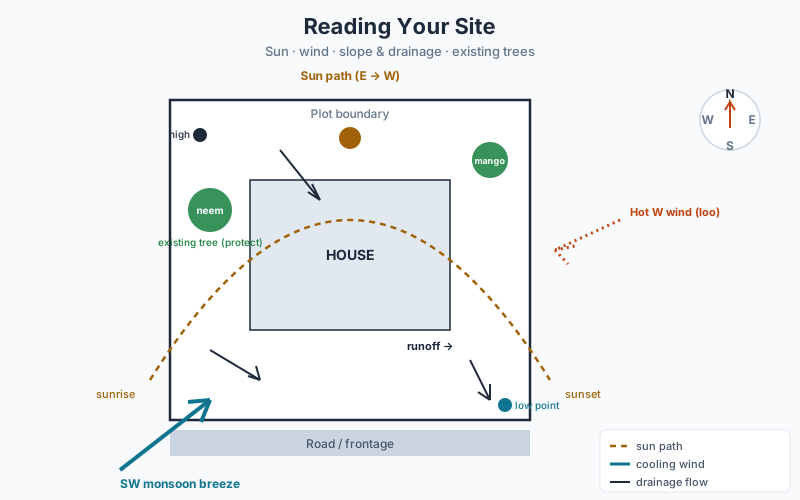
Next, walk the site at three different times — early morning, mid-afternoon, and after a rain shower if you can. Mark where the sun reaches, where shadows from neighbouring buildings fall, where the breeze comes from, and crucially where water pools or runs. Note existing trees and large shrubs by species and trunk girth; a mature mango, tamarind or neem is worth far more than anything you can plant in a decade, and it should anchor the design rather than be cleared for convenience. Our companion guide on the best trees for Indian homes explains which natives are worth protecting and why.
The site-analysis checklist
Use this table as a field worksheet. Tick each item off on the plot itself, not from satellite imagery.
| What to read | How to read it | Why it matters for landscape | Typical India note |
|---|---|---|---|
| Boundaries & area | Sale deed + survey drawing; physically pace the edges | Sets buildable area after setbacks | Verify against neighbour walls; encroachments are common |
| Levels / slope | Contour or level survey by a licensed surveyor | Decides drainage, terracing, sit-out location | Even 0.3–0.6 m fall changes the plan |
| Sun path | Observe + a sun-path app for your latitude | Where to shade, where to plant, where to pave | Sun is high overhead in summer, low in the south in winter |
| Prevailing wind | Note breeze direction at 2–3 times of day | Cooling courtyards, screening dust/odour | SW monsoon wind vs hot dry pre-monsoon "loo" in the north |
| Drainage & runoff | Watch where water flows after rain | Avoid flooding, plan recharge | Check the municipal storm drain level outside |
| Soil & water table | Trial pit + percolation test; ask borewell drillers | Plant selection, foundations, recharge feasibility | Black cotton soil swells; rocky soil resists pits |
| Existing trees | Tag species + girth + canopy spread | Free shade and structure; legal protection | Felling often needs municipal/forest permission |
| Access & frontage | Measure road width and entry point | Gate, driveway, turning circle | Wider road = wider setback in many by-laws |
| Neighbours & shadows | Note adjacent building heights | Shade and privacy on your plot | Tall neighbour to the south steals winter sun |
| Views & nuisances | Stand at likely sit-out spots | Frame good views, screen bad ones | Screen transformers, drains, blank walls |
Sun path and orientation
Orientation is the single highest-leverage decision in site planning, and the one homeowners most often get wrong because the builder oriented the house to the road rather than to the sun. In most of India the sun is high and punishing from the south and west in summer, while the north receives soft, even light all year. This has direct landscape consequences, explored in more depth in orientation, light and views.
In practical terms: the west and south-west are where heat gain is worst, so this is where you want tall shade trees, pergolas, or a buffer of dense planting to protect both the building and any outdoor seating. The north side is the most comfortable for a year-round garden, a play lawn, or a reading nook, because it never bakes. The east gets gentle morning sun — ideal for a kitchen garden, a morning sit-out, or a tulsi court. The south, when open, is the prized winter-sun side and should not be blocked by an evergreen wall.
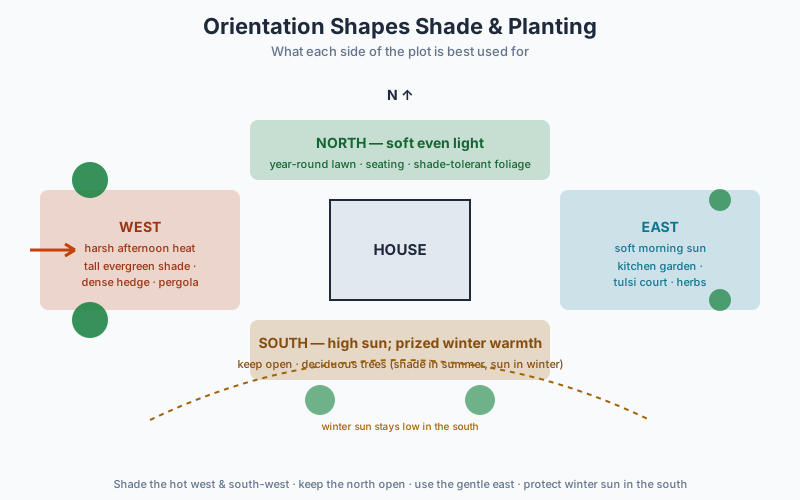
| Plot side | Summer sun | Best landscape use | Planting strategy |
|---|---|---|---|
| North | Minimal direct sun | Year-round lawn, seating, play | Shade-tolerant; ferns, foliage, screening shrubs |
| East | Soft morning sun | Kitchen garden, morning sit-out, tulsi court | Sun-loving but heat-gentle; herbs, flowering shrubs |
| South | Strong, high; valuable winter sun | Keep open for winter warmth; deciduous shade | Deciduous trees that shade summer, drop leaves in winter |
| West | Harsh afternoon heat | Buffer zone, utility, dense screen | Tall evergreen shade trees, thick hedge, pergola |
Wind, microclimate and water
Wind is the forgotten variable. Across much of north and central India, a hot dry pre-monsoon wind (the "loo") arrives from the west and north-west, while the cooling south-west monsoon wind brings the rains. On the coast and in the south, the sea breeze and land breeze reverse through the day. You can use this: a gap or a shallow courtyard aligned to the cooling breeze pulls fresh air across outdoor space, while a dense windbreak on the hot-wind side cuts dust and heat. This is the heart of microclimate design — making small, deliberate adjustments so a corner of your plot is several degrees cooler and far more usable.
Water deserves its own reading. Watch where rain runs and pools; identify the lowest point of the plot and the level of the municipal storm drain it must ultimately reach (you cannot drain uphill). The National Building Code (NBC 2016) and most municipal by-laws now require rainwater harvesting on plots above a threshold area, and on most residential plots a recharge pit or a storage tank is both mandatory and genuinely useful. The deeper mechanics — recharge pits, swales, permeable paving and storage sizing — are covered in sustainable water management for landscapes. For site planning, the rule is simple: slope hard surfaces away from the building and toward a planted soak-away or recharge structure, never toward the neighbour.
Setbacks, FAR and by-laws
You do not own the right to build to your boundary. Every local authority mandates setbacks — the open margins you must leave on the front, rear and sides — and a Floor Area Ratio (FAR / FSI) that caps total built-up area. These are precisely the spaces that become your landscape, so the by-law is, in effect, your first landscape brief. Setback values vary widely by city, plot size and road width, so always confirm the current rules with your local Urban Local Body, Development Authority or municipal corporation before designing. The table below gives indicative residential figures to orient you — treat them as a pointer, not a substitute for the sanctioned rule.
| By-law element | What it controls | Indicative residential range | Where to confirm |
|---|---|---|---|
| Front setback | Margin from front road | 1.5–6 m, rises with road/plot width | Local Development Authority / ULB |
| Side & rear setbacks | Side and back margins | 1–4.5 m each, by plot size | Municipal building by-laws |
| FAR / FSI | Built-up area vs plot area | ~1.0–2.0 for low-rise residential | State/city DCR or building rules |
| Ground coverage | Max footprint % of plot | ~50–65% typical for plots | Local by-laws |
| Plinth height | Floor level above road | Often 450–750 mm min | Flood-prone areas mandate higher |
| Rainwater harvesting | Mandatory above plot threshold | Required on most plots (~100–300 m² up) | NBC 2016 + municipal rules |
| Tree felling / planting | Protection + mandatory tree count | Permission to fell; min trees per plot | Municipal/forest department |
| Compound wall | Height and gate setback | Commonly ≤1.5–1.8 m, gate set back | Local by-laws |
Authorities such as the Central Public Works Department (CPWD) publish horticulture and landscape norms that many residential projects borrow from, and the Council of Architecture (COA) governs the architects who sanction plans. For the homeowner, the takeaway is to treat the setback margins as designed space from day one rather than as leftover strips around a building.
Zoning the plot into use areas
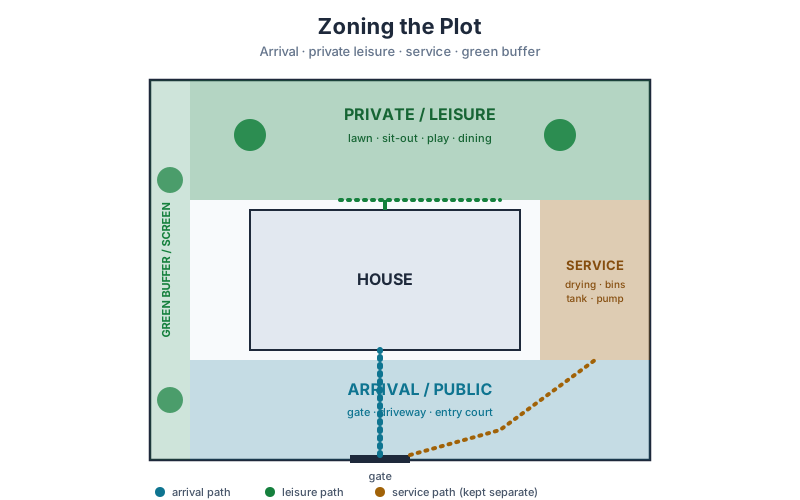
Once you understand the constraints, organise the open ground into a small number of use zones. Good site planning resolves into three or four clear areas, each with a different character, privacy level and surface. A landscape architect would call this functional zoning; for a home it is mostly common sense made deliberate.
| Zone | Purpose | Typical location | Surface & planting | Privacy |
|---|---|---|---|---|
| Arrival / public | Gate, driveway, entry court | Front, toward road | Firm paving, accent tree, low planting | Open, welcoming |
| Private / leisure | Lawn, sit-out, play, dining | Rear or sheltered side | Lawn, shade tree, soft planting | Screened from street |
| Service / utility | Drying yard, bins, tank, pump | Side or rear, near kitchen | Hard, washable, screened | Hidden |
| Buffer / green edge | Screening, recharge, windbreak | Perimeter, west side | Dense hedge, trees, soak-away | Boundary |
The discipline is to keep these from bleeding into one another: nobody wants the drying yard visible from the dining sit-out, or the recharge pit under the driveway. Circulation — the paths and the driveway — should link the zones with as little crossing as possible. Keep the service route from the gate to the kitchen short and separate from the leisure route into the garden. A turning radius of around 5–5.5 m is comfortable for a car; a footpath of 900 mm lets two people pass; steps on a sloped plot should be generous and gently graded rather than steep and mean.
Routing services and infrastructure
Below and across the planned zones run the unglamorous systems that make the landscape work — and that are ruinous to retrofit. Plan them on the same drawing as the zones, not afterwards.
- Stormwater & drainage: surface gradients of roughly 1:100 to 1:50 carry rain to channels and then to recharge pits or the municipal drain. Keep finished garden levels below plinth and door sills.
- Irrigation: decide early whether you want drip lines, sprinklers or simple hose points; sleeve the lines under any paving before it is laid, and connect to a harvested-water tank where possible.
- Electrical & lighting: run garden lighting and pump conduits in protected sleeves under paths; locate the meter, pump and any DG away from leisure zones.
- Water supply & sewerage: position the underground sump, overhead tank, septic/STP and inspection chambers where they can be accessed without tearing up the lawn.
A single coordinated services layer drawn over your zoning plan prevents the classic disaster of laying a beautiful lawn and then trenching through it a month later for a forgotten cable.
Phasing: build the bones first
Few homeowners can — or should — do everything at once. The trick is to sequence work so that the things you cannot easily change later happen first, and the soft, cheap, reversible things come last. Get levels, drainage, recharge, hardscape sub-bases and tree pits right at the start, while machinery and contractors are already on site. Lawns, shrubs, seasonal colour, furniture and lighting fixtures can follow in later seasons as budget allows.
| Phase | What to do | Why now | Reversible later? |
|---|---|---|---|
| 1. Earthwork | Grading, levels, drainage, recharge pit | Heavy machinery on site; sets everything | No |
| 2. Hard structure | Driveway base, paths, retaining walls, sleeves | Needs to be under future planting | Hard |
| 3. Trees & soil | Plant/protect trees, improve soil, lay turf base | Trees take years; soil hard to redo later | Hard |
| 4. Soft & finish | Shrubs, lawn, lighting, furniture, pots | Cheap, seasonal, easy to adjust | Yes |
Spread over two or three monsoon cycles, this phasing keeps cost manageable and lets newly planted trees establish before the finishing layers go in. For a realistic sense of what each layer costs, see the landscape cost guide for India.
Bringing it together
Read the land, respect the by-law, zone the open ground, route the services, then phase the build — done in that order, residential site planning turns a leftover yard into a coherent, climate-tuned extension of the home. The plot you bought already contains most of the answers; your job is to notice them before the concrete is poured. When you are ready to explore design ideas across the whole property, the landscape design hub and the work of India's landscape architects are good next stops — and tools like Studio Matrx can help you visualise the zoning and planting on your own plot before you commit to it on the ground.
References
- National Building Code of India, NBC 2016 (Bureau of Indian Standards) — provisions on site planning, drainage and rainwater harvesting.
- Indian Society of Landscape Architects (ISOLA) — professional guidance on landscape as infrastructure.
- Central Public Works Department (CPWD) — Horticulture and landscape works references.
- Council of Architecture (COA) — regulation of architectural practice and plan sanction.
- Indian Green Building Council (IGBC) — green homes criteria on site, water and trees.
- Local Development Authority / Urban Local Body building by-laws and Development Control Regulations (city-specific setback, FAR and tree norms).
Export this guide
Related Guides — Deep-dive reading
Site Analysis for Homeowners: How to Read a Plot Before You Build
The master guide to reading your land — its legal envelope, sun, wind, slope, soil, access, neighbours, views, services and microclimate — before you buy a plot or draw a plan.
Site PlanningSloping Site Design: Building on a Gradient
How to read a slope, choose between terracing, cut-and-fill and stilts, and turn a hillside plot in Pune, Bengaluru's outskirts or the Ghats into an asset instead of a liability.
Site PlanningDesigning for Views and Privacy
The site-level craft of capturing the good view while screening the neighbour's window three metres away — tuned for dense Indian plots.
Site PlanningRelated Tools — Try Free
Rainwater Tank Sizer
How big should your rainwater tank be? Computes annual harvest, recommended tank capacity in litres, water-bill savings, and payback — for 10 Indian cities.
RWH CalculatorCross-Ventilation Analyzer
Estimate airflow and air changes per hour (ACH) from room size, window areas, layout, and local wind — with NBC 2016 Part 8 compliance check.
Ventilation CalculatorPlot Buildability Report
How much can you build? FSI, ground coverage, setbacks and height → buildable footprint, built-up area, floors, parking and area statement, with a PDF.
Feasibility Tool