
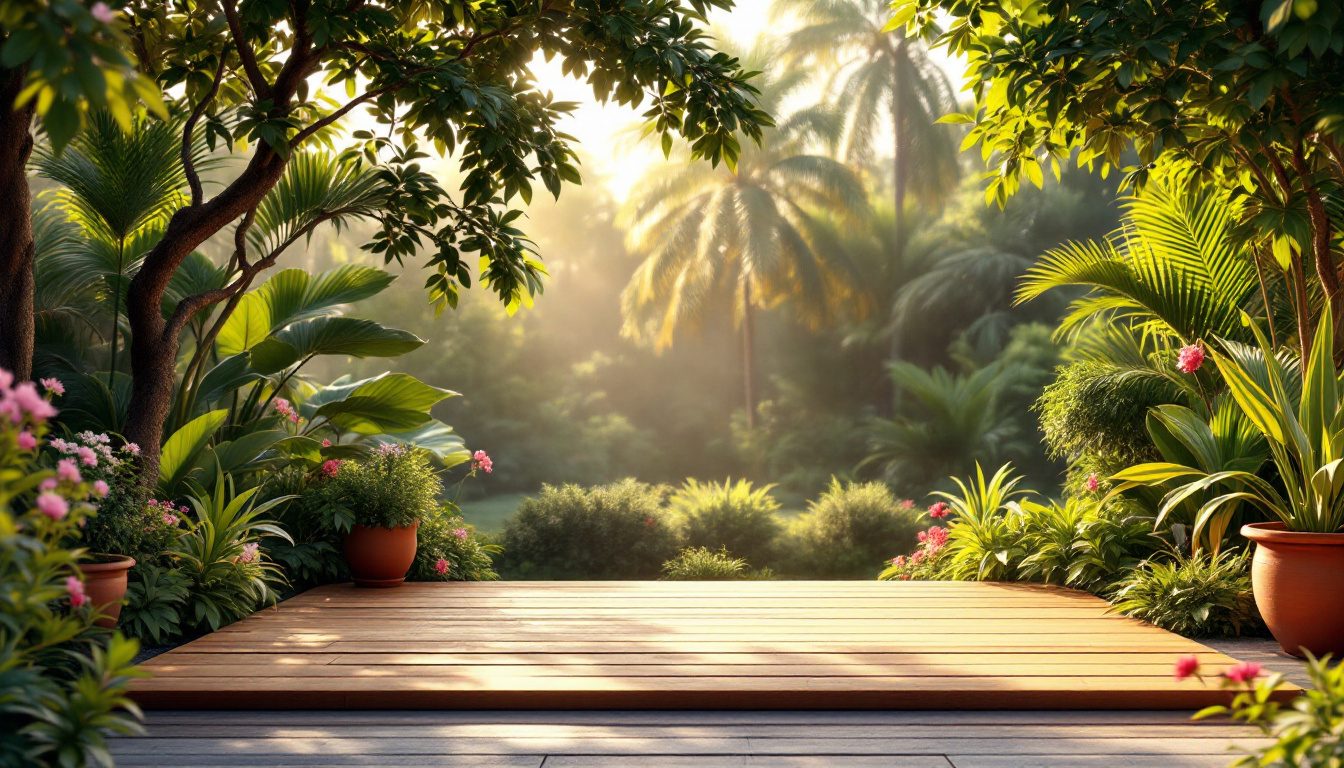
Designing Outdoor Wellness Spaces
Yoga decks, plunge pools, fire pits and barefoot paths — designing the active wellness garden for the Indian climate and the whole family
There is a particular hour in an Indian morning — somewhere between the first temple bell and the heat — when the terrace belongs to you. A mat unrolled on warm tile, the smell of damp earth from the night's watering, a koel somewhere in the gulmohar, the city still soft. For a few minutes the body remembers something the air-conditioned flat had let it forget: that we are creatures who were meant to move outdoors, in light, on the ground. The grandmother who did her surya namaskar on the terrace at dawn, the family that ate dinner in the courtyard under the stars, the children who ran barefoot on warm stone — they were doing wellness, decades before the word arrived with a price tag.
This guide is about designing the outdoor active wellness space — the garden, terrace, courtyard or sit-out built not just to be looked at but to be used for movement, ritual and gathering. It is the lively sibling of the healing garden, which is restorative and contemplative; here we are concerned with the yoga deck and the plunge pool, the outdoor gym and the fire pit, the barefoot path and the star deck. We will look at why exercising and gathering outdoors works on the body differently from the same things done indoors, at how to map a plot into wellness zones, and at the stubborn Indian realities — heat, monsoon, privacy, elders, mosquitoes — that decide whether your beautiful deck gets used or quietly becomes a place to dry papads.
An outdoor wellness space is not a garden with gym equipment dropped into it — it is a designed sequence of zones for movement, water, gathering and stillness, tuned to your climate and your family so the outdoors becomes the most-used room in the house rather than the least.
Why "outside" changes the activity, not just the address
Do twenty minutes of yoga in your bedroom and twenty minutes on a planted terrace, and your phone will record the same calories. Your nervous system will not record the same session. A substantial body of research now separates green exercise — physical activity in the presence of nature — from the identical activity done indoors, and the difference is measurable.
The phrase comes from the environmental scientists Jules Pretty and Jo Barton at the University of Essex. Their 2010 multi-study analysis (ten UK studies, around 1,250 participants) found that just five minutes of green exercise produced significant improvements in self-esteem and mood, with the largest effects in the first five minutes and in the presence of water. Controlled trials comparing outdoor and indoor walking find that outdoor exercise brings greater revitalisation and positive engagement, less tension, confusion, anger and depression, and — importantly for whether you keep doing it — a greater stated intention to repeat the activity.
Then there is blue space. The environmental psychologist Mathew White and colleagues at the University of Exeter have shown across large population datasets that proximity and visual access to water — sea, lake, even a domestic water feature — is associated with better self-reported general and mental health, over and above the benefit of green space alone. This is the scientific licence for the plunge pool, the reflecting pool and the simple bowl of moving water we will keep returning to.
Finally, the gentlest end: shinrin-yoku, forest bathing, formalised in Japan in the 1980s. The physiologist Qing Li and others have linked time among trees to reduced cortisol, lower blood pressure and pulse, and — through inhaled wood compounds called phytoncides — measurable rises in the body's natural-killer immune cells lasting days. You do not need a forest; a dense, fragrant, layered planting around a sit-out reproduces a surprising amount of the same effect.
Underpinning all of it is E. O. Wilson and Stephen Kellert's biophilia hypothesis — the proposition that humans carry an innate affiliation with living systems, and that environments dense with life quietly regulate us. The wellness terrace is biophilia made operational: a place built to put the body back into contact with what it evolved among. (For the design grammar of that contact, see our biophilic landscape design guide and the biophilic score tool.)

| Effect | Finding | Setting | Source |
|---|---|---|---|
| Mood / self-esteem | Significant lift after just 5 minutes of activity | Green space, strongest with water present | Barton & Pretty 2010 |
| Stress hormone | Lower salivary cortisol vs. urban setting | Forest walking / sitting | Li et al.; forest-bathing trials |
| Blood pressure & pulse | Measurable reduction | Forest environment | Park, Tsunetsugu et al. |
| Immune function | Raised natural-killer cell activity, lasting days | Forest, via phytoncides | Li et al. |
| General & mental health | Better self-reported health near water | Coastal / blue space | White et al. 2013 |
| Adherence | Greater intention to repeat the exercise | Outdoor vs. indoor | Coon et al. systematic review |
We do not go to the garden to escape life. We go to remember that we are alive — that breath, ground and light were the original medicine, and they are still free.
The wellness zones: mapping a plot into activity, water, gathering and stillness
The single most common mistake is to treat the whole outdoor area as one undifferentiated "garden" and then wonder why nobody uses it for anything in particular. A wellness space works the way a good home works — as a set of rooms, each with a job, linked by a path you actually want to walk. Four families of zone do most of the work.
Movement zones are flat, firm, generous and private enough to be unselfconscious: the yoga and meditation deck, an open lawn or stretch of soft paving for floor work, an outdoor gym corner, perhaps a barefoot or reflexology path that doubles as circulation. Water zones are the wellbeing multiplier — a plunge pool or cold plunge, a jacuzzi, an outdoor shower, or simply a moving-water feature whose sound masks the city. Social zones are for the wellness of belonging: the conversation circle, the fire pit, the outdoor dining table, the sit-out where chai happens. Quiet zones are the overlap with the healing garden — a single bench in dappled shade, a star deck for sleeping out, a screened nook with a fragrant plant and nothing to do.
The art is in the adjacencies. The yoga deck wants morning sun and visual calm, so it goes east and away from the gate. The fire pit and dining want evening use and a degree of enclosure. The plunge pool wants both privacy and a sunny spot to dry off. The barefoot path can stitch the zones together, turning circulation itself into a sensory event. Keep noisy and quiet apart; keep the journey between them planted, so moving through the garden is part of the therapy. This sequencing of experience is the same craft we explore in why some gardens feel peaceful, the pillar for this cluster.

| Zone | Core elements | Best orientation | Size that works |
|---|---|---|---|
| Movement | Yoga/meditation deck, lawn, outdoor gym, reflexology path | East / north-east (morning sun, soft) | Deck 2.4 × 3 m for one; 3.6 × 4.5 m for a class of 4-6 |
| Water | Plunge pool, jacuzzi, outdoor shower, fountain | South / west pocket (sun to dry); pool min 2.5 × 4 m | Cold plunge 1.2 × 1.5 × 1.1 m deep; sound feature any size |
| Social | Fire pit, dining, conversation circle, sit-out | West / sheltered corner (evening) | Circle ø 3.5-4 m seats 6-8; dining 2 m clear all round |
| Quiet | Single bench, star deck, screened nook, hammock | North / shaded, away from gate | Star deck 3 × 3 m for two; nook needs only 1.5 × 2 m |
The yoga and meditation deck: India's oldest wellness room, redesigned
Long before "wellness deck" was a brochure phrase, India practised on the terrace at dawn and in the courtyard at dusk. The design task is to honour that instinct with a surface, an enclosure and a microclimate that make the practice possible across the year.
Start with the surface. Timber decking — FSC-certified teak, an affordable Indian-grown option, or a good thermally-treated composite — is kind to joints, drains fast after monsoon, and stays cooler underfoot than stone in sun. Lay boards with a 4-6 mm gap and a slight fall (1 in 80) so water never pools. A 2.4 × 3.0 metre deck suits one or two practitioners; allow 3.6 × 4.5 metres for a small class. Keep it dead level — a yoga surface that isn't level is one nobody trusts.
Then the enclosure, which separates a deck people use from a deck people feel watched on. The instinct to practise unobserved is ancient; design for it with a green screen (bamboo, Bambusa; or a clipped Murraya paniculata / kamini hedge), a jaali or batten screen, or a planted earth-mound on the exposed side. You want refuge — back covered — with a long view out, the prospect-and-refuge balance that the landscape researcher Jay Appleton named and every comfortable outdoor room obeys.
Finally the microclimate, the decider in India. A pergola or fixed-louvre canopy turns a deck unusable from 9 a.m. into one that works at any hour; orient louvres to cut the high summer sun but admit the low winter sun. Ring the deck with aromatic, air-cleaning planting — tulsi (Ocimum sanctum), jasmine (Jasminum sambac, mogra), lemongrass (Cymbopogon, also a mosquito deterrent), khus and the night-blooming raat ki rani (Cestrum nocturnum) — so the practice is scented as well as seen. Add a discreet water sound and the backdrop is complete.

Water for wellness: plunge, shower and the sound of moving water
Blue space is the cheapest upgrade in wellness landscaping because even the smallest amount of water pays back. There is a hierarchy of effort.
At the top sits the plunge pool or cold plunge — a compact body of water, 2.5-4 metres long or a 1.2-metre cube for a true cold plunge, for immersion rather than swimming. Cold-water immersion has a growing evidence base for circulation, recovery and mood, and fits courtyards and terraces where a full pool never would. A jacuzzi or warm spa serves the other end — muscle recovery and the social ritual of soaking — and pairs with a fire pit for cold-evening use. The outdoor shower, the most underrated element in Indian wellness design, is a post-swim, post-gym, post-gardening pleasure the climate practically demands; screen it for privacy, give it a teak duckboard and a pebble base that drains to a soak pit.
At the bottom of the effort ladder, and top of the value ladder, is the sound of moving water — a spout into a stone bowl, a recirculating wall fountain, a rill. It costs little, runs on a tiny pump, and does the heavy lifting Pretty and Barton's data predicts: it lifts mood, masks traffic and air-conditioner hum, and draws birds.
A word of Indian caution no imported wellness manual will give you: standing water breeds Aedes mosquitoes, the dengue and chikungunya vector. Every water element must move (a pump turning over the volume), be screened and treated, or drain dry between uses. Fountains, circulating plunge pools and koi ponds are safe; a forgotten bird-bath is not. Plan water frugally — recirculate, harvest monsoon runoff to top up, and lean on the principles in our sustainable water management for landscapes guide.
| Water element | Footprint | Approx. cost (2026) | Wellness role | Upkeep note |
|---|---|---|---|---|
| Cold plunge (1.2 m cube) | 1.5-2 sqm | ₹1.5-4 lakh | Recovery, alertness, circulation | Chiller + circulation; cover when idle |
| Plunge pool (2.5 × 4 m) | 10-12 sqm | ₹4-9 lakh | Immersion, cooling, blue space | Filtration mandatory; mosquito-safe if moving |
| Jacuzzi / spa | 4-6 sqm | ₹3-7 lakh | Muscle recovery, social soak | Heater + sanitiser; cover essential |
| Outdoor shower | 1.5-2 sqm | ₹25,000-1 lakh | Post-activity refresh | Soak-pit drainage; privacy screen |
| Recirculating sound feature | 0.5-2 sqm | ₹15,000-1.5 lakh | Mood, sound masking, birds | Top up for evaporation; clean pump |
Designing for the whole family — elders, children and the evening
A wellness space used by only the fittest member of the house is a failed wellness space. The strongest designs serve three generations at once, and India's joint-family terraces have always known this.
For elders, the priorities are slip-resistance and gentleness: textured stone or timber rather than polished granite, even paths at least 1.2 metres wide for a walking aid, gradual ramps instead of awkward steps, a handrail beside any level change, frequent shaded seating, and even lighting that removes the trip-hazard of shadow. A barefoot or reflexology path of graded smooth pebbles, set flush and bordered, gives elders a daily foot-massage circuit and children a sensory game — one element, two users.
For children, the wellness logic is loose, natural play: a patch of lawn, a tree worth climbing, a sandpit, edible plants to pick (curry leaf, mint, cherry tomatoes), and water they can safely splash in — never an unfenced deep pool. Nature play has its own research literature linking it to attention, motor skill and emotional regulation; the garden is a developmental tool, not just a backdrop.
For the family as a unit, the social zones earn their keep when the Indian climate allows: early morning and after dusk. That makes evening lighting non-negotiable. Light low and warm — bollards, step lights, recessed deck lights, lanterns, the fire pit itself — never a single harsh flood that flattens the garden and blinds the sky. Keep colour temperature warm (2200-2700 K), shield fixtures to cut glare, and put circuits on dimmers and zones so the same garden can be a children's play space at 6 p.m. and a quiet two-person star deck at 10. The star deck — a flat, slightly raised platform with bedding rolled out for sleeping under the sky, a cherished north-Indian summer tradition — is the purest family-wellness element of all, and costs almost nothing.
| User | Design priority | Specific moves |
|---|---|---|
| Elders | Safety, comfort, access | Slip-resistant surface, 1.2 m+ paths, ramps, handrails, frequent shaded seats, even light |
| Children | Safe sensory play | Lawn, climbable tree, sandpit, edible plants, fenced/shallow water only |
| Adults | Activity + recovery | Yoga deck, gym corner, plunge, gym-to-shower flow |
| Whole family | Gathering, ritual | Dining, fire pit, star deck, warm dimmable evening lighting |
The Indian climate reality: designing for the hours you can actually use it
Here is the truth every imported wellness-garden image omits: for much of the year, across much of India, the middle of the day outdoors is not wellness — it is heat stress. The IMD records summer afternoon temperatures routinely crossing 40 °C across the hot-dry and composite zones, and the heat-index higher still in humid coastal cities. A wellness space designed without reference to this is a beautiful failure. The response is to engineer the space for the usable hours and protect it through the unusable ones.
Design for early and late. The active hours are dawn to about 9 a.m. and after 5 p.m. — the rhythm of the traditional morning ritual and the evening sit-out. Orient the yoga deck east for soft morning sun; orient dining and fire pit west and shaded for the evening; put the most-used zones where the building's own shadow falls at those hours.
Shade for year-round use. Shade extends the usable day. A pergola with deciduous creeper (Pyrostegia, Thunbergia) or fixed louvres, a shade tree (neem Azadirachta indica, gulmohar, rain tree), a tensile sail or retractable canopy turn three usable hours into eight. A planted pergola also drops air temperature beneath it through evapotranspiration; vegetated shade is cooler than a solid roof.
Cover for the monsoon. Three months of rain need not mean three months indoors. A solid-roofed pavilion or covered verandah edge — the principle of the traditional verandah and the courtyard's colonnade — lets yoga, gathering and gazing-at-the-rain continue while the lawn drinks. Choose materials that take a soaking: hardwood or composite decking over a ventilated frame, stone over polished tile, powder-coated steel and stainless fixings, quick-dry outdoor upholstery.
Vastu and the open space. Where it matters to the family, classical vastu maps onto good climatic sense more often than not. The north-east (ishanya), the auspicious zone for water and openness, happens to be the cool, soft-morning-light quadrant ideal for a meditation deck or water body; the heavier south-west suits built mass and equipment; the open-centre brahmasthan echoes the courtyard's still, planted heart. You can honour these conventions and good design at once; see the wider treatment in our climate-responsive landscape design guide.

| Season | Challenge | Design response |
|---|---|---|
| Summer (Mar-Jun) | 40 °C+ midday; usable only early/late | East deck for dawn; west shaded evening zone; dense shade; cooling water |
| Monsoon (Jun-Sep) | Heavy rain, humidity, mosquitoes | Covered pavilion; fast-draining surfaces; moving/screened water; rot-proof materials |
| Winter (Oct-Feb) | Cool, the prime outdoor season | Fire pit and spa for warmth; admit low sun; star deck; outdoor dining peaks |
| Year-round | Sun, glare, rain, pests | Pergola/louvres, soak-pit drainage, aromatic pest-deterrent planting |
Sound, scent and the senses: the invisible layers
The zones, the deck and the water are the bones. What turns a competent outdoor room into a felt wellness experience is the layer most people never plan: the senses beyond sight.
Sound is designed by addition and subtraction. Add the gentle — moving water, the soft clatter of bamboo, wind chimes tuned low, the birds that good planting recruits. Subtract the harsh — site quiet zones away from compressor units and the gate, and let a dense planted buffer and the white-noise of water mask the traffic. Scent is the most direct route to calm because smell wires straight to the limbic system; build an aromatherapy palette into the planting — jasmine and mogra at the deck, lemongrass and tulsi at the seating, the night perfume of raat ki rani and parijat (Nyctanthes, harsingar) for the evening, fragrant herbs you brush past on the path. Touch is the barefoot path's gift: graded textures — river pebbles, warm timber, cool stone, soft grass — read through the soles in a way most of us forgot we could feel. Taste closes the circle: an edible and medicinal corner of curry leaf, tulsi, mint, aloe and a lime tree turns the garden into a daily, harvestable ritual.
None of this is decoration. Each sense engaged is another channel through which the nervous system registers I am safe, I am in a living place — the biophilic regulation the whole space exists to deliver.
What this means for your home
1. Zone before you plant. Decide where movement, water, gathering and stillness go, and tune each to sun, privacy and the hours you will use it — get the four-zone map right and the rest follows.
2. Build one good movement surface. A level, well-drained, lightly enclosed yoga or meditation deck with morning sun and a fragrant edge is the highest-return single element. Start there.
3. Add water, even a little. A recirculating sound bowl is the cheapest wellbeing upgrade you can make; a plunge pool the most luxurious. Whatever you choose, make sure it moves or drains — never breed mosquitoes.
4. Design for early and late, cover for the rest. Orient for dawn and dusk, shade aggressively for summer, roof part of it for the monsoon, and light it warm and low so the evening hours work.
5. Serve three generations. Slip-resistant surfaces and a barefoot path for elders, safe natural play for children, recovery and ritual for adults. A space that only one person uses is a space that withers.
6. Layer the invisible senses. Aromatic planting, the sound of water, textures underfoot, an edible corner — these are what make people return, and returning is the whole point.
7. Test the wellbeing of your plan. Run your proposed garden through the biophilic score tool to see how strongly it connects you to living systems before you build.
How Studio Matrx helps
Designing an outdoor wellness space is an exercise in juggling sun angles, privacy, seasons, family needs and a real budget at once — which is exactly the kind of spatial problem that is hard to hold in your head and easy to see when it is drawn. DesignAI can visualise your terrace, courtyard or garden as a zoned wellness space — placing the yoga deck where the morning sun lands, the plunge pool where it stays private, the fire pit where the evening gathers — and let you feel the difference between schemes before a single tile is laid or a single tree is planted. Bring your plot; we will help you turn it into the most-used room in your home.
References
1. Barton, J. & Pretty, J. (2010). "What is the Best Dose of Nature and Green Exercise for Improving Mental Health? A Multi-Study Analysis." Environmental Science & Technology, 44(10), 3947-3955.
2. Pretty, J., Peacock, J., Sellens, M. & Griffin, M. (2005). "The mental and physical health outcomes of green exercise." International Journal of Environmental Health Research, 15(5), 319-337.
3. White, M. P., Alcock, I., Wheeler, B. W. & Depledge, M. H. (2013). "Coastal proximity, health and well-being: Results from a longitudinal panel survey." Health & Place, 23, 97-103. (Blue space and wellbeing.)
4. Coon, J. T., Boddy, K., Stein, K., Whear, R., Barton, J. & Depledge, M. H. (2011). "Does Participating in Physical Activity in Outdoor Natural Environments Have a Greater Effect on Physical and Mental Wellbeing than Physical Activity Indoors? A Systematic Review." Environmental Science & Technology, 45(5), 1761-1772.
5. Li, Q. (2010). "Effect of forest bathing trips on human immune function." Environmental Health and Preventive Medicine, 15(1), 9-17. (Shinrin-yoku, phytoncides, natural-killer cells.)
6. Park, B. J., Tsunetsugu, Y., Kasetani, T., Kagawa, T. & Miyazaki, Y. (2010). "The physiological effects of Shinrin-yoku (taking in the forest atmosphere or forest bathing)." Environmental Health and Preventive Medicine, 15(1), 18-26. (Cortisol, blood pressure, pulse.)
7. Wilson, E. O. (1984). Biophilia. Harvard University Press; and Kellert, S. R. & Wilson, E. O. (eds.) (1993). The Biophilia Hypothesis. Island Press.
8. Appleton, J. (1975). The Experience of Landscape. Wiley. (Prospect-and-refuge theory.)
9. Cooper Marcus, C. & Barnes, M. (1999). Healing Gardens: Therapeutic Benefits and Design Recommendations. Wiley.
10. Indian Meteorological Department (IMD) — seasonal and heatwave temperature records for Indian climate zones.
11. Krishen, P. (2006). Trees of Delhi: A Field Guide. Penguin. (Native and naturalised species for Indian planting.)
Part of the Studio Matrx Landscape series. Continue with why some gardens feel peaceful, healing gardens for Indian homes, biophilic landscape design, and climate-responsive landscape design.
Export this guide
Related Guides — Deep-dive reading
Orientation, Light & Views: Designing With Your Space, Not Against It
How reading your plot's sun, breeze and views — and placing each room on the right face — gives an Indian home that is cooler, brighter and quietly right, instead of one that fights its site forever.
Design PrinciplesHomes That Improve Mental Wellbeing
The whole-home, indoor-biophilia approach to calm — how plants, light, air, quiet and the right balance of togetherness and retreat make an Indian home restorative.
Healthy HomesHealing Gardens: Designing Restorative Outdoor Space for Home
The evidence-based restorative garden for the Indian home — Ulrich's supportive-garden theory, attention restoration, the cortisol data, and a medicinal-aromatic plant palette of tulsi, jasmine, vetiver, brahmi and ashwagandha
LandscapeRelated Tools — Try Free
Acoustic Privacy (STC) Visualizer
Indian healthcare acoustic visualizer — compare wall assemblies and noise sources, see received SPL after STC attenuation, and check FGI 2018 / IS 1950 / NABH speech-privacy compliance with live dual-canvas waveform.
Acoustic ToolCircadian Light Meter
Patient-centric circadian lighting visualizer for Indian healthcare design — time-of-day × intensity → CCT, melanopic lux (EML / mEDI), melatonin suppression, and an alertness curve. Calibrated against WELL v2 L03 Circadian Lighting Design, CIE S 026:2018, Brainard 2001, and Lucas et al. 2014.
Circadian ToolCross-Ventilation Analyzer
Estimate airflow and air changes per hour (ACH) from room size, window areas, layout, and local wind — with NBC 2016 Part 8 compliance check.
Ventilation Calculator