
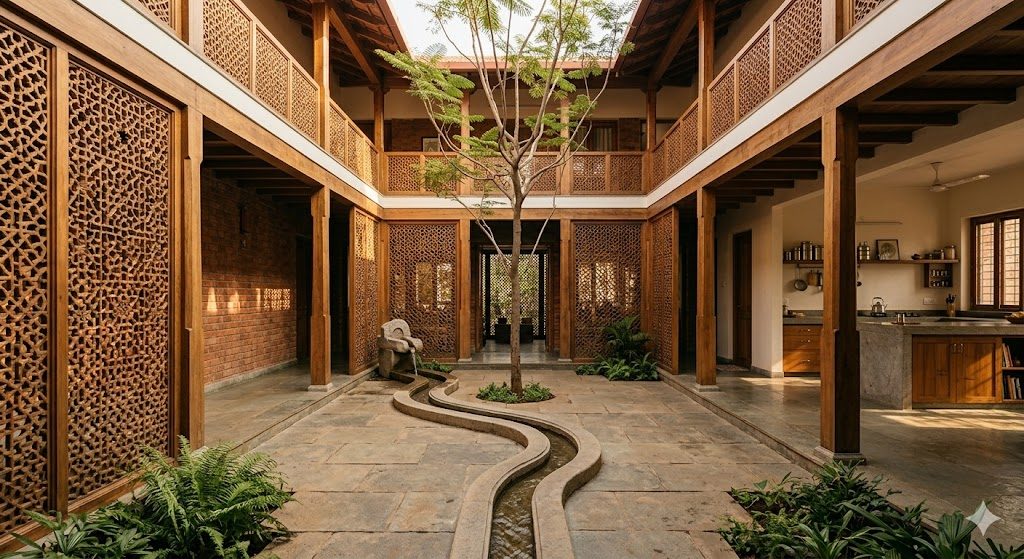
What Is Biophilic Architecture?
Designing for our innate bond with nature — the science and practice of nature-connected buildings
Step into an old courtyard house on a hot afternoon and your body relaxes before your mind has named why. The air moves. A tree throws shifting shadow on a lime-washed wall. Somewhere water sits cool in a stone tank, and a bird you cannot see is making the only sound. The room you came from was sealed and humming with an air-conditioner; this one is open to the sky and somehow more comfortable, more alive. You did not decide to feel calmer. Something older than deciding did it for you.
That involuntary settling is the whole subject of biophilic architecture. It is design that takes seriously a simple, stubborn fact about our species: we evolved outdoors, among living things, and our nervous systems still expect them. Build as if that were true — with views and daylight, breeze and water, grain and growth — and people are measurably calmer, sharper and healthier inside what you make.
Biophilic architecture is the practice of designing buildings that satisfy the human instinct to affiliate with nature — not by adding a few plants, but by weaving light, air, water, materials, living things and nature-derived forms and spaces into the fabric of a place so that being inside feels like being kept by the natural world rather than walled off from it.
What it actually is
The root word is biophilia — literally "love of life" or of living systems. The psychoanalyst Erich Fromm used it first, but it was the Harvard biologist Edward O. Wilson who, in his 1984 book "Biophilia", gave it its enduring meaning: the innate tendency of human beings to seek connection with nature and other forms of life. Wilson's claim was not poetic decoration. It was an evolutionary argument. For the overwhelming majority of human history we lived in landscapes, and the brains we carry into glass towers were tuned by those landscapes — to read a sheltering tree, an open horizon, the glint of water, the colour of a ripe fruit, the movement that might be predator or prey. That tuning did not switch off when we moved indoors.
Biophilic architecture is what you get when you design for that tuning instead of against it. It is not a style in the way that brutalism or art deco are styles — it has no signature silhouette, no required material. It is a design philosophy, a set of intentions about how a building should relate to the living world, which can be expressed in a mud house or a high-rise. The ethos beneath it is restorative: a building should not merely shelter the body, it should help regulate the whole organism — lowering stress, restoring attention, supporting recovery — by giving the senses the natural contact they quietly hunger for.
Crucially, biophilic design is about contact and pattern, not literal wilderness. A shaft of moving daylight, a timber floor that carries grain, a window framing a single tree, a draught of real air, the sound of water — each is a thread back to nature, and the more of them a space holds, woven well, the more deeply it works.
Where the idea came from
The intellectual lineage is unusually clear, which is rare for a design movement.
The biology came first. Fromm coined biophilia in 1964; Wilson made it famous and evolutionary in 1984. In the same year, almost as if on cue, the environmental psychologist Roger Ulrich published a short paper in the journal "Science" that would become the single most cited piece of evidence in the field. Ulrich studied gall-bladder surgery patients in a Pennsylvania hospital. Some recovered in rooms whose windows looked onto a small stand of trees; others, identical in every other respect, looked onto a brick wall. The patients with the green view recovered faster, needed fewer strong painkillers, and were described more positively by nurses. A view of nature, it turned out, was medicine. That study — "View Through a Window May Influence Recovery from Surgery" — is the moment the intuition became data.
The framework came next. The American social ecologist Stephen Kellert, Wilson's collaborator, spent the following decades turning biophilia from a biological observation into something architects could actually use. In "Biophilic Design" (2008, with Judith Heerwagen and Martin Mador) he set out the categories and attributes of nature-connected building — direct experience of nature, indirect experience, and the experience of space and place. Kellert is, more than anyone, the father of biophilic design as a discipline.
Finally the toolkit. In 2014 the New York consultancy Terrapin Bright Green — led by William Browning, with Catherine Ryan and Joseph Clancy — published "14 Patterns of Biophilic Design", a slim, brilliant document that took Kellert's ideas and the accumulated science and distilled them into fourteen concrete, designable patterns. It is the field's working manual. When a contemporary architect says "we used pattern 11, prospect, on the upper terrace," this is the document they mean. Browning's patterns are what made biophilic design buildable rather than merely admirable.
"Nature holds the key to our aesthetic, intellectual, cognitive and even spiritual satisfaction." — E.O. Wilson, "Biophilia" (1984)
The principles: three categories, fourteen patterns
The cleanest way to hold the whole framework in your head is Kellert's three families, which the 14 Patterns slot neatly into.
1. Nature IN the space — the direct, living presence of nature inside or immediately around the building. This is the category people think of first, and it is far richer than potted plants. It covers the visual connection with nature (a real view of greenery, sky or water), the non-visual connections (birdsong, fragrance, the feel of a breeze), non-rhythmic sensory stimuli (dappled light, leaves moving), thermal and airflow variability (a draught here, a warm patch of sun there, instead of a flat conditioned 24 degrees everywhere), the presence of water, dynamic and diffuse daylight that shifts through the day, and a felt connection to natural systems — weather, seasons, the cycle of a plant.
2. Natural analogues — nature represented rather than literally present, for the times and places where living nature cannot reach. This family has three patterns: biomorphic forms and patterns (curves, spirals, leaf and shell and wave motifs — the geometry of growing things rather than the right angle), material connection with nature (wood, stone, lime, bamboo, clay, wool — materials that carry grain, age honestly and feel of the earth), and complexity and order (the fractal richness of a textured screen or a woven surface, detail that rewards a second look without tipping into chaos).
3. Nature OF the space — the spatial configurations we evolved to read, regardless of whether anything green is present. This is the subtlest and most architectural family. Prospect is the long, open, commanding view — the savannah outlook, the terrace, the overlook — that tells the body it can see what is coming. Refuge is its opposite and partner: the sheltered, backed, lower-ceilinged nook — the cave, the window-seat, the alcove — that tells the body its back is safe. Mystery is the partial reveal, the courtyard glimpsed through an arch, the corridor that curves out of sight, that draws you forward. And risk/peril is a thrill held safely in check — a cantilever, a glazed floor, a height with a sturdy rail. Prospect and refuge together, the geographer Jay Appleton argued, are the deepest spatial recipe for feeling "at home."
| Category | What it offers | Example patterns | A homeowner's version |
|---|---|---|---|
| Nature in the space | Direct contact | Views, water, daylight, airflow, plants | A window onto a tree; an open court; a breeze you can feel |
| Natural analogues | Echoes of nature | Materials, biomorphic forms, complexity & order | A timber floor; a stone wall; a carved jaali |
| Nature of the space | Evolved spatial cues | Prospect, refuge, mystery, risk | A terrace view; a reading nook; a court seen through an arch |
The art lies in distribution. You do not deploy all fourteen patterns in every room; you map them to programme. The terrace wants prospect; the reading corner wants refuge; the entry sequence wants mystery; the living space wants daylight, view and air.
How it differs from "just adding plants"
This is the single most useful distinction to grasp, because the market is full of "biophilic" projects that are really just expensive houseplant arrangements.
Adding plants is one move inside one pattern (visual connection). It is welcome, but on its own it is shallow, and it can even backfire — a wall of struggling, under-lit foliage in a sealed office reads as neglect, not nature. True biophilic design works structurally: it organises the building so that daylight, real air, views and water reach the rooms; so that the materials underfoot and overhead are of the earth; so that the spaces themselves offer prospect and refuge. A biophilic home might contain very few plants and still bathe you in nature, because its courtyard pulls the sky inside, its sections move air without a fan, its timber and stone age in your company, and its windows are placed to frame the one good tree.
Put bluntly: plants are nature in a pot; biophilic architecture is the building behaving like a piece of landscape. The deepest version is not contact with nature added on top of a sealed box — it is a building that has stopped being a sealed box. For a fuller, clinical treatment of how these mechanisms drive measurable healing outcomes, our companion guide on biophilic healing environments in Indian healthcare goes deep, as does the more technical biophilic intelligence in healthcare piece.
The evidence: why any of this is worth the trouble

Biophilic design is unusual among design philosophies in resting on a real, replicated body of research rather than on taste alone. The headline findings, stripped to essentials:
Stress falls. Across many studies, contact with natural views, daylight and plant material is associated with lower cortisol, lower blood pressure and slower heart rate — the physiological signature of a parasympathetic, "rest and recover" state. Even short exposures register.
Recovery speeds up. Ulrich's 1984 window study set the template, and later work in hospitals, recovery wards and ICUs has repeatedly found that access to nature — views, gardens, daylight — correlates with shorter stays, less pain medication and better mood.
Cognition sharpens. Attention Restoration Theory, developed by Rachel and Stephen Kaplan, holds that natural scenes gently restore the directed attention that desks and screens exhaust. Studies of daylit classrooms and nature-rich offices report better focus, memory and test performance, and faster reaction times.
Air, mood and productivity improve. Daylight, real ventilation and greenery are linked to higher reported wellbeing, lower absenteeism and measurable gains in productivity — which is why biophilic design has moved from a wellness nicety to a line item in serious commercial briefs.
None of this is magic, and the honest version matters: effects vary by person, by dose and above all by the quality of the design. Biophilia is a tendency, not a switch. But the direction of the evidence is consistent enough that designing for nature is no longer a romantic indulgence — it is closer to a public-health strategy you happen to build. Our guides on how good architecture reduces stress and the wider architectural psychology of comfortable spaces follow these threads further.
Materials, light and water in practice
How is it actually made? The biophilic toolkit is concrete.
Light is the first instrument. Biophilic light is daylight, and specifically dynamic, diffuse daylight — light that changes through the day and the seasons, that comes from more than one direction, that throws moving shadow. The aim is the opposite of the flat, shadowless fluorescence of a basement office. North light for steadiness, controlled south and east light for warmth and movement, clerestories and courtyards to pull light deep into a plan. A space that knows what time of day it is, without a clock, is doing biophilic work.
Air is the second, and the most ignored. Real, moving, variable air — the draught from a cross-ventilated room, the cool exhale of a courtyard at dusk, a window you can actually open — is a direct sensory channel to the natural world that a thermostat cannot fake. Thermal variability, far from a defect, is a pattern: a body that experiences a little warmth and a little cool is more comfortable and more alert than one held in a flat, sealed band. Our cross-ventilation analyzer helps you find the openings that make this happen.
Water is the third — the most powerful sensory anchor of all, working on sight, sound and even humidity at once. A still reflecting pool, a runnel, a fountain, a temple-tank cool against the heat: water reads to the human nervous system as life and safety, which is why even a small one transforms a court.
Materials are the fourth. Biophilic materials are natural ones that carry grain, weight and the marks of age — timber, stone, lime, terracotta, bamboo, cane, wool, leather. They satisfy the "material connection" and "complexity and order" patterns simultaneously, because a piece of real timber is both of-the-earth and richly, fractally detailed. They also age honestly, deepening rather than degrading — a kinship with the wabi-sabi sensibility of impermanence and patina. For palettes that lean into this, see our earthy interior palette guide.
Greenery and view are the fifth — but placed for connection, not decoration: the window framing the one good tree, the green wall sited where it gets light and will thrive, the planted court you pass on the way in.
In the Indian context: biophilia was always here
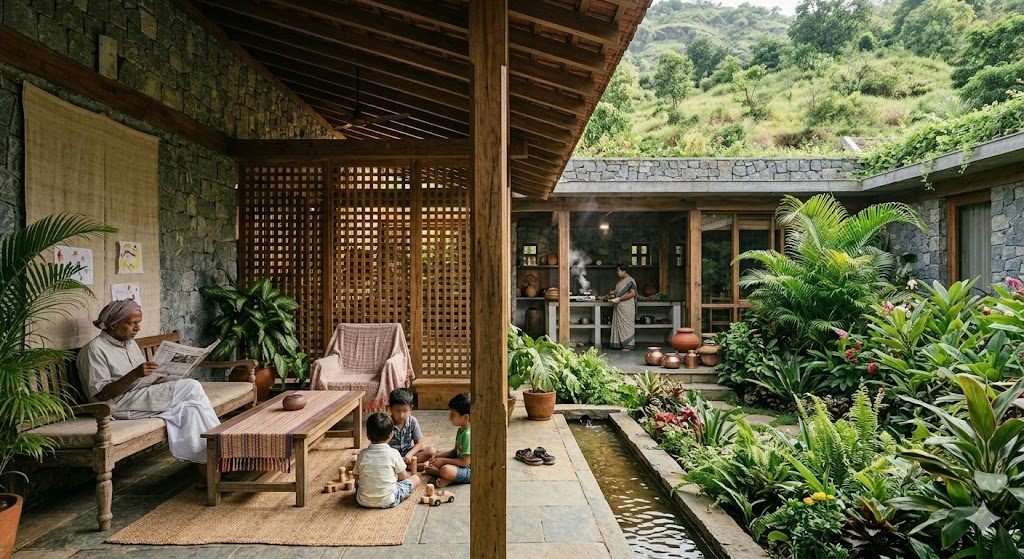
Here is the quiet truth of biophilic architecture in India: it is not a Western import to be adopted. It is a Western re-articulation of what Indian building already knew. The vocabulary is new; the practice is millennia old, and it survives wherever architecture has not yet been sealed shut by glass and mechanical cooling.
The courtyard — the aangan, the chowk, the nadumuttam of Kerala, the brahmasthan of a Vaastu plan — is the most complete biophilic device humans have ever made. A single open-to-sky court delivers daylight, ventilation, a connection to weather and season, often water and a tree, and a profound prospect-and-refuge geometry, all at once. Our dedicated guide on courtyard homes as climate-responsive design traces this in detail. The verandah and the deep chajja mediate inside and out, giving shaded prospect. The jaali — the carved stone or timber screen — is biophilic on three counts at once: it filters light into dappled, non-rhythmic patterns, it lets air move, and its geometry is biomorphic complexity-and-order made buildable. The tulsi in its raised brick vrindavan at the threshold; the temple tank mirroring a gopuram; the stepwell descending to cool water — these are not picturesque survivals. They are sophisticated answers to the same question Browning's patterns ask.
The climate fit is exact. Across India's hot-dry, warm-humid and composite zones, the biophilic moves and the passive cooling strategies are largely the same moves: courts, cross-ventilation, shaded openings, thermal mass, water for evaporative cool. Designing for nature and designing for the Indian climate turn out to be one design problem, which is the great gift of building biophilically here — comfort and connection are not a trade-off but the same line.
The modern masters knew this. Charles Correa built his entire philosophy on the phrase "open-to-sky space," arguing that in a warm climate the most important room in the house is often the one with no roof — his Kanchanjunga tower, his Belapur housing, his Jawahar Kala Kendra all turn the court and the terrace into living rooms. Balkrishna Doshi, India's first Pritzker laureate, threaded light, water and earth-toned, hand-built materials through Sangath, his own Ahmedabad studio half-buried in the ground beneath vaulted, china-mosaic roofs and pools — a building you experience as a landscape. Geoffrey Bawa, across the strait in Sri Lanka, dissolved the line between building and garden so completely that one can no longer say where his houses end. This lineage runs straight into today's contemporary Indian architecture and the revival of vernacular wisdom in modern homes, and it sits close to the broader tropical architecture of India. It is a first cousin of organic architecture, which grows a building from its site, and of human-centred design, which starts from how people actually feel and behave.
Bring it home, in order
You do not need a famous architect or a large plot to build biophilically. You need to make these moves, roughly in this priority:
1. Win the view first. Place the rooms you live in toward the best green, sky or water outlook you have, and frame it deliberately with the window — one well-aimed window beats a wall of glass onto a parking lot.
2. Let daylight in, dynamically. Aim for light from two sides of important rooms, and for some that moves and dapples. Test your openings with our cross-ventilation analyzer so light and air arrive together.
3. Make the air real. Ensure every key room can be cross-ventilated and that you can open a window. A ceiling fan and an operable opening beat a sealed, conditioned box for both comfort and connection.
4. Find or make a court. Even a small open-to-sky light well, a deep planted balcony or a terrace garden delivers an outsized share of the benefit — the single highest-leverage biophilic move in an Indian home.
5. Choose natural, ageing materials. Bring in timber, stone, lime, terracotta, cane and wool where hands and feet meet the building — floor, threshold, seating, screen.
6. Add water, even a little. A small reflecting bowl in the court, a wall runnel, a quiet fountain — for sound, sight and cool.
7. Plant for connection, not decoration. Site greenery where it gets light and will thrive and where you will actually see it from inside; a tree at a window earns its keep.
8. Carve out one refuge. Build a single backed, sheltered, lower nook — a window-seat, a reading alcove — and pair it with a prospect somewhere else. Score the result with our biophilic score tool.
Where it goes wrong
Biophilic design fails in a few predictable ways, all worth naming. The first is greenwashing by foliage — a project that bolts plants onto a sealed, daylight-starved, air-conditioned shell and calls it biophilic. Without daylight, air and view, the plants are a struggling alibi. The second is the unmaintainable green wall — ambitious vertical gardens specified without irrigation, light or a maintenance budget, which brown within a year and read as decay. Living systems are a commitment, not a finish. The third is picturesque over restorative — designing for the photograph rather than for the body, so the nature is there to be seen in a render but never felt as air, sound or shade. The fourth is forgetting the spatial patterns — pouring effort into plants and materials while ignoring prospect, refuge and the daylight section, which are where much of the real psychological work happens. And the fifth, peculiarly modern, is sealing the very thing that worked — taking a courtyard house that breathed and glazing it shut for air-conditioning, severing every connection in the name of comfort, when the building already had the better answer.
The corrective in every case is the same: design the building to behave like a piece of landscape first, and let the planting be the last layer, not the alibi.
To go further, our biophilic score tool audits how nature-connected a space already is, and DesignAI can generate light-filled, court-centred, naturally ventilated layouts for your own home in minutes — testing the views, daylight and airflow before a single wall is built. Begin where the instinct begins: with a window onto something alive.
References
1. Wilson, E.O. "Biophilia." Harvard University Press, 1984.
2. Kellert, S., Heerwagen, J. & Mador, M. (eds). "Biophilic Design: The Theory, Science and Practice of Bringing Buildings to Life." Wiley, 2008.
3. Ulrich, R.S. "View Through a Window May Influence Recovery from Surgery." Science, 224(4647), 1984.
4. Browning, W., Ryan, C. & Clancy, J. "14 Patterns of Biophilic Design." Terrapin Bright Green, 2014.
5. Kaplan, R. & Kaplan, S. "The Experience of Nature: A Psychological Perspective." Cambridge University Press, 1989.
6. Correa, C. "The New Landscape: Urbanisation in the Third World." Butterworth Architecture, 1989.
7. Curtis, W.J.R. "Balkrishna Doshi: An Architecture for India." Rizzoli, 1988.
Keep reading: organic architecture explained, what is human-centred design, and what is wabi-sabi architecture.
Export this guide
Related Guides — Deep-dive reading
Biophilic & Healing Environments for Healthcare in India
An Architect's Working Reference — Roger Ulrich's Restorative Theory, Stephen Kellert's 14 Patterns of Biophilic Design, Therapeutic Gardens, Hospital Courtyards, Patient-Room Nature Views, End-of-Life Space, Indian Planting Palette, and the Biophilic Healthcare Toolkit
Healthcare ArchitectureHomes That Improve Mental Wellbeing
The whole-home, indoor-biophilia approach to calm — how plants, light, air, quiet and the right balance of togetherness and retreat make an Indian home restorative.
Healthy HomesThe Architectural Psychology of Comfortable Spaces
Why some rooms feel right and others never do — the science of space and the human mind
Design EducationRelated Tools — Try Free
Cross-Ventilation Analyzer
Estimate airflow and air changes per hour (ACH) from room size, window areas, layout, and local wind — with NBC 2016 Part 8 compliance check.
Ventilation CalculatorHealing View Impact Calculator
Evidence-Based Design dashboard quantifying the recovery impact of nature view + daylight factor on analgesic use, length of stay, and HCAHPS patient-experience uplift. Calibrated against Ulrich 1984 (Science), Park & Mattson 2008, and the CHD EBD evidence base.
EBD CalculatorBrise-Soleil Visualizer
Interactive horizontal-louvre cut-off angle calculator — sun altitude, louvre depth, and spacing inputs with a live shadow preview. Computes θ = arctan(spacing/depth) for façade shading, ECBC envelope compliance, hospital daylight design, and tropical sun-control detailing.
Sun Shading Tool