
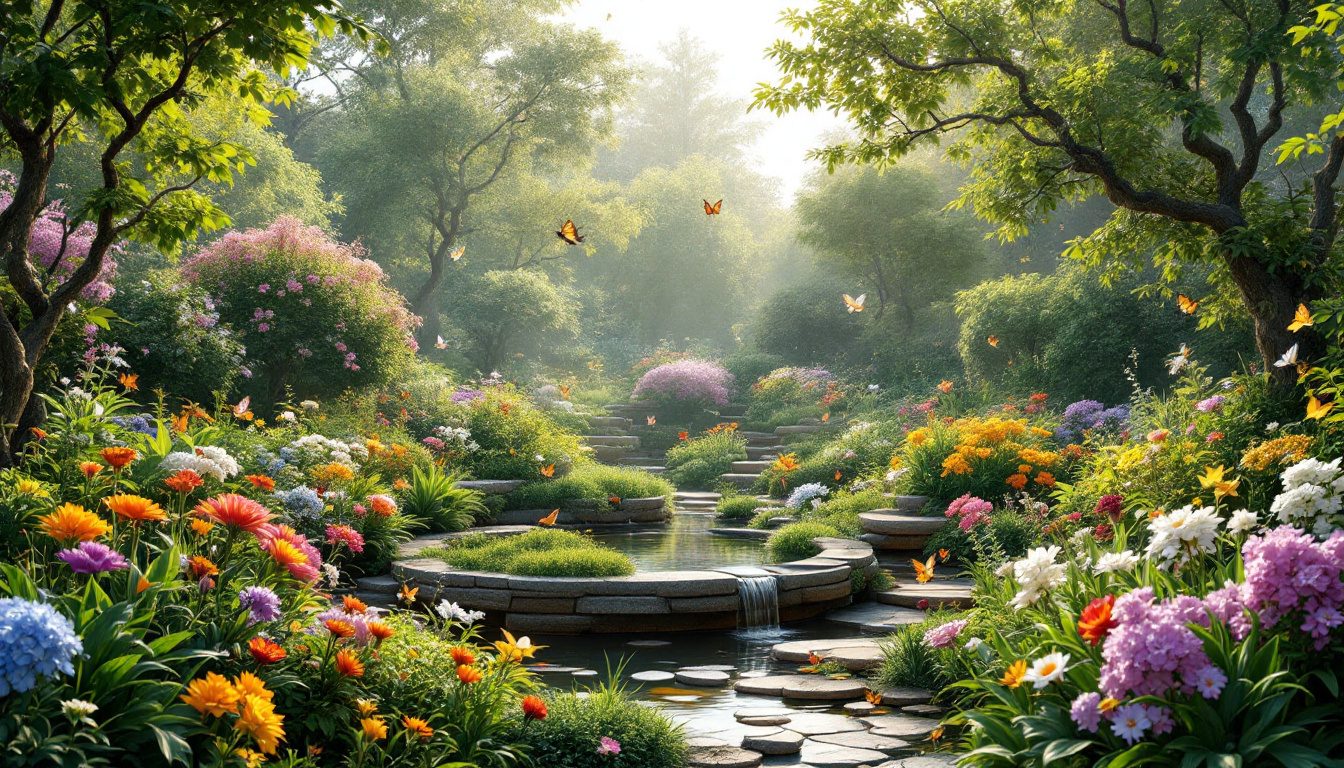
Biophilic Landscape Design for Indian Homes
Translating biophilia to the garden: Kellert's patterns, native planting, layered ecology and the evidence that living landscapes cool, clean and calm
There is a moment, early on a Bengaluru morning or after the first monsoon shower in Pune, when a small garden does something a room never can. A coppersmith barbet starts its metronome call from somewhere in the foliage, a sunbird stitches between the hibiscus, the air smells of wet earth and crushed curry leaf, and your shoulders drop without your permission. You did not decide to relax. Some older part of you recognised it was among living things and quietly stood down. That recognition has a name.
This guide is about translating biophilia — our innate, evolved affinity for life and lifelike processes — into the outdoor realm of the Indian home: the courtyard, the balcony, the terrace, the strip of soil along the boundary wall. Where our companion guide What is biophilic architecture deals with the building — its light, materials and views — this one treats the garden as a designed ecology: how to choose plants, water, layers and forms so that a small Indian plot does the most for birds, butterflies, the local climate and the people who live there. We work from real frameworks (Kellert's patterns, Wilson's biophilia hypothesis) and real evidence (Ulrich, the Kaplans, Kuo), grounded in native species and Indian conditions.
A biophilic landscape is not a garden that merely looks natural — it is one engineered to be genuinely alive: layered, native-rich, water-touched and sensory, so that it cools the home, cleans the air, feeds pollinators and birds, and steadies the nervous system, all from the same square metres.
Biophilia: the idea, and why it belongs outdoors
The word biophilia was popularised by the biologist Edward O. Wilson in his 1984 book of that name, where he defined it as "the innate tendency to focus on life and lifelike processes." The argument is evolutionary: for almost all of human history we lived inside ecosystems, reading them constantly for food, water, shelter and danger, and the minds that did this well survived. We are, in Wilson's phrase, hardwired to affiliate with nature — and that wiring did not switch off when we moved indoors.
Stephen Kellert, the Yale social ecologist who worked alongside Wilson, took the crucial next step and turned the hypothesis into a design discipline. If we are drawn to nature, Kellert reasoned, the built environment should be shaped to satisfy that drive rather than starve it. His framework — laid out in the 2008 collection Biophilic Design and the 2015 paper "The Practice of Biophilic Design" with Elizabeth Calabrese — organises the experience of nature into patterns across three dimensions. The Indian landscape is the purest place to apply them, because outdoors you work with the real material of biophilia — actual plants, real birds, weather you can feel — rather than its representations.
The same evidence that justifies biophilic buildings justifies biophilic gardens, often more strongly, because the outdoor exposure is direct. We unpack the deeper "why does this feel calming" question in the cluster pillar, Why some gardens feel peaceful in India; here we stay practical about the making of one.
Kellert's patterns, translated to the garden
Kellert and Calabrese describe fourteen patterns grouped under three experiences of nature. Most discussion applies them to interiors; mapping them onto an Indian garden makes the framework far more concrete, because the garden can deliver many of them in literal, undiluted form.
| Dimension | Kellert pattern | What it means in a garden | Indian landscape move |
|---|---|---|---|
| Direct nature | Light | Real, changing daylight and shade | A canopy tree casting dappled shade; an east-facing seat for morning sun |
| Direct nature | Plants & biodiversity | Abundant, varied living plants | Layered native planting, not a clipped monoculture lawn |
| Direct nature | Water | Visible, audible, touchable water | A small lily pond, a bird bath, a runnel fed by the AC condensate |
| Direct nature | Animals | Birds, butterflies, fish, fauna | Nectar and host plants that pull in sunbirds and butterflies |
| Direct nature | Weather | Awareness of climate and season | A monsoon-fed rain chain; flowering keyed to the seasons |
| Natural analogues | Natural materials | Wood, stone, clay over plastic | Kota stone paving, terracotta pots, bamboo screens |
| Natural analogues | Organic forms | Curves and shapes drawn from nature | Meandering paths, kidney-shaped beds, no rigid grids |
| Natural analogues | Biomorphic patterns | Fractal, leaf-like, repeating motifs | A jaali screen, fern textures, ripple in water |
| Nature of the space | Prospect | An open, surveyable view | A seat that looks out over the whole garden |
| Nature of the space | Refuge | An enclosed, sheltered nook | A bench under a pergola or against a hedge |
| Nature of the space | Mystery | A partly hidden promise of more | A path that curves out of sight behind a shrub |
| Nature of the space | Risk / peril | Safe edge of risk or thrill | Stepping stones across water; a slight level drop |
The "nature of the space" patterns — prospect, refuge, mystery and the safe thrill of peril — are the ones designers most often forget, yet they explain why some gardens feel merely planted and others inhabited. Give the eye a long view (prospect) and the body a sheltered place to sit (refuge), then let a path curve out of sight so the garden is never fully revealed (mystery) — the spatial grammar the British landscape tradition, from Capability Brown to Gertrude Jekyll, arrived at by intuition and Kellert later named.
The evidence: what living landscapes do to us
The case for biophilic landscaping is not aesthetic preference; it is a measurable physiological and psychological effect, backed by some of the most cited studies in environmental psychology.
The foundational result is Roger Ulrich's 1984 paper in Science, "View Through a Window May Influence Recovery from Surgery." Gall-bladder patients whose windows looked onto a stand of trees, versus identical patients facing a brick wall, had shorter post-operative stays, needed fewer strong painkillers, and drew fewer negative nurse notes. A view of vegetation — not even a garden you could enter — measurably changed recovery. Ulrich's later Stress Recovery Theory held that natural scenes trigger a rapid, automatic drop in physiological arousal we cannot fully suppress.
Rachel and Stephen Kaplan, in The Experience of Nature (1989), built the complementary Attention Restoration Theory: natural environments are rich in "soft fascination" — clouds, leaves, water, birdsong — that engages attention gently and lets the brain's exhausted directed-attention system recover. A garden does not just calm you; it restores your capacity to concentrate.
Frances Kuo and colleagues at the University of Illinois took this into ordinary residential life. Among Chicago public-housing residents, those beside green, tree-rich common spaces reported less mental fatigue, less aggression and violence, and stronger neighbourly ties than residents of identical buildings facing barren ground. The active ingredient was everyday greenery within sight of home — exactly what a biophilic garden provides.
| Study / source | What was measured | Key finding |
|---|---|---|
| Ulrich, Science (1984) | Surgical recovery vs window view | Tree view cut hospital stay and strong-analgesic use vs brick wall |
| Kaplan & Kaplan (1989) | Directed-attention fatigue | Natural settings restore concentration via "soft fascination" |
| Kuo & Sullivan (2001) | Aggression, mental fatigue (housing) | Greener surroundings linked to less violence, less fatigue |
| WHO / urban greenspace reviews | Mortality, mental health | Access to greenspace associated with lower stress and mortality |
| Forest-bathing studies (Japan) | Cortisol, blood pressure | Time among trees lowered salivary cortisol and BP |
"The land is one organism. Its parts, like our own parts, compete with each other and co-operate with each other." — Aldo Leopold, A Sand County Almanac (1949). A biophilic garden is small enough to design and large enough to remember that.
You can put a rough number on your own plot's biophilic richness with our Biophilic Score tool, which scores a space against criteria drawn from this body of research — useful before and after a redesign.
Native planting: the engine of a living garden
If one decision separates a biophilic landscape from a merely green one, it is the choice of native species. Native plants co-evolved with local insects, birds and soil over millennia, and that relationship is the literal food web of your garden. Entomologist Doug Tallamy's research found that native oaks supported hundreds of caterpillar species while ornamental exotics supported almost none; caterpillars are the protein nesting birds feed their chicks, so a garden of exotics can look lush yet be a biological desert. The principle holds in India.
A native-rich garden also costs less and asks less: species adapted to the local climate need less irrigation, no exotic fertiliser, and far less pesticide. In a country of worsening water stress — IMD recording more erratic monsoons, many cities under summer rationing — a garden that drinks rainwater and groundwater rather than treated municipal supply is a responsibility, not a luxury. The Foundation for Revitalisation of Local Health Traditions (FRLHT) in Bengaluru and Pradip Krishen's field guides, especially Trees of Delhi and Jungle Trees of Central India, are the practical references for choosing indigenous species region by region.
| Garden role | Native (recommended) | Why | Avoid / be wary of |
|---|---|---|---|
| Canopy / shade tree | Neem (Azadirachta indica), Arjuna (Terminalia arjuna), Indian beech / Pongam (Pongamia pinnata) | Deep shade, host insects, deep roots | Eucalyptus (water-hungry), Conocarpus (allergenic, banned in some states) |
| Flowering tree | Amaltas (Cassia fistula), Indian coral (Erythrina), Kachnar (Bauhinia) | Mass nectar, bird-attracting | Gulmohar (exotic, low ecological value but iconic) |
| Shrub | Hibiscus, Lantana (sterile cultivars only), Ixora, Tecoma | Long flowering, nectar | Invasive wild Lantana camara |
| Hedge / screen | Henna (Mehndi), Murraya (curry leaf / kamini) | Fragrant, dense, useful | Clipped exotic conifers |
| Groundcover | Indian pennywort (Brahmi), wedelia, native grasses | Soil cover, low water | Resource-hungry exotic turf lawn |
Lawns deserve special caution. The clipped exotic lawn is among the thirstiest and least biophilic features you can plant: it supports almost no insect life, demands constant water and mowing, and struggles through the dry season. Replacing even part of a lawn with layered native beds multiplies the garden's biodiversity many times over while cutting its water bill.
Layered planting: building the structure of a forest
A natural Indian woodland or scrub is not a single height; it is a stack of layers, each occupied by different plants and animals. The most powerful structural move in biophilic landscaping is to imitate that stack — canopy, understorey, shrub, herb and groundcover — rather than planting everything at one level. Layering gives a garden its depth, its cool microclimate, and the niches that draw a full cast of wildlife.
Each layer earns its place. The canopy — neem, arjuna or pongam — casts the deep shade that cools everything below and gives large birds their perch and nest sites. The understorey of amaltas or coral fills mid-height with nectar and structure. The shrub layer of hibiscus, ixora and tecoma is where most nectar action happens at eye level. The herb and groundcover layer holds soil, retains moisture and hosts ground-feeders. Even a balcony can compress this into containers: a tall pot with a slim tree, a flowering shrub, and trailing groundcover over the edge.
Layering also does the thermal work. A dense, multi-layer bed transpires far more water than bare ground or paving, and that evapotranspiration is the most powerful natural cooling mechanism available — the same process explored in the best trees for Indian homes. A well-planted courtyard can run several degrees cooler than the paved street outside, a passive air-conditioner for the rooms that open onto it.
| Layer | Typical height | Native examples | Wildlife it serves |
|---|---|---|---|
| Canopy | 8–20 m | Neem, Arjuna, Pongam | Large birds, raptors, fruit bats |
| Understorey | 3–8 m | Amaltas, Indian coral, Kachnar | Barbets, bulbuls, sunbirds |
| Shrub | 0.5–3 m | Hibiscus, Ixora, Tecoma, Henna | Sunbirds, butterflies, small reptiles |
| Herb / groundcover | 0–0.5 m | Brahmi, wedelia, native grasses | Ground-feeders, pollinating insects |
Water, sensory plants and the multi-sensory garden
Direct nature in Kellert's framework is not only visual. The most affecting gardens engage every sense, and three elements do most of that work: water, fragrance and texture.
Water is the highest-impact biophilic addition for its size. Even a shallow bird bath or a half-buried earthen pot transforms a garden's wildlife and soundscape — water draws birds to drink and bathe, supports dragonflies, and adds the "soft fascination" the Kaplans identified. A small lily pond with native fish controls mosquito larvae naturally. In water-scarce India the trick is to recirculate: a tiny solar pump moving the same water, topped up with AC condensate or harvested rain, gives the sight and sound of a stream with almost no waste.
Fragrance anchors memory and mood more directly than any other sense, because smell wires straight into the limbic system. India's traditional gardens lean heavily on scent — night-blooming raat ki rani (Cestrum nocturnum), parijat (Nyctanthes, the night-flowering jasmine sacred across the subcontinent), mogra and chameli jasmines, and the curry leaf and tulsi that double as kitchen and medicine. A seat downwind of a fragrant shrub turns an ordinary pause into a sensory event.
Touch and sound complete the set: soft lamb's-ear and fern textures invite the hand, bamboo and tall grasses rustle in the breeze, gravel underfoot changes the sound of a walk. The edible garden — pots of tulsi, mint, chillies, curry leaf and seasonal greens — adds taste, the most intimate connection of all, and turns the garden into a daily relationship rather than a view. This sensory layering distinguishes a garden you look at from one you live inside.
Birds, butterflies and pollinators: designing for wildlife
A garden becomes unmistakably alive when it hosts other creatures, and you can design for this with precision. Butterflies have a two-part need gardeners routinely half-meet: adults drink nectar, but females lay only on specific host plants their caterpillars can eat. Plant nectar without hosts and butterflies visit but never breed; plant both and you get a self-sustaining population.
The pairings are well documented by Indian lepidopterists and birders. Lime and curry-leaf (Citrus, Murraya) host the Common and Lime Swallowtails; calotropis (aak) hosts the Plain Tiger; cassia and senna host the grass-yellows; Tridax and Lantana flowers feed adults of dozens of species. For birds, native figs (Ficus) are keystone — a single fruiting peepal or banyan can feed barbets, bulbuls, koels and mynas for weeks — while tubular red and orange flowers (hibiscus, tecoma, coral) are built for sunbird tongues.
| Wildlife you want | Plants to provide | Role |
|---|---|---|
| Sunbirds | Hibiscus, Tecoma, Indian coral, Russelia | Tubular nectar flowers |
| Barbets, bulbuls, koels | Ficus (peepal, banyan, fig), Singapore cherry | Fruiting trees |
| Common Mormon / Lime butterfly | Curry leaf, lime, citrus | Larval host |
| Plain Tiger / Common Crow | Calotropis, Asclepias | Larval host |
| Grass-yellow butterflies | Cassia, Senna | Larval host |
| Bees & native pollinators | Tulsi, marigold, single-flower (not double) blooms | Pollen & nectar |
Two further moves matter as much as planting. First, eliminate pesticides — a sprayed garden cannot host a food web, because the insects you poison are the food the birds came for. Second, leave a little mess: a pile of leaf litter, a dead branch, an undisturbed corner. Tidiness is the enemy of biodiversity; the wildest-feeling gardens have stopped fighting their own ecology.
Measurable benefits: cooling, air and wellbeing
The biophilic garden pays for itself in services that can be quantified — the strongest argument for spending on planting rather than paving.
Cooling is the headline benefit in Indian cities, most of which now suffer pronounced urban-heat-island effects — built-up areas running several degrees hotter than vegetated surroundings, a gap IPCC and Indian urban-climate studies show is widening. A mature canopy and dense planting cool through shade and evapotranspiration combined; field measurements across tropical cities commonly find tree-shaded ground 2 to 8 degrees Celsius cooler than adjacent paving, with the cooled microclimate reaching the rooms that open onto the garden. The US Forest Service's i-Tree ecosystem-services tools, and Indian urban-tree studies, value a single mature tree's annual benefits — cooling, stormwater capture, air filtering, carbon storage — at thousands of rupees a year.
Air quality. Vegetation captures particulate matter on leaf surfaces and through the leaf boundary layer; studies of urban green belts find meaningful reductions in PM2.5 and PM10 immediately downwind of dense planting, with rough-leaved, dense-canopied species best. In Indian cities where PM2.5 routinely exceeds safe limits many-fold, a layered green buffer along a boundary is a genuine, if partial, filter for the home behind it.
Wellbeing, finally, returns us to where we began. The cooling and cleaner air are real, but the deepest return is the one Ulrich and the Kaplans measured: lower stress, faster mental restoration, better sleep, more time outdoors and with neighbours. For a feature that occupies a few square metres and, once established, largely runs itself, no other element of the home delivers as broad a dividend.
| Benefit | Typical effect | Source / basis |
|---|---|---|
| Local cooling | 2–8 degrees C below adjacent paving under canopy | Tropical urban-microclimate field studies; i-Tree |
| PM2.5 / PM10 capture | Measurable reductions downwind of dense planting | Urban green-belt air-quality studies |
| Water use | Native beds use a fraction of an exotic lawn's water | FRLHT / native-horticulture guidance |
| Stress & recovery | Lower cortisol, faster attention restoration | Ulrich (1984); Kaplan & Kaplan (1989) |
| Biodiversity | Many-fold rise in bird & butterfly species vs lawn | Tallamy native-vs-exotic food-web research |
How to apply this to your home
1. Score what you have, then plant for the gaps. Run your space through the Biophilic Score tool to see which of Kellert's patterns are missing — usually water, layering, or wildlife planting — and target those first.
2. Go native before you go big. A single well-chosen native canopy tree (neem, arjuna, pongam) and a few native shrubs out-perform a plot full of thirsty exotics for cooling, wildlife and water cost. Use FRLHT and Pradip Krishen's guides for your region.
3. Build in layers, not levels. Even on a balcony, stack a small tree, a flowering shrub and trailing groundcover so the planting has depth and niches.
4. Add water, however small. A bird bath or a recirculating pot transforms wildlife and soundscape for almost no water if you top it from rain or AC condensate.
5. Pair nectar with host plants. Curry leaf and lime for swallowtails, calotropis for tigers, figs for birds — design the full life cycle, not just the flower.
6. Stop spraying and tolerate a little mess. No pesticides, a corner of leaf litter, a dead branch left standing — these are what let the food web close.
7. Give the space prospect, refuge and mystery. A seat with a long view, a sheltered nook, and a path that curves out of sight turn a planted plot into an inhabited garden.
How Studio Matrx helps
Designing a biophilic landscape means holding many variables at once — sun and shade, native palettes, planting layers, water, wildlife and the views from inside. Studio Matrx's DesignAI lets you visualise your courtyard, balcony or terrace as a layered, native-rich garden before you dig, testing canopy positions, planting schemes and water features against your real plot and climate. With the Biophilic Score tool, it turns this guide into a buildable plan — a garden that is not just green, but genuinely alive.
References
1. Wilson, E. O. (1984). Biophilia. Harvard University Press. (Origin of the biophilia hypothesis.)
2. Kellert, S. R., Heerwagen, J. & Mador, M. (2008). Biophilic Design: The Theory, Science and Practice of Bringing Buildings to Life. Wiley.
3. Kellert, S. R. & Calabrese, E. F. (2015). The Practice of Biophilic Design. (The fourteen patterns across three dimensions.)
4. Ulrich, R. S. (1984). "View Through a Window May Influence Recovery from Surgery." Science, 224(4647), 420–421.
5. Ulrich, R. S. et al. (1991). "Stress Recovery During Exposure to Natural and Urban Environments." Journal of Environmental Psychology, 11(3), 201–230.
6. Kaplan, R. & Kaplan, S. (1989). The Experience of Nature: A Psychological Perspective. Cambridge University Press. (Attention Restoration Theory.)
7. Kuo, F. E. & Sullivan, W. C. (2001). "Aggression and Violence in the Inner City: Effects of Environment via Mental Fatigue." Environment and Behavior, 33(4), 543–571.
8. Tallamy, D. W. (2007). Bringing Nature Home: How You Can Sustain Wildlife with Native Plants. Timber Press.
9. Krishen, P. (2006). Trees of Delhi: A Field Guide; and Jungle Trees of Central India (2013). Penguin / Viking. (Indigenous-species reference.)
10. Foundation for Revitalisation of Local Health Traditions (FRLHT), Bengaluru — native and medicinal plant databases for India.
11. Nowak, D. J. et al. — i-Tree ecosystem-services models, US Forest Service (tree cooling, air-quality and stormwater valuation).
12. Leopold, A. (1949). A Sand County Almanac. Oxford University Press.
Part of the Studio Matrx Landscape series. Continue with why some gardens feel peaceful in India, what is biophilic architecture, and the best trees for Indian homes.
Export this guide
Related Guides — Deep-dive reading
Biophilic Intelligence: Designing "Living" Healthcare Ecosystems
Three Pillars of Biophilic Design — Direct Nature · Natural Analogues · Spatial Logic — Calibrated for Indian Climate, Culture, and the EBD Evidence Base
Healthcare ArchitectureHow Buildings Can Give Back: Biodiversity and Environmental Health
How an Indian home and its plot can actively improve the ecology and environment around it, not just reduce harm
SustainabilityHomes That Improve Mental Wellbeing
The whole-home, indoor-biophilia approach to calm — how plants, light, air, quiet and the right balance of togetherness and retreat make an Indian home restorative.
Healthy HomesRelated Tools — Try Free
Healing View Impact Calculator
Evidence-Based Design dashboard quantifying the recovery impact of nature view + daylight factor on analgesic use, length of stay, and HCAHPS patient-experience uplift. Calibrated against Ulrich 1984 (Science), Park & Mattson 2008, and the CHD EBD evidence base.
EBD CalculatorCross-Ventilation Analyzer
Estimate airflow and air changes per hour (ACH) from room size, window areas, layout, and local wind — with NBC 2016 Part 8 compliance check.
Ventilation CalculatorCircadian Light Meter
Patient-centric circadian lighting visualizer for Indian healthcare design — time-of-day × intensity → CCT, melanopic lux (EML / mEDI), melatonin suppression, and an alertness curve. Calibrated against WELL v2 L03 Circadian Lighting Design, CIE S 026:2018, Brainard 2001, and Lucas et al. 2014.
Circadian Tool