
Fire Alarm Testing in India (2026): The Weekly Test, Battery Autonomy & Cause-and-Effect
The routine test regime that proves a fire-alarm system actually works - the weekly call-point test, functional detector and sounder checks, the battery standby test and cause-and-effect verification, done without crying wolf.
A fire-alarm system is not proven by its certificate on the wall. It is proven by being tested - regularly, on a schedule, with the results written down. The uncomfortable truth across India is that vast numbers of buildings have a system that was installed to win the Fire NOC and then never tested again: the standby batteries have quietly died, half the zones sit isolated, detectors are dust-choked or painted over, and the staff on duty have never once heard the sounders. "Installed" is not "working," and the only thing that tells the difference is fire alarm testing. A system that has never been tested must be presumed broken, because there is no evidence it is anything else.
This is the testing chapter of Studio Matrx's fire-safety library, sitting under the complete guide to fire safety in India, and it is the direct sibling of the fire-alarm maintenance guide. Maintenance keeps the system healthy; testing proves it still responds. It is written for RWA committees, facility managers, builders and the owners of offices, shops, hotels and hospitals - the people who must hold the AMC contractor accountable, keep the log book, and above all make sure the routine tests actually happen.
Scope and safety - read this first. A building fire-alarm system is a statutory, engineered installation, and its testing regime is set by IS 2189 : 2026 and the National Building Code (via SP 7 : 2026, Part 4 Fire and Life Safety), tied to the premises Fire NOC under your State Fire Services Act and Rules. This guide explains what testing is meant to prove and how to run a test safely; it is educational guidance, not legal advice, and never a manual for defeating a system. Functional testing of detectors, the battery autonomy test and the full cause-and-effect verification are done by, or under, your licensed fire-alarm contractor. If a real fire is ever found during any test, stop testing, evacuate, and call the fire brigade on 101 or 112.
Why a never-tested system is presumed broken
Every part of a fire-alarm system degrades silently. Standby batteries lose capacity over two or three years and give no outward sign until the grid drops. Detectors accumulate dust and lose sensitivity, or get painted over during renovation. Sounders get disconnected during other works and never reconnected. Zones get isolated to stop a nuisance alarm and are forgotten. None of this shows on a panel that reads "normal" on a good day. The system can look perfectly healthy and be completely dead, and the only way to know which is to test it.
That is why testing is not optional housekeeping - it is the evidence. A fire officer, an insurer or an investigating authority does not ask whether you believe the system works; they ask to see the test log. A blank log book, or one with entries that stop a month after commissioning, is treated exactly as it should be: as proof that nobody knows whether the system works, which in a life-safety installation means it must be assumed it does not.
The test regime - what is tested, and how often
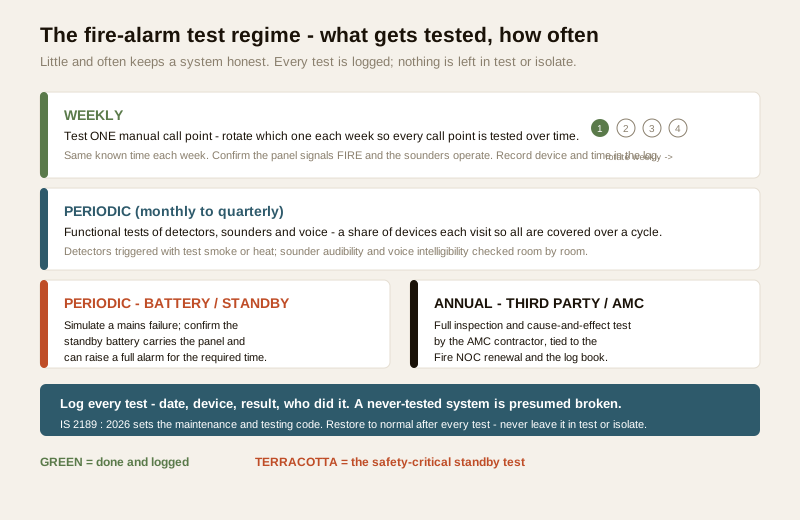
Good testing is little and often. Rather than one heroic annual test that disrupts the whole building, the regime spreads small, routine checks across the year so that every device and every function is exercised over a cycle, and any failure surfaces quickly. The exact frequencies follow IS 2189 : 2026 and your contractor's schedule, but the shape is consistent.
| Test | Typical frequency | What it proves | Who |
|---|---|---|---|
| Weekly call-point test | Weekly, rotating device | The panel receives a manual alarm and the sounders operate | Trained on-site person |
| Functional detector test | Monthly to quarterly, a share each visit | Each detector still senses smoke or heat and reports its zone | AMC contractor |
| Sounder and voice test | Periodic | Alarm is audible everywhere; voice messages are intelligible | AMC contractor |
| Battery standby (autonomy) test | Periodic | The panel runs the system and can alarm through a power cut | AMC contractor |
| Cause-and-effect test | Periodic and at any change | Dampers, doors, lifts and pressurization actually respond | AMC contractor |
| Third-party / AMC inspection | Annual, tied to Fire NOC | The whole system meets code and is fit to certify | Licensed contractor / authority |
The weekly test of a manual call point
The keystone of the whole regime is a simple weekly ritual: operate one manual call point using its test key, confirm the panel registers a FIRE signal from the correct zone and the sounders sound, then reset. The discipline is in the rotation - a different call point is tested each week, in sequence, so that over a cycle of weeks every call point in the building has been proven, not just the one nearest the panel. Doing it at the same known time each week means occupants learn to expect it and the front desk is not alarmed. Every weekly test is a single line in the log: date, which call point, result.
This weekly test is the one routine an owner or facility manager can genuinely own without a contractor. It exercises the entire signalling chain - a human input, the wiring, the panel's response, the sounders - in under a minute, and it is the earliest warning that something in that chain has failed.
Functional tests of detectors, sounders and voice
Detectors are tested functionally - a smoke detector with a puff of test aerosol, a heat detector with a safe heat source - to confirm each actually senses and reports. Because a large building has hundreds of detectors, the contractor tests a share each visit so that every device is covered over an agreed cycle rather than all at once. The same visit checks the sounders for audibility in every occupied space, and, where the building has voice evacuation, checks that the spoken messages are clear and intelligible rather than a booming echo. These functional tests are contractor work, done under the AMC, and they are where a painted-over or dust-dead detector is finally caught.
The battery standby (autonomy) test
This is the test India fails most often, and it is the one that matters most, because in this country a fire and a power cut so frequently arrive together. A system that works beautifully on mains is worthless if it goes dark the moment the grid drops - which is exactly when a fire during an outage needs it. The autonomy test is the only thing that proves the standby battery is still alive.
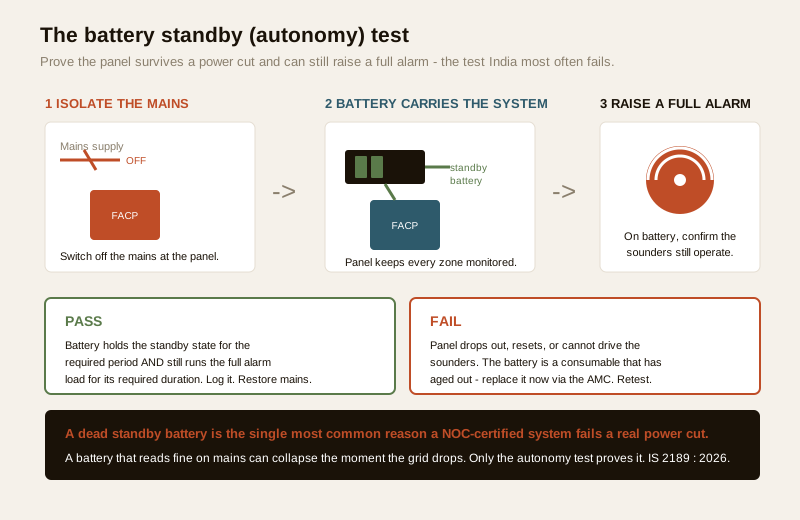
The test simulates a mains failure: the contractor isolates the mains supply at the panel and confirms that the standby battery seamlessly takes over, holding the whole system in its monitored state and - the crucial part - still able to drive a full alarm if a fire signal comes during the outage. A pass means the battery holds the standby state for its required period and then still has the reserve to run the full alarm load, sounders and outputs included, for its required duration. A fail is anything less: the panel drops out, resets, or cannot drive the sounders on battery alone.
| Autonomy test outcome | What it means | Action |
|---|---|---|
| Pass | Battery holds standby and runs the full alarm load for the required time | Log the result; restore mains; nothing further |
| Weak / short hold | Battery has aged and lost capacity | Schedule replacement now via the AMC; do not wait |
| Fail - panel drops out | Standby battery is effectively dead | Replace immediately; the system currently has no power reserve |
The honest reality is that the standby battery is a consumable that ages out on a two-to-three-year horizon, gives no warning on mains, and is the single most common reason a NOC-certified system fails a real power cut. Only the autonomy test surfaces this. The interplay between mains, battery and panel is covered in depth in the fire-alarm panels guide; the point here is that you cannot infer battery health - you must test it.
Cause-and-effect verification - does the building actually respond
On any large or complex building the panel does far more than ring a bell. Through programmed cause-and-effect, a fire in one zone is meant to close the fire and smoke dampers on that path, release the held-open fire doors, recall the lifts to a safe floor, and start stair pressurization and smoke extraction. All of that is only real if it has been tested. A cause-and-effect verification triggers a zone and then physically confirms that each programmed effect actually happens - not that the panel thinks it sent the command, but that the damper moved, the door shut, the lift came down.
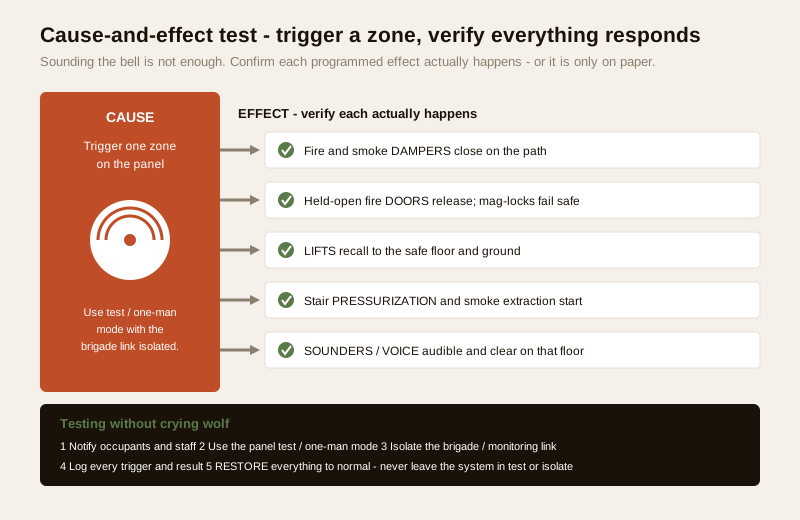
This matters most in the high-rise, hospital and hotel settings, where phased evacuation, lift recall and stair pressurization are load-bearing parts of the life-safety strategy - a cause-and-effect failure there is a failure of the escape plan itself. The verification is contractor work, checked against the building's cause-and-effect matrix, and it must be repeated whenever the system is changed or extended, because a re-programming can silently break an effect that used to work. Alongside the safety outputs, this is also when the sound-level and audibility of the sounders and the intelligibility of any voice evacuation are confirmed on the affected floor.
How to test without crying wolf
The reason so many buildings stop testing is that a careless test empties the building, summons the fire brigade, and trains everyone to ignore the alarm - so people quietly abandon testing altogether. The answer is not to stop testing; it is to test properly. A controlled test never becomes a false emergency.
- Notify occupants and staff in advance. Tell people a test is happening, at a known time, so the sounders are expected and nobody evacuates in panic or, worse, learns to ignore a real alarm.
- Use the panel's test or one-man-test mode. Modern panels have a test mode that lets a single person walk the building triggering devices while the panel auto-resets each one, without launching the full building response.
- Isolate the brigade or monitoring link for the duration. If the panel signals a monitoring station or the fire brigade, that link is isolated during the test so a routine test does not dispatch an engine - and it is the first thing restored afterwards.
- Log everything. Every device triggered, the result, the time and the person - written in the test log book at the panel. The log is the entire point of the exercise.
- Restore to normal - always. The moment the test is done, the panel comes out of test mode, every isolated zone and the brigade link are re-enabled, and the panel is confirmed to read normal. A system left in test or isolate after a test is worse than untested, because it looks tested and is silently off.
That last rule is the one that kills people when it is broken. Isolating a zone or the brigade link for a test is legitimate and logged; leaving it isolated afterwards turns a safety measure into a permanent hole in the protection. Restoring to normal is not the tidy-up at the end of the test - it is part of the test. This is the same deadly habit the fire-alarm maintenance guide and the panels guide warn against: never leave a system in isolate or fault to buy silence.
The third-party inspection and the Fire NOC
Sitting above the routine tests is the periodic full inspection - typically annual - carried out by the AMC contractor and tied to the renewal of the premises Fire NOC. This is the comprehensive check: a full functional sweep, the battery autonomy test, the complete cause-and-effect verification, sound-level and intelligibility measurement, and a review of the log book to confirm the routine regime has actually been running through the year. The office, apartment, school and hospital fire-safety guides set out how this inspection sits within each occupancy's overall compliance and NOC obligations.
The log book is what turns all of this into something an authority can trust. A well-kept test log - weekly call-point tests running unbroken, periodic functional and battery tests recorded, cause-and-effect verifications dated - is the single most persuasive piece of evidence that a system is genuinely maintained and not a decoration. Use the fire-alarm system selector and fire-detector selector when specifying or upgrading a system, the home fire-safety scorecard to check the domestic layer, and the emergency-preparedness guidance to tie the alarm regime into the building's evacuation plan. For the electrical risks behind both the fire and the panel supply, see the electrical guides.
When the law requires a professional - and why you never leave it disabled. Functional testing of detectors, the battery standby test, the full cause-and-effect verification and the annual third-party inspection are qualified tasks for your licensed fire-alarm contractor under the AMC, certifying to IS 2189 : 2026, the National Building Code (SP 7 : 2026, Part 4) and the premises Fire NOC under the State Fire Services Act and Rules. What is squarely on the owner and manager is the discipline: run and log the weekly call-point test, insist the periodic and battery tests actually happen, keep the test log book complete, and never - during a test or after it - leave a zone, a sounder, the brigade link or the whole panel in isolate, test or fault to stop a nuisance. A fire-alarm system that is never tested is presumed broken. A system left in test or isolate is worse: it looks alive and is silently dead.
Key takeaways
- A never-tested fire-alarm system is presumed broken - every part degrades silently, "installed" is not "working," and only testing produces the evidence that it still responds; a blank test log is treated as proof the system cannot be relied on.
- The regime is little and often - a weekly manual call-point test that rotates through the call points, periodic functional tests of detectors, sounders and voice, the battery standby test, cause-and-effect verification, and an annual third-party inspection tied to the Fire NOC.
- The battery standby (autonomy) test is the one India fails most - simulate a mains failure and confirm the standby battery carries the panel and can raise a full alarm for the required duration; a dead battery gives no warning on mains and only this test finds it.
- Cause-and-effect must be physically verified - trigger a zone and confirm the dampers close, the fire doors release, the lifts recall, and pressurization starts; the panel sending a command is not proof the effect happened, and re-programming can silently break it.
- Test without crying wolf, then restore to normal - notify occupants, use test or one-man mode, isolate the brigade link, log everything, and re-enable every zone and link the moment you finish; a system left in test or isolate is worse than untested.
References
- IS 2189 : 2026, Bureau of Indian Standards - Selection, Installation and Maintenance of Automatic Fire Detection and Alarm System, Code of Practice. The core code governing the periodic testing regime, functional and battery-standby testing, cause-and-effect verification and the maintenance obligations for a building fire-alarm system. Verify the current edition via the BIS catalogue: https://www.services.bis.gov.in/
- National Building Code of India, SP 7 : 2026 (the NBC), Part 4 "Fire and Life Safety" - the framework requiring maintained, tested automatic fire detection and alarm systems in buildings by occupancy and height; the older SP 7 : 2016 edition is withdrawn but still widely quoted. Verify the current edition via the BIS catalogue: https://www.services.bis.gov.in/
- The relevant State Fire Services Act and Rules and the Model Building Bye-Laws (MoHUA) - these set when a Fire NOC and a certified, maintained and periodically tested fire-alarm system are legally required for a given premises, and the inspection and record-keeping obligations that follow.
- Manufacturer datasheets, commissioning records and installation manuals for the specific control panel, batteries and field devices installed - the authority for the panel's test and one-man-test procedures, the battery-standby rating, and the building's cause-and-effect matrix; always follow the equipment's own documentation and the AMC contractor's test records.
This is an educational overview, not legal advice, and not a substitute for a licensed fire-safety consultant or fire-alarm contractor. Fire-alarm testing, the battery standby test, cause-and-effect verification, the Fire NOC and any statutory inspection are qualified professional tasks - engage licensed fire professionals and the State Fire Services, and verify any standard's current status via the BIS catalogue before relying on it.
Export this guide
Related Guides — Deep-dive reading
Fire Alarm Maintenance in India (2026): AMC, Battery Standby & Keeping It Alive
Most Indian fire-alarm systems are installed for the Fire NOC and then rot - dead batteries, painted detectors, isolated zones, a blank log book. This guide sets out what proper maintenance per IS 2189 : 2026 actually involves.
SecurityVoice Evacuation Systems in India (2026): PAVA, Phased Messages & Intelligibility
Why malls, hotels, hospitals, airports and high-rises replace the bell with spoken instructions - how a voice-alarm (PAVA / EVAC) system tells people exactly what to do, floor by floor, and why intelligibility, zoning and standby power decide whether it works.
SecurityFire Safety Maintenance Calendar for India (2026): The Year-Round Routine That Keeps It All Working
India's core fire-safety disease is installed for the NOC, then neglected. The cure is a written, owned maintenance calendar - who checks what, when - so no fire-safety element ever silently fails.
SecurityRelated Tools — Try Free
Electrical Safety & Load Audit
Home electrical audit — 10 categories, 65+ checkpoints across earthing, RCCB, MCB, wiring, switchboards, appliance circuits, DG/inverter backup.
Safety AuditFire Detector Selector
Smoke, heat, CO, gas or flame? Pick a space and its fuels and hazards and get the right detector type(s) to consider — with the one placement rule that matters most for each, including the LPG-low vs PNG-high gas rule.
Detector SelectorLift Installation Timeline Calculator
Phase-wise timeline in weeks for installing a home lift — new build or retrofit.
Lift Calculator