
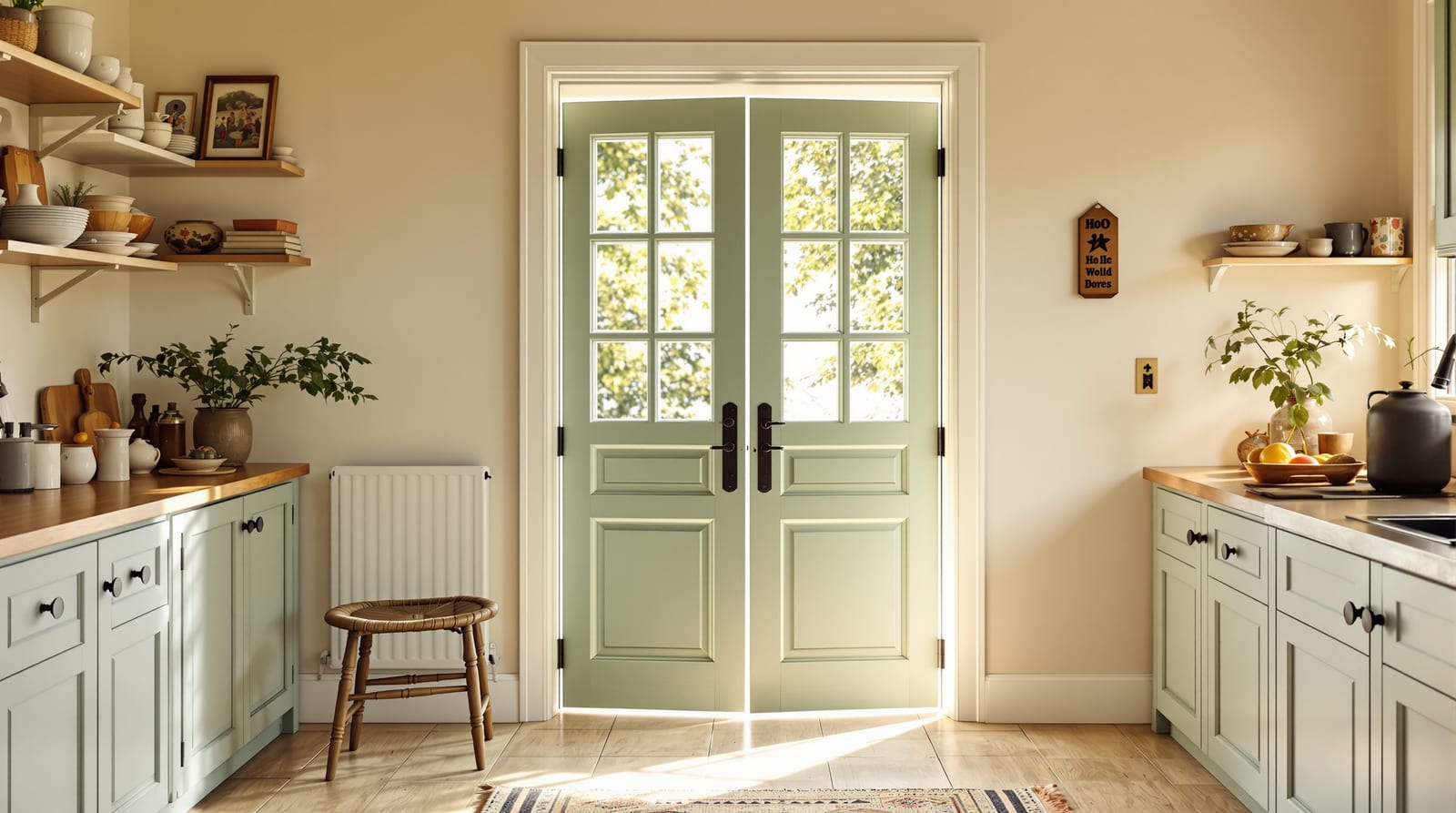
Dutch Doors in India: Split / Stable Doors for Kitchens, Nurseries & Vendor Entrances
How a horizontally divided door — top half open, bottom half closed — earns its place in Indian kitchens, pet zones, nurseries and farmhouse entrances.
A Dutch door — known in carpentry circles as a stable door or split door — is simply one doorway fitted with two shutters stacked one above the other, hinged so the top half and bottom half open independently. Open the top, keep the bottom bolted, and you get a half-open doorway: light and breeze and conversation flow over a barrier that still pens in a crawling baby, a curious Labrador or a kitchen cat. It is an old farmhouse idea (originally to keep livestock out of the house while letting air in over the lower leaf), and in the Indian home it solves a very specific set of everyday frictions that a normal single-leaf door cannot.
This guide is the practical, India-grounded take: where a split door genuinely earns its keep, where it is the wrong choice, how it is built, what materials and hardware to specify, and roughly what your carpenter or factory will charge. For the broader picture of every door type, see the complete guide to home doors in India and the types-of-doors comparison hub.
What a Dutch door actually is
Picture a standard 900 x 2100 mm doorway. Instead of one tall shutter, you hang two: a lower leaf roughly 1000-1100 mm high and an upper leaf making up the rest. Both swing on their own pair of hinges off the same frame (chowkat). Each half has its own latch or bolt. A small barrel bolt or a "shoot bolt" lets you lock the two leaves together so the door behaves as a normal single door when you want it to — you push both at once and walk through.
The three working positions are the whole point:
- Both closed and bolted together — a normal, private, secure door.
- Top open, bottom closed — the signature Dutch position: air, light, sightline and conversation over a waist-high barrier.
- Both open — full clear passage, like any door.
Many Dutch doors add a small shelf or ledge on top of the lower leaf — a flat capping plank, sometimes with a lip — that turns the closed bottom half into a handy pass-through counter. You set a tiffin, a parcel or a glass of water on it and hand it across without opening up. In a kitchen or a vendor-facing front door, that shelf is genuinely useful.
Where Dutch doors make sense in Indian homes
The split door is a niche product, but its niches are real and recurring in Indian households.
| Use-case | What the split door does | Best position | Notes for Indian homes |
|---|---|---|---|
| Kitchen entrance | Talk to / serve the delivery boy, cook or house help while pets and toddlers stay out of the cooking zone | Top open, bottom closed with shelf | Pairs with a kitchen door; keeps gas-stove area gated from a crawling child |
| Nursery / baby room | See and hear the baby; air and light flow; child cannot crawl out | Top open, bottom closed | Replaces the ugly clip-on baby gate; bottom leaf height ~1000 mm |
| Pet zone / utility | Dog or cat contained while you keep an eye and the room stays ventilated | Top open, bottom closed | Add a small pet flap in the lower leaf if needed |
| Pooja / store anteroom | Ventilation and a sightline without leaving the room fully open | Top open | Complement Vastu sensibilities; keep threshold (dehleez) |
| Farmhouse / bungalow entrance | Classic stable-door charm; greet visitors, take deliveries over the lower leaf | Top open, bottom shelved | Best in independent houses with a verandah or compound, not flats |
| Vendor-interaction front door | Sabziwala, courier, milkman handled at a half-open, semi-secure door | Top open, bottom bolted + shelf | Only where there is a gated compound; never as a flat's sole front door |
| Home office | Signal "available but don't fully barge in"; light and air without an open door | Top open | Keeps a pet or child out of a video call |
The common thread: a Dutch door is for places where you want air, light and a sightline at the same time as a physical barrier at floor level. If you only want air and light, an ordinary window or a louvered door is cheaper. If you only want a barrier, any normal door does it. The split door is for the specific moment you want both at once, repeatedly, every day.
Where a Dutch door does NOT make sense
Be honest about the limits before you commit:
- Apartments / flats as the main front door. A half-open door onto a shared corridor or lift lobby is a security and privacy liability — anyone can reach over the lower leaf. Apartment main doors should be solid, with good door security and ideally a smart lock and video door system. Use Dutch doors only on internal openings in a flat (a nursery, a utility) where security is not the job.
- Where you need real intruder resistance. The lower leaf is short; the upper opening is wide. This is not a security door.
- Heavy-monsoon / driving-rain elevations. With the top open, rain blows straight in. On exposed coastal or hill-station faces, plan a deep verandah or chajja overhead.
- AC rooms. Two leaves means two meeting edges and a horizontal mid-rail joint — more gaps to leak conditioned air. A single well-sealed door is better for a cooled room.
- Tight budgets where the door is purely functional. You are paying for two leaves plus extra hinges and bolts to do a job a normal door plus a baby gate could do for less.
Construction: two leaves, one frame
A Dutch door is more carpentry than a normal door because everything is doubled at the joint. Key build decisions:
The split height. The lower leaf is usually 1000-1100 mm tall — roughly waist height, high enough to stop a toddler or a dog but low enough to lean and talk over comfortably. Tall users may push it to 1150 mm. The split is rarely dead-centre; a lower-heavy split looks and works better.
Hinges. Each leaf gets its own pair (heavier leaves, three) of hinges on the same side of the frame. Use good butt hinges or, for solid timber, ball-bearing hinges so neither leaf sags. Both leaves must swing the same direction so they nest when fully open.
The meeting rail. Where the two leaves meet there is a horizontal joint. To stop light, gaps and draughts — and to stop someone reaching through — a good Dutch door has a rebated (overlapping) meeting rail or a planted lip: the lower leaf carries a small upstand or the upper leaf an overhang so they overlap rather than butt. This also stops the top leaf swinging in past the bottom one.
Locking the two together. A barrel bolt, tower bolt or a flush shoot-bolt mounted on the inside lets you pin the leaves together so the door operates as one. For the front door add a proper mortise lock or latch on the lower (or combined) leaf so it secures like a normal door when both halves are bolted.
The shelf / ledge (optional). A capping plank screwed flat to the top edge of the lower leaf, ~100-150 mm deep, ideally with a small front lip so things do not roll off. Great as a pass-through for parcels and tiffins.
Frame and threshold. A normal chowkat works; the frame must be square and well-anchored because two independently swinging leaves are unforgiving of a twisted frame. Keep a low threshold (≤12 mm if accessibility matters, per the Harmonised Guidelines 2021).
Below: an elevation of a Dutch door with the top half swung open and the bottom half closed and bolted, showing the meeting rail and shelf.
Materials for a Dutch door
A split door can be built in most of the materials a normal door can. Because two of the leaves and the joinery are exposed and worked harder, material choice matters.
| Material | Suitability for a Dutch door | Indian-climate note |
|---|---|---|
| Solid timber (sal, sheesham, mango) | Excellent — takes the doubled hinge/bolt loads, stable leaves, classic farmhouse look | Season well; monsoon swelling at the meeting rail needs a generous reveal |
| Teak (Burma / CP) | Premium farmhouse and bungalow choice; dimensionally stable, ages beautifully | Naturally termite- and rot-resistant; see teak wood doors |
| Engineered wood / blockboard panel | Good value, stable, paint or laminate finish | Seal all edges, especially the cut meeting rail; see engineered wood doors |
| WPC | Waterproof, termite-proof, low-maintenance for a utility or kitchen split door | Less "warm" look; fine for back-of-house; see WPC doors |
| Flush (factory) split | Possible but the horizontal cut exposes the core; needs careful edge-banding | Not ideal where wet; a panelled build is usually better — compare with flush doors |
For a Dutch door specifically, a panelled (framed) construction usually beats a flush slab, because you are cutting and finishing two leaf edges at the meeting rail and a panelled door handles that joint and the planted shelf more gracefully. See panel doors in India for the framing and stile-and-rail detail that applies directly here, and the door materials comparison hub for the full material trade-off.
Ventilation, light and security — the three-way trade-off
The Dutch door is, at heart, a tool for managing three things at once:
- Ventilation and light. Opening the top leaf gives you a large, high opening — better cross-ventilation than a window low in the wall, and a generous daylight spill into a kitchen or nursery. In hot, humid Indian summers this passive airflow is a real comfort win.
- Containment. The closed lower leaf is a physical floor-level barrier — the whole reason to choose this over a window. Toddlers, pets and clutter stay on their side.
- Security and privacy — the cost. With the top open you have an unguarded, reachable-over opening and a clear sightline in. That is fine over a controlled space (your own compound, a verandah inside a gated plot) and unacceptable on an exposed boundary. Never treat a Dutch door as a security door. When you need the door to be secure, bolt both leaves together and rely on the mortise lock — and pick the elevation accordingly.
The practical rule: use the open-top position only where you can see and trust what is on the other side. For everything else, the bolted-together mode is your normal secure door.
What a Dutch door costs in India
Think of a Dutch door as roughly the price of a normal door plus a premium for the extra leaf joinery and hardware — not double. The leaf material quantity is similar to a single door (you are dividing the same height), but you pay for a second pair of hinges, a second latch/bolt set, the rebated meeting rail, the optional shelf and the extra carpenter time to fit two leaves to swing true.
| Item | Indicative cost (varies by city/vendor) |
|---|---|
| Door leaf material (panel/solid, both halves) | Similar to a single door of the same size — solid wood from ~₹800/sq ft; teak ~₹800-1,500+/sq ft; engineered/panel ~₹4,000-12,000 per shutter |
| Extra hardware (second hinge pair, barrel/shoot bolt, meeting-rail rebate) | ~₹1,500-5,000 over a single door |
| Shelf / ledge fabrication | ~₹500-1,500 |
| Frame (chowkat) | sal/teak ~₹350-900/ft run; WPC frame ~₹1,500-3,500 |
| Fitting labour (more than a single door) | ~₹1,500-3,500 |
| GST | +18% typical |
As a ballpark, a decent engineered/panelled Dutch door, fitted, lands around ₹12,000-25,000, and a solid teak farmhouse Dutch door with a carved face and shelf can run ₹30,000 and well upward — closer to a designer main door than a plain internal one. These are indicative and move with timber rates, city and finish; cross-check against the door cost benchmark for India and run your numbers through the door cost calculator. Because it is a custom, made-to-order item, expect a local carpenter to be your most flexible route; few factories stock split doors off the shelf.
How to specify one well
If you have decided a Dutch door fits, give your carpenter or fabricator a clear brief:
1. Opening and split: doorway size (e.g., 900 x 2100 mm), lower-leaf height (~1000-1100 mm).
2. Swing direction for both leaves (same side, opening inward is usual and Vastu-friendly for a main door — complement, don't duplicate, Vastu for the main door).
3. Meeting rail: rebated/overlapping, with a draught lip.
4. Shelf: yes/no, depth, and front lip.
5. Hardware: hinge type (ball-bearing for solid leaves), the bolt that pins the two leaves, and a mortise lock if it is an external/front door — see the door hardware guide.
6. Material and finish: per the table above, with all cut edges sealed against monsoon moisture and termites.
7. Threshold: keep it low (≤12 mm) if anyone in the house uses a walker or wheelchair — see accessible doors in India.
For checking the door's swing clearance against the worktop or wall before you commit, the door swing planner and this short walkthrough on how to measure a small room both help.
Frequently asked questions
Is a Dutch door safe for a baby or a pet?
Yes, for containment — that is exactly what it is good at. A closed lower leaf of ~1000 mm stops a crawling baby or most dogs and cats while you keep an eye and the air flowing. It is not a security door, so use it on internal openings or inside a gated compound, never as the unsupervised main door of a flat.
Can I add a Dutch door to my apartment?
On internal openings — a nursery, a utility, a home office — yes, and it works well. As the flat's main front door, no: a half-open door onto a shared corridor is a privacy and security risk. For a flat's front door, choose a solid door with proper security and, if you want to interact with visitors, a video door system instead.
Will rain come in when the top is open?
If the elevation is exposed, yes — open-top means an open upper half. Plan a Dutch door under a verandah, deep chajja or covered porch so you can keep the top open through a shower. On a fully exposed face, you will end up closing the top during the monsoon, which defeats the purpose.
How is a Dutch door different from a normal door with a vent or a louvered panel?
A vent or a louvered door gives you air and light through a fixed opening but no floor-level barrier and no pass-through. A Dutch door gives you an actual openable upper leaf, a closeable lower barrier, and an optional shelf — three modes in one door. You pay for that flexibility in extra joinery and hardware.
Does a Dutch door cost double a normal door?
No. The leaf material is similar to one door of the same size; you mainly pay extra for the second pair of hinges, the bolt that locks the leaves together, the rebated meeting rail, the optional shelf and more fitting labour. Budget roughly a normal door plus ₹3,000-8,000 of premium, more for solid teak and carving.
For the full menu of door types and how the split door sits among them, return to the complete guide to home doors in India, the types-of-doors comparison, and the kitchen door guide where a Dutch door most often finds its home.
Export this guide
Related Guides — Deep-dive reading
The Complete Home Door Guide for Indian Homes (2026): Types, Materials, Cost, Security & Vastu
Everything an Indian homeowner needs to specify the right door for every opening — from main entrance to bathroom — with real 2026 prices, IS/NBC standards and Vastu sense.
Home Doors & EntrancesDouble Doors in India (2026): Two-Leaf Entrances, Proportions, Hardware & Cost
When a double-leaf door makes sense for Indian main entrances, pooja rooms and master suites, plus active/inactive leaf hardware, the Vastu note on even panels, security at the meeting stile and the rupee premium over a single door.
Home Doors & EntrancesUniversal Design Doors for Indian Homes: Inclusive Doors That Work for Everyone (2026)
How to design and specify doors that serve children, the elderly, pregnant women, the injured and wheelchair users by default - generous width, lever handles, near-flush thresholds, low-force closing, contrast and good lighting - without your home ever looking medical.
Home Doors & EntrancesRelated Tools — Try Free
Cross-Ventilation Analyzer
Estimate airflow and air changes per hour (ACH) from room size, window areas, layout, and local wind — with NBC 2016 Part 8 compliance check.
Ventilation CalculatorDoor Cost Calculator
Estimate the all-in cost of a door — leaf, frame, hardware, fitting and GST — by type, material and size.
Door CalculatorWindow Hardware Cost Calculator
Estimate window hardware cost — hinges, handles, locks, rollers and multipoint gears.
Window Calculator