
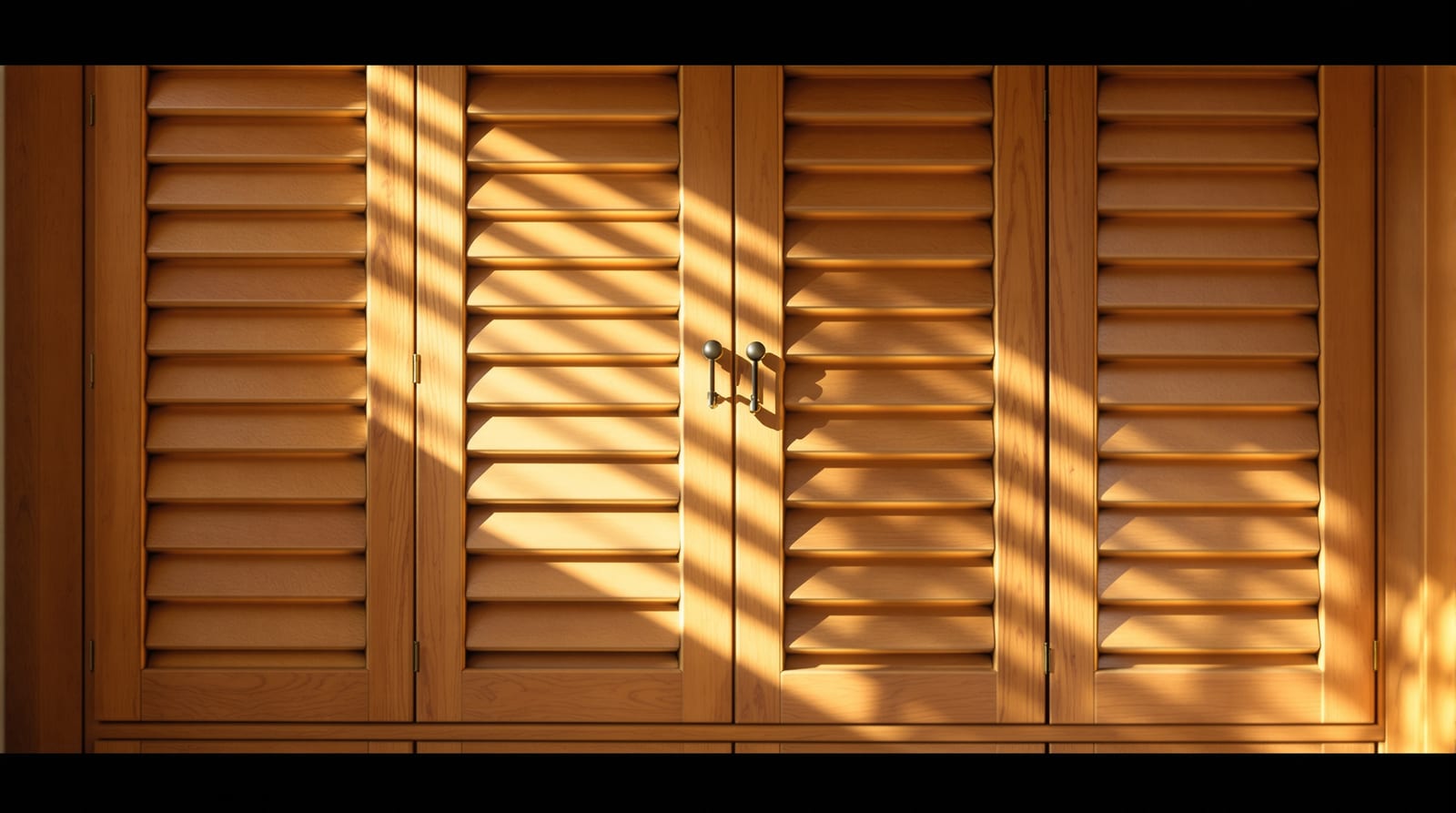
Louvered Doors in India: Slatted Doors for Ventilation, Wardrobes & Utility (2026)
How angled-slat louvre doors give airflow, privacy and light-block for wardrobes, utility, store rooms, AC cupboards and bathrooms — materials, cost and cleaning reality.
A louvered door is a door whose leaf is filled with rows of angled, overlapping slats instead of a solid panel. Those slats are the whole point: they let air move through a closed door while still blocking the direct line of sight and most of the light. In Indian homes — where wardrobes mildew in the monsoon, store rooms go stale, AC cupboards cook, and shoe cabinets announce themselves — that quiet trickle of ventilation is often worth more than a perfectly solid, perfectly silent door. This guide covers where louvre doors genuinely beat solid doors, fixed vs adjustable slats, full-louvre vs part-louvre designs, materials that survive Indian moisture, the dust-cleaning reality nobody warns you about, and 2026 costs.
For where louvered doors sit among the full door family, see the types of doors guide and the complete home doors guide.
How a louvre actually works
Each slat is set at a downward angle — typically 30 to 45 degrees — and the slats overlap so that, looking straight on, you cannot see through the gaps. Air, however, does not travel in straight lines only; it slides along and around the angled blades, so the door breathes even though your eye is blocked. The downward tilt also sheds dust and the occasional water splash away rather than funnelling it inward, and it cuts direct glare from a light source behind the door.
That geometry gives you three things at once that a solid door cannot:
- Airflow — moisture-laden, stale or hot air can escape and fresh air can creep in, even when the door is shut and locked.
- Privacy — at normal standing distance and eye level, overlapping slats hide the contents.
- Light control — most direct light is blocked, but a soft diffused glow can pass, so a louvered wardrobe or store does not feel like a black box.
The trade-off is honest: louvres are not soundproof, not dust-proof, and not as private as a flush leaf if someone shines a torch from the side or crouches. So you place them where ventilation matters more than acoustic isolation. If your priority is a quiet, sealed bedroom door, a flush door or panel door is the right call instead.
Fixed vs adjustable louvres
There are two families, and the choice changes both price and behaviour.
Fixed louvres have slats permanently set at one angle. They are simpler, cheaper, sturdier and the overwhelming default for interior cupboard, wardrobe, utility and store-room doors in India. There is nothing to break or jam, and constant ventilation is exactly what a wardrobe or store wants. This is what you will get from almost any carpenter or factory shutter unless you ask otherwise.
Adjustable (operable) louvres have a small lever or tilt rod that swivels all the slats together, so you can open them for maximum airflow or close them flat for more privacy and light-block. They cost noticeably more, the moving mechanism is a potential failure point, and they collect dust in the pivots. In homes they make sense mainly for a room divider, a study nook, or a balcony/verandah door where you want to dial light and breeze through the day. For most cupboards, fixed louvres are the smarter buy.
Full-louvre vs part-louvre (panel combos)
You rarely need slats from top to bottom. Common configurations:
| Configuration | Where it suits | Why |
|---|---|---|
| Full louvre (slats whole leaf) | AC/equipment cupboard, store room, utility, shoe cabinet | Maximum airflow; heat and odour escape fully |
| Louvre top, solid panel bottom | Wardrobes, bedroom storage | Vents the warm upper air; solid base hides clutter and resists knocks |
| Solid top, louvre bottom | Under-sink, laundry, water-heater cupboard | Vents at floor level where damp air and appliance heat sit |
| Centre louvre band, solid rails | Decorative interior / passage doors | Style-led; a slim vent for show plus a little airflow |
| Louvre inset in a panel door | Designer wardrobes, dressing rooms | One louvre panel as a feature within a panel door frame |
A part-louvre leaf is usually the sweet spot for a bedroom wardrobe: the louvre band sheds the warm, humid air that builds up around folded clothes, while the solid lower panel takes the scuffs and hides shoes and bags.
Materials — and why moisture decides everything
Louvre slats have far more exposed surface and edge than a flat panel, so swelling, warping and rot show up faster in a bad material. Match the material to the room's wetness.
| Material | Moisture tolerance | Indicative cost | Maintenance / cleaning | Best for |
|---|---|---|---|---|
| Solid wood (sal, mango, rubberwood; teak premium) | Moderate; swells in monsoon if unsealed | Slats add labour: ₹4,000-12,000+ per shutter | Periodic polish/seal; dusting between slats | Dry wardrobes, decorative interior, premium dressing rooms |
| MDF (with PVC membrane or laminate) | Low — avoid any damp; swells permanently if wet | ₹2,500-6,000 per shutter | Wipe only; never use near water | Dry bedroom wardrobes, study cupboards |
| Plywood (BWR/BWP grade) | Moderate to good if BWP and well-sealed edges | ₹3,000-7,000 per shutter | Re-seal cut edges; dust slats | General wardrobes, store rooms |
| WPC (wood-plastic composite) | High — waterproof, termite- and borer-proof | ₹75-150/sq ft (≈ ₹2,500-5,500 per shutter) | Just wipe; no swelling, no polish | Utility, laundry, under-sink, bathroom-adjacent — the all-rounder |
| PVC | High — fully waterproof, light | ₹1,500-4,000 per shutter | Wipe; can sag/discolour in heat over years | Bathrooms, balconies, budget utility |
| Aluminium (extruded slats) | Excellent — rust-free, coastal-safe | ₹450-900/sq ft of opening | Wipe; powder-coat lasts; pivots if operable | AC/equipment cupboards, coastal homes, modern look |
All figures are indicative and vary by city, vendor and finish; add roughly 18% GST, plus frame, hardware and fitting (₹800-3,000 per door labour). Cross-check against the door cost benchmark and the WPC doors guide for the composite option. For a head-to-head on materials by climate, see best door material in India and the materials comparison hub.
The short version for Indian conditions: in any cupboard that touches water, heat or laundry damp — utility, under-sink, water-heater, bathroom — WPC or aluminium are the safe choices, because they will not swell, rot, attract termites or need annual polish. Save solid wood and MDF louvres for genuinely dry wardrobes and decorative interior doors.
Where louvre doors beat solid doors
This is the case for choosing slats deliberately rather than by accident:
- Wardrobes (anti-mould): Folded cotton and silk trap humidity; a sealed solid wardrobe in a coastal or monsoon climate grows that musty smell and the odd patch of mildew. Louvres let the trapped air turn over, keeping clothes drier. Pair with a small silica or camphor sachet for the worst months.
- Utility and laundry cupboards: Washing machines, mops and damp linen throw off moisture and heat. A louvre door vents it instead of bottling it into mildew. See the utility door guide.
- Store rooms: Pulses, grains and rarely-opened goods go stale and attract pests in dead air. A ventilated store room door keeps the space breathing.
- AC and equipment cupboards: Inverters, stabilisers, water purifiers, modems and indoor AC units all generate heat. A solid door traps it and shortens equipment life; a louvre door lets it dissipate.
- Shoe cabinets: The single best argument for louvres. Trapped shoe odour is a ventilation problem, not a cleaning one — slats fix it at source.
- Bathroom and water-heater cupboards: Constant damp needs an escape route. Use only WPC, PVC or aluminium louvres here, never MDF or unsealed wood. Cross-link the bathroom door guide.
If, instead, your need is privacy and quiet (a bedroom, study or pooja room), louvres are the wrong tool — choose a solid or flush door.
The dust-cleaning reality
No one selling louvre doors mentions this, so here it is plainly: angled slats are dust magnets, and a full-height louvre door has a lot of edges. In a dusty Indian city, or near a construction site or main road, expect a film along the upper face of each slat within a week or two. Cleaning means going slat by slat — a microfibre cloth, a slat/blind duster (the soft tong-shaped tool), or an old sock over your hand works; a vacuum brush helps for the first pass. Adjustable louvres are worse because the pivots and the tilt rod trap grime too.
Practical ways to keep it sane:
- Prefer fixed over adjustable unless you genuinely need the tilt — fewer crevices.
- Choose wider, fewer slats rather than many thin ones where the look allows; less surface to wipe.
- Use part-louvre (solid lower panel) so the easily-grubby lower zone is a quick single wipe.
- Pick wipe-clean materials (WPC, aluminium, laminate) over open-grain wood that holds dust.
If you, or whoever cleans the home, will not realistically dust slats every couple of weeks, restrict louvres to a few high-value spots (shoe cabinet, AC cupboard) rather than every cupboard in the house.
Sizing, hardware and fitting
Louvre doors follow the same opening sizes as any interior door: cupboard and wardrobe shutters are made to the carpentry opening, while a walk-in store or utility door follows standard widths — roughly 800-900 mm × 2100 mm for utility, with the usual 2100 mm (7 ft) interior height. For room-by-room sizing see the door size standards guide and the residential door standards.
A few fitting notes specific to slats:
- Louvre leaves are heavier and floppier than they look; use good butt or concealed hinges (three per tall leaf) so they do not sag and rub. See the door hardware guide.
- For wardrobes, soft-close hinges keep slatted shutters from rattling.
- Factory-made WPC and aluminium louvre shutters arrive square and consistent; a local carpenter's solid-wood louvre is bespoke but only as good as the workshop — ask to see a sample for slat spacing and finish.
- Keep a small clearance at the bottom; the point is airflow, so do not seal the gap.
Frequently asked questions
Are louvered doors a good idea for an Indian bedroom wardrobe?
Yes, for ventilation — they fight the musty, mildew smell that solid wardrobes develop in monsoon and coastal climates. The catch is dusting. A good compromise is a part-louvre shutter (louvre band on top, solid panel below) in WPC or laminated ply, which vents the warm upper air while keeping cleaning manageable.
Do louvre doors give enough privacy?
For normal standing eye level, yes — overlapping angled slats block the direct sightline so contents are hidden. They are not torch-proof or fully private at odd angles, and they are not soundproof, so they suit cupboards, stores and utility spaces rather than bedrooms or bathrooms where you want a sealed, quiet door.
Which material is best for a louvre door near water — bathroom or utility?
WPC or aluminium. Both are fully waterproof, termite-proof and need only wiping. Avoid MDF entirely near damp (it swells permanently) and use solid wood only if it is well-sealed and not in direct splash. PVC is a budget waterproof option but can discolour or sag over years in heat.
Fixed or adjustable louvres for a cupboard?
Fixed, in almost all cases. Cupboards, wardrobes, stores and shoe cabinets want constant ventilation, so there is nothing to gain from a tilt mechanism — and the moving parts add cost, collect dust and can jam. Save adjustable louvres for room dividers or balcony/verandah doors where you want to dial light and breeze.
How much do louvered doors cost in India in 2026?
Indicatively: a WPC louvre shutter runs about ₹75-150 per sq ft (roughly ₹2,500-5,500 for a standard shutter); MDF/laminate ₹2,500-6,000; solid wood ₹4,000-12,000+; and framed aluminium ₹450-900 per sq ft of opening. Add about 18% GST plus frame, hardware and ₹800-3,000 fitting labour. Prices vary by city and vendor — check the door cost guide.
Export this guide
Related Guides — Deep-dive reading
The Complete Home Door Guide for Indian Homes (2026): Types, Materials, Cost, Security & Vastu
Everything an Indian homeowner needs to specify the right door for every opening — from main entrance to bathroom — with real 2026 prices, IS/NBC standards and Vastu sense.
Home Doors & EntrancesAluminium Doors in India: Profiles, Glazing, Cost & uPVC vs Steel (2026)
Framed glazed aluminium doors — sliding, openable and French-style — for balconies, utility and modern facades: powder-coat vs anodised vs wood-finish profiles, IS 733/1285 sections, thermal-break options and ₹/sq ft costs.
Home Doors & EntrancesBathroom Door for Indian Homes (2026): Waterproof Materials, Sizes, Ventilation & Locks
How to pick a toilet door that survives years of splash, steam and monsoon humidity — material ranking, the wet-area threshold detail, ventilation, narrow sizing, privacy locks and anti-rust fittings.
Home Doors & EntrancesRelated Tools — Try Free
Door Cost Calculator
Estimate the all-in cost of a door — leaf, frame, hardware, fitting and GST — by type, material and size.
Door CalculatorDoor Material Comparison Tool
Compare 2–4 door materials on cost, durability, maintenance, security and moisture resistance.
Comparison ToolBefore vs After — Cost Reality Check
Compare what you expected to pay vs what you actually paid, category by category.
Reality Check